16S rRNA vs. Shotgun Metagenomics: A Comprehensive Guide to Choosing the Right Gut Microbiome Analysis Method
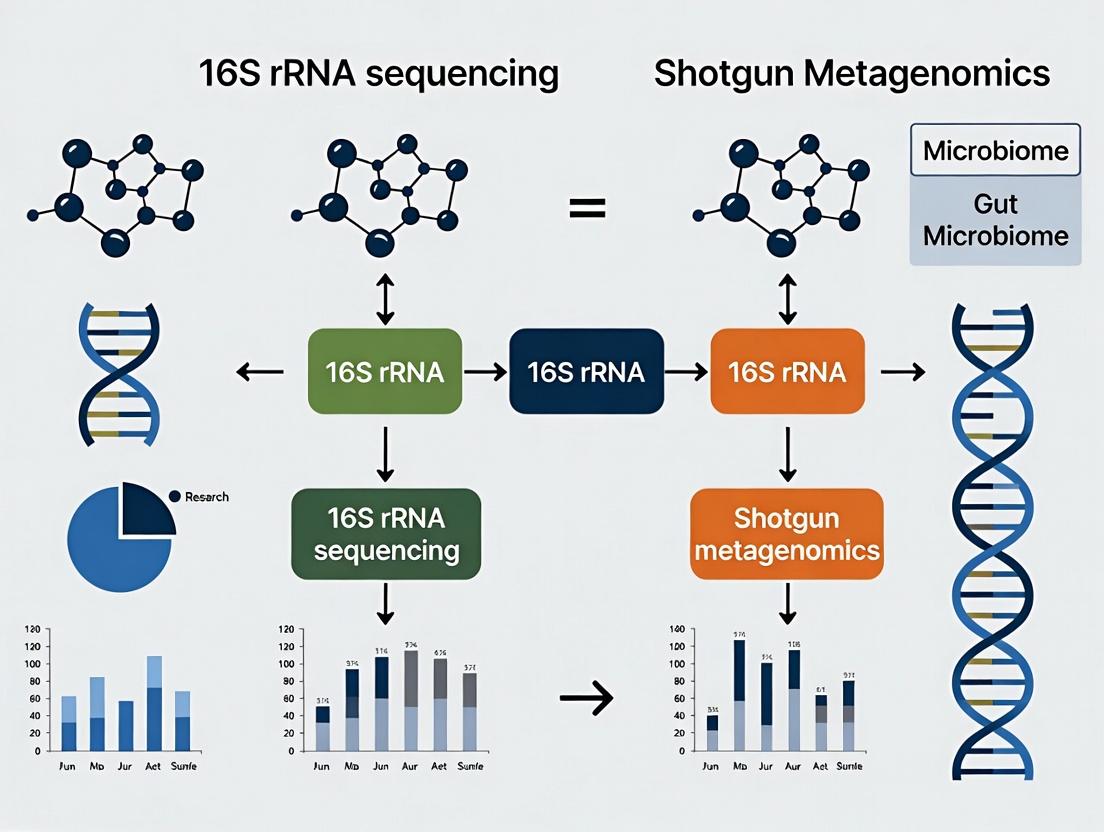
This article provides a detailed comparison of 16S rRNA sequencing and shotgun metagenomics for gut microbiome analysis, tailored for researchers and drug development professionals.
16S rRNA vs. Shotgun Metagenomics: A Comprehensive Guide to Choosing the Right Gut Microbiome Analysis Method
Abstract
This article provides a detailed comparison of 16S rRNA sequencing and shotgun metagenomics for gut microbiome analysis, tailored for researchers and drug development professionals. It covers foundational principles, methodological workflows, common troubleshooting scenarios, and a rigorous comparative validation of each technique's strengths and limitations. The goal is to empower informed decision-making for study design, data interpretation, and application in biomedical research, balancing resolution, cost, and translational potential.
Gut Microbiome Analysis 101: Understanding 16S and Shotgun Sequencing Core Principles
Within the context of gut microbiome research for therapeutic discovery, the choice between targeted 16S rRNA gene sequencing and whole-genome shotgun (WGS) metagenomics defines the scope and resolution of analysis. This Application Note details the technical specifications, protocols, and comparative outputs of these two cornerstone approaches, enabling informed experimental design for researchers and drug development professionals.
Comparative Analysis: Core Characteristics & Outputs
Table 1: High-Level Comparison of 16S rRNA and WGS Metagenomics
| Feature | 16S rRNA Gene Sequencing | Whole-Genome Shotgun Metagenomics |
|---|---|---|
| Primary Target | Hypervariable regions (e.g., V1-V9) of the 16S ribosomal RNA gene | All genomic DNA in a sample (fragmented) |
| Sequencing Depth | Shallow to moderate (10k-100k reads/sample) | Deep (10M-100M+ reads/sample) |
| Taxonomic Resolution | Genus to species level (rarely strain-level) | Species to strain-level, with phylogenetic profiling |
| Functional Insight | Inferred from reference databases (limited accuracy) | Direct gene prediction & pathway reconstruction (e.g., KEGG, COG) |
| Cost per Sample | Low to Moderate | High |
| Bioinformatics Complexity | Moderate (standardized pipelines) | High (demanding computational resources) |
| Primary Output Metrics | OTU/ASV table, Alpha/Beta Diversity, Taxonomic Composition | Metagenomic Assembly, Gene Catalog, Pathway Abundance, Strain Variants |
Table 2: Quantitative Data Output Comparison (Typical Human Gut Sample)
| Data Type | 16S rRNA Sequencing | Shotgun Metagenomics |
|---|---|---|
| Reads per Sample | 50,000 | 20,000,000 |
| Identifiable Taxa (Avg.) | 150-300 Genera | 500-1000 Species |
| Functional Features | ~10 (Inferred MetaCyc Pathways) | ~10,000 (KO Gene Families) |
| Data Volume (Raw) | ~50 MB | ~6 GB |
| Processing Time | ~1-2 hours | ~24-48 hours |
Experimental Protocols
Protocol 3.1: 16S rRNA Gene Amplicon Sequencing for Gut Microbiota
Objective: To profile the bacterial and archaeal community composition from fecal DNA via amplification and sequencing of the V3-V4 hypervariable region.
Materials: (See Scientist's Toolkit, Section 5) Steps:
- DNA Extraction: Use a bead-beating mechanical lysis kit (e.g., QIAamp PowerFecal Pro DNA Kit) on 180-220 mg of homogenized fecal sample. Include negative extraction controls.
- PCR Amplification: Amplify the ~460 bp V3-V4 region using primers 341F (5′-CCTACGGGNGGCWGCAG-3′) and 806R (5′-GGACTACHVGGGTWTCTAAT-3′) with attached Illumina adapter overhangs.
- Reaction: 25 µL containing 12.5 ng template DNA, 0.2 µM each primer, 2X KAPA HiFi HotStart ReadyMix.
- Cycling: 95°C 3 min; 25 cycles of [95°C 30s, 55°C 30s, 72°C 30s]; 72°C 5 min.
- Amplicon Purification: Clean PCR products using AMPure XP beads (0.8X ratio).
- Index PCR & Library Prep: Perform a second, limited-cycle PCR to attach dual indices and sequencing adapters. Purify final library with AMPure XP beads (0.9X ratio).
- Quantification & Pooling: Quantify libraries via qPCR (e.g., KAPA Library Quantification Kit). Normalize and pool equimolarly.
- Sequencing: Sequence on Illumina MiSeq (2x300 bp) or NovaSeq (2x250 bp) platform to achieve minimum 50,000 paired-end reads per sample.
Protocol 3.2: Whole-Genome Shotgun Metagenomic Sequencing
Objective: To comprehensively sequence all genetic material in a fecal sample for taxonomic and functional analysis.
Materials: (See Scientist's Toolkit, Section 5) Steps:
- High-Quality DNA Extraction: Use a protocol optimized for high molecular weight DNA (e.g., phenol-chloroform with mechanical lysis). Quantify with Qubit dsDNA HS Assay; assess integrity via pulse-field or standard agarose gel electrophoresis. Aim for >1 µg of DNA with fragment size >20 kb.
- Library Preparation: Fragment DNA via acoustical shearing (Covaris) to a target size of 350-550 bp. Use a blunt-end repair, A-tailing, and ligation-based kit (e.g., Illumina DNA Prep) with dual-index adapters. Avoid PCR amplification where possible; if required, use ≤8 PCR cycles.
- Library QC: Precisely quantify library fragment size distribution using a Bioanalyzer or TapeStation. Quantify molar concentration via qPCR.
- Sequencing: Pool libraries and sequence on an Illumina NovaSeq 6000 using an S4 flow cell (2x150 bp) to target a minimum of 20 million paired-end reads per sample for human gut studies. For strain-level resolution, aim for 50-100 million reads.
Visualization of Workflows & Decision Logic
Title: Method Selection Logic for Gut Microbiome Profiling
Title: Comparative Experimental and Bioinformatic Workflows
The Scientist's Toolkit: Research Reagent Solutions
Table 3: Essential Materials for 16S rRNA and WGS Protocols
| Item & Example Product | Category | Function in Protocol |
|---|---|---|
| Bead-Beating DNA Kit(QIAamp PowerFecal Pro DNA Kit) | DNA Extraction | Mechanical and chemical lysis for robust microbial cell wall disruption from complex matrices like stool. |
| PCR Enzymes for Amplicons(KAPA HiFi HotStart ReadyMix) | Amplification | High-fidelity polymerase for accurate amplification of target 16S regions with minimal bias. |
| Magnetic Beads(AMPure XP Beads) | Library Clean-up | Size-selective purification of PCR amplicons and final sequencing libraries. |
| High-Sensitivity DNA Assay(Qubit dsDNA HS Assay) | Quantification | Fluorometric quantitation of low-concentration, double-stranded DNA without interference from RNA. |
| Library Prep Kit(Illumina DNA Prep) | Library Construction | Enzymatic fragmentation, end-prep, adapter ligation, and PCR for whole-genome shotgun libraries. |
| Library QC Instrument(Agilent TapeStation 4150) | Quality Control | Accurate sizing and quantification of final sequencing library fragments prior to pooling. |
| Index Adapters(Illumina IDT for Illumina) | Sequencing | Unique dual indexes for multiplexing samples, enabling sample demultiplexing after sequencing. |
The characterization of the gut microbiota has undergone a revolutionary transformation, driven primarily by two pivotal methodological paradigms: 16S rRNA gene sequencing and shotgun metagenomics. Within the context of a thesis comparing these approaches, this document provides detailed application notes and protocols. The evolution from targeted 16S sequencing to untargeted shotgun sequencing has progressively reshaped our understanding from a taxonomic census to a functional blueprint of the gut ecosystem, directly impacting drug development and translational research.
Methodological Evolution & Key Comparative Data
Table 1: Historical Context and Core Technical Comparison
| Aspect | 16S rRNA Gene Sequencing | Shotgun Metagenomics |
|---|---|---|
| Primary Output | Taxonomic profile (primarily genus level). | Taxonomic profile (species/strain level) & functional gene catalog. |
| Theoretical Basis | Exploits hypervariable regions as phylogenetic markers. | Sequences all genomic DNA randomly. |
| Key Historical Period | ~1990s - 2010s (dominance); remains vital for large cohort studies. | ~2008 - Present (increasing dominance with cost reduction). |
| Typical Read Depth | 10,000 - 50,000 reads/sample (for diversity capture). | 10 - 40 million reads/sample (for functional insight). |
| Resolution | Limited to genus/species; cannot resolve strains reliably. | Species and strain-level resolution; mobile genetic elements. |
| Functional Insight | Indirect, via inferred phylogeny or PICRUSt. | Direct, via identification of protein-coding genes and pathways. |
| Cost per Sample (2024 est.) | $20 - $100 (low-depth) | $150 - $500 (high-depth, 10M+ reads) |
| Primary Impact on Understanding | Established link between dysbiosis and disease (e.g., IBD, obesity). | Revealed mechanistic links (e.g., microbial pathways for drug metabolism, biosynthesis of bioactive molecules). |
| Main Limitation | Functional black box; primer bias; multiple copy number variation. | High host DNA contamination in gut samples; computationally intensive; requires high-quality databases. |
Table 2: Quantitative Findings Shaped by Each Method
| Landmark Finding | Key Method | Typical Data Output | Impact on Field |
|---|---|---|---|
| Core human gut microbiota concept. | 16S Sequencing | Identification of dominant phyla: Bacteroidetes (~20-60%), Firmicutes (~30-70%), Actinobacteria, Proteobacteria. | Defined "healthy" baseline; enabled dysbiosis metrics. |
| Enterotypes (community types). | 16S & Shotgun | Clusters driven by Bacteroides (ET-B), Prevotella (ET-P), Ruminococcus (ET-F). | Suggested stratified host-microbe interactions. |
| Gut microbiome gene catalog. | Shotgun Metagenomics | ~10 million non-redundant genes (MetaHIT); >150 million genes (updated). | Provided reference for functional potential; highlighted interpersonal variation. |
| Identification of gut-derived biomarkers. | Shotgun Metagenomics | Specific microbial genes (e.g., cutC for TMA production) or pathways (e.g., secondary bile acid synthesis) correlated with disease. | Enabled hypothesis-driven drug target discovery (e.g., small molecule inhibitors of microbial enzymes). |
| Strain-level transmission & persistence. | Shotgun Metagenomics | Single Nucleotide Variants (SNVs) tracking; >60% of strains stable over 5 years. | Critical for probiotic and live biotherapeutic development. |
Detailed Experimental Protocols
Protocol 1: 16S rRNA Gene Amplicon Sequencing for Gut Microbiota Profiling (Illumina MiSeq)
Application: Rapid, cost-effective taxonomic profiling of hundreds to thousands of stool samples.
I. Sample Preparation & DNA Extraction
- Homogenization: Weigh 180-220 mg of frozen stool. Add to a tube with 1.4 mL of lysis buffer (e.g., QIAamp PowerFecal Pro Kit buffer) and sterile zirconia beads.
- Mechanical Lysis: Bead-beat at 4-6 m/s for 3 x 60 seconds, with cooling on ice between cycles.
- DNA Purification: Follow kit protocol (e.g., QIAamp PowerFecal Pro Kit). Include negative extraction controls.
- QC: Quantify DNA using Qubit dsDNA HS Assay. Assess purity via A260/A280 (~1.8). Store at -20°C.
II. Library Preparation (Dual-Indexing, Two-Step PCR) Primers: 515F (5'-GTGYCAGCMGCCGCGGTAA-3') / 806R (5'-GGACTACNVGGGTWTCTAAT-3') targeting V4 region.
- Primary PCR (Add Indexes & Adapters):
- Reaction Mix (25 µL): 2X KAPA HiFi HotStart ReadyMix (12.5 µL), 10µM each Forward/Reverse primer (1.25 µL each), Template DNA (10-50 ng), nuclease-free water to volume.
- Cycling: 95°C 3 min; 25 cycles of [98°C 20s, 55°C 30s, 72°C 30s]; 72°C 5 min.
- Clean-up: Use magnetic beads (e.g., AMPure XP) at 0.8x ratio. Elute in 25 µL.
- Secondary PCR (Add Illumina Sequencing Adapters):
- Use Illumina Nextera XT Index Kit v2. Follow manufacturer's protocol (8 cycles).
- Final Clean-up & Pooling: Clean with AMPure XP (0.8x). Quantify pools by qPCR (KAPA Library Quant Kit). Normalize and pool equimolarly.
III. Sequencing & Bioinformatic Analysis
- Sequencing: Load pool onto MiSeq Reagent Kit v3 (600-cycle) for 2x300 bp paired-end reads (~50,000 reads/sample).
- Processing (QIIME 2/DADA2 pipeline):
- Import demultiplexed reads.
- Denoise with DADA2: quality filtering (maxEE=2), truncation (truncLen=250,240), error model learning, merging.
- Generate Amplicon Sequence Variants (ASVs) table.
- Assign taxonomy using a trained classifier (e.g., Silva 138 or Greengenes2 2022.10) against the 515F/806R region.
- Generate alpha/beta diversity metrics (Faith PD, Shannon, UniFrac).
Protocol 2: Shotgun Metagenomic Sequencing of Stool DNA
Application: Comprehensive taxonomic and functional analysis for hypothesis-driven mechanistic research.
I. High-Quality, High-Molecular-Weight DNA Extraction
- Protocol: Use a protocol optimized for host DNA depletion and high MW yield (e.g., modified QIAamp PowerFecal Pro with additional RNase A and proteinase K steps, or phenol-chloroform extraction).
- QC: Use Qubit (dsDNA HS), TapeStation/ Bioanalyzer (DNA Integrity Number, DIN >5 desired), and qPCR for host (human ACTB) vs. microbial (16S) DNA ratio. Aim for >80% microbial DNA.
II. Library Preparation (Illumina DNA Prep)
- Input: Fragment 100-500 ng of DNA via acoustic shearing (Covaris) to ~350 bp.
- End Repair, A-tailing & Adapter Ligation: Follow Illumina DNA Prep protocol. Use unique dual indexes (UDIs).
- PCR Enrichment: 6-8 cycles. Clean-up with AMPure XP (0.8x).
- Final QC: TapeStation for fragment size; qPCR for accurate quantification.
III. Sequencing & Analysis
- Sequencing: Load on NovaSeq X Plus or NovaSeq 6000 using a 2x150 bp S4/X Plus flow cell. Target 20-40 million read pairs per sample.
- Bioinformatic Pipeline (KneadData, MetaPhlAn 4, HUMAnN 3):
- Quality Control & Host Removal:
KneadDatawith Trimmomatic (remove adapters, min length 50, min quality 20) and Bowtie2 (against human reference GRCh38). - Taxonomic Profiling:
MetaPhlAn 4using its integrated marker gene database (mpavJan21CHOCOPhlAnSGB). - Functional Profiling:
HUMAnN 3(default settings). Maps reads to UniRef90/UniRef50, infers pathway abundance (MetaCyc).
- Quality Control & Host Removal:
Visualizations
Title: 16S vs Shotgun Metagenomics Workflow
Title: Historical Method Evolution Drives New Questions & Insights
The Scientist's Toolkit: Research Reagent Solutions
Table 3: Essential Materials for Gut Microbiota Analysis
| Item | Function/Application | Example Product/Kit |
|---|---|---|
| Stabilization Buffer | Preserves microbial community structure at room temperature post-collection for longitudinal studies. | OMNIgene•GUT, Zymo Research DNA/RNA Shield |
| Bead-Beating Tubes | Mechanical lysis of robust bacterial cell walls (e.g., Gram-positive) for unbiased DNA extraction. | MP Biomedicals Lysing Matrix E tubes, Qiagen PowerBead Tubes |
| Host DNA Depletion Kit | Selectively removes human/host DNA from stool extracts to increase microbial sequencing depth in shotgun workflows. | NEBNext Microbiome DNA Enrichment Kit, QIAamp DNA Microbiome Kit |
| High-Fidelity PCR Master Mix | Accurate amplification of 16S regions with minimal bias for amplicon sequencing. | KAPA HiFi HotStart ReadyMix, Q5 High-Fidelity DNA Polymerase |
| Metagenomic Standards | Positive controls for both 16S and shotgun workflows to assess technical variability and batch effects. | ZymoBIOMICS Microbial Community Standard, ATCC MSA-1003 |
| Magnetic Bead Clean-up Kits | Size-selective purification of DNA libraries and PCR products. Essential for NGS library prep. | Beckman Coulter AMPure XP, KAPA Pure Beads |
| Bioinformatics Databases | Curated reference databases for taxonomic classification and functional annotation. | SILVA, GTDB, MetaPhlAn database, UniRef, MetaCyc |
| Analysis Platforms | Cloud or local compute resources for processing large-scale metagenomic data. | Terra.bio, Amazon Omics, QIIME 2 Galaxy, AnVIL |
Within the debate on 16S rRNA sequencing versus shotgun metagenomics for gut microbiome research, understanding key terminologies is critical for experimental design and data interpretation. This note clarifies the distinctions between Operational Taxonomic Units (OTUs) and Amplicon Sequence Variants (ASVs), the concepts of taxonomic profiling versus functional potential, and the role of read depth.
OTUs vs. ASVs: Defining Microbial Diversity
Operational Taxonomic Units (OTUs) are clusters of sequencing reads, typically at a 97% similarity threshold, used as a proxy for microbial species. This method is heuristic, relying on clustering algorithms that can group genetically similar but distinct sequences, potentially obscuring true biological variation.
Amplicon Sequence Variants (ASVs) are unique DNA sequences derived from high-resolution denoising algorithms. They represent biological sequences inferred from reads with single-nucleotide resolution, providing a more reproducible and precise unit for diversity analysis.
Table 1: Quantitative Comparison of OTU vs. ASV Approaches
| Feature | OTU (97% Clustering) | ASV (Denoising) |
|---|---|---|
| Resolution | Approximate (cluster-level) | Single-nucleotide |
| Bioinformatic Method | Heuristic clustering (e.g., UCLUST, VSEARCH) | Denoising (e.g., DADA2, UNOISE3, Deblur) |
| Reproducibility | Lower (varies with algorithm/parameters) | Higher (exact sequence is stable) |
| Sensitivity to PCR Errors | Moderate (errors may form new clusters) | High (errors are modeled and removed) |
| Typical Diversity (Richness) | Lower (clusters reduce unique units) | Higher (retains true variants) |
| Computational Demand | Lower | Higher |
Protocol: Generating ASVs with DADA2 for 16S Data
- Demultiplex & Quality Filter: Remove primers and truncate reads based on quality profiles (e.g., truncLen=c(240,160) for paired-end 250bp V4 reads). Filter reads with expected errors >2.
- Learn Error Rates: Model the error profile of the dataset (
learnErrorsfunction). - Dereplication & Denoising: Apply the core sample inference algorithm (
dadafunction) to identify ASVs. - Merge Paired Reads: Merge forward and reverse reads (
mergePairs). - Construct Sequence Table: Build an ASV count table across all samples.
- Remove Chimeras: Identify and remove chimeric sequences (
removeBimeraDenovo).
Title: DADA2 ASV Inference Workflow
Taxonomic Profiling vs. Functional Potential
Taxonomic Profiling answers the question "Who is there?" It involves classifying DNA sequences (16S amplicons or phylogenetic marker genes from shotgun data) into a taxonomic hierarchy (phylum to species). It describes community structure but not capability.
Functional Potential answers "What could they do?" It involves predicting the metabolic capabilities of a microbiome by aligning shotgun metagenomic reads to databases of protein-coding genes (e.g., KEGG, EggNOG, COG). It does not measure active gene expression, which requires metatranscriptomics.
Table 2: Comparison of Profiling Objectives
| Aspect | Taxonomic Profiling | Functional Potential (Shotgun) |
|---|---|---|
| Primary Data | 16S rRNA gene or marker genes | Whole-genome shotgun reads |
| Key Question | Composition & diversity | Metabolic capacity & pathways |
| Output | Abundance of taxa (e.g., Bacteroides spp.) | Abundance of gene families/pathways (e.g., KEGG orthologs) |
| Method | Alignment to 16S databases (SILVA, Greengenes) or k-mer based (Kraken2) | Alignment to functional databases (KEGG, EggNOG) or de novo assembly & annotation |
| Strengths | Cost-effective, well-established, high sensitivity | Insight into community function, strain-level variation |
| Limitations | Limited resolution, infers function indirectly | Higher cost, computationally intensive, potential database bias |
Protocol: Shotgun Metagenomic Analysis for Functional Profiling with HUMAnN 3.0
- Quality Control & Host Filtering: Use Trimmomatic or Fastp for adaptor/quality trimming. Align reads to a host genome (e.g., human GRCh38) with Bowtie2 and remove aligning reads.
- Metagenomic Assembly (Optional): Assemble quality-filtered reads into contigs using MEGAHIT or metaSPAdes.
- Gene Abundance Profiling: Run HUMAnN 3.0 pipeline: a. Nucleotide Search: Align reads against the ChocoPhlAn database of pangenomes. b. Translated Search: Remaining unaligned reads are searched against the UniRef90 protein database via Diamond. c. Stratification: Generate gene family abundances (UniRef90s) stratified by contributing species.
- Pathway Abundance: Map gene families to metabolic pathways (MetaCyc) using the
humann_regroup_tableandhumann_pathwaystools.
Title: Shotgun Functional Profiling Workflow
Read Depth: Implications for 16S vs. Shotgun
Read Depth (sequencing depth) is the number of reads generated per sample. It directly impacts the sensitivity and reliability of detecting low-abundance taxa or genes.
- For 16S rRNA Sequencing: Saturation of diversity (rarefaction curves) is typically achieved at lower depths (e.g., 20,000-50,000 reads/sample for gut microbiota). Beyond this, additional reads primarily resample dominant taxa.
- For Shotgun Metagenomics: Much greater depth (e.g., 10-20 million reads/sample) is required to achieve sufficient coverage of the diverse genomic content, especially for functional profiling and detecting rare gene variants.
Table 3: Recommended Read Depth & Impact
| Method | Typical Depth per Sample | Primary Driver for Depth | Consequence of Insufficient Depth |
|---|---|---|---|
| 16S rRNA Amplicon | 20,000 - 100,000 reads | Capturing rare taxa; reaching saturation in alpha diversity curves. | Underestimation of microbial richness; biased community structure. |
| Shotgun Metagenomics | 5 - 20 million reads (5-10 Gb) | Covering low-abundance genomes and gene families for functional analysis. | Poor assembly; inability to detect rare functions or strains; noisier functional profiles. |
Protocol: Determining Sequencing Depth via Rarefaction Curves (16S Data)
- Generate ASV/OTU Table: As per Protocol 1.
- Subsampling (Rarefaction): Use the
rarecurvefunction in R's vegan package or QIIME 2'salpha-rarefaction. Repeatedly subsample the count matrix at increasing sequencing depths (e.g., increments of 1000 reads). - Calculate Diversity: At each depth, calculate an alpha diversity metric (e.g., Observed ASVs, Shannon Index) for each sample.
- Plot & Interpret: Plot the mean diversity metric against sequencing depth. The point where the curve plateaus indicates sufficient depth for capturing diversity. Compare across sample groups to ensure consistent saturation.
The Scientist's Toolkit: Research Reagent Solutions
Table 4: Essential Materials for Gut Microbiome Studies
| Item | Function & Application |
|---|---|
| Qiagen DNeasy PowerSoil Pro Kit | Gold-standard for DNA extraction from complex, inhibitor-rich fecal samples. Ensures high yield and purity for downstream sequencing. |
| ZymoBIOMICS Microbial Community Standard | Defined mock community of bacteria and fungi. Serves as a positive control for extraction, sequencing, and bioinformatic pipeline accuracy. |
| KAPA HiFi HotStart ReadyMix | High-fidelity PCR polymerase for 16S amplicon library preparation. Minimizes PCR errors critical for ASV inference. |
| Illumina DNA Prep Tagmentation Kit | Efficient library preparation for shotgun metagenomic sequencing, utilizing a fast, tagmentation-based approach. |
| Nextera XT Index Kit | Provides dual indices for multiplexing hundreds of samples on Illumina platforms, essential for cost-effective sequencing runs. |
| PhiX Control v3 | Illumina sequencing control. Spiked-in (1-5%) to monitor cluster generation, sequencing accuracy, and phasing/prephasing on the flow cell. |
| Mag-Bind TotalPure NGS Beads | Magnetic SPRI beads for DNA size selection and clean-up during library preparation. Used for normalizing insert sizes and removing adapters. |
Within the context of comparative gut microbiome analysis for therapeutic development, the selection between 16S rRNA gene sequencing and shotgun metagenomics is dictated by the primary research question. 16S rRNA sequencing provides a cost-effective, high-depth census of microbial taxonomy ("Who is there?"), while shotgun metagenomics enables functional potential profiling ("What can they do?"). This application note delineates the protocols, data outputs, and reagent toolkits for each method, guiding researchers in aligning experimental design with strategic objectives in drug and biomarker discovery.
16S rRNA Gene Sequencing: Answering "Who is There?"
Core Protocol: Hypervariable Region Amplification & Sequencing
Objective: To characterize microbial community composition and phylogenetic diversity.
Detailed Protocol:
- DNA Extraction: Isolate total genomic DNA from 180-220 mg of fecal sample using a bead-beating mechanical lysis kit (e.g., QIAamp PowerFecal Pro DNA Kit). Include negative extraction controls.
- PCR Amplification: Amplify hypervariable regions (e.g., V3-V4) with barcoded primers (e.g., 341F/805R).
- Reaction Mix (25 µL): 12.5 µL 2x KAPA HiFi HotStart ReadyMix, 5-10 ng template DNA, 0.2 µM each primer.
- Thermocycling: 95°C for 3 min; 25-30 cycles of 95°C for 30s, 55°C for 30s, 72°C for 30s; final extension at 72°C for 5 min.
- Library Preparation & Sequencing: Clean amplicons with AMPure XP beads, quantify, pool equimolarly, and sequence on an Illumina MiSeq (2x300 bp) or NovaSeq platform to achieve a minimum of 50,000 reads per sample.
- Bioinformatics: Process using QIIME 2 (2024.5). Denoise with DADA2, assign taxonomy against the SILVA v138 or Greengenes2 2022.2 database, and align sequences to build a phylogeny.
Table 1: Representative 16S rRNA Sequencing Data Output (Simulated Cohort, n=50)
| Metric | Healthy Cohort (Mean ± SD) | IBS Cohort (Mean ± SD) | p-value | Primary Question Addressed |
|---|---|---|---|---|
| Alpha Diversity (Shannon Index) | 4.2 ± 0.5 | 3.5 ± 0.6 | 0.001 | Community richness & evenness |
| Observed ASVs/OTUs | 350 ± 45 | 280 ± 60 | 0.005 | Taxonomic unit count |
| Relative Abundance: Bacteroidetes | 45% ± 8% | 35% ± 10% | 0.01 | Phylum-level composition |
| Relative Abundance: Faecalibacterium | 8% ± 3% | 3% ± 2% | <0.001 | Genus-level biomarker identification |
Workflow Diagram
Diagram 1: 16S rRNA sequencing workflow for taxonomy.
The Scientist's Toolkit: Key Reagents for 16S Sequencing
| Reagent/Material | Function & Rationale |
|---|---|
| Bead-Beating Lysis Kit | Mechanical and chemical lysis for robust breakage of diverse bacterial cell walls in feces. |
| Phylum-Specific PCR Primers | Ensure broad amplification of bacterial 16S rRNA gene regions while minimizing host DNA amplification. |
| KAPA HiFi HotStart Polymerase | High-fidelity polymerase reduces PCR errors in amplicon sequences. |
| SPRI/AMPure XP Beads | Size-selective clean-up of PCR amplicons and library normalization. |
| SILVA/Greengenes2 Database | Curated rRNA database for accurate taxonomic classification of sequence variants. |
Shotgun Metagenomics: Answering "What Can They Do?"
Core Protocol: Whole-Genome Sequencing & Functional Profiling
Objective: To profile the collective functional gene content and metabolic potential of the microbiome.
Detailed Protocol:
- High-Yield DNA Extraction: Use a kit optimized for long fragments (e.g., MagAttract PowerSoil DNA KF Kit) from 200 mg feces. Quantify with Qubit dsDNA HS Assay; check integrity via gel electrophoresis (target >10 kb).
- Library Preparation: Fragment 100 ng DNA via acoustic shearing (Covaris) to ~350 bp. Prepare library using a ligation-based kit (e.g., Illumina DNA Prep). Do not perform PCR amplification to avoid bias, if possible.
- Deep Sequencing: Sequence on Illumina NovaSeq (2x150 bp) to a minimum depth of 10-20 million paired-end reads per sample for human gut samples.
- Bioinformatics:
- Taxonomic: Use Kraken2/Bracken with the GTDB database for species/strain-level profiling.
- Functional: Align reads to functional databases (e.g., KEGG, eggNOG, MetaCyc) using HUMAnN 3.0. Quantify gene families (UniRef90s) and metabolic pathway abundances.
Table 2: Representative Shotgun Metagenomics Data Output (Simulated Cohort, n=50)
| Metric | Healthy Cohort (Mean ± SD) | IBS Cohort (Mean ± SD) | p-value | Primary Question Addressed |
|---|---|---|---|---|
| Species Richness | 180 ± 25 | 150 ± 35 | 0.003 | Strain-level diversity |
| Pathway Abundance:\nShort-Chain FA Synthesis | 15,500 ± 2,200 (RPK) | 9,800 ± 2,800 (RPK) | <0.001 | Metabolic potential |
| Gene Abundance:\nAntibiotic Resistance Genes | 50 ± 15 (RPK) | 120 ± 40 (RPK) | <0.001 | Resistome profiling |
| Bacterial Load\n(Microbial Reads / Total Reads) | 85% ± 5% | 78% ± 8% | 0.02 | Community biomass estimate |
Workflow Diagram
Diagram 2: Shotgun metagenomics workflow for function.
The Scientist's Toolkit: Key Reagents for Shotgun Metagenomics
| Reagent/Material | Function & Rationale |
|---|---|
| High-Integrity DNA Extraction Kit | Maximizes yield of long, shearing-resistant DNA fragments for unbiased representation. |
| Covaris AFA System | Reproducible, enzyme-free acoustic shearing for consistent fragment sizes. |
| PCR-Free Library Prep Kit | Eliminates amplification bias, preserving true abundance ratios of genomic fragments. |
| GTDB (Genome Taxonomy DB) | Genome-derived database for consistent and current taxonomic classification. |
| KEGG / MetaCyc Databases | Curated repositories of metabolic pathways and orthologs for functional inference. |
Integrated Decision Pathway for Method Selection
Diagram 3: Method selection based on research question.
The choice between 16S rRNA gene sequencing and shotgun metagenomics for gut microbiome analysis represents a fundamental decision point in research design. This decision directly impacts the resolution of taxonomic data, the depth of functional insight, and the overall project cost. The "Central Dogma" of this resolution posits that one cannot simultaneously maximize all three axes; optimizing for one necessitates trade-offs with the others.
Core Trade-off Matrix:
- Taxonomic Depth: Resolution at the species or strain level.
- Functional Insight: Identification of genes, pathways, and metabolic potential.
- Cost: Financial expenditure per sample, inclusive of sequencing and bioinformatics.
Quantitative Comparison Table
Table 1: Direct Comparison of 16S rRNA Sequencing vs. Shotgun Metagenomics
| Feature | 16S rRNA Gene Sequencing | Shotgun Metagenomics |
|---|---|---|
| Target Region | Hypervariable regions (e.g., V3-V4) of the 16S rRNA gene | All genomic DNA in sample |
| Primary Output | Amplicon sequence variants (ASVs) or OTUs | Short reads from entire genomes |
| Taxonomic Resolution | Genus-level (reliable), species-level (limited) | Species to strain-level (high) |
| Functional Insight | Inferred from reference databases (e.g., PICRUSt2), indirect | Direct gene prediction and pathway analysis (e.g., HUMAnN3) |
| Cost per Sample (2024) | $20 - $80 (sequencing only) | $100 - $400+ (sequencing only) |
| Bioinformatics Complexity | Moderate (standardized pipelines: QIIME2, mothur) | High (resource-intensive: KneadData, MetaPhlAn, HUMAnN3) |
| Host DNA Contamination | Minimal (targeted amplification) | Significant, requires depletion or filtering |
| Key Limitation | PCR bias, incomplete functional data | High cost, computational demand, host DNA interference |
| Ideal Use Case | Large cohort studies, biodiversity surveys, taxonomic screening | Mechanistic studies, drug target discovery, functional pathway analysis |
Detailed Application Notes
Application Note AN-01: Cohort Screening for Dysbiosis
- Recommended Method: 16S rRNA sequencing (V4 region).
- Rationale: For studies involving 1000+ human samples where the primary goal is to identify shifts in microbial community structure (e.g., Firmicutes/Bacteroidetes ratio) associated with a disease state at manageable cost.
- Trade-off Accepted: Sacrifices direct functional resolution and strain-level accuracy for broad taxonomic overview and statistical power.
Application Note AN-02: Mechanistic Insight for Drug Development
- Recommended Method: Shotgun metagenomics.
- Rationale: Essential for identifying specific bacterial strains, virulence factors, antibiotic resistance genes, and metabolic pathways (e.g., short-chain fatty acid synthesis) that are direct targets for therapeutic intervention.
- Trade-off Accepted: Higher per-sample cost limits cohort size but provides actionable functional data.
Experimental Protocols
Protocol P-01: 16S rRNA Gene Amplicon Sequencing (Illumina MiSeq)
Title: Standardized Gut Microbiome 16S Library Prep.
I. DNA Extraction & Quality Control
- Use a bead-beating based kit (e.g., QIAamp PowerFecal Pro DNA Kit) for mechanical lysis of robust bacterial cell walls.
- Elute DNA in 50-100 µL of TE buffer or nuclease-free water.
- Quantify DNA using a fluorometric assay (e.g., Qubit dsDNA HS Assay). Accept concentrations > 1 ng/µL.
- Verify integrity by running 1 µL on a 1% agarose gel or using a Genomic DNA ScreenTape.
II. PCR Amplification of Target Region
- Primers: Use primers 515F (5'-GTGYCAGCMGCCGCGGTAA-3') and 806R (5'-GGACTACNVGGGTWTCTAAT-3') targeting the V4 region.
- Master Mix (25 µL reaction):
- 12.5 µL 2x KAPA HiFi HotStart ReadyMix
- 5 µL Template DNA (1-10 ng)
- 1.25 µL Forward Primer (10 µM)
- 1.25 µL Reverse Primer (10 µM)
- 5 µL Nuclease-free water
- Cycling Conditions:
- 95°C for 3 min.
- 25 cycles of: 95°C for 30 sec, 55°C for 30 sec, 72°C for 30 sec.
- 72°C for 5 min. Hold at 4°C.
III. Index PCR & Library Pooling
- Clean up PCR products with magnetic beads (e.g., AMPure XP).
- Perform a second, short-indexing PCR (8 cycles) with dual-index barcodes (e.g., Nextera XT Index Kit).
- Quantify libraries, normalize to 4 nM, and pool equimolarly.
- Sequence on Illumina MiSeq using 2x250 bp v2 chemistry.
Protocol P-02: Shotgun Metagenomic Sequencing (Illumina NovaSeq)
Title: Host DNA-Depleted Shotgun Metagenomic Library Preparation.
I. DNA Extraction & Host Depletion
- Extract high-molecular-weight DNA using a protocol with a mechanical lysis step (e.g., phenol-chloroform with bead beating).
- Treat sample with RNase A.
- Perform host DNA depletion using a probe-based kit (e.g., NEBNext Microbiome DNA Enrichment Kit) targeting human/host gDNA. This step is critical for gut samples.
II. Library Preparation & Size Selection
- Fragment 100-200 ng of enriched DNA to ~350 bp using a focused-ultrasonicator (e.g., Covaris M220).
- Prepare library using a kit designed for low-input DNA (e.g., NEBNext Ultra II FS DNA Library Prep Kit).
- Perform double-sided size selection with SPRIselect beads to isolate fragments ~350 - 450 bp.
III. Sequencing
- Quantify final library by qPCR (e.g., KAPA Library Quantification Kit).
- Pool libraries and sequence on a high-throughput platform (e.g., Illumina NovaSeq 6000) to a target depth of 10-20 million 2x150 bp paired-end reads per sample for human gut microbiome analysis.
Visualization Diagrams
Diagram 1: Method Decision Workflow
Title: Choosing Between 16S and Shotgun Sequencing
Diagram 2: Central Dogma Trade-off Triangle
Title: The Resolution Trade-off Triangle
The Scientist's Toolkit: Research Reagent Solutions
Table 2: Essential Materials for Gut Microbiome Sequencing
| Item | Function | Example Product(s) |
|---|---|---|
| Bead-Beating Lysis Kit | Mechanical disruption of tough Gram-positive bacterial cell walls in stool samples. | QIAamp PowerFecal Pro DNA Kit, MP Biomedicals FastDNA Spin Kit |
| PCR Inhibitor Removal Beads | Binds and removes humic acids, bile salts, and other PCR inhibitors common in feces. | OneStep PCR Inhibitor Removal Kit (Zymo), Sera-Mag Carboxylate-Modified Beads |
| High-Fidelity DNA Polymerase | Critical for accurate amplification of 16S target region with minimal error. | KAPA HiFi HotStart ReadyMix, Q5 High-Fidelity DNA Polymerase |
| Dual-Index Barcode Kit | Allows multiplexing of hundreds of samples in a single sequencing run. | Illumina Nextera XT Index Kit v2, IDT for Illumina UD Indexes |
| Host DNA Depletion Kit | Selectively removes human (or other host) DNA to increase microbial sequencing yield in shotgun workflows. | NEBNext Microbiome DNA Enrichment Kit, QIAseq Methyl-Depletion Kit |
| Library Prep Kit (Low Input) | Prepares sequencing libraries from the nanogram quantities of DNA typical after host depletion. | NEBNext Ultra II FS DNA Library Prep Kit, Illumina DNA Prep |
| Size Selection Beads | Precisely selects DNA fragments of the desired length for optimal library insert size. | Beckman Coulter SPRIselect, MagBio HighPrep PCR |
| Library Quantification Kit (qPCR) | Accurate absolute quantification of sequencing-ready libraries; essential for pooling. | KAPA Library Quantification Kit for Illumina, qPCR-based assays |
From Sample to Data: Step-by-Step Workflows and Best-Practice Applications
This application note details the experimental and computational workflows for two primary methods in gut microbiome analysis: 16S rRNA gene amplicon sequencing and shotgun metagenomic sequencing. Framed within a thesis comparing these approaches for gut microbiome research in drug development, this document provides standardized protocols, platform comparisons, and pipeline architectures to guide researchers in selecting and implementing the optimal methodology.
Library Preparation Protocols
Protocol 1: 16S rRNA Gene Amplicon Sequencing (V3-V4 Region)
Objective: To amplify and sequence hypervariable regions of the bacterial 16S rRNA gene for taxonomic profiling. Key Reagents: See "The Scientist's Toolkit" Table 1.
- Genomic DNA Extraction: Isolate high-molecular-weight DNA from 180-220 mg of fecal sample using a bead-beating mechanical lysis kit. Perform purification steps as per manufacturer. Elute in 50-100 µL of TE buffer. Quantify using fluorometry (e.g., Qubit dsDNA HS Assay).
- PCR Amplification: Set up first-round PCR to amplify the target region.
- Primers: 341F (5'-CCTACGGGNGGCWGCAG-3') and 805R (5'-GACTACHVGGGTATCTAATCC-3').
- Reaction Mix: 2X KAPA HiFi HotStart ReadyMix (12.5 µL), forward and reverse primers (0.2 µM each), template DNA (1-10 ng), nuclease-free water to 25 µL.
- Cycling Conditions: 95°C for 3 min; 25 cycles of: 95°C for 30 s, 55°C for 30 s, 72°C for 30 s; final extension at 72°C for 5 min.
- Indexing & Library Clean-up: Perform a second, limited-cycle PCR to attach dual indices and Illumina sequencing adapters using a commercial indexing kit (e.g., Nextera XT Index Kit). Purify final libraries using SPRIselect beads at a 0.8X ratio. Pool libraries equimolarly.
- QC: Assess library fragment size (~550 bp) and concentration using a Bioanalyzer/TapeStation and qPCR.
Protocol 2: Shotgun Metagenomic Sequencing
Objective: To sequence all genomic DNA from a microbial community for functional and taxonomic analysis. Key Reagents: See "The Scientist's Toolkit" Table 2.
- Genomic DNA Extraction & QC: Isolate DNA as in Protocol 1, with emphasis on removing inhibitors and shearing minimization. Verify integrity via pulse-field or standard gel electrophoresis. Requirement: >1 µg of input DNA with average fragment size >20 kb is ideal.
- Fragmentation & Size Selection: Fragment 100 ng-1 µg of DNA to a target size of ~350 bp using a focused-ultrasonicator (e.g., Covaris) or enzymatic fragmentation mix. Clean and size-select using SPRIselect beads (typically 0.45X-0.55X ratio) to remove very small fragments.
- Library Construction: Use a commercial kit for Illumina preparation (e.g., Illumina DNA Prep).
- End Repair & A-tailing: Convert fragmented DNA to blunt-ended, 5'-phosphorylated fragments, then add a single 'A' nucleotide to 3' ends.
- Adapter Ligation: Ligate Illumina sequencing adapters with complementary 'T' overhangs.
- Library Amplification: Perform 4-8 cycles of PCR to enrich for adapter-ligated fragments and incorporate index sequences.
- Final QC & Pooling: Purify with SPRIselect beads (0.8X). Quantify by fluorometry and profile size distribution (~450-500 bp) by Bioanalyzer. Pool libraries based on molarity.
Sequencing Platforms & Data Characteristics
Table 1: Sequencing Platform Comparison for Microbiome Applications
| Platform (Model) | Read Type | Max Output per Flow Cell/Run | Avg. Read Length | Ideal Method | Key Consideration for Microbiome |
|---|---|---|---|---|---|
| Illumina NovaSeq 6000 (S4 Flow Cell) | Paired-end | 2500-3000 Gb | 2x150 bp | Shotgun Metagenomics | Highest throughput for large cohort studies. |
| Illumina NextSeq 2000 (P3 Flow Cell) | Paired-end | 600-900 Gb | 2x150 bp | Both (High-plex 16S or med-scale shotgun) | Balance of throughput and cost for mid-scale projects. |
| Illumina MiSeq (v3 Kit) | Paired-end | 8.5-15 Gb | 2x300 bp | 16S rRNA Amplicon | Long reads ideal for spanning full-length 16S hypervariable regions. |
| MGI DNBSEQ-G400 (FCL Flow Cell) | Paired-end | 1440 Gb | 2x150 bp | Both | Cost-effective alternative for high-throughput shotgun. |
| Oxford Nanopore (PromethION P24) | Single-end, Long-read | 70-140 Gb per cell (24 cells) | >10 kb (N50) | Metagenomic Assembly, Hybrid Sequencing | Enables complete genome assembly and epigenetic detection. |
Computational Pipelines
Pipeline 1: 16S rRNA Amplicon Data Analysis (QIIME 2 / DADA2)
Objective: From raw sequencing reads to Amplicon Sequence Variants (ASVs) and taxonomic profiles.
Diagram 1: 16S analysis pipeline with QIIME2
Detailed Steps:
- Demultiplexing & Import: If not done on-instrument, demultiplex reads using
q2-demux. Import data into QIIME 2 artifacts (qiime tools import). - Denoising & ASV Inference: Use
qiime dada2 denoise-pairedwith parameters:--p-trunc-len-f 280 --p-trunc-len-r 220 --p-trim-left-f 0 --p-trim-left-r 0 --p-max-ee 2.0. This performs quality filtering, error rate learning, dereplication, sample inference, and chimera removal to produce a sequence table of Amplicon Sequence Variants (ASVs). - Taxonomic Assignment: Classify ASVs using a pre-trained classifier (
qiime feature-classifier classify-sklearn) against the SILVA 138 database (99% OTUs from the SSU region). Output is a taxonomy table. - Phylogenetic Tree Construction: Align sequences with MAFFT (
qiime alignment mafft), mask positions (qiime alignment mask), and build a tree with FastTree2 (qiime phylogeny fasttree). - Diversity Analysis: Calculate core metrics with
qiime diversity core-metrics-phylogenetic(rarefaction depth is critical; choose based on sampling depth). Output includes PCoA plots (e.g., weighted/unweighted UniFrac) and alpha diversity indices.
Pipeline 2: Shotgun Metagenomic Data Analysis (MetaPhlAn & HUMAnN)
Objective: From raw reads to taxonomic and functional profiles.
Diagram 2: Shotgun metagenomic profiling workflow
Detailed Steps:
- Quality Control & Host Read Filtering:
- Assess reads:
fastqc sample_R1.fastq.gz sample_R2.fastq.gz. - Trim adapters and low-quality bases:
trimmomatic PE -phred33 sample_R1.fastq.gz sample_R2.fastq.gz ... LEADING:3 TRAILING:3 SLIDINGWINDOW:4:15 MINLEN:70. - Align reads to the human reference genome (e.g., hg38) using
bowtie2 --very-sensitive-localand retain non-aligning pairs.
- Assess reads:
- Taxonomic Profiling with MetaPhlAn4: Run
metaphlan sample_R1.fastq.gz,sample_R2.fastq.gz --input_type fastq --bowtie2out sample.bowtie2.bz2 --nproc 8 -o sample_profile.txt. This maps reads to a database of clade-specific marker genes. - Functional Profiling with HUMAnN3:
- Run
humann --input sample.fastq --output humann_output --threads 8 --protein-database uniref90. - This pipeline: 1) Calls MetaPhlAn for taxonomy. 2) Maps reads against pangenome databases of the detected species (ChocoPhlAn). 3) Maps remaining reads to UniRef90 protein families.
- Normalize results:
humann_renorm_table --units cpm(copies per million).
- Run
- Pathway-Level Analysis: HUMAnN infers MetaCyc pathway abundance and coverage via
humann_pathways. Results can be stratified by contributing species. - Advanced Analyses: For assembly-based analysis, use
megahitormetaSPAdesfor co-assembly, followed by gene prediction (Prodigal), and binning (MetaBAT2) to recover Metagenome-Assembled Genomes (MAGs).
The Scientist's Toolkit
Table 2: Key Research Reagent Solutions for 16S rRNA Amplicon Sequencing
| Item | Function & Rationale |
|---|---|
| PowerSoil Pro Kit (QIAGEN) | Gold-standard for fecal DNA extraction; combines mechanical and chemical lysis with inhibitor removal. |
| KAPA HiFi HotStart ReadyMix | High-fidelity polymerase for minimal bias amplification of the 16S target region. |
| Nextera XT Index Kit (Illumina) | Provides a wide array of dual indices for multiplexing hundreds of samples on MiSeq/NextSeq. |
| SPRIselect Beads (Beckman Coulter) | For size-selective clean-up and library normalization; more reproducible than gel-based methods. |
| Qubit dsDNA HS Assay Kit | Fluorometric quantification specific to double-stranded DNA, critical for accurate library pooling. |
Table 3: Key Research Reagent Solutions for Shotgun Metagenomics
| Item | Function & Rationale |
|---|---|
| MagAttract PowerMicrobiome Kit (QIAGEN) | Magnetic bead-based extraction optimized for high yield, inhibitor-free DNA from complex samples. |
| Covaris microTUBES & AFA Beads | For consistent, tunable acoustic shearing of DNA to the ideal size for NGS library prep. |
| Illumina DNA Prep Kit | Streamlined, enzymatic library prep protocol with integrated bead-based clean-ups. |
| IDT for Illumina DNA/RNA UD Indexes | Offers unique dual (UD) indexes for ultra-high multiplexing, minimizing index hopping effects. |
| Agilent High Sensitivity DNA Kit | Accurate sizing and quantification of final libraries pre-pooling on a Bioanalyzer system. |
Within gut microbiome research, selecting between 16S rRNA gene sequencing and shotgun metagenomics is a critical methodological decision that impacts data resolution, cost, and interpretability. This decision is context-dependent, varying across discovery research, large-scale cohort studies, and clinical trials. This framework provides a structured approach for selecting the optimal tool based on project goals, budget, and sample characteristics.
Comparative Analysis: 16S rRNA Sequencing vs. Shotgun Metagenomics
Table 1: Core Technical and Performance Comparison
| Parameter | 16S rRNA Gene Sequencing | Shotgun Metagenomics |
|---|---|---|
| Primary Target | Hypervariable regions of 16S rRNA gene | All genomic DNA in sample |
| Taxonomic Resolution | Genus to species level (rarely strain) | Species to strain level, with phylogenetic profiling |
| Functional Insight | Inferred via databases (e.g., PICRUSt2), indirect | Direct measurement of gene families & metabolic pathways |
| Required Sequencing Depth | 10,000 - 50,000 reads/sample (lower) | 10 - 40 million reads/sample (higher) |
| Cost per Sample (Relative) | Low (~1x) | High (~5-10x) |
| Host DNA Contamination Sensitivity | Low (specific amplification) | High (requires depletion or deep sequencing) |
| Bioinformatics Complexity | Moderate (OTU/ASV pipelines) | High (assembly, binning, complex annotation) |
| Optimal Primary Use Case | Taxonomic profiling in large cohorts, hypothesis generation | Functional pathway analysis, strain tracking, novel gene discovery |
Table 2: Suitability by Research Stage
| Research Phase | Recommended Primary Method | Key Rationale | Typical Sample Size |
|---|---|---|---|
| Discovery / Exploratory | Shotgun Metagenomics | Maximizes hypothesis-generating data (functional potential, strain variation). | Small (n < 100) |
| Large Cohort / Epidemiological | 16S rRNA Sequencing | Cost-effective for large n; robust taxonomic profiling for association studies. | Large (n > 500) |
| Clinical Trial (Biomarker) | 16S rRNA Sequencing or Targeted Shotgun* | Balances cost and precision for pre/post-intervention taxon shifts. | Medium (50 < n < 300) |
| Clinical Trial (Mechanistic) | Shotgun Metagenomics | Essential for understanding functional microbial response to therapy. | Medium (50 < n < 300) |
| Validation / Diagnostic | qPCR or Targeted Panel | Confirmatory, high-throughput, and quantitative validation of specific signals. | Variable |
*Note: "Targeted Shotgun" refers to techniques like capture sequencing for specific genomic regions.
Experimental Protocols
Protocol 1: Standardized 16S rRNA Gene Sequencing Workflow for Cohort Studies
Objective: To generate reproducible, high-throughput taxonomic profiles from hundreds to thousands of fecal samples.
- Sample Collection & Stabilization: Use DNA/RNA Shield-fecal collection tubes or similar stabilization buffer immediately upon collection. Store at -80°C.
- DNA Extraction: Employ a bead-beating mechanical lysis kit (e.g., QIAamp PowerFecal Pro DNA Kit) with strict negative controls.
- PCR Amplification: Amplify the V3-V4 hypervariable region using dual-indexed primers (e.g., 341F/806R). Use a polymerase with high fidelity (e.g., KAPA HiFi HotStart) and minimal cycles (25-30) to reduce chimeras.
- Library Preparation & Quantification: Clean amplicons with magnetic beads. Quantify using fluorometry (e.g., Qubit). Pool libraries equimolarly.
- Sequencing: Sequence on Illumina MiSeq (2x300 bp) or NovaSeq (2x250 bp) platform to achieve a minimum of 10,000 reads per sample after quality control.
- Bioinformatic Processing: Process using DADA2 or QIIME 2 pipeline for denoising, amplicon sequence variant (ASV) calling, and taxonomy assignment against the SILVA or Greengenes database.
Protocol 2: Shotgun Metagenomic Sequencing for Mechanistic Clinical Trials
Objective: To assess the comprehensive genetic functional potential and strain-level composition of the gut microbiome in an interventional study.
- Sample Collection & Input Mass: Collect at least 200 mg of fecal material in a stabilizer. Aim for >1 µg of high-molecular-weight DNA.
- High-Quality DNA Extraction: Use a rigorous protocol with bead-beating, chemical lysis, and column-based purification (e.g., MagAttract PowerMicrobiome DNA Kit). Assess integrity via gel electrophoresis or Fragment Analyzer.
- Host DNA Depletion (Optional but Recommended): Use an enzymatic or probe-based method (e.g., NEBNext Microbiome DNA Enrichment Kit) to increase microbial sequencing yield, especially for rectal swab or mucosal samples.
- Library Preparation: Fragment DNA to ~350 bp, perform end-repair, adapter ligation, and PCR amplification (8-12 cycles) using a kit designed for low-input or metagenomic DNA (e.g., Illumina DNA Prep).
- Sequencing: Sequence on an Illumina NovaSeq 6000 using an S4 flow cell to generate a minimum of 20 million 2x150 bp paired-end reads per sample.
- Bioinformatic Analysis:
- Quality Control & Host Filtering: Use Trimmomatic and KneadData (Bowtie2 vs. human genome).
- Taxonomic Profiling: Use MetaPhlAn 4 for species/strain-level profiling.
- Functional Profiling: Use HUMAnN 3 to quantify gene families (UniRef90) and metabolic pathways (MetaCyc).
- Assembly & Binning: For high-depth samples, perform co-assembly with MEGAHIT and bin genomes with MetaBAT2 to generate metagenome-assembled genomes (MAGs).
Visual Frameworks
Decision Flow for Method Selection
Data Relationship Between Methods
The Scientist's Toolkit: Research Reagent Solutions
Table 3: Essential Reagents and Kits for Gut Microbiome Analysis
| Item | Function | Example Product |
|---|---|---|
| Fecal Collection & Stabilization Kit | Preserves microbial community composition at room temperature for transport/storage, inhibiting nuclease activity. | OMNIgene•GUT, Zymo DNA/RNA Shield Fecal Collection Tubes |
| Mechanical Lysis Beads | Ensures robust cell wall disruption of Gram-positive bacteria and spores, critical for DNA yield representativeness. | Zirconia/Silica Beads (0.1 mm & 0.5 mm mix) |
| High-Throughput DNA Extraction Kit | Standardized, 96-well format kit for simultaneous, PCR-inhibitor-free DNA isolation from many samples. | QIAamp 96 PowerFecal Pro QIAcube HT Kit |
| PCR Polymerase for Amplicons | High-fidelity enzyme with low error rate and minimal GC bias for accurate 16S amplification. | KAPA HiFi HotStart ReadyMix |
| Dual-Indexed Primer Set | Allows multiplexing of hundreds of samples with unique barcode combinations for Illumina sequencing. | Illumina 16S Metagenomic Sequencing Library Prep |
| Host DNA Depletion Kit | Selectively removes human (or mouse) host DNA to dramatically increase microbial sequencing depth. | NEBNext Microbiome DNA Enrichment Kit |
| Metagenomic Library Prep Kit | Optimized for complex, low-input environmental DNA, enabling efficient library construction from fragmented genomes. | Illumina DNA Prep with Tagmentation |
| Quantitative PCR Master Mix | For absolute quantification of specific bacterial taxa or total bacterial load as a validation step. | SYBR Green or TaqMan Universal Master Mix |
Application Notes
Within the ongoing methodological debate of 16S rRNA sequencing versus shotgun metagenomics for gut microbiome research, 16S remains the preeminent tool for large-scale population cohorts and ecological dynamics studies. Its cost-effectiveness and standardized pipelines enable the processing of thousands of samples, facilitating population-level hypotheses generation and ecological theory testing.
Key Advantages in the Cohort Context:
- Scale & Cost: Enables feasible sequencing of 10,000+ samples per study, providing statistical power for associating microbial taxa with demographic, dietary, and health phenotypes.
- Taxonomic Profiling: Provides robust genus-level and often species-level identification, sufficient for many ecological analyses (e.g., diversity indices, core microbiome, broad taxonomic shifts).
- Standardization: Well-established, curated reference databases (e.g., SILVA, Greengenes) and analysis pipelines (QIIME 2, mothur) ensure reproducibility across international consortia.
Limitations within the Thesis Context: While shotgun metagenomics is required for strain-level resolution, functional pathway analysis, and discovery of novel genes, 16S-based inference of function (e.g., via PICRUSt2) provides a viable, high-throughput proxy for generating initial functional hypotheses in large cohorts.
Quantitative Data Summary:
Table 1: Comparative Throughput and Cost Analysis (Per Sample)
| Metric | 16S rRNA Sequencing (V4 Region) | Shotgun Metagenomics |
|---|---|---|
| Sequencing Depth Required | 10,000 - 50,000 reads | 10 - 20 million reads |
| Approx. Cost (USD) | $20 - $50 | $100 - $300 |
| Typical Samples per Lane (NovaSeq) | 500 - 1,000 | 12 - 24 |
| Primary Output | Taxonomic profile (Genus/Species) | Taxonomic profile + genetic functional potential |
Table 2: Representative Large-Scale Cohort Studies Using 16S
| Cohort Name | Sample Size | Key Ecological Finding |
|---|---|---|
| Flemish Gut Flora Project | >3,000 | >70% of microbial taxa shared across >=95% of individuals. |
| American Gut Project | >10,000 | Strong association between microbiome alpha diversity and plant diet variety. |
| Lifelines-DEEP | ~1,500 | Medication use (e.g., antibiotics, PPIs) is a major confounder in microbiota-disease associations. |
Detailed Experimental Protocols
Protocol 1: 16S rRNA Gene Amplicon Library Preparation (V4 Region)
Objective: To generate multiplexed Illumina libraries from fecal DNA for sequencing of the 16S rRNA V4 hypervariable region.
Research Reagent Solutions:
- PCR Primers (515F/806R): Target the V4 region. Include Illumina adapter overhangs.
- Phusion High-Fidelity DNA Polymerase: Provides high accuracy during amplification.
- AMPure XP Beads: For PCR purification and size selection.
- Nextera XT Index Kit (Illumina): For dual indexing of samples.
- Qubit dsDNA HS Assay Kit: For accurate DNA quantification.
- Agilent Bioanalyzer High Sensitivity DNA Kit: For library fragment size validation.
Procedure:
- DNA Input: Normalize extracted fecal DNA to 5 ng/µL in 10 mM Tris pH 8.5.
- First-Stage PCR (Amplification):
- Assemble 25 µL reactions: 12.5 µL Phusion Master Mix, 2.5 µL each primer (1 µM), 2.5 µL DNA, 7.5 µL PCR-grade water.
- Cycle: 98°C for 30s; 25 cycles of (98°C for 10s, 55°C for 30s, 72°C for 30s); 72°C for 5 min.
- PCR Clean-up: Purify reactions with 1.2X AMPure XP beads. Elute in 25 µL Tris buffer.
- Index PCR (Barcoding):
- Assemble 50 µL reactions: 25 µL Phusion Master Mix, 5 µL each Nextera XT index primer, 5 µL purified PCR product, 10 µL water.
- Cycle: 98°C for 30s; 8 cycles of (98°C for 10s, 55°C for 30s, 72°C for 30s); 72°C for 5 min.
- Library Clean-up: Purify with 1X AMPure XP beads. Elute in 32.5 µL Tris buffer.
- Quantification & Pooling: Quantify each library using Qubit. Check fragment size (~350 bp) on Bioanalyzer. Pool libraries equimolarly.
- Sequencing: Denature and dilute pooled library per Illumina protocol. Sequence on MiSeq (2x250 bp) or NovaSeq (2x150 bp) platform.
Protocol 2: Bioinformatic Processing with QIIME 2 (2024.5)
Objective: Process raw sequencing reads into Amplicon Sequence Variants (ASVs) and taxonomic assignments.
Procedure:
- Import: Import demultiplexed paired-end reads into a QIIME 2 artifact (
q2-demux). - Denoising: Use DADA2 via
q2-dada2to quality filter, denoise, merge paired reads, and remove chimeras, resulting in a feature table of ASVs and representative sequences.- Commands: Trim forward reads at position 240, reverse at 200 based on quality plots.
- Taxonomy Assignment: Classify ASVs using a pre-trained Naïve Bayes classifier (based on SILVA 138 99% OTUs clustered at 99% similarity over the V4 region) and the
q2-feature-classifierplugin. - Phylogenetic Tree: Generate a rooted phylogenetic tree for diversity analyses using
q2-phylogeny(MAFFT alignment, FastTree). - Diversity Analysis: Calculate core metrics (alpha: Shannon, Faith PD; beta: Jaccard, Weighted/Unweighted UniFrac) using
q2-diversityat a sampling depth chosen via rarefaction curves.
Mandatory Visualizations
Title: 16S Cohort Study Workflow
Title: 16S vs. Shotgun Decision Logic
Within the broader thesis comparing 16S rRNA sequencing and shotgun metagenomics for gut microbiome analysis, this application note focuses on the superior functional resolution of shotgun sequencing. While 16S rRNA profiling is limited to taxonomic identification, shotgun metagenomics enables direct genetic characterization of microbial communities. This capability is critical for linking specific microbial functions—such as enzymatic pathways, virulence factors, and biosynthesis genes—to host physiological phenotypes and individual variations in therapeutic drug response.
Key Advantages Over 16S rRNA Sequencing
The following table quantifies the comparative advantages of shotgun metagenomics for functional host-microbe-drug interaction studies.
Table 1: Functional Analysis Capabilities: 16S rRNA vs. Shotgun Metagenomics
| Analysis Feature | 16S rRNA Sequencing | Shotgun Metagenomics | Implication for Host Phenotype/Drug Studies |
|---|---|---|---|
| Primary Output | Taxonomic profiling (genus/species level) | Whole-genome sequence data | Enables detection of genes, not just taxa. |
| Functional Resolution | Indirect inference via databases (e.g., PICRUSt2) | Direct quantification of microbial genes and pathways | Direct link between microbial function (e.g., drug-metabolizing enzyme) and host outcome. |
| Pathway Coverage | Predicted, limited accuracy | Directly annotated (e.g., via KEGG, MetaCyc) | Accurate mapping of pathways affecting drug metabolism (e.g., β-glucuronidase) or host health. |
| Detection of ARGs | Not possible | Direct quantification and variant analysis | Critical for understanding drug response failure and personalized therapy. |
| Strain-Level Resolution | Rare, limited | Possible with sufficient depth | Links specific pathogenic or probiotic strains to phenotypic outcomes. |
| Typical Cost per Sample (USD) | $50 - $150 | $150 - $500+ | Higher cost justified by direct functional data. |
Core Protocol: From Sample to Functional Correlation
This protocol outlines the end-to-end workflow for applying shotgun metagenomics to correlate microbial function with host phenotype and drug pharmacokinetics/pharmacodynamics (PK/PD).
Protocol 3.1: Integrated Host-Microbiome-Drug Study Workflow
Objective: To identify microbial genomic features correlated with host phenotypic measures (e.g., drug concentration, inflammation markers, efficacy scores).
Materials & Reagents:
- Biological: Stool samples from cohort (e.g., patients pre- and post-drug treatment), matched host phenotype data (e.g., plasma drug levels, metabolomics, clinical scores).
- Kit: DNA extraction kit optimized for Gram-positive/negative bacteria and lysis-resistant cells (e.g., QIAamp PowerFecal Pro DNA Kit).
- QC: Fluorometric dsDNA quantification assay (e.g., Qubit dsDNA HS Assay).
- Library Prep: Fragmentation, adapter ligation kits (e.g., Illumina DNA Prep).
- Sequencing: High-output sequencing platform (e.g., Illumina NovaSeq 6000 for >10M paired-end 150bp reads/sample).
- Bioinformatics: High-performance computing cluster, workflow managers (Nextflow/Snakemake).
Procedure:
- Sample Collection & Phenotyping: Collect stool samples at specified timepoints relative to drug administration. Concurrently, record host phenotype data (e.g., blood draws for drug PK).
- Metagenomic DNA Extraction: Perform mechanical and chemical lysis. Purify DNA. Critical: Include extraction blanks as controls.
- Library Preparation & Sequencing: Fragment DNA, size-select (~550bp), add dual-indexed adapters, amplify, and pool libraries. Sequence on an Illumina platform to a minimum depth of 10 million high-quality reads per sample.
- Bioinformatic Processing: a. Quality Control & Host Depletion: Use FastQC and Trimmomatic. Align reads to host genome (e.g., hg38) with Bowtie2 and remove alignments. b. Taxonomic & Functional Profiling: Analyze quality-filtered reads with: * Kraken2/Bracken for taxonomic abundance. * HUMAnN 3.0 for quantification of gene families (UniRef90) and metabolic pathways (MetaCyc). c. Specialized Profiling: Use DeepARG or CARD for antibiotic resistance gene (ARG) profiling; gutSMASH for secondary metabolite biosynthesis gene clusters.
- Statistical Integration: Perform multivariate analysis (e.g., PERMANOVA) to test association of microbial pathways with host phenotypes. Use linear models (e.g., MaAsLin2) to identify specific microbial genes/pathways significantly correlated with continuous host variables like drug AUC or cytokine levels.
Data Interpretation & Pathway Mapping
Key findings are often visualized via metabolic pathway diagrams. Below is an example mapping the microbial activation of the prodrug SN-38G to the active chemotherapeutic SN-38 via bacterial β-glucuronidase, a mechanism linked to drug toxicity.
Diagram Title: Microbial Activation of Drug Causes Host Toxicity
The Scientist's Toolkit
Table 2: Essential Research Reagent Solutions for Shotgun Host-Microbe-Drug Studies
| Item | Function/Application | Example Product |
|---|---|---|
| Stabilization Buffer | Preserves microbial community structure at point of collection for accurate functional genomics. | OMNIgene•GUT, RNAlater |
| Bead-Beating Lysis Kit | Robust cell wall disruption for unbiased DNA extraction from all microbial taxa. | QIAamp PowerFecal Pro, MP Biomedicals FastDNA Spin Kit |
| PCR Inhibitor Removal Beads | Critical for obtaining high-quality, amplifiable DNA from complex stool samples. | OneStep PCR Inhibitor Removal Kit |
| High-Fidelity Library Prep Kit | Prepares sequencing libraries from low-input or degraded metagenomic DNA. | Illumina DNA Prep, NEBNext Ultra II FS |
| Metagenomic Standard | Controls for technical variation from extraction through sequencing for cross-study comparison. | ZymoBIOMICS Microbial Community Standard |
| Bioinformatics Pipeline | Containerized workflow for reproducible taxonomic/functional profiling. | nf-core/mag, HUMAnN 3.0, BioBakery |
Advanced Integrative Analysis Workflow
The final step involves correlating multi-omic data layers to generate testable hypotheses about mechanism.
Diagram Title: Multi-Omic Integration for Mechanism Hypothesis
1. Introduction & Rationale Within the debate of 16S rRNA gene sequencing versus shotgun metagenomics for gut microbiome analysis, a synergistic, integrative approach is emerging as a powerful paradigm. 16S data offers cost-effective, high-depth taxonomic profiling, while shotgun metagenomics provides comprehensive functional potential and strain-level resolution. Combining these datasets in a multi-omics framework allows researchers to link community structure with function, validate findings, and generate more robust biological hypotheses for therapeutic development.
2. Comparative Data Summary
Table 1: Core Technical Comparison of 16S and Shotgun Metagenomics
| Parameter | 16S rRNA Gene Sequencing | Shotgun Metagenomics |
|---|---|---|
| Target Region | Hypervariable regions of 16S gene | All genomic DNA |
| Read Depth Required | 10,000 - 50,000 reads/sample | 10 - 40 million reads/sample |
| Primary Output | Operational Taxonomic Units (OTUs) / Amplicon Sequence Variants (ASVs) | Metagenome-Assembled Genomes (MAGs), Gene Catalogs |
| Taxonomic Resolution | Genus to species level (limited) | Species to strain level (high) |
| Functional Insight | Inferred via PICRUSt2, Tax4Fun2 | Directly profiled via KEGG, COG, CAZy, etc. |
| Relative Cost per Sample | Low (~$20-$100) | High (~$100-$500+) |
| Key Limitation | PCR bias, limited functional data | Host DNA contamination, computational complexity |
Table 2: Quantitative Outcomes from an Integrative Study Design (Hypothetical Cohort)
| Analysis Goal | 16S-Only Result | Shotgun-Only Result | Integrated Result & Added Value |
|---|---|---|---|
| Identify IBD Biomarkers | Prevotella spp. decreased (p=0.03). | 12 virulence factor genes enriched (p<0.01). | Links Prevotella loss to decreased mucin degradation potential; identifies specific pathogenic strains. |
| Diet-Response Association | Bifidobacterium abundance correlates with fiber (r=0.65). | GH43 glycoside hydrolase families increased. | Directly ties Bifidobacterium increase to specific fiber-degrading gene abundance (r=0.71). |
| Drug-Microbiome Interaction | Beta diversity shifts post-treatment (R²=0.15). | Antibiotic resistance gene (ARG) load increases 2.5x. | Associates community shift with expansion of taxa harboring specific ARGs (e.g., ermF in Bacteroidetes). |
3. Experimental Protocols
Protocol 3.1: Parallel DNA Extraction for Dual-Sequencing Objective: Obtain high-quality genomic DNA suitable for both 16S amplification and shotgun library construction. Materials: See "The Scientist's Toolkit" below. Steps:
- Homogenize 200 mg of fecal sample in 1 mL of Lysis Buffer (MT) using a bead-beater (5 min, 4°C).
- Incubate at 95°C for 10 minutes to enhance cell disruption.
- Centrifuge at 14,000 x g for 5 min. Transfer supernatant to a new tube.
- Add 250 µL of Inhibitor Removal Solution (MT). Vortex and incubate on ice for 5 min. Centrifuge at 14,000 x g for 5 min.
- Bind DNA from supernatant using a Silica Membrane Column (MT) per manufacturer's protocol.
- Elute DNA in 100 µL of Elution Buffer (TE). Assess concentration (Qubit) and integrity (agarose gel/Fragment Analyzer).
- Aliquot: Divide eluted DNA into two aliquots (≥20 µL each) for separate 16S and shotgun library prep.
Protocol 3.2: Integrated Bioinformatic Analysis Workflow Objective: Process and correlate 16S and shotgun data. Input: Paired-end FASTQ files for both 16S and shotgun data from the same sample set. Steps: A. 16S Data Processing (using QIIME2 v2024.5):
- Demultiplex and quality filter (
q2-demux,q2-dada2). - Generate Amplicon Sequence Variants (ASVs) and assign taxonomy using a pre-trained classifier (e.g., Silva 138).
- Export feature table and taxonomy for downstream analysis. B. Shotgun Data Processing (using ATLAS v2.8):
- Quality trim and remove host reads (e.g., human GRCh38) using
fastpandBowtie2. - Perform co-assembly per sample group using
MEGAHIT. - Bin contigs to obtain Metagenome-Assembled Genomes (MAGs) using
CONCOCT. - Annotate MAGs and unbinned reads for functional profiles (
eggNOG-mapper,DRAM). C. Data Integration (in R, usingphyloseq,mia,MixOmics): - Create a
TreeSummarizedExperimentobject containing 16S ASV counts, shotgun MAG abundances, and functional pathway abundances (from HUMAnN3). - Perform multi-block Partial Least Squares (DIABLO) analysis to identify correlated features across the 16S taxonomic and shotgun functional datasets.
- Validate correlations by checking if taxa identified by 16S contain the linked functional genes in their MAGs from the shotgun data.
4. Visualization of Workflows and Relationships
Title: Integrated 16S and Shotgun Metagenomics Workflow
Title: Data Integration and Validation Logic Flow
5. The Scientist's Toolkit: Research Reagent Solutions
| Item / Kit Name | Function in Integrative Study | Key Consideration |
|---|---|---|
| Qiagen DNeasy PowerLyzer PowerSoil Pro Kit | Robust, standardized DNA extraction maximizing yield and quality for both sequencing types. | Effectively removes PCR inhibitors; critical for shotgun success. |
| ZymoBIOMICS Spike-in Control (Bacteria) | Quantitative metric for biomass and technical variation across both 16S and shotgun datasets. | Enables normalization and detection of batch effects. |
| KAPA HiFi HotStart ReadyMix (PCR) | High-fidelity polymerase for 16S V4 amplification and shotgun library enrichment. | Minimizes sequencing errors and chimeras in 16S data. |
| Illumina DNA Prep with IDT UD Indexes | Flexible library preparation for shotgun metagenomics, compatible with dual-indexing. | Reduces index hopping and allows pooling of diverse projects. |
| NEBNext Host Depletion Kit (Human) | Removes human DNA from shotgun samples to increase microbial sequencing depth. | Essential for low-microbial-biomass samples or biopsies. |
| Qubit dsDNA HS Assay Kit | Accurate quantification of low-concentration DNA for library construction. | More accurate than UV spectrometry for dilute, sheared DNA. |
Navigating Pitfalls: Common Challenges and Optimization Strategies for Robust Data
Within the broader thesis comparing 16S rRNA sequencing and shotgun metagenomics for gut microbiome research, the integrity of downstream data is fundamentally dictated by pre-analytical and analytical rigor. 16S rRNA sequencing, targeting hypervariable regions, is highly sensitive to reagent-borne bacterial DNA contamination, which can distort low-biomass community profiles. Shotgun metagenomics, while providing comprehensive functional and taxonomic insights, is susceptible to both DNA contamination and host DNA over-representation, requiring efficient microbial enrichment. Both approaches mandate stringent controls to distinguish biological signal from technical artifact, making kit selection, extraction controls, and lab best practices critical determinants of data validity and cross-method comparability.
Quantitative Comparison of Commercial DNA Extraction Kits
Performance metrics for common kits are summarized based on recent benchmarking studies (2023-2024).
Table 1: Performance Metrics of Select DNA Extraction Kits for Fecal Samples
| Kit Name | Technology/Bead Size | Avg. DNA Yield (ng/50 mg) | Host DNA Depletion | Identified Contaminant Genera (Common Kit Bacteria) | Best Suited For |
|---|---|---|---|---|---|
| QIAamp PowerFecal Pro | Mechanical (0.1 & 0.5mm beads) | 450 ± 120 | Low | Pseudomonas, Delftia, Sphingomonas | High yield for shotgun; moderate 16S bias |
| MagAttract PowerMicrobiome | Magnetic Bead, Inhibitor Removal | 380 ± 95 | High (optional) | Bradyrhizobium, Methylobacterium | Shotgun metagenomics with host depletion |
| ZymoBIOMICS DNA Miniprep | Bead Beating (0.1mm beads) | 320 ± 80 | Low | Pseudomonas, Acinetobacter | 16S rRNA sequencing; includes mock community controls |
| DNeasy PowerSoil Pro | Bead Beating & Spin Column | 420 ± 110 | Very Low | Bacillus, Pelomonas | Standard for low-biomass or inhibitor-rich samples |
| NEB Monarch Microbiome | Enzymatic Lysis & Column | 300 ± 70 | High (integrated) | Minimal reported | Shotgun where host DNA is primary concern |
Note: Yield is sample-dependent. Contaminant genera are commonly introduced from kit reagents and vary by lot.
Table 2: Impact of Extraction Method on Observed Taxonomic Bias (Relative Abundance % Shift)
| Taxonomic Group | Bead-Beating Only (vs. Enzymatic+Mechanical) | Enzymatic Lysis Only (vs. Mechanical) | Recommendation |
|---|---|---|---|
| Gram-Positive (Firmicutes, e.g., Clostridium) | +15% to +25% | -20% to -35% | Combined enzymatic+mechanical lysis is critical. |
| Gram-Negative (Bacteroidetes) | -5% to -10% | +10% to +15% | Less affected, but mechanical lysis still beneficial. |
| Fungal Cells/Zymospores | +40% to +60% | -50% to -70% | Requires rigorous mechanical disruption. |
| Tough Spores (e.g., Bacillus) | +30% to +50% | -40% to -60% | Extended bead-beating or chemical pre-treatment. |
Detailed Experimental Protocols
Protocol 3.1: Systematic Extraction Negative Control Processing
Purpose: To identify and quantify contaminating DNA introduced during extraction. Materials: Nuclease-free water, selected DNA extraction kit, PCR-grade tubes. Procedure:
- Parallel Processing: Include at least one extraction negative control (ENC) for every batch of 12 sample extractions. The ENC is nuclease-free water substituted for the sample.
- Identical Treatment: Process the ENC through the exact same workflow as the samples, including all incubation times, bead-beating (use clean beads), and elution steps.
- Amplification & Sequencing: Subject the eluted DNA from the ENC to the same library prep and sequencing protocol (16S rRNA gene amplification with V4 primers or shotgun library construction).
- Bioinformatic Subtraction: Process sequences through the same pipeline. Contaminant taxa identified in the ENC (present at >0.1% relative abundance) should be tracked and considered for in silico subtraction from corresponding samples, especially critical for low-biomass studies.
Protocol 3.2: Incorporation of External and Internal Spike-In Controls
Purpose: To control for extraction efficiency, PCR bias, and quantitative abundance estimates. Materials: ZymoBIOMICS Microbial Community Standard, Pseudomonas fluorescens (cultured, inactivated) spike-in, quantitative PCR (qPCR) reagents. Procedure:
- External Mock Community: Co-extract a well-characterized mock microbial community (e.g., ZymoBIOMICS) with each batch. Compare post-sequencing results to the known composition to assess taxonomic bias and detection limits.
- Internal Quantitative Spike-In: Prior to extraction, spike a known, invariant quantity of an exogenous organism (e.g., inactivated P. fluorescens cells, not expected in gut) into each sample and ENC.
- qPCR Quantification: Perform absolute qPCR targeting the spike-in organism on extracted DNA.
- Normalization: Use the recovery efficiency of the spike-in (calculated as recovered qDNA/initial spiked DNA) to normalize the total microbial load calculated for the sample, correcting for extraction yield variations.
Protocol 3.3: Laboratory Best Practices for Low-Biomass Work
Purpose: To minimize environmental contamination. Materials: Dedicated PCR workstation with UV light, filtered pipette tips, sterile consumables, 10% bleach (fresh), 70% ethanol, lab coats dedicated to pre-PCR area. Procedure:
- Spatial Separation: Maintain strictly separate pre-PCR (DNA extraction, PCR setup) and post-PCR (gel electrophoresis, sequencing library cleanup) areas. Equipment and consumables must not travel between zones.
- Surface Decontamination: Before work, clean all surfaces, pipettes, and equipment in the pre-PCR hood with 10% bleach, followed by 70% ethanol, then nuclease-free water. UV-irradiate the cabinet for 20 minutes.
- Personal Protective Equipment (PPE): Wear a fresh lab coat and gloves in the pre-PCR area. Change gloves frequently, especially after handling potential contaminants.
- Reagent Aliquoting: Aliquot all buffers, enzymes, and water into single-use volumes upon receipt to limit freeze-thaw cycles and widespread contamination from a single source.
Visualizations
Title: Workflow for Extraction and Negative Control Processing
Title: Sources and Mitigation of Bias in Microbiome Analysis
The Scientist's Toolkit: Research Reagent Solutions
Table 3: Essential Materials for Controlled Microbiome DNA Extraction
| Item Name | Function/Benefit | Example Product/Catalog |
|---|---|---|
| DNA/RNA Shield for Feces | Immediate sample stabilization at collection; preserves in vivo ratio and inhibits nuclease activity. | Zymo Research, R1100 |
| Certified Nuclease-Free Water | Used for rehydration, dilution, and negative controls; low background DNA contamination is critical. | Invitrogen, 10977015 |
| Process Control Spike-In (Inactivated Cells) | Exogenous, quantifiable cells added pre-extraction to monitor and normalize for extraction efficiency. | BEI Resources, Pseudomonas fluorescens (NR-29436) |
| External Mock Community Standard | Defined mix of microbial genomes; verifies extraction, amplification, and sequencing performance. | ZymoBIOMICS, D6300 |
| Inhibitor Removal Technology Beads | Magnetic beads specifically designed to bind humic acids, bile salts, and other PCR inhibitors from stool. | Qiagen, MagAttract PowerMicrobiome Kit |
| Human/ Host DNA Depletion Kit | Selectively removes methylated host DNA, enriching for microbial DNA for shotgun metagenomics. | New England Biolabs, NEBNext Microbiome DNA Enrichment Kit |
| PCR Primer Set with Balanced Specificity | Validated primers for 16S rRNA gene regions (e.g., V4) with minimal taxonomic bias and well-characterized contaminant profile. | 515F/806R (Earth Microbiome Project) |
| UV-Crosslinkable PCR Workstation | Dedicated hood with UV sterilization to decontaminate surfaces and air before sensitive pre-PCR setup. | Labconco, Purifier PCR Enclosure |
Within the broader thesis comparing 16S rRNA sequencing and shotgun metagenomics for gut microbiome analysis, three pivotal bioinformatic challenges critically influence data interpretation and comparative validity. This document provides detailed Application Notes and Protocols to address: (1) mitigating primer mismatches in 16S sequencing, (2) optimizing host DNA depletion for shotgun workflows, and (3) making informed taxonomic database choices. Effective management of these factors is essential for accurate biological inference in both research and drug development contexts.
Application Note & Protocol: Primer Mismatch Mitigation in 16S rRNA Sequencing
Challenge: Universal primers targeting conserved regions of the 16S rRNA gene can have mismatches to specific taxa, causing amplification bias and underrepresentation in gut microbiome profiles.
Protocol: In Silico Primer Evaluation and Custom Primer Design
Target Region & Primer Selection:
- Identify the hypervariable region (e.g., V3-V4) for analysis based on your thesis goals (breadth vs. resolution).
- Compile a list of commonly used primer pairs (e.g., 341F/806R, 515F/806R).
In Silico Evaluation with
ecoPCR/MEME:- Tool: Use
ecoPCR(OBITools suite) or theMEMEsuite for motif analysis. - Input: Your primer sequences and a curated reference database (e.g., GTDB, SILVA).
- Process: Simulate in silico PCR.
ecoPCRreports amplification efficiency and mismatches per taxon. - Output Analysis: Identify taxonomic groups (e.g., specific Bifidobacterium, Lactobacillus spp.) with high mismatch counts leading to potential drop-out.
- Tool: Use
Custom Primer Design (if necessary):
- Alignment: Extract and align target regions for underrepresented clades.
- Degenerate Base Incorporation: At mismatch positions, introduce IUPAC degenerate bases (e.g., R for A/G, S for G/C).
- Validation: Re-run in silico PCR with modified primers to assess improved coverage.
Experimental Validation:
- Perform mock community experiments with known compositions, comparing standard and modified primers.
- Use qPCR to compare amplification efficiency for pure cultures of previously mismatched taxa.
Quantitative Data Summary: Table 1: In Silico Primer Coverage Analysis (Example for Human Gut Taxa)
| Primer Pair | Reference Database | Total Taxa Tested | Taxa with 0 Mismatches | Taxa with ≥2 Mismatches | Key Affected Genera (≥2 mismatches) |
|---|---|---|---|---|---|
| 341F (std) / 806R (std) | SILVA v138.1 | 15,000 | 89% | 4.1% | Bifidobacterium adolescentis, Lactobacillus fermentum |
| 341F (mod)/ 806R (mod) | SILVA v138.1 | 15,000 | 97% | 0.7% | None in top 100 genera |
| 515F / 806R | GTDB r207 | 12,500 | 95% | 2.5% | Certain Clostridia |
Title: 16S Primer Evaluation and Optimization Workflow
Application Note & Protocol: Host DNA Depletion for Shotgun Metagenomics
Challenge: In gut biopsies or low-microbial-biomass samples, host DNA can constitute >99% of sequenced material, drastically reducing microbial sequencing depth and increasing cost.
Protocol: Comparative Evaluation of Depletion Methods
- Sample Preparation: Split a single homogenized gut biopsy or stool sample with spiked-in known controls (e.g., known quantity of Pseudomonas aeruginosa DNA) into aliquots.
- Parallel Depletion Treatments:
- A. No Depletion: Standard DNA extraction (e.g., QIAamp PowerFecal Pro).
- B. Enzymatic Depletion (e.g., NEBNext Microbiome DNA Enrichment Kit): Uses a methylation-dependent restriction enzyme to digest human DNA.
- C. Probe-Based Depletion (e.g., NovoRemove): Uses biotinylated probes to hybridize and remove host DNA.
- D. Size Selection: Post-extraction, use magnetic beads to selectively retain smaller microbial DNA fragments.
- Library Prep & Sequencing: Prepare libraries from equal input DNA masses from each treatment. Sequence on the same Illumina NovaSeq run.
- Bioinformatic Analysis:
- Read Classification: Use
Kraken2/Brackenagainst a standard database. - Metrics: Calculate: (1) % host reads, (2) % microbial reads, (3) microbial alpha-diversity, (4) recovery efficiency of spike-in controls.
- Read Classification: Use
Quantitative Data Summary: Table 2: Host DNA Depletion Method Performance (Simulated Data Based on Current Literature)
| Method | Avg. Host Reads (%) | Avg. Microbial Reads (%) | Fold Increase in Microbial Reads | Impact on Microbial Community Diversity (Bias) | Recovery of Gram-negative Spike-in |
|---|---|---|---|---|---|
| No Depletion | 98.5% | 1.5% | 1x | Reference | 100% |
| Enzymatic | 70% | 30% | 20x | Moderate (depletes methylated microbes) | 85% |
| Probe-Based | 40% | 60% | 40x | Low (some loss from non-specific binding) | 92% |
| Size Selection | 85% | 15% | 10x | High (favors small-genome microbes) | 65% |
The Scientist's Toolkit: Host Depletion Reagents
| Reagent / Kit | Function | Key Consideration |
|---|---|---|
| NEBNext Microbiome DNA Enrichment Kit | Enzymatic digestion of methylated (e.g., human) DNA. | Can deplete methylated bacterial taxa (e.g., some Firmicutes). |
| NovoRemove (Probe-Based) | Biotinylated human probes hybridize and remove host DNA via streptavidin beads. | High cost; requires optimization of input DNA and hybridization time. |
| QIAamp DNA Microbiome Kit | Combined enzymatic & mechanical lysis with selective host lysis. | Integrated extraction and depletion workflow. |
| AMPure XP / SPRI Beads | Size-based selection to retain smaller microbial DNA fragments. | Simple but crude; introduces significant community bias. |
| RNase H & DNAse I | Enzymatic removal of RNA and free DNA in samples prior to extraction. | Reduces total nucleic acid load, improving depletion efficiency. |
Title: Comparative Host DNA Depletion Experimental Design
Application Note: Taxonomic Database Choice
Challenge: Database selection (e.g., Greengenes, SILVA, GTDB) profoundly influences taxonomic labels, diversity metrics, and cross-study comparability in both 16S and shotgun analyses.
Application Notes:
- Greengenes (v13.5/2022): Curated for 16S; older, stable taxonomy but lacks recent microbial diversity.
- SILVA (v138.1): Comprehensive, frequently updated rRNA database; offers both legacy and GTDB-aligned taxonomies. The current standard for 16S.
- GTDB (r207/v214): Genome-based, phylogenetically consistent taxonomy resolving long-standing misclassifications. Becoming the standard for shotgun and modern 16S studies.
- NCBI RefSeq: Non-curated, large; contains redundancy and errors but is extensive.
Protocol: Benchmarking Database Impact on Your Thesis Data
- Data Processing: Take a representative subset of 16S ASVs and shotgun metagenomic reads from your thesis samples.
- Parallel Classification:
- For 16S: Classify ASVs using
qiime2 feature-classifierwith SILVA and GTDB-trained classifiers. - For Shotgun: Classify reads using
Kraken2/Brackenwith separate SILVA and GTDB-standardized custom databases.
- For 16S: Classify ASVs using
- Comparative Metrics: For each sample, compare:
- Taxonomic assignment rates at Phylum, Genus, and Species levels.
- Shannon Diversity Index.
- Relative abundance of key gut taxa (e.g., Faecalibacterium, Bacteroides).
- Report Discrepancies: Document systematic differences (e.g., Clostridium clusters reassigned to novel genera in GTDB).
Quantitative Data Summary: Table 3: Impact of Database Choice on Taxonomic Assignment (Example)
| Metric | 16S Data (V4 Region) | Shotgun Metagenomic Data |
|---|---|---|
| Database Compared | SILVA v138.1 vs. GTDB r207 | GTDB r207 vs. NCBI RefSeq |
| % of Reads/ASVs Assigned | 99% vs. 95% | 85% vs. 90% |
| Number of Genera Detected | 150 vs. 155 (+5 novel GTDB genera) | 220 vs. 250 |
| Change in Key Taxon Abundance | Ruminococcus (SILVA) split into Agathobacter (GTDB) | Eubacterium complex redistributed |
| Recommended for Thesis | Use GTDB-aligned taxonomy for cross-method comparability. | Use GTDB for phylogenetic consistency. |
Title: Database Selection Benchmarking Protocol
Within the ongoing methodological debate of 16S rRNA gene sequencing versus shotgun metagenomics for gut microbiome research, a critical and often underappreciated challenge is the analysis of low biomass samples. These samples, which contain minimal microbial DNA, are susceptible to contamination and stochastic effects, potentially skewing comparative conclusions between the two sequencing approaches. This application note details protocol modifications and sensitivity considerations essential for generating reliable data from challenging low biomass samples in gut microbiome studies.
The Low Biomass Challenge in Gut Microbiome Research
Low biomass in gut samples can arise from specific disease states (e.g., IBS), dietary interventions, or sample types like intestinal biopsies or luminal washes. The table below summarizes key quantitative challenges and comparative sensitivity limits of standard 16S rRNA versus shotgun metagenomics protocols.
Table 1: Sensitivity Limits and Challenges in Low Biomass Microbiome Analysis
| Parameter | Standard 16S rRNA Protocol | Standard Shotgun Metagenomics Protocol | Critical Low Biomass Impact |
|---|---|---|---|
| Minimum Input DNA | 1-10 ng | 10-100 ng | Increased risk of kitome/contaminant dominance |
| Detection Limit (Theoretical) | ~0.01% relative abundance | ~0.1% relative abundance (species-level) | Rare taxa detection becomes unreliable |
| PCR Cycles (16S only) | 25-35 cycles | N/A | Increased cycles for low biomass increase chimera formation & bias |
| Negative Control Reads | Typically < 10% of sample reads | Can be > 50% in very low biomass samples | Compromises biological interpretation; dictates need for robust decontamination |
| DNA Extraction Yield Variance | Moderate | High | Becomes the primary determinant of downstream profile |
Modified Experimental Protocols
Protocol 1: Ultra-Clean DNA Extraction for Low Biomass Fecal and Biopsy Samples
This protocol minimizes contamination and maximizes yield.
Materials:
- Sample material (fecal aliquot ≤10 mg, or intestinal biopsy)
- UV-irradiated laminar flow hood or dead air box
- Dedicated, sterile, DNA-free consumables (filter tips, tubes)
- Modified Lysis Buffer: Commercial kit buffer (e.g., from QIAamp PowerFecal Pro DNA Kit) supplemented with 2% Polyvinylpyrrolidone (PVP-40) to inhibit polyphenols.
- Enhanced Bead Beating: 0.1 mm and 0.5 mm zirconia/silica beads in a 1:1 ratio.
- Carrier RNA: 1 µg of poly-dA or glycogen (molecular biology grade, confirmed DNA-free).
Procedure:
- Pre-Processing: Perform all pre-PCR steps in a UV hood. Wipe surfaces with 10% bleach, followed by 70% ethanol and DNA Away. Include at least 3 extraction negative controls (lysis buffer only).
- Lysis: Transfer sample to a bead-beating tube. Add 800 µL of modified lysis buffer and carrier RNA.
- Mechanical Disruption: Bead beat at 6.0 m/s for 3 minutes (2x 90s cycles with 5 min incubation on ice between cycles).
- Incubation: Heat at 65°C for 10 minutes.
- DNA Binding & Purification: Follow kit instructions. Perform two consecutive washes with pre-warmed (70°C) wash buffer.
- Elution: Elute in 25-30 µL of 10 mM Tris-HCl (pH 8.0), pre-heated to 70°C. Do not use water, as lower pH can compromise DNA stability.
Protocol 2: 16S rRNA Gene Sequencing with Contamination-Aware Library Prep
Modifications to standard 16S PCR to mitigate bias.
Materials:
- DNA extract from Protocol 1.
- Primers: V4 region primers 515F/806R with overhang adapters. Prepare as a single, high-fidelity, pooled primer aliquot to minimize lot variation.
- Polymerase: Use a high-fidelity, low-bias polymerase (e.g., KAPA HiFi HotStart ReadyMix) with proofreading capability.
- PCR Cleanup: Size-selective magnetic beads (e.g., AMPure XP).
Procedure:
- PCR Setup: In a UV hood, set up reactions in triplicate 25 µL reactions per sample to overcome stochasticity.
- PCR Cycling:
- 95°C for 3 min.
- 25-28 cycles (Do NOT exceed 30) of: 95°C for 30s, 55°C for 30s, 72°C for 60s.
- 72°C for 5 min.
- Note: Cycle number is determined by qPCR standard curve on representative samples; use the minimum cycles required for reliable library amplification.
- Pool & Clean: Pool triplicate reactions. Purify with 0.8x volume of size-selective beads to remove primer dimers and large chimeras.
- Indexing PCR: Perform a limited-cycle (5-8 cycles) indexing PCR. Clean up with 1.0x bead ratio.
Protocol 3: Shotgun Metagenomics Library Prep from Sub-nanogram Input
Utilizing whole genome amplification (WGA) for ultra-low input.
Materials:
- DNA extract from Protocol 1.
- Multiple Displacement Amplification (MDA) kit (e.g., REPLI-g Single Cell Kit).
- dsDNA Fragmentase (e.g., NEBNext dsDNA Fragmentase).
- Low-Input Library Prep Kit (e.g., Illumina DNA Prep or Nextera XT).
Procedure:
- Whole Genome Amplification: For inputs < 1 ng, perform MDA according to the kit protocol in a dedicated area separate from post-amplification steps. Include multiple negative controls (elution buffer).
- Amplicon Fragmentation: Purify MDA product (0.8x beads). Fragment 100 ng of amplified product to ~350 bp using dsDNA Fragmentase (15-20 min at 37°C).
- Library Construction: Proceed with a low-input library prep kit, using half-reaction volumes where possible to conserve reagents.
- Size Selection: Perform a double-sided size selection (e.g., 0.45x left-side, then 0.15x right-side with beads) to remove very short fragments and large MDA artifacts.
The Scientist's Toolkit: Research Reagent Solutions
Table 2: Essential Reagents for Low Biomass Microbiome Studies
| Reagent / Solution | Function | Key Consideration |
|---|---|---|
| Polyvinylpyrrolidone (PVP-40) | Binds polyphenols/humics in stool/biopsy, improving DNA purity and polymerase efficiency. | Critical for complex gut samples; reduces co-extraction of inhibitors. |
| Molecular Grade Glycogen or poly-dA Carrier | Prevents non-specific adsorption of trace nucleic acids to tube walls during precipitation/concentration. | Must be certified DNA-free to avoid adding contaminant DNA. |
| Zirconia/Silica Beads (0.1 & 0.5 mm mix) | Maximizes cell lysis efficiency across diverse bacterial cell wall types (Gram+/Gram-). | More effective than larger beads alone for breaking tough cell walls. |
| High-Fidelity, Low-Bias Polymerase | Reduces PCR errors and chimera formation during 16S amplification. | Essential when increasing PCR cycles for low biomass; maintains sequence fidelity. |
| Size-Selective SPRI Magnetic Beads | Allows precise removal of primer dimers and selection of optimal insert sizes. | Bead ratio optimization (e.g., 0.8x) is crucial for cleaning 16S amplicons. |
| Multiple Displacement Amplification (MDA) Kit | Isothermal, semi-linear amplification for whole-genome amplification from <1 pg DNA. | Introduces amplification bias; requires stringent negative controls and post-hoc decontamination. |
| DNA/RNA Decontamination Spray (e.g., DNA Away) | Degrades contaminating nucleic acids on lab surfaces and equipment. | Routine use in pre-PCR areas is non-negotiable for low biomass work. |
Data Analysis & Decontamination Workflow
A systematic bioinformatic decontamination step is mandatory. The following diagram outlines the logical decision process for identifying and removing contaminant signals prior to ecological analysis.
Title: Bioinformatic Decontamination Decision Workflow
Comparative Experimental Workflow
The core methodological divergence between 16S and shotgun metagenomics approaches for low biomass samples is summarized below.
Title: 16S vs Shotgun Workflow for Low Biomass Samples
Robust analysis of low biomass gut samples requires stringent, contamination-aware wet-lab protocols tailored to the chosen sequencing method (16S rRNA or shotgun), followed by systematic bioinformatic decontamination. While 16S sequencing, with its lower DNA requirement and higher sensitivity to rare taxa, may seem advantageous, it introduces specific PCR biases. Shotgun metagenomics provides functional insights but often requires WGA for very low inputs, which introduces different amplification artifacts. The choice between methods must be informed by the specific research question, acknowledging that protocol modifications for low biomass are not merely optimizations but essential redesigns to ensure data fidelity in comparative gut microbiome research.
Within the comparative analysis of 16S rRNA gene sequencing and shotgun metagenomics for gut microbiome research, data sparsity and compositionality present fundamental analytical challenges. 16S data, representing relative abundances of operational taxonomic units (OTUs) or amplicon sequence variants (ASVs), is inherently sparse (many zero counts) and compositional (each sample sums to a constant total). Shotgun metagenomics, while providing functional and strain-level resolution, also yields compositional data at the taxonomic or gene-family level. This sparsity, driven by biological absence, undersampling, or technical dropout, reduces statistical power and complicates differential abundance testing. Appropriate normalization and transformation techniques are therefore critical for deriving robust biological inferences in drug development and mechanistic research.
Quantitative Comparison of Sparsity in 16S vs. Shotgun Data
The following table summarizes typical sparsity metrics and characteristics from contemporary studies comparing these two modalities.
Table 1: Characteristics of Data Sparsity in 16S rRNA Sequencing vs. Shotgun Metagenomics
| Feature | 16S rRNA Gene Sequencing | Shotgun Metagenomics |
|---|---|---|
| Typical Sparsity (% Zero Counts) | 70-90% | 50-80% |
| Primary Cause of Zeros | Undersampling, biological absence, PCR dropout. | Biological absence, limited sequencing depth, filtering. |
| Data Type | Compositional count data (ASV/OTU table). | Compositional count data (species/gene/KO table). |
| Effective Library Size | Highly variable due to PCR amplification bias. | Variable but more directly related to sequencing depth. |
| Common Normalization Goal | Account for uneven sampling depth & compositionality. | Account for sequencing depth & compositionality for cross-sample comparison. |
Normalization and Transformation Techniques: Application Notes
Table 2: Common Techniques for Handling Sparsity and Compositionality
| Technique | Core Principle | Best Suited For | Key Consideration |
|---|---|---|---|
| Total Sum Scaling (TSS) | Divides counts by total reads per sample. | Initial simple scaling. | Exacerbates compositionality; sensitive to outliers. |
| Cumulative Sum Scaling (CSS) [1] | Scales by a percentile of counts distribution. | 16S data; high sparsity. | Implemented in metagenomeSeq. Reduces influence of high-count features. |
| Median-of-Ratios (DESeq2) [2] | Estimates size factors based on geometric mean. | Shotgun count data; moderate sparsity. | Sensitive to high sparsity; requires careful filtering. |
| Trimmed Mean of M-values (TMM) [3] | Trims extreme log-fold-changes and high abundance. | Both 16S & shotgun. | Assumes most features are not differentially abundant. |
| Center Log-Ratio (CLR) Transform [4] | Log-transforms after dividing by geometric mean of sample. | Compositional data analysis. | Requires zero imputation (e.g., pseudo-count). |
| ANCOM-BC [5] | Models sampling fraction to estimate absolute abundances. | Differential abundance testing. | Addresses compositionality bias explicitly. |
| Zero-Inflated Gaussian (ZIG) or Zero-Inflated Negative Binomial (ZINB) Models [1] | Mixture models for zero-inflated count data. | Highly sparse 16S data. | Computationally intensive; complex interpretation. |
Detailed Experimental Protocols
Protocol 4.1: Standardized Pipeline for Normalization and Differential Abundance Testing on Sparse 16S Data
Objective: To process an ASV table for robust between-group comparisons.
Input: Quality-filtered, chimera-checked ASV count table and sample metadata.
Reagents & Software: QIIME2, R (phyloseq, DESeq2, ANCOM-BC, ggplot2), High-performance computing cluster.
Procedure:
- Filtering: Remove ASVs with less than 10 total counts across all samples or present in fewer than 5% of samples.
- Normalization (Choice A - for Beta Diversity): Perform a CSS normalization using
metagenomeSeq::cumNormMat()or a variance-stabilizing CLR transform usingmicrobiome::transform(). - Normalization (Choice B - for Differential Abundance):
a. For DESeq2: Use
phyloseq::phyloseq_to_deseq2(). DESeq2 internally applies its median-of-ratios normalization. b. For ANCOM-BC: UseANCOMBC::ancombc()function directly on filtered counts. It incorporates its own normalization for sampling fraction. - Statistical Testing: Apply the chosen model (Wald test in DESeq2, log-linear model in ANCOM-BC) with appropriate covariate adjustment (e.g., age, BMI).
- Multiple Test Correction: Apply Benjamini-Hochberg FDR correction to p-values.
- Visualization: Generate volcano plots or cladograms of significant taxa.
Protocol 4.2: Handling Shotgun Metagenomic Taxonomic Profiles for Case-Control Studies
Objective: To normalize species-level abundance counts from a tool like MetaPhlAn for association testing.
Input: MetaPhlAn merged abundance table (species-level).
Reagents & Software: R (stats, ggplot2, Maaslin2), Python (SciPy).
Procedure:
- Pre-processing: Convert relative abundances to pseudo-counts (multiply by a large constant, e.g., 1e6). Filter species with mean relative abundance <0.01%.
- Normalization: Apply a CLR transformation. Add a pseudo-count of 1 (or 0.5) to all zeros before transformation:
clr(x) = log(x / g(x)), whereg(x)is the geometric mean. - Association Testing: Use a linear model (e.g.,
Maaslin2) with CLR-transformed abundances as the outcome. Alternatively, use a non-parametric test (Mann-Whitney U) on CLR values if normality assumptions are violated. - Addressing Confounding: Include technical (sequencing depth) and biological (diet, medication) covariates as fixed effects in the model.
- Validation: Check for heteroscedasticity in residuals. Consider robust regression methods if severe.
Visualizations
Title: Normalization Workflow for Sparse Microbiome Data
Title: The Compositionality Problem in Microbiome Data
The Scientist's Toolkit: Research Reagent Solutions
Table 3: Essential Reagents and Tools for Data Normalization Analysis
| Item / Solution | Function / Purpose | Example / Note |
|---|---|---|
| ZymoBIOMICS Microbial Community Standard | Provides a mock community with known abundances to benchmark bioinformatics pipelines, including normalization efficacy. | Validates if normalization recovers expected ratios. |
| PhiX Control V3 | Sequencing run control for error rate calibration. Essential for ensuring raw data quality prior to normalization. | Illumina catalog # FC-110-3001. |
| DNA LoBind Tubes | Minimizes DNA adhesion during library prep, reducing technical variation that exacerbates sparsity. | Eppendorf catalog # 0030108051. |
| PCR Duplicate Removal Tools (e.g., clumpify) | For shotgun data, removes optical/PCR duplicates to obtain more accurate count distributions. | Part of BBMap suite. |
R/Bioconductor phyloseq |
Data structure and toolkit for organizing and analyzing microbiome count data prior to normalization. | Integrates with many normalization packages. |
R Package metagenomeSeq |
Specifically designed for normalization (CSS) and differential abundance testing on sparse marker-gene data. | Implements zero-inflated Gaussian models. |
R Package ANCOMBC |
Provides a rigorous statistical framework for differential abundance testing that accounts for compositionality. | Models the sampling fraction directly. |
R Package Maaslin2 |
A flexible framework for finding associations between clinical metadata and microbial abundances (CLR-based). | Broadly used for shotgun data analysis. |
| QIIME 2 Core Distribution | Provides plugins for essential preprocessing steps (demux, denoise) that impact downstream sparsity. | q2-composition plugin for CLR transforms. |
Within the broader thesis examining 16S rRNA gene sequencing versus shotgun metagenomics for gut microbiome analysis, a critical practical question arises: how to optimize cost versus information depth. This application note details the strategic decision-making process for choosing between shallow shotgun sequencing (low-pass, high-volume) and deep, targeted 16S rRNA sequencing to maximize biological insight per unit cost. We provide data-driven comparisons, explicit experimental protocols, and a toolkit for implementation.
Quantitative Comparison & Decision Framework
Table 1: Core Technical & Cost Parameters (Per Sample, Approximate)
| Parameter | Deep 16S Sequencing (V3-V4) | Shallow Shotgun Metagenomics |
|---|---|---|
| Sequencing Depth | 50,000 - 100,000 reads | 1 - 5 million reads |
| Primary Cost Driver | Library prep & moderate sequencing | High-volume, low-cost per Gb sequencing |
| Approx. Cost (USD) | $40 - $80 | $60 - $120 |
| Taxonomic Resolution | Genus-level, some species | Species to strain-level |
| Functional Insight | Inferred via databases (PICRUSt2, etc.) | Direct from sequencing data |
| Host DNA Depletion | Not required (targeted) | Often required (cost adder) |
| Optimal Sample Size | Large cohorts (100s-1000s) | Medium cohorts (10s-100s) |
| Data Output | ~20-50 MB | ~300-1500 MB |
Table 2: Suitability Assessment for Common Research Goals
| Research Goal | Recommended Method | Rationale |
|---|---|---|
| Large Cohort Biomarker Discovery (e.g., disease association) | Deep 16S | Lower cost enables power; genus-level often sufficient for initial discovery. |
| Functional Pathway Analysis | Shallow Shotgun | Direct gene content analysis surpasses inference accuracy. |
| Low-Biomass Sample | Deep 16S | Higher depth on target amplicon improves detection sensitivity. |
| Strain-Tracking / Virulence Factor ID | Shallow Shotgun | Required for resolution below species level and direct gene detection. |
| Longitudinal, High-Frequency Sampling | Deep 16S | Cost-effectiveness allows for dense time-series data. |
| Therapeutic Mode-of-Action | Shallow Shotgun | Essential for linking taxonomy to precise genetic functions. |
Experimental Protocols
Protocol 3.1: Deep 16S rRNA Gene Sequencing (V3-V4 Hypervariable Region)
Objective: Generate high-depth taxonomic profiles from fecal DNA. Reagents: See "Scientist's Toolkit" (Section 5).
Steps:
- DNA Extraction: Use a bead-beating mechanical lysis kit (e.g., QIAamp PowerFecal Pro) to ensure Gram-positive bacterial lysis. Quantify DNA via fluorescence (Qubit).
- PCR Amplification: Perform triplicate 25µL reactions per sample using primers 341F (5′-CCTAYGGGRBGCASCAG-3′) and 806R (5′-GGACTACNNGGGTATCTAAT-3′) with attached Illumina adapters. Use a high-fidelity polymerase.
- Cycle: 95°C 3min; 25 cycles of [95°C 30s, 55°C 30s, 72°C 30s]; 72°C 5min.
- Amplicon Pooling & Clean-up: Combine triplicate reactions and purify using a size-selection magnetic bead system (e.g., AMPure XP). Validate on agarose gel.
- Indexing PCR: Attach dual indices and full Illumina sequencing adapters via a limited-cycle (8 cycles) PCR. Perform a second bead clean-up.
- Library QC & Pooling: Quantify final libraries via qPCR (KAPA Library Quant Kit). Normalize and pool equimolarly.
- Sequencing: Sequence on Illumina MiSeq (2x300bp) or NovaSeq 6000 (2x250bp) to a minimum depth of 50,000 paired-end reads per sample.
Protocol 3.2: Shallow Shotgun Metagenomic Sequencing
Objective: Generate microbial genetic content data for taxonomic and functional analysis at minimal cost. Reagents: See "Scientist's Toolkit" (Section 5).
Steps:
- DNA Extraction & QC: Use a high-yield, mechanical lysis kit. Assess integrity via gel electrophoresis or Fragment Analyzer. Input requirement: ≥50 ng, minimal degradation.
- Host Depletion (Optional but Recommended): For gut biopsies or samples with high human DNA, use a probe-based depletion kit (e.g., NEBNext Microbiome DNA Enrichment Kit).
- Library Preparation: Utilize a tagmentation-based, PCR-free or low-cycle-PCR kit (e.g., Illumina DNA Prep) to minimize bias. Fragment DNA to ~350bp.
- Library QC & Normalization: Precisely quantify libraries via qPCR. Normalize to 2-4 nM.
- Sequencing Pooling & Strategy: Pool up to 96 samples per lane. Sequence on a high-output platform (NovaSeq 6000, S4 flow cell) using a 2x150bp configuration. Target 3-5 million raw read pairs per sample (∼1-2 Gb of data).
Visualized Workflows & Decision Pathways
Decision Workflow: Method Selection
Experimental Protocol Comparison
The Scientist's Toolkit
Table 3: Essential Research Reagent Solutions
| Item | Function in Protocol | Example Product(s) |
|---|---|---|
| Mechanical Lysis DNA Kit | Efficient cell wall disruption for Gram-positive/negative bacteria in feces. | QIAamp PowerFecal Pro, DNeasy PowerLyzer Kit |
| High-Fidelity DNA Polymerase | Accurate amplification of 16S target region with minimal bias. | Q5 High-Fidelity, KAPA HiFi HotStart |
| Size-Selective Magnetic Beads | Clean-up of PCR products and final libraries; remove primer dimers. | AMPure XP, SPRIselect |
| Dual-Indexed Adapter Kit | Unique barcoding of samples for multiplexed sequencing. | Illumina Nextera XT Index Kit, IDT for Illumina |
| Library Quantification Kit | Accurate molar quantification for balanced sequencing pool. | KAPA Library Quant Kit (qPCR-based) |
| Shotgun Library Prep Kit | Fast, PCR-free or low-cycle library construction from genomic DNA. | Illumina DNA Prep, Nextera Flex |
| Host Depletion Kit | Reduces human DNA fraction in clinical samples (e.g., biopsies). | NEBNext Microbiome DNA Enrichment Kit |
| Fluorometric DNA Assay | Accurate quantification of low-concentration DNA. | Qubit dsDNA HS Assay |
Head-to-Head Comparison: Validating Findings, Resolution Limits, and Translational Value
Within the broader thesis comparing 16S rRNA sequencing and shotgun metagenomics for gut microbiome research, a critical question is the degree of taxonomic concordance between these methodologies. This application note synthesizes current data and provides protocols for conducting such comparative analyses.
Table 1: Summary of Reported Genus- and Species-Level Correlations
| Study Focus | Correlation at Genus Level (R² / ρ) | Correlation at Species Level (R² / ρ) | Key Notes | Reference Year |
|---|---|---|---|---|
| Human Gut Microbiome | 0.61 - 0.89 (Spearman's ρ) | 0.21 - 0.56 (Spearman's ρ) | Stronger correlation for high-abundance taxa; species-level often limited by 16S database resolution. | 2023 |
| Marine Microbiomes | ~0.85 (Bray-Curtis Dissimilarity) | Not broadly reported | Genus-level community profiles show high similarity; functional potential diverges. | 2024 |
| Inflammatory Bowel Disease Cohorts | 0.70 - 0.90 (Genus ρ) | Low to moderate | Shotgun detects more disease-associated species; 16S reliably tracks major genus shifts. | 2023 |
| Agricultural Soils | 0.75 (Weighted UniFrac) | Not applicable | High protocol-dependency; DNA extraction method significantly impacts concordance. | 2024 |
Table 2: Common Sources of Discrepancy
| Discrepancy Source | Impact on Genus-Level | Impact on Species-Level |
|---|---|---|
| Variable Region Selection (16S) | Moderate (e.g., V4 vs V3-V4) | High (differential resolution power) |
| Reference Database Choice | High (e.g., SILVA vs. Greengenes) | Very High (Strain/species markers absent in 16S DBs) |
| Bioinformatic Pipeline | High (DADA2 vs. Deblur vs. Mothur) | Very High (k-mer based vs. marker gene) |
| Sequencing Depth | Low (if adequate for 16S) | High (Shotgun requires deep sequencing for rare species) |
| Genomic Similarity | Low (for distinct genera) | Very High (e.g., E. coli vs. Shigella spp.) |
Experimental Protocols
Protocol 1: Paired Sample Processing for Method Comparison Objective: To minimize pre-analytical variation when comparing 16S and shotgun metagenomics from the same gut microbiome sample.
- Sample Homogenization: Aliquot 200 mg of fecal sample into 2 mL cryotubes using sterile technique. Perform mechanical lysis (e.g., bead beating) in a single, homogenized master mix before splitting for dual DNA extraction.
- Parallel DNA Extraction: Use a kit designed for hard-to-lyse bacteria (e.g., QIAamp PowerFecal Pro DNA Kit). Split the lysate post-bead-beating into two equal volumes for separate column-based purifications. Elute in 50 µL of Tris-EDTA buffer.
- DNA QC & Normalization: Quantify using fluorometry (Qubit dsDNA HS Assay). Assess integrity via gel electrophoresis. For 16S: Dilute all samples to 5 ng/µL. For Shotgun: Proceed with library prep from 50-100 ng of input DNA as per manufacturer specs.
- Sequencing Library Preparation:
- 16S rRNA Gene (V3-V4): Amplify with primers 341F/806R (or similar) using a limited cycle PCR. Use a dual-indexing strategy (e.g., Nextera XT Index Kit) to minimize index hopping. Clean up with AMPure XP beads.
- Shotgun Metagenomic: Use a fragmentation-based library prep kit (e.g., Illumina DNA Prep). Perform size selection (e.g., 350-550 bp insert) using bead-based methods.
- Sequencing: Pool libraries equimolarly. Sequence 16S libraries on an Illumina MiSeq (2x300 bp) to obtain ~50,000 reads/sample. Sequence shotgun libraries on an Illumina NovaSeq (2x150 bp) targeting 10-20 million paired-end reads/sample.
Protocol 2: Bioinformatic Analysis for Taxonomic Concordance Objective: To generate comparable taxonomic profiles from 16S and shotgun data.
- 16S Data Processing (Using QIIME2-2024.5):
Shotgun Data Processing (Using MetaPhlAn 4 or Kraken2/Bracken):
Concordance Analysis (R - core steps):
Visualizations
Title: Workflow for 16S and Shotgun Taxonomic Comparison
Title: Key Factors Causing Taxonomic Discrepancy
The Scientist's Toolkit: Key Research Reagent Solutions
| Item / Kit | Primary Function in Comparison Studies |
|---|---|
| QIAamp PowerFecal Pro DNA Kit | Robust, standardized DNA extraction from stool, critical for minimizing batch effects in parallel analyses. |
| Illumina DNA Prep Kit | Reproducible, high-throughput library preparation for shotgun metagenomic sequencing. |
| KAPA HiFi HotStart ReadyMix | High-fidelity PCR polymerase for 16S rRNA gene amplification, reducing chimera formation. |
| Nextera XT Index Kit | Provides dual indices for multiplexing both 16S and shotgun libraries, ensuring sample identity. |
| AMPure XP Beads | Size selection and clean-up for both 16S amplicons and shotgun libraries; essential for library QC. |
| MetaPhlAn 4 Database | Curated marker gene database for species/strain-level profiling from shotgun data. |
| SILVA SSU Ref NR 99 | Curated, high-quality 16S rRNA reference database for taxonomy assignment (aligns with ARB). |
| ZymoBIOMICS Microbial Community Standard | Defined mock community used as a positive control to validate accuracy and detect technical bias. |
Application Notes
Within the ongoing debate comparing 16S rRNA gene sequencing to shotgun metagenomics for gut microbiome research, the latter emerges as the unequivocal tool for hypothesis-driven science requiring resolution beyond microbial taxonomy. While 16S rRNA sequencing offers a cost-effective profile of community structure at the genus level, shotgun metagenomics provides a comprehensive, high-resolution map of the entire genetic repertoire of a microbial community. This document outlines the exclusive capabilities of shotgun metagenomics, framed against 16S rRNA sequencing, through specific application notes and protocols.
Core Differentiators and Quantitative Comparison:
Table 1: Comparative Analysis of 16S rRNA Sequencing vs. Shotgun Metagenomics
| Feature | 16S rRNA Gene Sequencing | Shotgun Metagenomics |
|---|---|---|
| Taxonomic Resolution | Primarily genus-level; limited species/strain discrimination. | Species and strain-level identification; can track specific strains across samples. |
| Functional Insight | Inferred from taxonomic profiles (PICRUSt2, etc.); predictive and low accuracy. | Direct measurement of all genes (e.g., KEGG, COG, EC numbers); enables reconstruction of metabolic pathways. |
| Quantitative Data | Relative abundance (compositional). | Can yield estimates of absolute abundance with spike-in controls (e.g., CAMISIM, QIME2 q2-feature-classifier). |
| Organisms Detected | Bacteria and Archaea only. | All domains: Bacteria, Archaea, Viruses, Fungi, Protozoa. |
| Primary Output | Amplicon sequence variants (ASVs) or OTUs. | Metagenome-Assembled Genomes (MAGs), gene catalogs, pathway abundances. |
| Typical Sequencing Depth | 10,000 - 50,000 reads/sample. | 10 - 50 million reads/sample (for human gut). |
| Cost per Sample (Example) | ~$20 - $100 | ~$100 - $500+ |
Exclusive Applications of Shotgun Metagenomics:
- Strain-Level Tracking: Identification of single-nucleotide variants (SNVs) and mobile genetic elements allows for tracking of antibiotic-resistant strains, probiotic persistence, and pathogenic outbreaks across hosts and time.
- Functional Pathway Profiling: Direct quantification of metabolic pathway abundance (e.g., for short-chain fatty acid synthesis, bile acid metabolism, drug metabolism) links microbiome composition to host physiology.
- Antibiotic Resistance Gene (ARG) and Virulence Factor Profiling: Comprehensive cataloging of the "resistome" and "virulome" from assembled contigs or direct read alignment to curated databases (e.g., CARD, VFDB).
- Discovery of Novel Genomes: Binning of contigs into Metagenome-Assembled Genomes (MAGs) enables the discovery of previously uncultured microorganisms.
Protocols
Protocol 1: Shotgun Metagenomics Workflow for Gut Microbiome Analysis
Objective: To process raw shotgun metagenomic sequencing data from fecal samples into taxonomic profiles, functional annotations, and metagenome-assembled genomes.
Research Reagent Solutions & Essential Materials:
| Item | Function |
|---|---|
| QIAamp PowerFecal Pro DNA Kit (QIAGEN) | Efficient microbial cell lysis and inhibitor removal for high-yield, high-quality DNA from stool. |
| KAPA HyperPrep Kit (Roche) | Library preparation with robust PCR-free or low-cycle options to minimize bias. |
| Illumina NovaSeq 6000 S4 Reagent Kit | High-output sequencing to achieve >20 million 150bp paired-end reads per sample. |
| ZymoBIOMICS Microbial Community Standard | Mock community with known composition for benchmarking pipeline accuracy and sensitivity. |
| PhiX Control v3 (Illumina) | Spiked-in during sequencing for base calling and alignment quality metrics. |
| Bioinformatics Pipeline (e.g., nf-core/mag) | Standardized, containerized workflow for quality control, assembly, binning, and profiling. |
Experimental Workflow:
- DNA Extraction: Use a bead-beating protocol (e.g., QIAamp PowerFecal Pro) to ensure broad cell lysis. Include an external spike-in (e.g., known quantity of Salmonella bongori) for absolute abundance estimation. Quantify DNA using fluorometry (Qubit).
- Library Preparation & Sequencing: Fragment 100ng-1ug DNA, perform end-repair, adapter ligation, and limited-cycle PCR (if required). Pool libraries and sequence on an Illumina platform (e.g., NovaSeq) targeting 20-50 million paired-end (2x150bp) reads per sample.
- Bioinformatic Analysis:
- Quality Control & Host Depletion: Use Fastp for adapter trimming and quality filtering. Align reads to the host genome (e.g., human GRCh38) using Bowtie2 and remove matching reads.
- Taxonomic Profiling: Directly align reads to a curated database (e.g., mOTUs2 for species-level profiling, MetaPhlAn4) using Bowtie2 or Kallisto.
- Functional Profiling: Align reads to a functional database (e.g., UniRef90, KEGG) using DIAMOND or HUMAnN3. Normalize results to copies per million reads.
- De novo Assembly & Binning: Assemble quality-filtered reads per sample or co-assemble across samples using MEGAHIT or metaSPAdes. Bin contigs >1500bp into MAGs using MetaBAT2. Check MAG quality with CheckM. Annotate MAGs with Prokka or DRAM.
Diagram 1: Shotgun Metagenomics Workflow
Protocol 2: Strain-Level Variant Calling from Metagenomic Data
Objective: To identify single-nucleotide variants (SNVs) within a target species population to distinguish strains and track their dynamics.
Methodology:
- Reference Mapping: Using BWA-MEM or Bowtie2, map the high-quality, host-depleted reads from multiple samples to a high-quality reference genome of the target species (e.g., Escherichia coli str. K-12 substr. MG1655).
- Variant Calling: Use a metagenomics-specific variant caller like MetaPop to identify positions with significant allele frequency differences across samples, accounting for mapping quality and read depth. Set a minimum depth threshold (e.g., 10x) for the species across samples.
- Strain Profiling: Cluster samples based on their SNV profiles (e.g., using a PCA or phylogeny built from concatenated SNVs). Link the presence of specific strain-level SNV patterns to functional genes (e.g., SNPs in the gyrA gene for quinolone resistance).
Diagram 2: Strain-Level SNV Analysis Pipeline
Protocol 3: Functional Pathway Abundance and Analysis
Objective: To quantify the abundance of complete metabolic pathways and relate them to host metadata or interventions.
Methodology:
- Gene Abundance Table: Generate a gene abundance table using HUMAnN3. This pipeline aligns reads to a pan-genome database (ChocoPhlAn), performs translated search on unclassified reads, and normalizes results to copies per million (CPM).
- Pathway Reconstruction: HUMAnN3 uses MinPath to reconstruct pathway abundance from gene families (EC numbers/KOs), reporting both pathway coverage and abundance.
- Statistical Integration: Import the pathway abundance table into a statistical environment (R/Python). Use multivariate methods (PERMANOVA) to test for group differences and MMvec or similar tools to infer metabolite-microbe functional relationships. Visualize key differentially abundant pathways (e.g., butyrate synthesis: acetyl-CoA → butyryl-CoA → butyrate).
Diagram 3: Functional Pathway Analysis Flow
This application note is framed within a broader thesis investigating the complementary roles of 16S rRNA gene sequencing and shotgun metagenomics in gut microbiome research. While 16S sequencing provides a cost-effective profile of bacterial community structure, shotgun metagenomics enables functional potential analysis and higher taxonomic resolution. Re-analyzing published datasets with both methods is crucial for elucidating methodological biases and deriving robust biological insights, directly impacting biomarker discovery and therapeutic development in pharmaceutical research.
Published Dataset Re-analysis: Quantitative Comparison
The following table summarizes key differential outcomes from the re-analysis of two seminal gut microbiome studies: the Human Microbiome Project (HMP) and a Crohn’s Disease (CD) case-control study (e.g., MetaHIT). Data reflects comparative outputs from consistent bioinformatic reprocessing (QIIME2 for 16S; MetaPhlAn/KneadData for shotgun).
Table 1: Comparative Outputs from Re-analysis of Published Datasets
| Analytical Dimension | 16S rRNA Sequencing (V4 Region) | Shotgun Metagenomics | Implication of Discrepancy |
|---|---|---|---|
| Taxonomic Resolution | Genus-level (≈60% of reads); Rarefied to 10,000 reads/sample. | Species & strain-level; No rarefaction required. | Shotgun identifies disease-associated Escherichia coli strains missed by 16S. |
| Bacterial Diversity (Shannon Index) | Mean: 3.5 ± 0.8 in HMP healthy cohort. | Mean: 4.2 ± 0.6 in same cohort. | Shotgun captures higher genetic diversity within taxa, inflating alpha diversity metrics. |
| Firmicutes/Bacteroidetes (F/B) Ratio | Calculated from relative abundance. HMP Mean: 1.2. | Calculated from relative abundance. HMP Mean: 0.9. | Differential primer bias (against Bacteroidetes in 16S) skews this common metric. |
| Functional Potential | Inferred via PICRUSt2 (NSTI score: 0.15 ± 0.05). | Directly quantified via HUMAnN3 (Gene Families/KEGG Orthologs). | False positives in inferred bile salt hydrolase genes from 16S; shotgun validates absence. |
| Pathogen Detection | Limited to genus-level (Salmonella spp.). | Confirmed presence of Clostridioides difficile toxin B gene (tcdB). | Shotgun provides direct, functional evidence of virulence, critical for drug development. |
| Cost per Sample (Approx.) | $50 - $100 (Low) | $150 - $300 (High) | Drives experimental design; 16S for large cohort screening, shotgun for deep dive on subsets. |
Detailed Experimental Protocols for Re-analysis
Protocol 3.1: Unified Bioinformatics Pipeline for 16S rRNA Dataset Re-analysis
- Data Retrieval: Download raw FASTQ files from public repositories (e.g., SRA, ENA) using
fasterq-dumporparallel-fastq-dump. - Quality Control & Denoising: Process using QIIME2 (2024.5 release).
qiime dada2 denoise-paired --i-demultiplexed-seqs demux.qza --p-trim-left-f 19 --p-trim-left-r 20 --p-trunc-len-f 240 --p-trunc-len-r 200 --o-representative-sequences rep-seqs.qza --o-table table.qza --o-denoising-stats stats.qza
- Taxonomic Assignment: Use a pre-fitted sklearn classifier on the V4 region of the 16S rRNA gene against the SILVA 138.1 reference database.
- Diversity Analysis: Generate a phylogeny with
qiime phylogeny align-to-tree-mafft-fasttree. Calculate core metrics (alpha/beta diversity) at a sampling depth of 10,000 sequences per sample.- Functional Inference: Export feature table and run PICRUSt2 (
picrust2_pipeline.py) with standard parameters to predict MetaCyc pathways.
Protocol 3.2: Standardized Shotgun Metagenomics Re-analysis Protocol
- Data Retrieval & Pre-processing: As per Protocol 3.1.
- Host Read Removal: Use
kneaddata(v0.12.0) with the human genome (GRCh38_p13) as the reference.
kneaddata --input raw_R1.fastq --input raw_R2.fastq --reference-db human_db --output knead_out --trimmomatic /path --trimmomatic-options "SLIDINGWINDOW:4:20 MINLEN:50"
- Profiling & Functional Analysis:
- Taxonomic Profiling: Run
metaphlan(v4.0) on cleaned reads.metaphlan knead_out/*_paired_*.fastq --input_type fastq --bowtie2out metagenome.bowtie2.bz2 --nproc 8 -o profiled_metagenome.txt- Functional Profiling: Run
humann(v3.7) using the--bypass-nucleotide-searchflag and the ChocoPhlAn pan-genome database.humann --input cleaned.fastq --output humann_output --threads 8- Strain-Level Analysis: For pathogens of interest, use
StrainPhlAn(from MetaPhlAn suite) or map reads to specific virulence gene databases (e.g., VFDB) usingbowtie2andsamtools.
Visualizations of Workflows and Logical Relationships
Title: Comparative Gut Microbiome Re-analysis Workflow
Title: Logical Framework Linking Method Bias to Re-analysis Outcomes
The Scientist's Toolkit: Research Reagent & Resource Solutions
Table 2: Essential Materials and Tools for Comparative Microbiome Re-analysis
| Item / Solution | Provider / Example | Primary Function in Re-analysis Context |
|---|---|---|
| Curated Reference Databases | SILVA 138.1 (16S), GTDB r214 (Genomes), ChocoPhlAn (Pan-genome) | Standardized taxonomic classification and functional profiling across studies. |
| Bioinformatics Pipeline Suites | QIIME2, MOTHUR (16S); HUMAnN3/MetaPhlAn4, ATLAS (Shotgun) | Ensure reproducible, end-to-end analysis from raw reads to biological interpretation. |
| High-Performance Computing (HPC) Access | Cloud (AWS, GCP) or Institutional Cluster | Essential for processing large shotgun datasets (memory & CPU-intensive alignment). |
| Positive Control Mock Communities | ZymoBIOMICS Microbial Community Standards | Benchmark pipeline performance and quantify technical variability in re-analysis. |
| Data Repository Access | SRA, ENA, Qiita, MG-RAST | Source for publicly available raw sequencing data for re-analysis. |
| Statistical & Visualization Platforms | R (phyloseq, microbiome, ggplot2), Python (scikit-bio, matplotlib) | Perform standardized differential abundance testing and generate publication-quality figures. |
This work is situated within a broader thesis comparing 165 rRNA gene amplicon sequencing and shotgun metagenomic sequencing for gut microbiome analysis in disease diagnostics. The central question addresses which platform offers superior sensitivity and specificity for the concurrent detection of low-abundance microbial pathogens and host-derived biomarkers in complex cohorts, such as Inflammatory Bowel Disease (IBD) or colorectal cancer (CRC). This application note details protocols and benchmarks to quantify diagnostic potential.
Comparative Sensitivity Data: Pathogen & Biomarker Detection
The following tables summarize quantitative data from recent studies (2023-2024) comparing the sensitivity of 165 rRNA sequencing and shotgun metagenomics in clinical cohorts.
Table 1: Sensitivity for Detecting Known Bacterial Pathogens in IBD Cohorts
| Pathogen | 165 rRNA Sensitivity (%) | Shotgun Metagenomics Sensitivity (%) | Notes (Limit of Detection) |
|---|---|---|---|
| Clostridioides difficile (Toxin+) | 95-98% | 99-100% | Shotgun identifies toxin genes directly. |
| Escherichia coli (AIEC) | 60-75% | 92-98% | Shotgun enables strain-level identification of adherent/invasive pathotypes. |
| Campylobacter concisus | 40-55% | 85-90% | 165 primers have bias against this species. |
| Fusobacterium nucleatum | 88-94% | 97-99% | Both perform well; shotgun links to virulence factors. |
Table 2: Biomarker Detection Capabilities in CRC Cohorts
| Biomarker Type | 165 rRNA Sequencing | Shotgun Metagenomics |
|---|---|---|
| Microbial Gene Markers (e.g., F. nucleatum FadA) | Not Detected | High Sensitivity. Enables quantification of specific virulence genes. |
| Microbial Metabolic Pathways (e.g., Polyamine synthesis) | Inferred (imprecise) | Directly Quantified. Enables precise pathway abundance scoring. |
| Host DNA Contamination (e.g., Human DNA %) | Low/Not Applicable | Quantified. Can be used for host methylation or SNP analysis. |
| Antibiotic Resistance Genes (ARGs) | Not Detected | High Sensitivity. Provides resistome profile. |
Table 3: Overall Method Comparison for Diagnostic Potential
| Parameter | 165 rRNA Sequencing | Shotgun Metagenomics |
|---|---|---|
| Taxonomic Sensitivity (Species) | Moderate. Primer bias limits range. | High. Captures all domains, viruses, fungi. |
| Functional Insight | None (taxonomic inference only). | Comprehensive. Direct gene/pathway analysis. |
| Cost per Sample (Relative) | Low (1x) | High (5-10x) |
| Host DNA Removal Requirement | Moderate | Critical. Enrichment protocols needed for microbial sensitivity. |
| Suitability for Biomarker Discovery | Limited to taxon-based biomarkers. | Superior. Enables multi-kingdom and genetic biomarker discovery. |
Detailed Experimental Protocols
Protocol 3.1: Dual Nucleic Acid Extraction for Parallel 165 and Shotgun Analysis
Objective: To co-extract high-quality DNA and RNA (for downstream cDNA synthesis) from a single fecal sample to enable complementary analyses. Materials: See "Research Reagent Solutions" (Section 5). Procedure:
- Homogenization: Weigh 150-200 mg of frozen fecal sample in a sterile tube. Add 1 mL of Qiazol Lysis Reagent. Homogenize thoroughly using a bead beater (5 min, 4°C).
- Phase Separation: Add 200 μL of chloroform, vortex vigorously, and incubate for 3 min at RT. Centrifuge at 12,000 × g for 15 min at 4°C.
- RNA Recovery: Transfer the upper aqueous phase to a new tube. Precipitate RNA with isopropanol. Wash pellet with 75% ethanol. Resuspend in RNase-free water.
- DNA & Protein Recovery: Transfer the interphase and organic phase to a new tube. Add 100% ethanol to precipitate DNA. Pellet by centrifugation. Dissolve DNA-containing pellet in Buffer ATL from the DNeasy PowerSoil Pro Kit.
- DNA Purification: Complete the purification using the DNeasy PowerSoil Pro Kit protocol, including the recommended heating and bead-beating steps for robust lysis.
- QC: Quantify DNA using Qubit dsDNA HS Assay and RNA using Qubit RNA HS Assay. Assess integrity via gel electrophoresis or Bioanalyzer.
Protocol 3.2: Host DNA Depletion for Enhanced Shotgun Metagenomic Sensitivity
Objective: To enrich microbial DNA from samples with high host background (e.g., biopsy, stool with high human DNA) for improved pathogen detection sensitivity. Procedure:
- DNA Shearing: Fragment 1 μg of total DNA (from Protocol 3.1) to ~400 bp using a focused-ultrasonicator (e.g., Covaris).
- Probe Hybridization: Use the NEBNext Microbiome DNA Enrichment Kit. Dilute sheared DNA in hybridization buffer, add the human-specific probe mix (biotinylated), and incubate at 95°C for 10 min, then 60°C for 1 hour.
- Host DNA Capture: Bind hybridized probes (host DNA) to streptavidin magnetic beads at RT for 30 min with agitation.
- Microbial DNA Recovery: Place tube on a magnet. Carefully transfer the supernatant containing enriched microbial DNA to a new tube.
- Clean-up: Purify the enriched DNA using a 1.8x SPRI bead cleanup. Elute in 30 μL TE buffer.
- QC: Re-quantify DNA. Use qPCR with universal 165 primers and human ACTB primers to confirm host depletion and microbial DNA retention.
Protocol 3.3: Library Preparation & Sequencing for Benchmarking
Objective: To generate sequencing libraries for both platforms from the same sample extract for direct comparison. Part A: 165 rRNA Gene Amplicon Sequencing (V3-V4 region)
- First PCR: Amplify using primers 341F (5'-CCTACGGGNGGCWGCAG-3') and 805R (5'-GACTACHVGGGTATCTAATCC-3') with overhang adapters. Use KAPA HiFi HotStart ReadyMix (15-20 cycles).
- Clean-up: Purify amplicons with SPRIselect beads (0.8x ratio).
- Index PCR: Attach dual indices and sequencing adapters (Nextera XT Index Kit, 8 cycles). Clean up with SPRIselect beads (0.8x).
- Pooling & QC: Normalize and pool libraries. Check size (~550 bp) on Bioanalyzer.
Part B: Shotgun Metagenomic Library Preparation
- Library Construction: Use 50-100 ng of (enriched) DNA with the NEBNext Ultra II FS DNA Library Prep Kit. Follow manufacturer's protocol for end-prep, adapter ligation, and PCR amplification (8-12 cycles).
- Size Selection: Perform dual-SPRI size selection (e.g., 0.55x and 0.8x ratios) to retain fragments ~300-700 bp.
- QC: Quantify library concentration and verify size profile via Bioanalyzer.
Sequencing:
- 165 Libraries: Sequence on Illumina MiSeq platform with 2x300 bp v3 chemistry (minimum 50,000 reads/sample).
- Shotgun Libraries: Sequence on Illumina NovaSeq X platform with 2x150 bp configuration (aim for 20-40 million reads/sample for deep coverage).
Visualizations: Workflows and Decision Pathways
Diagram 1 Title: Comparative Gut Microbiome Analysis Workflow
Diagram 2 Title: Platform Selection Decision Pathway
Research Reagent Solutions
Table 4: Essential Materials and Reagents
| Item/Catalog | Supplier | Function in Protocol |
|---|---|---|
| Qiazol Lysis Reagent | Qiagen | Simultaneous lysis and stabilization of RNA/DNA from complex samples. |
| DNeasy PowerSoil Pro Kit | Qiagen | Gold-standard for inhibitory substance removal and high-yield DNA purification from stool. |
| NEBNext Microbiome DNA Enrichment Kit | New England Biolabs | Selective depletion of human host DNA via biotinylated probes. |
| KAPA HiFi HotStart ReadyMix | Roche | High-fidelity polymerase for accurate 165 rRNA amplicon generation. |
| NEBNext Ultra II FS DNA Library Prep Kit | New England Biolabs | Fast, robust library construction from low-input microbial DNA. |
| SPRIselect Beads | Beckman Coulter | Size-selective magnetic beads for PCR clean-up and size selection. |
| Qubit dsDNA HS / RNA HS Assays | Thermo Fisher | Accurate quantification of low-concentration nucleic acids. |
| MiSeq Reagent Kit v3 (600-cycle) | Illumina | 2x300 bp sequencing for 165 amplicons. |
| NovaSeq X Plus 25B Reagent Kit | Illumina | High-throughput, cost-effective deep sequencing for shotgun libraries. |
| PNA PCR Clamp Kit (optional) | PNA Bio | Suppresses host mitochondrial 165 amplification in biopsy samples. |
This application note provides a comparative analysis of 16S rRNA gene sequencing and shotgun metagenomics for gut microbiome analysis in translational drug development. We present quantitative data, detailed protocols, and actionable frameworks to guide researchers in selecting the optimal method for generating biologically relevant and clinically translatable insights.
Quantitative Comparison of Methodologies
Table 1: Technical & Analytical Comparison
| Parameter | 16S rRNA Sequencing | Shotgun Metagenomics |
|---|---|---|
| Primary Target | Hypervariable regions (e.g., V3-V4) of the 16S rRNA gene | All genomic DNA in a sample |
| Taxonomic Resolution | Genus-level (sometimes species) | Species to strain-level, with functional profiling |
| Functional Insight | Indirect, via inference from taxonomy | Direct, via gene family (e.g., KEGG, COG) and pathway analysis |
| Approx. Cost per Sample (USD) | $50 - $150 | $150 - $500+ |
| Bioinformatic Complexity | Moderate (e.g., QIIME2, mothur) | High (e.g., HUMAnN3, MetaPhlAn) |
| Key Strength | Cost-effective for cohort-scale taxonomic profiling | Comprehensive functional potential and resistome analysis |
| Key Limitation | Limited functional data, primer bias | Higher cost, host DNA contamination, complex data analysis |
| Actionability for Drug Dev | Biomarker discovery (taxonomic shifts) | Mechanism of action, target ID, biomarker discovery (functional) |
Table 2: Translational Impact Assessment (Compiled from Recent Literature, 2022-2024)
| Drug Development Stage | Actionable Insight from 16S | Actionable Insight from Shotgun |
|---|---|---|
| Target Identification | Identifies dysbiotic genera associated with disease state. | Identifies specific microbial pathways (e.g., bile acid metabolism) druggable by small molecules or biologics. |
| Preclinical Efficacy | Tracks broad microbial community restoration in animal models. | Elucidates precise microbial gene expression changes in response to treatment, linking to host physiology. |
| Biomarker Discovery | Taxonomic ratios (e.g., Firmicutes/Bacteroidetes) as patient stratification markers. | Functional gene signatures (e.g., butyrate synthesis genes) as predictive biomarkers of treatment response. |
| Safety & Toxicity | Detects gross dysbiosis or pathogen overgrowth. | Detects specific antibiotic resistance gene (ARG) transfer risk and pro-inflammatory pathway activation. |
| Clinical Trial Analysis | Cost-effective for large-scale longitudinal microbiome monitoring. | Reveals mechanistic links between drug response, microbial functions, and patient outcomes (e.g., in immuno-oncology). |
Detailed Experimental Protocols
Protocol 1: 16S rRNA Gene Sequencing for Cohort Biomarker Screening
Objective: To identify taxonomic biomarkers for patient stratification in a clinical trial setting.
Workflow:
- Sample Prep: Extract microbial DNA from fecal samples using a bead-beating kit (e.g., QIAamp PowerFecal Pro) to ensure lysis of tough Gram-positive bacteria.
- PCR Amplification: Amplify the V4 region using dual-indexed primers (515F/806R). Use a high-fidelity polymerase and limit PCR cycles (≤30) to reduce chimeras.
- Library Prep & Sequencing: Clean amplicons, quantify, and pool equimolarly. Sequence on an Illumina MiSeq (2x250 bp) to achieve ~50,000 reads/sample.
- Bioinformatic Analysis (QIIME2 v2024.5):
- Import demultiplexed data.
- Denoise with DADA2 to generate Amplicon Sequence Variants (ASVs).
- Assign taxonomy using a pre-trained classifier (e.g., SILVA v138) against the 515F/806R region.
- Core diversity analysis (alpha/beta diversity) and differential abundance testing (ANCOM-BC, Songbird).
Protocol 2: Shotgun Metagenomics for Mechanistic Insight
Objective: To elucidate functional mechanisms of drug-microbiome interactions in a preclinical model.
Workflow:
- Sample Prep & High-Yield DNA Extraction: Use mechanical and enzymatic lysis (e.g., MagAttract PowerMicrobiome DNA Kit). Assess DNA integrity via fragment analyzer.
- Host Depletion (Optional but Recommended): Apply a probe-based method (e.g., NEBNext Microbiome DNA Enrichment Kit) to increase microbial sequencing depth.
- Library Prep & Sequencing: Fragment DNA, prepare libraries (e.g., Illumina DNA Prep), and sequence on a NovaSeq X (2x150 bp) for ~20 million read pairs/sample.
- Bioinformatic Analysis:
- Quality Control & Host Filtering: FastQC, Trimmomatic, alignment to host genome (Bowtie2).
- Taxonomic Profiling: Use MetaPhlAn4 for species/strain-level abundance.
- Functional Profiling: Use HUMAnN3 pipeline: map reads to UniRef90/ChocoPhlAn pangenomes, quantify gene families (UniRef90) and metabolic pathways (MetaCyc).
- Statistical Analysis: Identify differentially abundant pathways (MaAsLin2), visualize with LEfSe, and reconstruct genomes (MetaWRAP BINNING/REFINEMENT).
Visualizations
Decision Workflow for Method Selection
Shotgun Metagenomics Protocol Flow
The Scientist's Toolkit: Research Reagent Solutions
Table 3: Essential Kits & Reagents
| Item (Supplier - Catalog Example) | Function in Microbiome Analysis | Primary Method |
|---|---|---|
| Bead-Beating DNA Extraction Kit (Qiagen - 51804) | Mechanical and chemical lysis for robust recovery of DNA from Gram-positive/negative bacteria and fungi. | Both (Critical for 16S) |
| Host DNA Depletion Kit (NEB - E2612) | Probes to hybridize and remove host (human/mouse) DNA, dramatically increasing microbial sequencing depth. | Shotgun Metagenomics |
| 16S PCR Primers (Dual-Indexed) (IDT) | Amplify specific hypervariable regions with unique barcodes for multiplexing. | 16S rRNA Sequencing |
| High-Fidelity PCR Master Mix (NEB - M0541) | Minimizes PCR errors and bias during 16S amplicon or shotgun library amplification. | Both |
| Metagenomic Standard (Mock Community) (ATCC - MSA-1003) | Controlled microbial mix for benchmarking extraction, sequencing, and bioinformatic pipeline performance. | Both (QC Essential) |
| Fragment Analyzer/ Bioanalyzer Kit (Agilent) | Assess DNA quality, size distribution, and quantity post-extraction and pre-library prep. | Both (Critical for Shotgun) |
| Shotgun Library Prep Kit (Illumina - 20041756) | Fragmentation, adapter ligation, and PCR amplification for next-generation sequencing. | Shotgun Metagenomics |
Conclusion
The choice between 16S rRNA sequencing and shotgun metagenomics is not a matter of one being universally superior, but rather of aligning the tool with the specific research question, budget, and desired outcome. 16S remains a powerful, cost-effective method for taxonomic profiling in large-scale studies where ecological trends are key. Shotgun metagenomics is indispensable for demanding functional insights, strain-level resolution, and hypothesis generation in mechanistic and translational research. Future directions point towards standardized hybrid protocols, improved reference databases, and the integration of these microbiome data with host metabolomic and immunologic profiles. For drug development professionals, this evolution will be critical in identifying robust microbial biomarkers, understanding drug-microbiome interactions, and developing novel microbiome-based therapeutics, making a nuanced understanding of these core technologies more essential than ever.