A Comprehensive Guide to 16S rRNA Gene Sequencing for Microbiome Analysis: From Foundational Principles to Advanced Applications in Biomedical Research
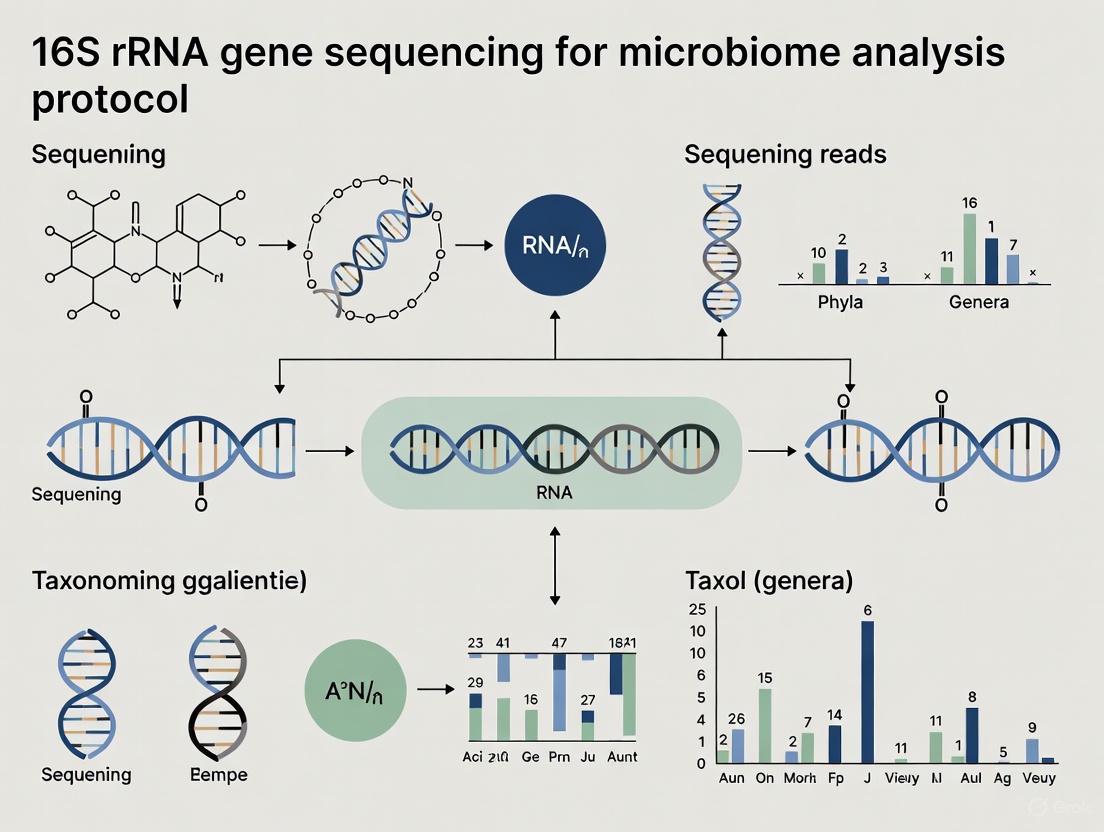
This article provides a comprehensive protocol and critical analysis of 16S rRNA gene sequencing for microbiome analysis, tailored for researchers, scientists, and drug development professionals.
A Comprehensive Guide to 16S rRNA Gene Sequencing for Microbiome Analysis: From Foundational Principles to Advanced Applications in Biomedical Research
Abstract
This article provides a comprehensive protocol and critical analysis of 16S rRNA gene sequencing for microbiome analysis, tailored for researchers, scientists, and drug development professionals. It covers foundational principles, detailing the structure and evolutionary significance of the 16S rRNA gene as a phylogenetic marker. A step-by-step methodological workflow is presented, from sample collection and DNA extraction through library preparation, sequencing, and bioinformatics analysis. The guide addresses common troubleshooting and optimization challenges, including primer selection, contamination control, and data interpretation pitfalls. Finally, it offers a rigorous validation and comparative framework, evaluating the technique's resolution against shotgun metagenomics and its growing role in clinical and translational research, such as understanding the gut microbiome in colorectal cancer and other disease states.
The 16S rRNA Gene: Unlocking Bacterial Phylogeny and Taxonomy
What is the 16S rRNA Gene? Structure, Function, and Conservation
The 16S ribosomal RNA (rRNA) gene is a fundamental genetic component found in all prokaryotes (bacteria and archaea) and serves as the cornerstone of microbial phylogenetics and taxonomy [1] [2]. As the DNA sequence that codes for the RNA component of the 30S small ribosomal subunit, its primary role is in the essential cellular process of protein synthesis [1] [3]. The gene's significance, however, extends far beyond this basic function. Its highly conserved nature, interspersed with species-specific variable regions, has established it as the most widely used molecular marker for bacterial identification and phylogenetic reconstruction [2] [4]. The pioneering work of Carl Woese in the 1970s, which utilized 16S rRNA gene sequencing to delineate the domain of Archaea, solidified its status as an indispensable "molecular clock" for evolutionary studies [1] [2] [5]. This application note details the structure, function, and conserved properties of the 16S rRNA gene, providing researchers with the foundational knowledge and protocols required for its application in modern microbiome analysis.
Structural Organization of the 16S rRNA Gene
The 16S rRNA gene has a length of approximately 1,500 to 1,550 base pairs and exhibits a characteristic architecture of conserved and variable regions that is critical to its utility [2] [3]. The "S" in 16S stands for Svedberg unit, which reflects the sedimentation coefficient of the ribosomal subunit and indirectly indicates its molecular size [1].
Conserved and Hypervariable Regions
The gene comprises nine hypervariable regions (V1-V9), which are short sequences (typically 30-100 base pairs long) flanked by longer, highly conserved regions [1] [4]. The variable regions accumulate mutations at a higher rate and provide the species-specific signature sequences necessary for discrimination, whereas the conserved regions are vital for the ribosome's core function and enable the design of universal PCR primers [1] [3].
Table 1: Characteristics of the Hypervariable Regions in the 16S rRNA Gene
| Region | Approximate Length (bp) | Key Characteristics and Applications |
|---|---|---|
| V1-V2 | ~510 bp | Provides good results for Escherichia/Shigella; can be sequenced on Roche 454 platform [1] [6]. |
| V3-V4 | ~428 bp | Commonly targeted by Illumina MiSeq; good for broad community analysis [1] [3]. |
| V4 | ~252 bp | A semi-conserved region; provides accurate phylum-level resolution and is commonly used in Illumina HiSeq [1] [6] [3]. |
| V6-V9 | ~548 bp | Noted as the best sub-region for classifying Clostridium and Staphylococcus [1] [6]. |
| V1-V9 | ~1500 bp | The full-length gene; provides the highest taxonomic accuracy across all taxa [6] [7]. |
Secondary and Tertiary Structure
The 16S rRNA molecule folds into a complex secondary and tertiary structure defined by base-pairing interactions, forming numerous stem-loops (helices) [1] [3]. This intricate structure acts as a scaffold, defining the positions of ribosomal proteins and facilitating its functional interactions within the ribosome [1] [5].
Biological Function and Conservation
Core Functions in Protein Synthesis
The 16S rRNA is not merely a structural component; it is functionally catalytic and critical for the initiation and fidelity of protein synthesis [1]. Its key functions include:
- mRNA Binding and Initiation: The 3′-end of the 16S rRNA contains the anti-Shine-Dalgarno sequence, which binds complementarily to the Shine-Dalgarno sequence on mRNA, ensuring correct positioning of the start codon (AUG) in the ribosomal P-site [1] [3].
- Ribosomal Subunit Interaction: The 16S rRNA directly interacts with the 23S rRNA of the large ribosomal subunit (50S), facilitating the stable binding of the 30S and 50S subunits to form the functional 70S ribosome [1] [3].
- Codon-Anticodon Stabilization: Within the ribosomal A-site, specific adenine residues (1492 and 1493) in the 16S rRNA form hydrogen bonds with the mRNA backbone, thereby stabilizing the correct codon-anticodon pairing between mRNA and tRNA and ensuring translational accuracy [1].
Evolutionary Conservation and Variation
The 16S rRNA gene is described as a "molecular fossil" due to its essential and unchanging role in the cell, which imposes strong evolutionary constraints, resulting in slow rates of sequence change [1] [3]. This makes it an excellent chronometer for measuring deep evolutionary relationships [2]. However, several factors complicate its use:
- Intragenomic Heterogeneity: Many bacterial genomes contain multiple copies of the 16S rRNA gene (operons), and sequence variation can exist between these copies within a single organism [1] [6] [8]. This heterogeneity can confound precise species-level identification and must be accounted for in high-resolution analyses [6].
- Horizontal Gene Transfer (HGT): Evidence shows that the 16S rRNA gene can be transferred horizontally between distantly related bacteria, challenging the assumption of strict vertical inheritance [1] [5] [8]. This promiscuity can lead to discordance between the 16S rRNA gene phylogeny and the true species phylogeny [8].
- Functional Conservation: Remarkably, despite significant sequence divergence, 16S rRNA genes from different phyla can be functionally interchangeable. Experimental evidence has demonstrated that an acidobacterial 16S rRNA gene (sharing only 78% identity with E. coli) could functionally complement E. coli ribosomes after a single base-pair correction, indicating that the molecular function is highly conserved even as the sequence evolves [5].
Experimental Protocols and Reagents
The following section outlines a detailed protocol for full-length 16S rRNA gene sequencing using Oxford Nanopore Technology (ONT), optimized from recent studies [7].
Full-Length 16S rRNA Gene Sequencing via MinION
Principle: This protocol leverages long-read nanopore sequencing to generate full-length (~1,500 bp) 16S rRNA amplicons, which provides superior taxonomic resolution compared to short-read sequencing of individual hypervariable regions [6] [7].
Workflow:
Step-by-Step Methodology:
- Genomic DNA Extraction: Extract high-quality genomic DNA from the microbial sample (e.g., using a ZymoBIOMICS DNA Miniprep Kit). Validate DNA purity and concentration using spectrophotometry and fluorometry, respectively.
- Full-Length 16S Amplification:
- Primers: Use universal primer pair 27F (5'-AGAGTTTGATCCTGGCTCAG-3') and 1492R (5'-CGGTTACCTTGTTACGACTT-3') to target the V1-V9 regions [1] [7].
- PCR Reaction:
- Template DNA: 1 ng
- Primers: 400 nM each
- Polymerase: 12.5 µL LongAmp Hot Start Taq DNA Polymerase (recommended for long amplicons)
- Total reaction volume: 25 µL
- Thermocycling Conditions:
- Initial Denaturation: 94°C for 1 min (1 cycle)
- Amplification: Denature at 94°C for 20 s, Anneal at 50°C for 30 s, Extend at 65°C for 90 s (25 cycles)
- Final Extension: 65°C for 3 min (1 cycle)
- Note: Limiting PCR cycles to 25 is critical to minimize amplification bias [7].
- PCR Product Purification: Purify the amplified ~1,500 bp product using SPRIselect magnetic beads according to the manufacturer's instructions. Quantify the purified DNA using a Qubit dsDNA BR Assay Kit.
- Library Preparation and Sequencing: Following the ONT "PCR barcoding amplicons" protocol (SQK-LSK109), barcode the purified amplicons from multiple samples using a PCR Barcoding Expansion kit. Pool the barcoded libraries, load them onto a MinION R9.4.1 flow cell, and perform sequencing for up to 48 hours.
The Scientist's Toolkit: Essential Research Reagents
Table 2: Key Reagents for 16S rRNA Gene Sequencing
| Item | Function/Application | Example Product/Catalog Number |
|---|---|---|
| Universal Primers (27F/1492R) | PCR amplification of the full-length 16S rRNA gene (V1-V9). | Custom synthesized oligos [7]. |
| High-Fidelity DNA Polymerase | Accurate amplification of long (~1.5 kb) amplicons with low error rate. | LongAmp Hot Start Taq DNA Polymerase (NEB M0534) [7]. |
| Magnetic Beads | Size-selective purification and cleanup of PCR amplicons. | SPRIselect magnetic beads (Beckman Coulter B23317) [7]. |
| DNA Quantitation Kit | Accurate quantification of low-concentration DNA for library preparation. | Qubit dsDNA BR Assay Kit (Thermo Fisher Scientific Q33238) [7]. |
| Barcoding Kit | Multiplexing samples by adding unique molecular barcodes during library prep. | ONT PCR Barcoding Expansion 1–96 (EXP-PBC096) [7]. |
| Sequencing Platform | Long-read sequencing of full-length 16S amplicons. | Oxford Nanopore MinION with R9.4.1 flow cell [7]. |
| Reference Database | Taxonomic classification of sequenced reads. | SILVA, Greengenes [1]. |
Applications in Microbial Research
The 16S rRNA gene is indispensable in modern microbiology and has enabled a paradigm shift from culture-based to sequence-based identification and community analysis.
- Microbiome Profiling: 16S rRNA amplicon sequencing is the primary method for characterizing complex bacterial communities in environments like the human gut, oral cavity, and soil [4] [9]. It allows researchers to determine which taxa are present and their relative abundances, linking dysbiosis to health and disease states [4].
- Clinical Microbiology and Pathogen Identification: The gene is routinely used in clinical labs to identify poorly described, rarely isolated, or phenotypically aberrant strains, leading to the recognition of novel pathogens [2]. It has demonstrated enhanced detection sensitivity compared to traditional culture, even after antibiotic treatment [1].
- Forensic Science: The highly individualized nature of human microbiomes, particularly on skin and in saliva, allows 16S rRNA profiling to be used for individual identification and linking persons to objects or locations [9].
- Phylogenetics and Species Delineation: Despite limitations at the strain level, the 16S rRNA gene remains the standard for determining the phylogenetic placement of new bacterial isolates and for delineating species, often with a 97% sequence similarity threshold used as a rule-of-thumb for species boundaries [6] [2].
Limitations and Considerations
While powerful, 16S rRNA gene analysis has inherent limitations that researchers must consider during experimental design and data interpretation.
- Limited Taxonomic Resolution: The gene often lacks the resolution to distinguish between closely related species or strains, particularly in taxa like Enterobacteriaceae and Clostridiaceae, which can share >99% 16S sequence similarity [1] [6].
- PCR and Bioinformatics Biases: The choice of primers, number of PCR cycles, polymerase, and bioinformatics pipeline (e.g., BugSeq vs. EPI2ME) can all significantly influence the resulting microbial community composition and must be carefully optimized and reported [7].
- Variable Copy Number: The number of 16S rRNA gene operons in a genome can range from 1 to 27, which can skew abundance estimates in community analyses, as taxa with higher copy numbers may be overrepresented [8].
- Phylogenetic Discordance: Phylogenies based on the 16S rRNA gene, especially its hypervariable regions, can show poor concordance with phylogenies based on the core genome due to recombination, HGT, and intragenomic variation [8]. Therefore, for strain-level analysis or robust phylogenetic inference, whole-genome sequencing is recommended.
The 16S rRNA gene is a uniquely powerful tool in microbial biology due to its universal distribution, functional constancy, and mosaic of conserved and variable sequences. Its structure is perfectly suited for its dual role in essential ribosomal function and as a molecular marker for identification and classification. While next-generation sequencing technologies now enable routine full-length 16S sequencing, offering superior resolution over short-read approaches, researchers must remain cognizant of its limitations, including copy number variation, limited strain-level discrimination, and phylogenetic discordance. A thorough understanding of the gene's structure, function, and conservation—as outlined in this application note—is fundamental to designing robust experiments, selecting appropriate protocols, and accurately interpreting data across diverse fields from clinical diagnostics to ecosystem ecology.
Why a Single Gene? The Principle Behind Using 16S as a Molecular Clock
The 16S ribosomal RNA (rRNA) gene has served as a cornerstone of microbial phylogenetics and taxonomy for decades. Its application as a molecular chronometer enables researchers to determine evolutionary relationships among bacteria and archaea, providing a framework for understanding microbial diversity in complex environments. This application note details the fundamental principles that establish the 16S rRNA gene as a preferred genetic marker, its specific structural properties that facilitate phylogenetic analysis, and standardized protocols for its application in modern microbiome research. By integrating theoretical foundations with practical methodologies, this document serves as an essential resource for researchers and drug development professionals employing 16S rRNA gene sequencing in their investigative workflows.
The Scientific Rationale for the 16S rRNA Gene
The selection of the 16S rRNA gene for phylogenetic studies is not arbitrary; it is grounded in a unique combination of molecular properties that make it exceptionally suitable as a molecular clock. As noted in early pioneering work, the gene functions as a molecular chronometer, where the degree of sequence conservation reflects its critical role in cell function [2]. The 16S rRNA is a component of the 30S subunit of the bacterial ribosome, which is indispensable for protein synthesis. This fundamental physiological role imposes strong selective pressure against mutations, particularly in regions directly involved in ribosomal assembly and function.
Several key attributes solidify its status as the gold standard marker:
- Universal Distribution: The gene is present in all bacteria and archaea, allowing for broad phylogenetic comparisons across all prokaryotic life [2] [10].
- Optimal Size and Structure: At approximately 1,550 base pairs in length, it provides a sufficiently large sequence for meaningful statistical analysis [2] [6]. Its structure comprises nine variable regions (V1-V9) interspersed with conserved regions. The variable regions provide the phylogenetic signal for distinguishing between taxa, while the conserved regions enable the design of universal PCR primers [2] [10] [11].
- Slow Evolutionary Rate: The gene exhibits a slow, relatively constant rate of sequence evolution over time. While not perfectly constant, this rate is sufficient to mark evolutionary distance and relatedness among organisms, fulfilling a primary requirement for a molecular clock [2].
- Extensive Reference Databases: Large, curated databases such as SILVA, Greengenes, and the RDP (Ribosome Database Project) contain hundreds of thousands of 16S rRNA sequences, providing an indispensable framework for taxonomic classification of newly sequenced data [2] [11].
Table 1: Core Characteristics of the 16S rRNA Gene as a Molecular Marker
| Characteristic | Description | Functional Implication |
|---|---|---|
| Universal Presence | Found in all bacteria and archaea. | Enables comprehensive profiling of entire prokaryotic communities. |
| Gene Length | ~1,500 base pairs. | Provides a sufficient amount of sequence data for robust statistical analysis. |
| Functional Constancy | Encodes a critical component of the protein synthesis machinery. | Subject to strong selective pressure, ensuring evolutionary relevance. |
| Structural Architecture | Combination of 9 variable and conserved regions. | Variable regions enable discrimination; conserved regions enable amplification. |
| Evolutionary Rate | Slow and relatively constant accumulation of mutations. | Acts as a "molecular clock" for measuring evolutionary time and relatedness. |
Structural Architecture and Phylogenetic Signal
The discriminatory power of the 16S rRNA gene stems from its chimeric architecture of variable and conserved regions. The conserved sequences reflect the common ancestry and essential function of the ribosome, while the hypervariable regions accumulate mutations at a higher rate, serving as unique fingerprints for different taxonomic groups.
The following diagram illustrates the structure of the 16S rRNA gene and the workflow for leveraging it in phylogenetic analysis:
This combination of stability and variability allows the 16S gene to be used for phylogenetic assignments at multiple levels. The conserved regions allow for the alignment of sequences from vastly different organisms and the design of broad-range PCR primers. The variable regions provide the necessary sequence divergence to distinguish between organisms at different taxonomic depths, from the phylum level down to the species and, in some cases, the strain level [2] [6]. It is crucial to note that the variable regions evolve at different rates, and no single region can resolve all bacterial taxa equally well. The choice of which variable region(s) to sequence is therefore a critical methodological consideration that depends on the specific research question and the bacterial lineages of interest [6] [12].
Wet-Lab Protocol: 16S rRNA Gene Amplicon Sequencing
This section provides a standardized protocol for generating 16S rRNA gene sequence data from complex microbial communities, such as those found in gut, skin, or environmental samples.
Sample Collection and DNA Extraction
Objective: To obtain high-quality microbial genomic DNA suitable for PCR amplification. Critical Considerations:
- Sample Preservation: Immediately freeze samples at -80°C or use commercial preservation buffers to prevent microbial community shifts.
- Low-Biomass Protocols: For samples with low bacterial density (e.g., skin, water), use extraction kits specifically validated for low biomass to minimize host DNA contamination and maximize microbial DNA yield [13]. Protocols involving D-Squame discs followed by in-house DNA extraction have been shown to be effective for skin [13].
- Inhibitor Removal: Ensure the extraction protocol effectively removes PCR inhibitors (e.g., humic acids in soil, bile salts in gut samples).
PCR Amplification of Target Regions
Objective: To specifically amplify the 16S rRNA gene or its hypervariable regions.
Reaction Setup:
| Component | Volume (μL) | Final Concentration |
|---|---|---|
| PCR-Grade Water | 10.5 | - |
| 2X KOD One PCR Master Mix | 15.0 | 1X |
| Mixed Forward/Reverse Primers (10 μM each) | 3.0 | 0.3 μM each |
| Template DNA (10-20 ng/μL) | 1.5 | 1-3 ng/μL |
| Total Volume | 30.0 |
Primer Selection: The choice of primers determines the variable region sequenced. Common choices include:
- 27F (AGRGTTTGATYNTGGCTCAG) and 1492R (TASGGHTACCTTGTTASGACTT) for full-length 16S [12].
- Region-specific primers (e.g., targeting V3-V4 for Illumina short-read sequencing).
Thermocycling Conditions:
| Cycle Step | Temperature | Time | Cycles |
|---|---|---|---|
| Initial Denaturation | 95°C | 2 minutes | 1 |
| Denaturation | 98°C | 10 seconds | 25 |
| Annealing | 55°C | 30 seconds | 25 |
| Extension | 72°C | 90 seconds | 25 |
| Final Extension | 72°C | 2 minutes | 1 |
| Hold | 4°C | ∞ | 1 |
Library Preparation and Sequencing
Objective: To prepare the PCR amplicons for next-generation sequencing. Steps:
- Purification: Clean PCR products using magnetic beads (e.g., AMPure XP/PB beads) to remove primers, dimers, and salts.
- Library Construction: For Illumina platforms, add sequencing adapters and dual-index barcodes via a second, limited-cycle PCR. This allows multiplexing of samples.
- Quality Control: Assess library concentration (e.g., via Qubit fluorometry) and fragment size (e.g., via Agilent Bioanalyzer).
- Sequencing: Pool libraries at equimolar concentrations and sequence on an appropriate platform (e.g., Illumina MiSeq for 2x300 bp V3-V4 reads; PacBio Sequel II for full-length 16S).
Bioinformatic Analysis: From Raw Sequences to Taxonomy
The transformation of raw sequencing data into biological insights requires a multi-step bioinformatic pipeline, implemented using various software packages and reference databases.
Core Bioinformatics Workflow
The following diagram outlines the standard bioinformatic processing steps for 16S rRNA amplicon data:
Key Steps and Tools
- Quality Filtering: Remove low-quality reads, trim adapter sequences, and truncate reads based on quality scores.
- Denoising and Chimera Removal: Correct sequencing errors and remove chimeric PCR artifacts using algorithms like those in DADA2 or QIIME 2 to resolve true biological sequences down to single-nucleotide differences [14] [6].
- Sequence Variant Inference: Generate Amplicon Sequence Variants (ASVs) or cluster sequences into Operational Taxonomic Units (OTUs). ASVs provide a higher resolution and are now generally preferred over OTUs.
- Taxonomic Assignment: Classify ASVs/OTUs by comparing them against curated reference databases using classifiers like the RDP classifier or BLAST [2] [11].
Table 2: Key Reagents and Computational Tools for 16S rRNA Analysis
| Category | Item | Specification/Version | Primary Function |
|---|---|---|---|
| Wet-Lab Reagents | PowerSoil DNA Isolation Kit | - | DNA extraction from complex samples. |
| KOD One PCR Master Mix | - | High-fidelity amplification of 16S gene. | |
| AMPure PB Beads | - | Purification and size-selection of PCR amplicons. | |
| Primer Sets | 27F / 1492R | - | Amplification of the full-length 16S rRNA gene. |
| 341F / 806R | - | Amplification of the V3-V4 hypervariable region. | |
| Bioinformatic Tools | QIIME 2 | 2024.5 | End-to-end microbiome analysis platform. |
| DADA2 | 1.28 | Inference of exact ASVs from amplicon data. | |
| phyloseq (R) | 1.44 | Statistical analysis and visualization of microbiome data. | |
| SILVA Database | SSU 138 | Curated database for taxonomic classification. |
Technical Considerations and Emerging Best Practices
Full-Length vs. Partial Gene Sequencing
The advent of third-generation sequencing (PacBio and Oxford Nanopore) has made high-throughput sequencing of the full-length (~1500 bp) 16S rRNA gene a reality. Evidence strongly supports the superiority of full-length sequencing for taxonomic resolution.
Table 3: Comparison of Sequencing Approaches for the 16S rRNA Gene
| Parameter | Short-Read (e.g., V4 Region) | Long-Read (Full-Length V1-V9) |
|---|---|---|
| Typical Platform | Illumina MiSeq/NovaSeq | PacBio Sequel IIe, Oxford Nanopore |
| Taxonomic Resolution | Good for genus-level, poor for species-level. | Superior; enables species and strain-level discrimination [6]. |
| Ability to Resolve Intragenomic Variation | No | Yes, can distinguish between multiple copies of the 16S gene within a single genome [6]. |
| Cost & Throughput | Lower cost per sample; very high throughput. | Higher cost per sample; lower throughput. |
| Error Profile | Low substitution errors. | Higher initial error rate, corrected via circular consensus sequencing (CCS) to >99.9% accuracy [6]. |
A 2019 study in Nature Communications demonstrated that the V4 region alone failed to confidently classify 56% of in-silico amplicons to the species level, whereas full-length sequences successfully classified nearly all sequences correctly [6]. Furthermore, full-length sequencing allows for the detection of intragenomic variation (sequence differences between multiple 16S gene copies in a single genome), which can provide additional strain-level resolution [6].
Selection of Hypervariable Regions
When full-length sequencing is not feasible, the choice of hypervariable region significantly impacts outcomes. Research indicates that the V1-V3 region often provides a resolution closest to that of the full-length gene for many applications, including skin microbiome studies [12]. Other regions, like V6-V8, also show high precision for specific environments like the gut [15]. It is critical to avoid regions known to perform poorly for your sample type; for example, the V4-V5 region should be avoided in infant fecal samples [15].
Limitations and Complementary Approaches
While powerful, 16S rRNA sequencing has limitations:
- Species-Level Ambiguity: Closely related species (e.g., E. coli and Shigella) may have identical or nearly identical 16S sequences [11].
- Multi-Copy Number Bias: The number of 16S gene copies per genome varies between taxa, potentially skewing abundance estimates [11].
- Lack of Functional Insight: The technique reveals "who is there" but not "what they are doing" [13] [11].
For functional analysis, shotgun metagenomic sequencing is the recommended complementary approach. It provides comprehensive insights into the functional potential of the community by sequencing all genomic DNA, allowing for the reconstruction of metabolic pathways and the identification of genes related to virulence and antibiotic resistance [13].
The 16S rRNA gene remains an indispensable tool in microbial ecology and drug development due to its unique properties as a molecular chronometer. Its universal distribution, structural combination of conserved and variable regions, and slow evolutionary rate provide a robust framework for phylogenetic analysis. Current best practices involve leveraging full-length gene sequencing where possible to maximize taxonomic resolution, or carefully selecting the most informative variable regions (e.g., V1-V3) for short-read platforms. By understanding the principles outlined in this application note and adhering to the detailed protocols, researchers can reliably harness the power of 16S rRNA gene sequencing to uncover the composition and dynamics of microbial communities, thereby accelerating discovery in basic research and therapeutic development.
The 16S ribosomal RNA (rRNA) gene is a cornerstone of microbial ecology and microbiome research, serving as a reliable genetic marker for profiling bacterial and archaeal communities. This ~1500 base-pair gene contains a unique architecture of highly conserved regions interspersed with nine hypervariable regions (V1-V9) that evolve at different evolutionary rates, enabling both universal amplification and taxonomic discrimination [6] [16]. Furthermore, its multi-copy nature within prokaryotic genomes introduces important considerations for quantitative interpretation. These key characteristics collectively establish the 16S rRNA gene as an powerful tool for microbial classification, though they also necessitate careful methodological considerations during experimental design and data analysis. This application note details these fundamental properties and provides structured protocols for researchers investigating microbial communities across various sample types.
Key Characteristics and Technical Data
Conserved and Variable Region Architecture
The 16S rRNA gene comprises nine variable regions (V1-V9) separated by conserved segments, with the conserved regions enabling universal primer binding for PCR amplification across diverse bacterial taxa, while the variable regions provide the sequence divergence necessary for taxonomic discrimination [6] [16]. The relative positions of these regions within the approximately 1500 bp gene are illustrated below:
Different hypervariable regions offer varying levels of taxonomic resolution, and their selection significantly impacts experimental outcomes. The table below summarizes the comparative performance of commonly targeted regions:
Table 1: Taxonomic resolution and performance characteristics of 16S rRNA hypervariable regions
| Target Region | Approximate Length (bp) | Recommended Applications | Taxonomic Resolution | Limitations and Biases |
|---|---|---|---|---|
| V1-V2 | ~350 | Respiratory microbiota [17], Streptococcus and Staphylococcus discrimination [17] | High for specific pathogens | Underrepresents Proteobacteria [6] |
| V3-V4 | ~460 | Human gut microbiome studies [18], general purpose | Good genus-level resolution | Poor for Actinobacteria [6] |
| V4 | ~250 | General environmental studies | Moderate genus-level resolution | Lowest discriminatory power (56% accurate species classification) [6] |
| V6-V8 | ~400 | Clostridium and Staphylococcus detection [6] | Varies by taxon | Limited validation across environments |
| V7-V9 | ~350 | Specific taxonomic groups | Lower diversity estimates [17] | Significantly reduced alpha diversity [17] |
| Full-length (V1-V9) | ~1500 | Species- and strain-level resolution [6] [19], clinical biomarkers [19] | Highest species/strain resolution | Higher cost, specialized platform required |
Multi-Copy Nature and Gene Copy Number Variation
A critical yet often overlooked characteristic of the 16S rRNA gene is its presence in multiple copies within a single bacterial genome, with copy numbers ranging from 1 to 21 across different taxa [20]. This multi-copy nature has profound implications for quantitative interpretation of 16S rRNA sequencing data, as abundance measurements reflect gene copy counts rather than actual cell numbers [20]. The diagram below illustrates this concept and its bioinformatic correction:
The table below compares main approaches for addressing 16S rRNA gene copy number variation:
Table 2: Methods for 16S rRNA gene copy number (16S GCN) estimation and correction
| Method Category | Examples | Underlying Principle | Advantages | Limitations |
|---|---|---|---|---|
| Taxonomy-Based | rrnDB [20], RDP [20] | Assigns average GCN based on taxonomic classification | Simple implementation, fast computation | Limited by classification accuracy and database completeness |
| Phylogeny-Based | PICRUSt2 [20] | Infers GCN from evolutionary relationships in phylogenetic trees | Accounts for evolutionary relationships | Dependent on reference tree quality and topology |
| Deep Learning | ANNA16 [20] | Predicts GCN directly from 16S sequence using neural networks | High accuracy, avoids classification steps | Computationally intensive, requires training data |
Application Notes and Experimental Protocols
Full-Length 16S rRNA Gene Sequencing for Enhanced Taxonomic Resolution
Principle: Third-generation sequencing platforms (PacBio, Oxford Nanopore) enable sequencing of the entire ~1500 bp 16S rRNA gene, capturing all variable regions and providing superior taxonomic resolution compared to short-read approaches targeting partial regions [6] [19] [21].
Experimental Workflow:
Step-by-Step Protocol:
DNA Extraction
Full-Length 16S Amplification
- Primer Design: Target conserved regions flanking V1-V9 (e.g., 27F: AGRGTTYGATYMTGGCTCAG; 1492R: RGYTACCTTGTTACGACTT) [21].
- PCR Reaction: Use high-fidelity polymerase (e.g., KAPA HiFi HotStart ReadyMix) with 20-27 cycles to minimize chimera formation [21].
- Cycling Conditions: 95°C for 3 min; 20-27 cycles of [95°C for 30s, 55-57°C for 30s, 72°C for 60s]; final extension at 72°C for 5 min [21].
Library Preparation and Sequencing
Bioinformatic Processing
- Demultiplex samples and generate CCS reads (PacBio) or basecall raw signals (Nanopore).
- Process sequences using DADA2 (QIIME2 plugin) for quality filtering, error correction, and amplicon sequence variant (ASV) inference [21].
- For Nanopore data, consider specialized tools like Emu that account for higher error rates [19].
- Perform taxonomic assignment using reference databases (SILVA, Greengenes) with species-level thresholds [16].
Hypervariable Region Selection for Specific Research Applications
Principle: Different hypervariable regions exhibit varying discriminatory power for specific bacterial taxa and sample types. Optimal region selection enhances detection sensitivity and taxonomic accuracy for particular research questions [17] [16].
Protocol for Region Selection and Validation:
Define Research Objectives and Expected Taxa
- Identify target microorganisms of interest and their relative abundance in sample type.
- Consult literature and database (e.g., SILVA TestPrime) for primer coverage evaluation [16].
Select Appropriate Hypervariable Region
- Respiratory Samples: Prioritize V1-V2 region, which demonstrates highest sensitivity and specificity (AUC: 0.736) for respiratory microbiota [17].
- Human Gut Microbiome: Consider V3-V4 region, well-established for gastrointestinal taxa with extensive reference databases [18].
- Species-Level Discrimination: Implement full-length V1-V9 sequencing when distinguishing closely related species (e.g., Escherichia coli vs. Shigella) [6] [21].
Wet-Lab Validation with Mock Communities
- Include mock community standards (e.g., ZymoBIOMICS Microbial Community) in sequencing runs.
- Compare theoretical vs. observed composition to calculate recall, precision, and F-measure for each primer set [16].
- Validate detection limits for low-abundance taxa of interest.
Bioinformatic Optimization
The Scientist's Toolkit: Essential Research Reagents and Materials
Table 3: Essential reagents and materials for 16S rRNA gene sequencing studies
| Category | Specific Product/Kit | Application Note | Critical Function |
|---|---|---|---|
| DNA Extraction | QIAamp PowerFecal Pro DNA Kit [21] | Optimal for tough-to-lyse gram-positive bacteria in stool | Comprehensive cell lysis and inhibitor removal |
| PCR Amplification | KAPA HiFi HotStart ReadyMix [21] | Essential for full-length 16S amplification with high fidelity | Reduces PCR errors and chimera formation |
| Library Prep | SMRTbell Prep Kit (PacBio) [21] | Required for circular consensus sequencing | Enables template preparation for long-read platforms |
| Quality Control | ZymoBIOMICS Microbial Community Standard [17] [21] | Mandatory for validating entire workflow performance | Identifies technical biases and quantifies accuracy |
| Sequencing | PacBio Sequel IIe System [21] | Recommended for high-throughput full-length 16S | Generates HiFi reads with Q30 quality for species ID |
| Bioinformatic Tools | DADA2 (QIIME2 plugin) [21] | Optimal for Illumina and PacBio CCS data | Precisely resolves amplicon sequence variants (ASVs) |
| Reference Databases | SILVA database [22] [16] | Continuously updated with quality-controlled sequences | Provides accurate taxonomic nomenclature framework |
The triumvirate of conserved regions, nine hypervariable domains, and multi-copy nature establishes the 16S rRNA gene as both a powerful and complex tool for microbial analysis. Researchers must strategically select hypervariable regions based on their specific sample type and research questions, recognizing that full-length sequencing provides superior taxonomic resolution while targeted regions offer cost-effective alternatives for well-characterized systems. Crucially, accounting for 16S rRNA gene copy number variation through bioinformatic correction is essential for accurate quantitative interpretation. As sequencing technologies continue to advance, particularly in long-read platforms, the full potential of 16S rRNA gene analysis is increasingly realizable, promising enhanced discriminatory power for clinical diagnostics, biomarker discovery, and fundamental microbial ecology research.
The 16S ribosomal RNA (rRNA) gene has served as the cornerstone of microbial phylogenetics and ecology for nearly half a century. This application note traces the revolutionary journey from Carl Woese's pioneering phylogenetic work to contemporary high-throughput sequencing protocols that enable comprehensive microbiome analysis. The 16S rRNA gene is universally present in bacteria and archaea, contains both highly conserved regions for primer binding and hypervariable regions providing species-specific signatures, and evolves at a rate that makes it ideal for measuring evolutionary relationships [1]. Understanding this historical context and technical evolution is essential for researchers designing robust microbiome studies in drug development, clinical diagnostics, and environmental monitoring.
Historical Foundation: Carl Woese's Phylogenetic Revolution
Pioneering Work in Molecular Phylogeny
In 1977, Carl Woese and George E. Fox pioneered the use of 16S rRNA for phylogenetic studies, fundamentally reshaping our understanding of the tree of life by revealing a previously unknown domain—Archaea [1]. Woese recognized that the 16S rRNA gene's molecular clock-like nature and universal distribution made it an ideal phylogenetic marker for comparing evolutionary relationships across all life forms [8]. His work established that the degree of sequence difference in the 16S rRNA gene correlated with evolutionary distance, enabling the reconstruction of phylogenetic relationships between diverse microorganisms.
Woese's comparative analysis approach was groundbreaking. In early work on 5S rRNA, he and George Fox demonstrated that by comparing sequences from just six different bacteria, they could deduce a common secondary structure compatible with all sequences [23]. This comparative method became the foundation for determining the secondary structure of the much larger 16S rRNA through compensating base change analysis, where helices were "proven" by finding two or more compensating base changes between organisms without non-compensated changes [23].
Technical Challenges in Early 16S rRNA Analysis
Early 16S rRNA analysis faced tremendous technical challenges before the advent of modern sequencing technologies. As Harry Noller's account reveals, determining the secondary structure of the ~1500-nucleotide 16S rRNA presented formidable obstacles. Computational predictions alone were insufficient, with estimates suggesting approximately 10,000 possible helices of four or more base pairs, corresponding to a staggering 10^115 possible secondary structures—far exceeding the number of fundamental particles in the known universe [23].
The collaboration between Woese and Noller to determine the 16S rRNA secondary structure relied on T1 RNase oligonucleotide catalogs from approximately 100 different bacteria. However, because T1 RNase cleaves at G residues and most RNA helices are G-rich, the oligonucleotides were often too short to assign to unique positions, yielding only around eight "proven" helices initially [23]. This limitation necessitated obtaining complete 16S rRNA sequences from divergent organisms such as Bacillus brevis and Halobacterium volcanii, which required heroic efforts including direct RNA sequencing and specialized gel methods when cloning proved difficult [23].
Technical Considerations and Limitations of 16S rRNA Sequencing
Phylogenetic Discordance and Genomic Heterogeneity
Despite its widespread use, modern research has revealed important limitations of the 16S rRNA gene as a phylogenetic marker. A critical 2022 study demonstrated that 16S rRNA gene phylogenies lack concordance with core genome phylogenies at both intra- and inter-genus levels [8]. At the intra-genus level, the 16S rRNA gene showed one of the lowest levels of concordance with core genome phylogeny (50.7% average), and was found to be recombinant and subject to horizontal gene transfer [8].
This phylogenetic discordance has far-reaching implications:
- Incorrect species/strain delineation and phylogenetic inference
- Confounded community diversity metrics when phylogenetic information is incorporated (e.g., Faith's phylogenetic diversity, UniFrac)
- Limited resolution for closely related species that share up to 99% sequence similarity [1]
The presence of multiple 16S rRNA gene copies within single genomes (ranging from 1-27 copies) [8] with intraspecies heterogeneity [1] further complicates abundance estimations and can lead to PCR-induced chimeras.
Primer Selection and Amplification Bias
Primer selection represents a critical source of variability in 16S rRNA gene-based microbiome profiling. Even minor mismatches between primer sequences and target regions can introduce substantial amplification bias, preferentially enriching certain taxa while underrepresenting others [24]. This bias affects both alpha and beta diversity measures and can distort downstream taxonomic assignments.
A 2025 comparative analysis of full-length 16S rRNA gene sequencing in human oropharyngeal swabs demonstrated that primer degeneracy significantly impacts microbial community composition and diversity estimates [24]. The study compared two primer sets with differing degrees of degeneracy and found:
- The more degenerate primer set (27F-II) yielded significantly higher alpha diversity (Shannon index: 2.684 vs. 1.850; p < 0.001)
- The degenerate primer detected a broader range of taxa across all phyla
- Taxonomic profiles from the degenerate primer showed strong correlation with reference datasets (r = 0.86) compared to weak correlation with standard primers (r = 0.49)
- The standard primer (27F-I) overrepresented Proteobacteria and underrepresented key genera including Prevotella, Faecalibacterium, and Porphyromonas [24]
Table 1: Impact of Primer Degeneracy on Taxonomic Classification in Oropharyngeal Swabs
| Metric | Standard Primer (27F-I) | Degenerate Primer (27F-II) | Statistical Significance |
|---|---|---|---|
| Shannon Diversity Index | 1.850 | 2.684 | p < 0.001 |
| Correlation with Reference Dataset | r = 0.49 (p = 0.06) | r = 0.86 (p < 0.0001) | Significant improvement |
| Proteobacteria Representation | Overrepresented | Balanced | - |
| Key Genera Detection | Underrepresented Prevotella, Faecalibacterium, Porphyromonas | Appropriate detection | - |
Modern Sequencing Platforms and Methodological Approaches
Comparison of Short-Read vs. Long-Read Technologies
Current 16S rRNA sequencing approaches primarily utilize two platform types: short-read (e.g., Illumina) and long-read (e.g., Oxford Nanopore Technologies, PacBio) technologies. Each offers distinct advantages and limitations for microbiome analysis.
Table 2: Comparison of 16S rRNA Gene Sequencing Platforms and Approaches
| Parameter | Illumina (Short-Read) | Oxford Nanopore (Long-Read) |
|---|---|---|
| Target Region | Partial hypervariable regions (typically V3-V4, ~400-500 bp) | Full-length 16S rRNA gene (V1-V9, ~1500 bp) |
| Taxonomic Resolution | Primarily genus-level | Species-level and sometimes strain-level |
| Read Length | 75-300 bp | Up to 15 kb |
| Error Rate | ~0.1% (Q30) | Recently improved to ~1% (Q20) with R10.4.1 chemistry |
| Primary Applications | Large-scale microbiome surveys, diversity studies | Biomarker discovery, pathogen identification, clinical diagnostics |
| Throughput | High | Medium to high |
| Cost | Moderate | Decreasing |
Short-read sequencing (Illumina) has become the most widely used approach in large-scale microbiome studies due to its high base-calling accuracy and established analysis pipelines [24]. However, its limited read length typically restricts analyses to partial hypervariable regions (most commonly V3-V4 or V4), constraining taxonomic classification primarily to the genus level and complicating comparisons across studies that target different regions [24].
Long-read sequencing technologies such as Oxford Nanopore Technologies (ONT) overcome this limitation by generating substantially longer reads, enabling full-length 16S rRNA gene sequencing and improving phylogenetic resolution [24]. While ONT sequencing was initially hindered by higher error rates (~6%), continuous improvements in flow cell design (R10.4.1), sequencing chemistry (Q20+ kits), and basecalling algorithms have markedly improved accuracy, now achieving modal read accuracies below 1% error [24] [19].
Bioinformatic Analysis Tools and Databases
The evolution of sequencing technologies has been paralleled by development of specialized bioinformatic tools for data analysis:
- Kraken 2 and KrakenUniq: Rapid taxonomic classification tools based on k-mer matching. KrakenUniq provides more accurate abundance estimates with lower false-positive rates, making it preferable for clinical diagnostics [25].
- Emu: A relative abundance estimation method designed for noisy long-read 16S rRNA data [19].
- DADA2: Popular for Amplicon Sequence Variant (ASV) inference from high-quality Illumina reads [19].
Database selection significantly influences taxonomic classification accuracy. A 2025 study comparing SILVA versus Emu's default database found that Emu's database obtained significantly higher diversity and identified species but sometimes overconfidently classified unknown species as the closest match due to its database structure [19].
Diagram 1: 16S rRNA gene sequencing workflow with critical decision points highlighted in red and potential biases in yellow.
Detailed Experimental Protocols
Full-Length 16S rRNA Gene Sequencing with Oxford Nanopore
Protocol: Full-length 16S rRNA gene amplification and sequencing using Oxford Nanopore Technology
Materials:
- Quick-DNA HMW MagBead kit (Zymo Research) or equivalent for DNA extraction
- Oxford Nanopore 16S Barcoding Kit (SQK-RAB204)
- Degenerate primers: 27F-II (5'-AGAGTTTGATCMTGGCTCAG-3') and 1492R (5'-CGGTTACCTTGTTACGACTT-3') [24]
- NanoDrop spectrophotometer and Quantus Fluorometer for quality control
- Oxford Nanopore MinION Mk1C with R10.4.1 flow cells
Procedure:
- Sample Collection and DNA Extraction:
- Collect samples using appropriate methods (e.g., oropharyngeal swabs transferred to DNA/RNA shielding buffer)
- Extract DNA using magnetic bead-based methods according to manufacturer's instructions
- Assess DNA purity (A260/A280 ratio ~1.8-2.0) and concentration using spectrophotometry and fluorometry
PCR Amplification:
Library Preparation and Sequencing:
- Prepare sequencing library according to ONT 16S barcoding kit protocol
- Load library onto MinION Mk1C with R10.4.1 flow cell
- Sequence for 24-48 hours using real-time basecalling
Bioinformatic Analysis:
- Perform taxonomic classification using Emu with default database or SILVA
- Utilize Dorado basecaller (super-accurate model recommended) [19]
V3-V4 16S rRNA Sequencing with Illumina
Protocol: V3-V4 hypervariable region sequencing using Illumina MiSeq
Materials:
- EZ1 Virus Mini kit v2.0 (Qiagen) or equivalent for DNA extraction
- KAPA HiFi DNA polymerase (Roche)
- Illumina adapter-containing primers: 341F (5'-CCTACGGGNGGCWGCAG-3') and 785R (5'-GACTACHVGGGTATCTAATCC-3') [25]
- MiSeq Reagent Kit v3 (600-cycle)
Procedure:
- DNA Extraction and Quality Control:
- Extract DNA with additional proteinase K pretreatment (56°C for 60 min)
- Quality check using TapeStation system
PCR Amplification:
- Prepare reaction: 12.5 μL KAPA HiFi DNA polymerase, 0.5 μL each primer, 1.5 μL nuclease-free water, 10 μL DNA template
- Cycling conditions: 95°C for 3 min; 45 cycles of: 95°C for 30s, 55°C for 30s, 72°C for 30s; final extension at 72°C for 5 min [25]
- Verify amplicons (~550 bp) using TapeStation
Library Preparation and Sequencing:
- Prepare library following Illumina 16S Metagenomic Sequencing Protocol with modifications for small 500-cycle nano-flow cell
- Sequence on MiSeq platform with 2×250 bp paired-end reads
Bioinformatic Analysis:
- Process sequences using DADA2 pipeline in QIIME2 for ASV inference
- Classify taxa using SILVA database
- Calculate diversity metrics (alpha and beta diversity)
Applications in Drug Development and Clinical Research
Biomarker Discovery and Precision Medicine
Full-length 16S rRNA sequencing has demonstrated significant advantages in biomarker discovery for disease detection and monitoring. A 2025 study on colorectal cancer (CRC) biomarkers compared Illumina-V3V4 with ONT-V1V9 sequencing and found that Nanopore sequencing identified more specific bacterial biomarkers for colorectal cancer, including Parvimonas micra, Fusobacterium nucleatum, Peptostreptococcus stomatis, Peptostreptococcus anaerobius, Gemella morbillorum, Clostridium perfringens, Bacteroides fragilis, and Sutterella wadsworthensis [19].
The study demonstrated that prediction of colorectal cancer through machine learning achieved an AUC of 0.87 with 14 species or 0.82 with just 4 species (P. micra, F. nucleatum, B. fragilis and Agathobaculum butyriciproducens), highlighting the potential for developing non-invasive diagnostic tests based on microbiome biomarkers [19].
Pharmaceutical Impact Assessment on Microbiomes
16S rRNA gene sequencing plays a crucial role in assessing the impact of pharmaceuticals on microbial communities, particularly in environmental risk assessment. Studies applying 16S rRNA sequencing have confirmed that pharmaceuticals, including antibiotics, NSAIDs, antidepressants, and complex mixtures, induce significant shifts in microbial community structure, reducing alpha diversity and enriching resistant taxa and antimicrobial resistance (AMR) genes [26].
This application is particularly relevant for drug development, where understanding the ecological impact of pharmaceutical compounds and their metabolites is essential for comprehensive risk assessment. The method enables monitoring of treatment effects on human microbiomes and environmental microbial communities exposed to pharmaceutical contamination through wastewater and agricultural practices [26].
The Scientist's Toolkit: Essential Research Reagents and Materials
Table 3: Essential Research Reagents and Materials for 16S rRNA Sequencing Studies
| Item | Function | Examples/Specifications |
|---|---|---|
| DNA Extraction Kits | High-quality DNA extraction from diverse sample types | Quick-DNA HMW MagBead kit (Zymo Research), EZ1 Virus Mini kit (Qiagen) with proteinase K pretreatment |
| Universal Primers | Amplification of 16S rRNA gene regions | 27F/1492R (full-length), 341F/785R (V3-V4); Degenerate versions recommended to reduce bias |
| Polymerase | High-fidelity PCR amplification | KAPA HiFi DNA Polymerase (Roche) for Illumina; ONT 16S Barcoding Kit for Nanopore |
| Sequencing Platforms | Generating sequence data | Illumina MiSeq (short-read), Oxford Nanopore MinION Mk1C (long-read) |
| Flow Cells/Chemistry | Platform-specific sequencing | Illumina MiSeq Reagent Kit v3; ONT R10.4.1 flow cells with Q20+ chemistry |
| Reference Databases | Taxonomic classification | SILVA, Greengenes, RDP; Emu's default database for Nanopore data |
| Bioinformatic Tools | Data processing and analysis | KrakenUniq, Emu, DADA2 (QIIME2), Dorado basecaller |
Diagram 2: Evolution of 16S rRNA sequencing technologies and capabilities over time.
The journey from Carl Woese's pioneering phylogenetic work to modern high-throughput 16S rRNA sequencing has transformed microbial ecology and opened new avenues for drug development and clinical diagnostics. While methodological challenges remain—including amplification biases, phylogenetic discordance, and database limitations—recent advances in long-read sequencing, degenerate primer design, and bioinformatic tools are steadily addressing these limitations.
Future developments will likely focus on integrating multi-omics approaches (metagenomics, metatranscriptomics) with 16S rRNA data to move beyond census-based information and truly understand functional responses to pharmaceutical interventions [26]. Standardization of methodologies and continued improvement in sequencing accuracy will further enhance the value of 16S rRNA sequencing in drug development pipelines, environmental risk assessment, and personalized medicine applications.
For researchers in drug development, the current state of 16S rRNA sequencing offers robust approaches for microbiome biomarker discovery, pharmaceutical impact assessment, and personalized therapeutic strategies based on individual microbiome profiles. By understanding both the historical context and technical considerations outlined in this application note, scientists can design more rigorous microbiome studies that account for methodological limitations while leveraging the full potential of this transformative technology.
The 16S rRNA Gene as a Universal Barcode for Bacterial and Archaeal Life
The 16S ribosomal RNA (rRNA) gene has served as a cornerstone for microbial ecology and identification for decades. This ~1,500 base-pair gene is found in all bacteria and archaea, and its structure—comprising nine hypervariable regions (V1-V9) interspersed with conserved sequences—makes it an ideal target for phylogenetic studies [27] [28]. The conserved regions enable the design of broad-range PCR primers, while the variable regions provide the nucleotide diversity necessary to discriminate between different taxonomic groups [27]. Consequently, 16S rRNA gene sequencing has become the method of choice for characterizing the composition of microbial communities from diverse environments, including the human body, soil, water, and industrial systems [27] [29].
This Application Note frames the use of the 16S rRNA gene within the context of a broader thesis on microbiome analysis protocols. It is designed to provide researchers, scientists, and drug development professionals with a detailed overview of the principles, applications, and detailed methodologies for using this universal barcode, including optimized experimental protocols and advanced data analysis considerations.
Principles and Applications of 16S rRNA Gene Sequencing
The 16S rRNA gene functions as a molecular clock due to its essential role in protein synthesis, which constrains its sequence from changing too rapidly. However, the hypervariable regions accumulate mutations at a rate that provides sufficient resolution for phylogenetic classification. This allows for the identification and relative quantification of bacteria and archaea present within a complex sample without the need for cultivation [27].
The typical workflow involves several key steps: sample collection and DNA extraction, PCR amplification of the 16S rRNA gene using primers targeting specific variable regions, library preparation, high-throughput sequencing, and bioinformatic analysis [27].
Table 1: Key Applications of 16S rRNA Gene Sequencing Across Fields
| Field | Primary Application | Specific Examples |
|---|---|---|
| Environmental Microbiology | Identification and classification of microorganisms in natural environments; assessment of diversity, pollution, and contamination. | Analysis of soil, water, and air samples [27]. |
| Medical Microbiology | Diagnosis and treatment of infections; insights into the role of the microbiome in health and disease. | Characterization of human gut, skin, and oral microbiomes; analysis of clinical samples from infected tissues [27] [30]. |
| Food Microbiology | Ensuring food safety and quality; screening for food-borne pathogens. | Analysis of fermented foods and beverages [27]. |
| Industrial Microbiology | Monitoring and optimizing industrial processes. | Production of biotechnology products and pharmaceuticals; wastewater treatment [27]. |
| Forensic Science | Individual identification and tracing the origin of biological evidence. | Analysis of skin ("touch microbiome") and soil microbial communities [29]. |
Critical Methodological Considerations
The accuracy and reliability of 16S rRNA gene sequencing results are highly dependent on several factors throughout the experimental pipeline. Researchers must make informed choices at each step to ensure their data is robust and interpretable.
Primer Selection and Variable Region Choice
The selection of PCR primers targeting specific variable regions is one of the most critical decisions, as it directly influences coverage, specificity, and taxonomic resolution [16] [31]. Different variable regions possess varying degrees of discriminatory power for different bacterial phyla.
- Coverage vs. Specificity: "Universal" primer pairs (e.g., 515F-806R targeting the V4 region) are designed to amplify a wide range of bacteria but may poorly amplify or miss specific groups, including many archaea [16] [32]. For example, the V4 region is a popular target but has been shown to miss certain Bacteroidetes when using the 515F-944R primer pair [16]. Specialist primers, such as those newly designed for Archaea (e.g., SSU1ArF/SSU1000ArR), can provide much higher coverage for these underrepresented domains [32].
- Taxonomic Resolution: Sequencing different variable regions can lead to significantly different microbial community profiles, even from the same donor sample [16]. While sequencing a single variable region (e.g., V4) is cost-effective, sequencing longer stretches spanning multiple regions (e.g., V1-V3 or V3-V4) generally improves taxonomic classification [6]. Full-length 16S gene sequencing (V1-V9) using third-generation platforms (PacBio, Oxford Nanopore) provides the highest possible resolution, enabling differentiation at the species and sometimes strain level [18] [6].
Table 2: Comparison of Commonly Targeted 16S rRNA Gene Variable Regions
| Target Region | Example Primer Pairs | Strengths | Weaknesses |
|---|---|---|---|
| V1-V2 | 27F-338R | Good resolution for certain taxa like Escherichia/Shigella [16] [6]. | Poor classification of Proteobacteria [6]. |
| V3-V4 | 341F-785R | Common, well-established region; good for gut microbiomes (Firmicutes, Bacteroidetes) [16] [18]. | Poor classification of Actinobacteria [6]. |
| V4 | 515F-806R | Highly popular; short length suitable for Illumina MiSeq; low error rate [33]. | Lowest species-level resolution; can miss key taxa [16] [6]. |
| V6-V8 | 939F-1378R | Good for classifying Clostridium and Staphylococcus [6]. | Less commonly used. |
| Full-length (V1-V9) | 27F-1492R | Highest species and strain-level resolution; identifies intragenomic sequence variants [6]. | Higher cost and longer sequencing time [18]. |
Bioinformatics and Reference Databases
The bioinformatic processing of 16S sequencing data profoundly impacts the results. Key considerations include:
- Clustering Methods: Traditional Operational Taxonomic Units (OTUs) cluster sequences at a fixed similarity threshold (e.g., 97% for species). In contrast, Amplicon Sequence Variants (ASVs) resolve sequences at a single-nucleotide level, providing higher resolution and improved cross-study comparability [16] [28].
- Reference Databases: Taxonomic assignment is only as good as the reference database used. Common databases include GreenGenes, SILVA, and the RDP. However, the use of niche-specific databases (e.g., the Human Oral Microbiome Database - HOMD) has been shown to improve classification accuracy by aligning reference sequences more closely with the microbial community under investigation [30] [28].
- Dynamic Thresholding: The use of a fixed identity threshold (e.g., 98.5-99%) for species-level classification can lead to misidentification. Implementing flexible, species-specific thresholds has been demonstrated to significantly improve classification accuracy [18].
Detailed Experimental Protocols
Sample Collection, Preservation, and DNA Extraction
Principle: The goal is to obtain high-quality, uncontaminated genomic DNA that accurately represents the microbial community.
Protocol (for human fecal samples):
- Collection: Collect samples using a provided sterile collection kit. For fecal samples, use a sterile spoon or swab to transfer material into a sterile container.
- Preservation: Immediate freezing at -20°C or -80°C is critical to preserve the microbial composition. Avoid freeze-thaw cycles. If immediate freezing is not possible, temporarily store samples at 4°C for a few hours or use a commercial preservation buffer [27].
- DNA Extraction:
- Use a commercially available DNA extraction kit suitable for the sample type (e.g., soil, stool, water).
- Lysis: Mechanically lyse cells using bead beating in a homogenizer (e.g., 40s at speed 6 m/s) combined with chemical lysis (e.g., SDS and enzymes) and heat (e.g., 2 min at 99°C). Freeze-thaw cycles may also be employed to enhance lysis [33].
- Precipitation and Purification: Add a salt solution and alcohol to precipitate DNA. Purify the DNA using spin columns or magnetic beads to remove impurities, proteins, and inhibitors. Elute DNA in nuclease-free water or TE buffer [27].
- Quantification: Quantify the extracted DNA using a fluorometric method (e.g., Qubit dsDNA HS Assay) [33].
Critical Step: Include a negative control (no sample) during the extraction and a positive control (e.g., a mock microbial community with known composition) to monitor contamination and efficacy [27] [28].
Library Preparation for Illumina Sequencing (V3-V4 Region)
Principle: To amplify the target 16S region and attach Illumina sequencing adapters and dual indices (barcodes) to allow for multiplexing of samples.
Protocol (Adapted from Kozich et al., 2013 and subsequent modifications [33]):
- First-Stage PCR - Amplicon Generation:
- Primers: Use primers 341F (5'-CCTACGGGNGGCWGCAG-3') and 785R (5'-GACTACHVGGGTATCTAATCC-3') for the V3-V4 region.
- Reaction Mix (25µl):
- 2-12.5 ng genomic DNA
- 0.5 µM each forward and reverse primer
- 12.5 µL 2x HOT FIREPol Blend Master Mix (or equivalent high-fidelity PCR mix)
- Nuclease-free water to 25 µL.
- Thermocycler Conditions:
- Initial denaturation: 95°C for 15 min.
- 25-30 cycles of:
- Denaturation: 95°C for 30 s.
- Annealing: 55°C for 30 s.
- Extension: 72°C for 30 s.
- Final extension: 72°C for 5 min.
- Hold at 4°C.
- Primers: Use primers 341F (5'-CCTACGGGNGGCWGCAG-3') and 785R (5'-GACTACHVGGGTATCTAATCC-3') for the V3-V4 region.
- PCR Clean-up: Purify the amplicons using magnetic beads (e.g., AMPure XP beads) to remove primers, dimers, and non-specific products.
- Second-Stage PCR - Index Attachment:
- Reaction Mix (25µl):
- 5 µL purified first-stage PCR product.
- 5 µL of each P5 and P7 Illumina index primer.
- 12.5 µL 2x HOT FIREPol Blend Master Mix.
- Nuclease-free water to 25 µL.
- Thermocycler Conditions:
- Initial denaturation: 95°C for 5 min.
- 8 cycles of: 95°C for 30 s, 55°C for 30 s, 72°C for 30 s.
- Final extension: 72°C for 5 min.
- Hold at 4°C.
- Reaction Mix (25µl):
- Final Clean-up: Purify the indexed amplicons a second time with magnetic beads.
- Library QC and Normalization: Quantify the final library using a fluorometer, check the size distribution (expect ~550 bp for V3-V4) on a bioanalyzer or tape station, and pool libraries in equimolar amounts.
Figure 1: Workflow for 16S rRNA Amplicon Library Preparation. This diagram outlines the key steps in preparing a sequencing library, from initial amplification of the target region to the final pooled library.
Sequencing and Data Analysis
Sequencing: Sequence the pooled library on an Illumina MiSeq or MiniSeq platform using a 2x250 bp or 2x300 bp paired-end kit to adequately cover the V3-V4 amplicon [33].
Bioinformatic Analysis (using QIIME 2 and DADA2 [28]):
- Demultiplexing: Assign raw sequencing reads to samples based on their unique barcodes.
- Denoising and Generating ASVs: Use the DADA2 pipeline within QIIME 2.
- Trim primers and low-quality bases from reads.
- Learn and correct for Illumina sequencing errors.
- Merge paired-end reads.
- Remove chimeric sequences.
- The output is a feature table of Amplicon Sequence Variants (ASVs) and their representative sequences.
- Taxonomic Assignment: Assign taxonomy to each ASV using a naive Bayesian classifier (e.g., the
classify-sklearnmethod in QIIME 2) against a reference database (e.g., SILVA or GreenGenes). - Diversity and Statistical Analysis:
- Alpha Diversity: Calculate within-sample diversity (e.g., Shannon index) using tools like phyloseq in R [28].
- Beta Diversity: Calculate between-sample diversity using metrics like Bray-Curtis dissimilarity or Weighted UniFrac. Visualize using PCoA plots.
- Differential Abundance: Test for significant differences in ASV abundance between sample groups using statistical models like the Linear Decomposition Model (LDM), which controls for multiple testing using False Discovery Rate (FDR) [28].
The Scientist's Toolkit: Essential Reagents and Materials
Table 3: Key Research Reagent Solutions for 16S rRNA Gene Sequencing
| Item | Function/Description | Example Product/Note |
|---|---|---|
| DNA Extraction Kit | Isolates microbial genomic DNA from complex samples. | MoBio PowerSoil Kit or equivalent; critical for lysis of tough cells [33]. |
| High-Fidelity PCR Master Mix | Amplifies 16S target region with low error rate. | HOT FIREPol Blend Master Mix; reduces PCR-derived sequence errors [33]. |
| Validated Primer Panels | PCR primers targeting specific hypervariable regions. | Panels for V3-V4 (341F/785R) or V4 (515F/806R); choice impacts results [16] [33]. |
| Magnetic Bead Clean-up Kit | Purifies PCR amplicons by removing impurities and small fragments. | AMPure XP Beads; used for size selection and clean-up [27]. |
| Mock Microbial Community | Control with known composition to assess sequencing accuracy. | ZymoBIOMICS Microbial Community Standard; validates entire workflow [28]. |
| Sequencing Platform | High-throughput system for generating sequence data. | Illumina MiSeq/MiniSeq for short reads; PacBio Sequel for full-length [33] [6]. |
| Reference Database | Curated sequence collection for taxonomic assignment. | SILVA, GreenGenes, or niche-specific databases (e.g., HOMD) [30] [28]. |
Advanced Concepts and Future Directions
Species and Strain-Level Resolution
While full-length 16S sequencing significantly improves taxonomic resolution, a major advancement lies in the identification and utilization of intragenomic 16S copy variants [6]. Many bacterial genomes contain multiple copies of the 16S rRNA gene, and these copies can have slightly different sequences. High-accuracy, full-length sequencing can resolve these subtle nucleotide substitutions. Rather than collapsing these variants, treating them as a "haplotype" for a given strain can provide a powerful new dimension for discrimination, enabling tracking of specific strains within complex communities [6].
The Impact of Primer Design
The development of novel primers remains an active area of research. Computational methods like multi-objective optimization (e.g., mopo16S) are now being used to design primer-set-pairs that simultaneously maximize efficiency, coverage (the fraction of bacterial sequences targeted), and minimize primer matching-bias (differences in the number of primers matching each sequence) [31]. This is crucial for quantitative studies, as matching-bias can lead to over- or under-amplification of certain taxa. Furthermore, primer design is evolving to improve the detection of historically underrepresented groups, such as Archaea, by leveraging updated sequence databases to create primers with fewer mismatches [32].
Figure 2: Computational Pipeline for Optimized 16S Primer Design. This diagram illustrates the multi-objective optimization process for designing primer pairs that balance efficiency, coverage, and minimal bias.
Executing the 16S rRNA Sequencing Workflow: A Step-by-Step Protocol from Sample to Data
In 16S rRNA gene sequencing for microbiome analysis, the integrity of the entire study hinges on the initial steps of sample collection and preservation. Inappropriate handling during these early stages can introduce contamination and cause nucleic acid degradation, leading to biased or erroneous results that no sophisticated downstream analysis can rectify [27]. This is particularly critical when studying low-biomass environments (such as certain human tissues, water, and air), where the target microbial signal can be easily overwhelmed by contaminating DNA [34] [35]. This document outlines standardized protocols and critical considerations for the collection and preservation of samples, with the goal of preserving an accurate representation of the microbial community for reliable 16S rRNA sequencing.
Critical Considerations for Sample Collection
Contamination Prevention
Contaminating DNA from reagents, collection equipment, and personnel can critically impact sequence-based microbiome analyses, especially for low-biomass samples [35]. A contamination-aware mindset is essential throughout the collection process.
- Personal Protective Equipment (PPE): Researchers should cover exposed body parts using gloves, goggles, coveralls or cleansuits, and shoe covers to prevent contamination from skin, hair, or aerosol droplets [34].
- Decontamination of Equipment: All tools, vessels, and surfaces that contact the sample should be decontaminated. A recommended procedure involves treatment with 80% ethanol to kill microorganisms, followed by a nucleic acid degrading solution (e.g., sodium hypochlorite/bleach, UV-C light, hydrogen peroxide) to remove residual DNA [34]. Whenever possible, use single-use, DNA-free consumables.
- Sample Controls: The inclusion of controls is non-negotiable for identifying contaminant sources. These should include:
- Negative controls: Empty collection vessels, swabs of the air in the sampling environment, aliquots of preservation solutions, and swabs of PPE or sampling surfaces [34].
- Positive controls: Mock microbial communities of known composition to assess the entire workflow's accuracy.
Sample Heterogeneity and Volume
- Stool Homogenization: For fecal samples, microbial profiles can differ between the inner and outer parts of the specimen [36]. Therefore, coarse homogenization of the entire stool sample is recommended before aliquoting to ensure a representative microbial analysis [36] [37].
- Sample Volume: The required volume is critical for obtaining sufficient DNA yield, particularly for low-biomass samples. While ~300 mg is often used for stool [36], larger volumes (e.g., 30–50 ml for catheter-collected urine) are recommended to ensure adequate DNA for sequencing [37].
Sample Preservation and Storage Methods
Immediate freezing at -80°C is the gold standard for preserving microbiome integrity [37]. However, this is often not feasible in remote or resource-limited fieldwork settings. The table below summarizes the performance of common preservation methods evaluated under realistic conditions.
Table 1: Comparison of Sample Preservation and Storage Methods
| Method | Typical Conditions | Impact on Microbiome Composition & Diversity | Best Use Cases |
|---|---|---|---|
| Immediate Freezing at -80°C | Frozen upon collection | Considered the "gold standard"; minimal changes | Laboratory settings where infrastructure is available [37] |
| Refrigeration at 4°C | Short-term storage (hours to ~2 weeks) | Effectively maintained microbial diversity; no significant difference from -80°C for fecal samples in one study [37] | Short-term storage when freezing is not immediately possible [27] [37] |
| Preservative Buffers (e.g., Ethanol, RNAlater, OMNIgene•GUT) | Ambient temperature for hours to days prior to freezing | Significant differences vs. immediate freezing, but intra-preservation technique variation is minimal; effective for consistent field collections [36] [37] | Fieldwork and large-scale studies where cold chain is unreliable [36] |
| Ambient Tropical Temperature (Time-to-Freezing) | 0–32 hours post-collection in shaded, ventilated areas | For preserved samples, variation across 0–32h time range was minimal, allowing for delayed freezing [36] | Real-world fieldwork in low- and middle-income countries (LMICs) [36] |
Key Findings from Fieldwork Studies
A Ugandan field study demonstrated that while the donor was the greatest source of microbiome variation, differences were observed between preservation methods (raw, ethanol, RNAlater) [36]. Critically, for a given preservation method, the variation was minimal across a time-to-freezing range of 0–32 hours at ambient tropical temperatures [36]. This finding provides a practical window for sample processing in challenging fieldwork conditions, so long as a consistent preservation method is used throughout a study.
Experimental Protocols for Validation
Protocol: Testing Preservation Method Efficacy
To validate the impact of any preservation method on a specific sample type, the following comparative protocol can be employed.
- Objective: To evaluate the effectiveness of different preservation methods in maintaining microbial community integrity compared to the gold standard of immediate freezing.
- Materials:
- Fresh sample (e.g., stool, soil).
- Sterile collection tubes.
- Preservative buffers (e.g., absolute ethanol, RNAlater, OMNIgene•GUT).
- -80°C freezer or dry ice.
- Methodology:
- Sample Processing: Homogenize the fresh sample thoroughly. Aliquot into portions for each preservation condition and time point.
- Apply Preservation Conditions:
- Condition A (Gold Standard): Immediately freeze an aliquot on dry ice or at -80°C.
- Condition B (Refrigeration): Store an aliquot at 4°C for a defined period (e.g., 24, 48, 72 hours) before freezing.
- Condition C (Preservative Buffer): Add the sample to the recommended volume of preservative buffer (e.g., approx. 1:6 stool:ethanol ratio [36]) and store at ambient temperature for different time points (e.g., 0 h, 8 h, 24 h, 32 h) before freezing.
- DNA Extraction and Sequencing: After all samples have been transferred to -80°C, extract DNA from all samples in a single batch using a standardized kit (e.g., MPbio FastDNA SPIN Kit for Soil [36]) to avoid batch effects. Perform 16S rRNA gene sequencing (e.g., V4 region using 515F/806R primers [38]) on all libraries in a single sequencing run.
- Data Analysis: Analyze sequencing data using a standardized pipeline (e.g., QIIME 2). Compare alpha-diversity (e.g., Shannon Index) and beta-diversity (e.g., Bray-Curtis dissimilarity) between conditions. Statistical tests like PERMANOVA can determine if community compositions are significantly different between preservation methods and the gold standard [36].
Protocol: Contamination Monitoring During Collection
- Objective: To identify and account for contaminating DNA introduced during the sample collection process.
- Materials: Sterile swabs, empty collection vessels, DNA-free water.
- Methodology:
- Prepare Controls: During sample collection, prepare the following controls:
- Field Blank: Open a sterile collection vessel at the sampling site and then close it.
- Swab Control: Swab the gloves of the collector or a surface the sample may contact.
- Reagent Blank: Include an aliquot of the preservation solution used.
- Processing: Process these controls alongside the actual samples through every subsequent step, including DNA extraction, library preparation, and sequencing.
- Bioinformatic Subtraction: After sequencing, the taxa and sequences identified in these negative controls can be used to infer and subtract potential contaminants from the actual sample data using tools like
decontam[34].
- Prepare Controls: During sample collection, prepare the following controls:
The Scientist's Toolkit: Research Reagent Solutions
Table 2: Essential Reagents and Kits for Sample Collection and Preservation
| Item | Function | Example Use Case |
|---|---|---|
| DNA Degrading Solution | Destroys contaminating free DNA on surfaces and equipment | Decontaminating reusable sampling tools and work surfaces before collection [34] |
| Personal Protective Equipment (PPE) | Forms a physical barrier to prevent operator-derived contamination | Clean suits, gloves, masks, and shoe covers used during sampling of low-biomass environments [34] |
| Preservative Buffers | Stabilizes microbial community and nucleic acids at room temperature | OMNIgene•GUT for stool; AssayAssure for urine; Ethanol or RNAlater for diverse sample types [36] [37] |
| DNA Extraction Kit | Isolates total genomic DNA from the sample matrix | MPbio FastDNA SPIN Kit for Soil; MoBio UltraClean Microbial DNA Isolation Kit; QIAamp DNA Stool Mini Kit [36] [35] |
| 16S rRNA PCR Primers | Amplifies target hypervariable region for sequencing | 515F (Parada)-806R (Apprill) primers targeting the V4 region [38] |
The diagram below summarizes the critical decision points and pathways for sample collection and preservation.
Within the framework of a comprehensive thesis on 16S rRNA gene sequencing for microbiome analysis, the DNA extraction phase is arguably the most critical determinant of success. This step directly influences the yield, quality, and representativeness of the microbial community data generated in downstream sequencing and bioinformatic analyses. The fundamental challenge lies in the vast diversity of microbial cell wall structures and the varying composition of different sample types, from high-biomass stool to low-biomass human tissues and environmental swabs. Inconsistent DNA extraction introduces significant experimental variability, potentially leading to erroneous biological conclusions [39]. This application note provides a detailed guide to optimizing lysis and purification strategies to ensure the accurate and reproducible recovery of microbial DNA from a wide array of sample matrices relevant to clinical and pharmaceutical research.
Core Principles and Challenges in Microbial DNA Extraction
The overarching goal of DNA extraction is to isolate total microbial genomic DNA that is both high in quality and representative of the in situ community. The process universally involves five key steps, each of which must be optimized for different sample types [40] [41]:
- Creation of Lysate: Breaking open microbial cells to release DNA.
- Clearing of Lysate: Separating soluble DNA from insoluble cellular debris.
- Binding to Purification Matrix: Isolating DNA from other cellular components.
- Washing: Removing contaminants and impurities.
- Elution: Releasing purified DNA into a stable buffer.
A primary technical challenge is the differential lysis efficiency across bacterial taxa. Gram-positive bacteria, with their thick peptidoglycan layer, are notoriously difficult to lyse compared to their Gram-negative counterparts. Gentle enzymatic lysis can severely under-represent Firmicutes, while overly aggressive mechanical lysis can shear the DNA from easily lysed cells, introducing another layer of bias [42] [43] [44]. Furthermore, sample-specific challenges such as the high abundance of host DNA in tissue biopsies [45] [39] or the presence of PCR inhibitors in soil and stool [46] must be addressed through tailored protocol modifications.
Comparative Analysis of DNA Extraction Methodologies
Evaluation of Lysis Techniques
Lysis is the foremost step where bias is introduced. The table below summarizes the common lysis methods, their mechanisms, and their relative advantages and limitations.
Table 1: Comparison of Common Microbial Lysis Techniques
| Lysis Method | Mechanism of Action | Advantages | Disadvantages/Limitations | Ideal Use Case |
|---|---|---|---|---|
| Mechanical (Bead Beating) | Physical disruption of cell walls via high-speed agitation with beads. | Highly effective for tough Gram-positive bacteria [42]. | Can shear DNA, potentially damaging more fragile cells; reproducibility can vary with bead beater load and position [43] [44]. | Standard for fecal samples; essential for samples with high Gram-positive content. |
| Chemical (Detergents) | Solubilizes lipid membranes and denatures proteins. | Rapid and easy to perform; suitable for easy-to-lyse cells [41]. | Less effective alone for microbes with robust cell walls [43]. | Often used in combination with other methods (e.g., enzymatic or mechanical). |
| Enzymatic (Lysozyme, Mutanolysin) | Hydrolyzes specific bonds in the peptidoglycan layer. | Can specifically target bacterial cell walls; gentler on DNA. | May not penetrate all cell structures; efficiency varies by bacterial species [45]. | Useful as a pre-treatment step for complex samples like tissues [45]. |
| Alkaline (KOH/Heat) | Degrades cell walls and membranes under basic conditions. | Rapid, non-mechanical; shows promising uniformity for both Gram-positive and Gram-negative bacteria in mock communities [43] [44]. | Converts DNA to single-stranded form, which may limit some downstream applications (though compatible with 16S rRNA PCR) [44]. | High-throughput 16S rRNA amplicon sequencing studies; when bead beating is not feasible. |
Performance of Commercial Kits and Protocols
Numerous studies have systematically compared commercial DNA extraction kits. The selection significantly impacts DNA yield, purity, and the observed microbial diversity.
Table 2: Performance Comparison of Selected DNA Extraction Protocols
| Extraction Protocol | Key Features | Reported Performance Metrics | Best For |
|---|---|---|---|
| HMP Protocol (Qiagen PowerSoil) | Bead-beating based. | Considered a benchmark; but may under-represent certain Firmicutes [43] [44]. | General-purpose fecal microbiome studies. |
| S-DQ Protocol (SPD + DNeasy PowerLyzer) | Stool preprocessing device (SPD) for homogenization + bead beating. | High DNA yield and purity; best overall performance for gut microbiota with high alpha-diversity and recovery of Gram-positive bacteria [42]. | Clinical gut microbiome studies where standardization and high quality are paramount. |
| Novel 'Rapid' Protocol (Alkaline Lysis) | KOH-based lysis with heat; no bead beating. | Higher observed taxonomic diversity in fecal samples; more consistent representation of Firmicutes in mock communities; faster processing [43] [44]. | High-throughput 16S rRNA studies seeking to reduce bead-beating bias. |
| Optimized Tissue Protocol | Saponin-based host cell lysis + DNase treatment + bead beating. | 4.5-fold enrichment of bacterial DNA from human colon biopsies; preserves relative phylum-level abundances [45]. | Low-biomass tissue samples (e.g., colon biopsies) for shotgun metagenomics. |
Detailed Experimental Protocols
Protocol 1: Optimized DNA Extraction from Fecal Samples Using the S-DQ Method
This protocol, adapted from [42], combines a stool preprocessing device (SPD) for homogenization with the QIAGEN DNeasy PowerLyzer PowerSoil kit for lysis and purification.
Workflow Diagram: Fecal DNA Extraction
Materials:
- Stool Preprocessing Device (SPD, bioMérieux)
- DNeasy PowerLyzer PowerSoil Kit (QIAGEN)
- Microcentrifuge
- Bead beater
- Ethanol (96-100%)
Procedure:
- Homogenization: Using the SPD, homogenize a small aliquot (100-200 mg) of stool sample according to the manufacturer's instructions. This ensures a uniform and representative starting material.
- Cell Lysis: Transfer a standardized volume of the homogenate to a PowerBead Tube containing a solution of chaotropic salts and detergents.
- Mechanical Lysis: Secure tubes in a bead beater and homogenize for 10 minutes at high speed. This step is critical for lysing Gram-positive bacteria.
- Purification: Follow the kit's standard procedure: a. Centrifuge to pellet debris. b. Transfer supernatant to a clean tube and add inhibitor removal solution. Centrifuge. c. Bind DNA to a silica membrane in a spin column by passing the supernatant through it. d. Wash the membrane twice with different wash buffers to remove contaminants. e. Elute the pure DNA in a low-salt elution buffer (e.g., Tris-EDTA or nuclease-free water).
Protocol 2: Bacterial DNA Enrichment from Tissue Biopsies
This protocol, adapted from [45], is designed for human tissue biopsies (~2-5 mm) and enriches for bacterial DNA by selectively depleting host DNA.
Workflow Diagram: Tissue DNA Extraction with Host Depletion
Materials:
- Saponin (0.0125% in PBS)
- DNase I
- Mutanolysin
- Proteinase K
- Bead beater and lysis tubes
- Commercial DNA purification kit (e.g., QIAamp DNA Micro kit)
Procedure:
- Selective Host Cell Lysis: Incubate the intact tissue biopsy in 0.0125% saponin in PBS on a rotator for 30 minutes at room temperature. This gently lyses mammalian cells without disrupting most bacterial cells.
- Host DNA Digestion: Add DNase I to the supernatant and incubate to degrade the released host DNA.
- Enzyme Inactivation: Heat-inactivate the DNase.
- Bacterial Cell Lysis: Transfer the tissue to a bead-beating tube. Add a lysis buffer containing mutanolysin and proteinase K, and perform vigorous bead beating.
- DNA Purification: Purify the released bacterial DNA using a silica-column-based method, following the manufacturer's instructions.
The Scientist's Toolkit: Essential Research Reagents
Table 3: Key Reagents for Optimized Microbial DNA Extraction
| Reagent / Kit | Function | Application Note |
|---|---|---|
| Stool Preprocessing Device (SPD) | Standardizes initial stool homogenization. | Dramatically improves reproducibility and DNA yield in fecal samples compared to manual weighing and homogenization [42]. |
| Chaotropic Salts (e.g., Guanidine HCl) | Disrupts molecular structures, inactivates nucleases, and promotes DNA binding to silica. | A key component in most modern silica-membrane-based purification kits [40]. |
| Saponin | A detergent that selectively lyses eukaryotic (host) cell membranes. | Critical for enriching bacterial DNA from tissue samples; at 0.0125%, it preserves bacterial cell integrity [45]. |
| Mutanolysin | An enzymatic cell wall lytic agent that specifically targets peptidoglycan. | Enhances lysis of Gram-positive bacteria when used as a pre-treatment or in combination with bead beating [45]. |
| Silica-Membrane Spin Columns | Provides a solid phase for DNA to bind while impurities are washed away. | The core of many commercial kits; enables efficient, rapid purification of high-quality DNA [40] [41]. |
| Potassium Hydroxide (KOH) with Heat | A chemical lysis method that degrades bacterial cell walls. | Foundation of the "Rapid" protocol; offers a uniform, bead-free alternative for 16S rRNA studies [43] [44]. |
The selection and optimization of a DNA extraction protocol are not one-size-fits-all endeavors. For robust and reproducible 16S rRNA gene sequencing in microbiome research, the protocol must be meticulously chosen based on the sample type and specific research question. For fecal samples, methods incorporating robust mechanical lysis, such as the S-DQ protocol, currently set the standard for diversity and yield [42]. For low-biomass tissue samples, protocols that include a host DNA depletion step, such as saponin treatment, are essential for achieving sufficient microbial sequencing depth [45]. Emerging methods, such as the alkaline-based 'Rapid' lysis, offer promising avenues for reducing bias and increasing throughput [43] [44]. By applying the principles and detailed protocols outlined in this document, researchers can significantly enhance the accuracy and reliability of their microbiome data, thereby strengthening the foundation for subsequent therapeutic development.
In 16S rRNA gene sequencing, the selection of hypervariable regions and their corresponding primers is a critical methodological step that directly influences the taxonomic resolution, accuracy, and reproducibility of microbiome profiling [47] [17]. This choice is not trivial, as different variable regions exhibit distinct phylogenetic resolutions and amplification biases, which can significantly impact downstream statistical analyses and biological interpretations [47] [48]. The 16S rRNA gene contains nine hypervariable regions (V1-V9), flanked by conserved sequences, and most sequencing platforms' read length constraints require researchers to select a subset of these regions for analysis [49] [50]. This protocol details evidence-based strategies for selecting and validating hypervariable regions and primers for 16S rRNA gene sequencing, framed within the context of optimizing microbiome analysis for clinical and research applications.
Technical Specifications of 16S rRNA Hypervariable Regions
The comparative performance of different hypervariable region combinations varies significantly across sample types and research objectives. The table below summarizes key performance metrics for common hypervariable region combinations based on empirical studies.
Table 1: Performance comparison of common 16S rRNA hypervariable region combinations
| Region Combination | Optimal Sample Type | Taxonomic Resolution | Key Advantages | Notable Limitations |
|---|---|---|---|---|
| V1-V2 | Respiratory samples [17], Clinical isolates [51] | High for specific genera (e.g., Akkermansia, Pseudomonas) [47] [17] | Highest sensitivity and specificity for respiratory microbiota (AUC: 0.736) [17]; Identified 40/41 clinical isolates to species level [51] | Lower universality for some gut taxa; requires longer read sequencing [52] |
| V3-V4 | General gut microbiota [47] [52] | Moderate to genus level [47] [50] | Widely established, well-curated databases [52]; Balanced coverage for diverse communities [48] | Limited species-level discrimination [50]; Findings sensitive to primer choice in anorexia nervosa studies [47] |
| V4 | General microbiome studies [52] | Moderate to genus level [52] | Relatively short length suitable for most platforms; comprehensive reference databases [52] | Highly conserved, potentially lower discrimination power [17] |
| V5-V7 | Respiratory samples [17] | Moderate [17] | Compositionally similar to V3-V4 in respiratory samples [17] | Less established for gut microbiome studies |
| V7-V9 | Specialized applications | Lower [17] | Useful for specific taxonomic groups | Significantly lower alpha diversity estimates [17] |
| Multiple Regions (e.g., V1-V9) | High-resolution requirements [49] [50] | High to species level [50] | ~100-fold improvement in resolution; averages PCR biases across regions [49] | Increased cost and computational complexity [49] |
Experimental Protocols for Region Validation
Protocol 1: In Silico Primer Validation
Purpose: To computationally evaluate primer coverage and specificity against reference databases before wet-lab experimentation [48].
Materials:
- Primer sequences targeting hypervariable regions of interest
- SILVA SSU Ref NR database (release 138.1 or newer) [48]
- TestPrime 1.0 tool or equivalent in silico PCR software [48]
Methodology:
- Database Preparation: Download and format the SILVA database containing full-length 16S rRNA gene sequences (>1,200 bp for Bacteria) [48].
- Primer Screening: Input degenerate primer sequences into TestPrime, allowing perfect alignment within degeneracy positions but no mismatches outside designed degenerate positions [48].
- Coverage Calculation: Assess primer coverage across target phyla (e.g., Actinobacteriota, Bacteroidota, Firmicutes, Proteobacteria for gut studies). Calculate coverage as the percentage of eligible sequences successfully amplified [48].
- Selection Criteria: Identify primer pairs achieving ≥70% coverage across all four dominant gut phyla, with ≥90% coverage for at least four out of 20 representative genera [48].
Protocol 2: Wet-Lab Validation Using Mock Communities
Purpose: To empirically verify primer performance using standardized microbial communities with known composition [17] [50].
Materials:
- ZymoBIOMICS Microbial Community Standard (D6300 or D6331) [17] [50]
- Appropriate DNA extraction kit (e.g., Bioneer Inc. for bacterial DNA) [53]
- PCR reagents including high-fidelity DNA polymerase (e.g., AccuPrime Taq DNA Polymerase High Fidelity) [51]
- Library preparation kit specific to targeted regions [52] [53]
- Illumina MiSeq or comparable sequencing platform [47] [53]
Methodology:
- DNA Extraction: Extract genomic DNA from mock community following manufacturer's protocol, using consistent input masses (e.g., 5 μL liquid culture) [51].
- PCR Amplification: Amplify target regions using validated thermal cycling conditions: 95°C initial denaturation for 2 min; 29 cycles of 95°C for 20 s, 57°C annealing for 30 s, and 72°C extension for 1 min; final extension at 72°C for 5 min [51].
- Library Preparation and Sequencing: Prepare libraries using dual barcoding approaches [47] [53]. For V3-V4 regions, use forward primer (5'-TCGTCGGCAGCGTCAGATGTGTATAAGAGACAGCCTACGGGNGGCWGCAG-3') and reverse primer (5'-GTCTCGTGGGCTCGGAGATGTGTATAAGAGACAGGACTACHVGGGTATCTAATCC-3') [53].
- Bioinformatic Analysis: Process sequences through QIIME2 (2019.10 or newer) with DADA2 for denoising [47]. Use Greengenes2 or SILVA database for taxonomic assignment [47] [48].
- Performance Metrics: Calculate precision, sensitivity, and F-scores by comparing observed taxa to expected composition. Evaluate abundance accuracy via correlation between observed and theoretical relative abundances [50].
Protocol 3: Multi-Region Sequencing with SMURF
Purpose: To implement the Short MUltiple Regions Framework (SMURF) for high-resolution microbial profiling [49].
Materials:
- Multiple primer pairs covering different hypervariable regions (e.g., custom set of six primer pairs spanning ~1200 bp) [49]
- xGen 16S Amplicon Panel v2 kits (for all nine variable regions) [50]
- SNAPP-py3 bioinformatics pipeline [50]
Methodology:
- Multi-Region Amplification: Independently amplify multiple 16S rRNA regions (e.g., V1-V2, V3-V4, V5-V7, V7-V9) using standard PCR conditions for each primer pair [17] [49].
- Library Pooling: Purify PCR products, quantify, and pool at equimolar ratios before sequencing [53].
- Computational Integration: Apply SMURF to solve the convex optimization problem that combines sequencing results from different regions into a coherent profile [49].
- Resolution Assessment: Compare resolving power of combined regions versus single regions by quantifying the reduction in ambiguous taxonomic assignments [49].
Workflow Visualization
Diagram 1: Hypervariable region selection workflow
The Scientist's Toolkit: Research Reagent Solutions
Table 2: Essential reagents and kits for 16S rRNA hypervariable region analysis
| Product Name | Target Region(s) | Key Features | Application Context |
|---|---|---|---|
| NEXTFLEX 16S V4 Amplicon-Seq Kit 2.0 [52] | V4 | Well-established reference databases; optimal for Illumina platforms | General microbiome surveys where genus-level resolution suffices |
| NEXTFLEX 16S V3-V4 Amplicon-Seq Kit [52] | V3-V4 | Contributes to community diversity metrics (UniFrac, Faith's PD) | Balanced approach for diversity and composition analysis |
| NEXTFLEX 16S V1-V3 Amplicon-Seq Kit [52] | V1-V3 | Higher taxonomic precision for specific microbial taxa | Studies targeting taxa better resolved by longer fragments |
| xGen 16S Amplicon Panel v2 [50] | All nine variable regions (V1-V9) | Comprehensive coverage; enables species-level resolution | High-resolution studies requiring maximal discriminatory power |
| ZymoBIOMICS Microbial Community Standards [17] [50] | N/A | Defined composition of known organisms; quality control | Protocol validation; benchmarking primer performance |
| QIAseq 16S/ITS Screening Panel [17] | Customizable | Designed for Illumina platforms; multiple region options | Standardized screening of respiratory or other specific sample types |
Discussion
Region-Specific Performance Considerations
The selection of hypervariable regions should be guided by the specific research question and sample type. For anorexia nervosa gut microbiome studies, the V1V2 and V3V4 regions show divergent results in longitudinal diversity measures, with Chao1 index values typically higher in V1V2, underscoring that most findings are sensitive to the chosen region [47]. For respiratory samples, V1-V2 demonstrates superior resolving power with an area under the curve (AUC) of 0.736 compared to other region combinations [17]. In clinical identification contexts, the V1-V2 region successfully identified 40 of 41 clinically important isolates to the species level, outperforming other regions tested [51].
Researchers must consider that primer bias remains a significant challenge, as "universal" primers often fail to capture full microbial diversity due to unexpected variability in conserved regions [48]. This limitation is particularly pronounced in complex ecosystems like the human gut microbiome, where intergenomic variation affects primer binding efficiency [48].
Emerging Approaches: Multi-Region Strategies
For applications requiring high taxonomic resolution, multi-region sequencing approaches represent a promising advancement. The SMURF (Short MUltiple Regions Framework) method combines sequencing results from different PCR-amplified regions to provide coherent profiling, effectively creating a de facto amplicon length equal to the total length of all amplified regions [49]. This approach demonstrates approximately 100-fold improvement in resolution compared to single regions when using a custom set of six primer pairs [49]. Similarly, sequencing all nine variable regions using xGen kits with the SNAPP-py3 pipeline enables accurate species-level identification, addressing a key limitation of single-region approaches [50].
These multi-region strategies offer additional advantages, including averaging of PCR biases across regions and compatibility with fragmented DNA samples [49]. While requiring more sophisticated experimental design and computational analysis, they represent the cutting edge of 16S rRNA-based microbial community profiling.
Selection of hypervariable regions and primers represents a critical decision point in 16S rRNA sequencing study design that directly influences taxonomic resolution and data accuracy. The V1-V2 region provides superior resolution for respiratory samples and clinical isolates, while V3-V4 and V4 remain workhorses for general gut microbiome studies. For maximum resolution, multi-region approaches like SMURF or comprehensive kits targeting all nine variable regions enable species-level discrimination that single regions cannot achieve. Researchers should validate selected regions against mock communities and utilize in silico tools to confirm coverage for their specific sample types and microbial communities of interest.
The selection of an appropriate sequencing platform is a critical step in the design of any 16S rRNA gene-based microbiome study. The choice fundamentally influences the resolution, accuracy, and scope of the resulting microbial community data. While second-generation short-read sequencing from Illumina has been the long-standing benchmark, third-generation long-read platforms from PacBio and Oxford Nanopore Technologies (ONT) are increasingly adopted for their ability to sequence the full-length 16S rRNA gene, promising enhanced taxonomic resolution. This application note provides a detailed comparative analysis of these three major platforms—Illumina, PacBio, and ONT—framed within the context of developing a robust microbiome analysis protocol. We summarize quantitative performance metrics, delineate detailed experimental methodologies, and offer data-driven recommendations to guide researchers in selecting the optimal platform for their specific research objectives.
Platform Comparison: Technical Specifications and Performance
The fundamental difference between these platforms lies in read length. Illumina sequences short fragments (typically 300-600 bp) of one or two hypervariable regions (e.g., V3-V4), whereas PacBio and ONT generate long reads (~1,500 bp) that span the entire V1-V9 region of the 16S rRNA gene [54] [55] [56]. This distinction is the primary driver of their differing performance in taxonomic classification.
Table 1: Comparative Performance of 16S rRNA Gene Sequencing Platforms
| Feature | Illumina (e.g., MiSeq, NextSeq) | Pacific Biosciences (PacBio Sequel II) | Oxford Nanopore (ONT MinION) |
|---|---|---|---|
| Typical Read Length | 300-600 bp (short-read) | ~1,450 bp (long-read, HiFi) | ~1,400 bp (long-read) |
| Target Region | Partial gene (e.g., V3-V4) | Full-length gene (V1-V9) | Full-length gene (V1-V9) |
| Key Sequencing Chemistry | Fluorescent reversible terminators | Circular Consensus Sequencing (CCS) | Nanopore-based electronic signal |
| Reported Error Rate | < 0.1% [57] | ~0.1% (Q27) for HiFi reads [54] | Historically 5-15%, improved with HAC basecalling [54] [57] |
| Species-Level Classification | ~48% of sequences [54] | ~63% of sequences [54] | ~76% of sequences [54] |
| Genus-Level Classification | ~80% of sequences [54] | ~85% of sequences [54] | ~91% of sequences [54] |
| Primary Bioinformatic Approach | ASV inference (e.g., DADA2) [54] | ASV inference (e.g., DADA2) [58] | OTU/ASV clustering [54] |
| Typical Output per Run | Millions to billions of reads | Hundreds of thousands to millions of HiFi reads | Hundreds of thousands to millions of reads |
| Key Advantage | High accuracy, low cost per base, high throughput | High accuracy for full-length reads, single-nucleotide resolution [58] | Longest read lengths, real-time analysis, portability |
A direct comparative study on rabbit gut microbiota revealed that while all three platforms produced correlated relative abundances of major taxa, they showed significant differences in diversity metrics and species-level resolution [54]. Notably, a substantial proportion of sequences classified at the species level were assigned ambiguous names like "uncultured_bacterium," underscoring that improved sequencing resolution alone cannot overcome the current limitations in reference databases [54].
Experimental Protocols for Full-Length 16S rRNA Gene Sequencing
PacBio Sequel II System for HiFi 16S Sequencing
This protocol is designed to generate highly accurate full-length 16S rRNA gene sequences using PacBio's Circular Consensus Sequencing (CCS).
Sample Preparation:
- DNA Extraction: Use a kit appropriate for your sample type (e.g., QIAamp PowerFecal DNA Kit for stool) to obtain high-quality genomic DNA.
- PCR Amplification: Amplify the full-length 16S rRNA gene using universal primers 27F and 1492R, both tailed with PacBio barcode sequences for multiplexing.
- PCR Reaction: Use KAPA HiFi HotStart DNA Polymerase for high-fidelity amplification.
- Cycling Conditions: 27 cycles of denaturation (95°C), annealing (55-60°C), and extension (72°C) [54].
- Library Preparation:
- Purify the PCR amplicons.
- Pool barcoded samples in equimolar concentrations.
- Prepare the SMRTbell library using the SMRTbell Express Template Prep Kit 2.0.
- Assess final library quality and quantity using a Fragment Analyzer and Qubit HS assay [54].
Sequencing:
- Sequence the library on a Sequel II system using the Sequel II Binding Kit 2.0 and Sequencing Kit 2.0.
- Perform Circular Consensus Sequencing (CCS) to produce high-fidelity (HiFi) reads with an average quality of ~Q27 [54] [58].
Oxford Nanopore MinION for Full-Length 16S Sequencing
This protocol enables real-time, full-length 16S sequencing, suitable for in-field or rapid turnaround applications.
Sample Preparation:
- DNA Extraction: Use a recommended kit for your sample type (e.g., ZymoBIOMICS DNA Miniprep for water, QIAGEN DNeasy PowerSoil for soil).
- Library Preparation: Use the ONT 16S Barcoding Kit (e.g., SQK-16S024).
- PCR Amplification: Amplify the full-length 16S rRNA gene (V1-V9) using barcoded primers from the kit. Perform 40 amplification cycles [54].
- Purification and Pooling: Purify the PCR products, quantify them, and pool up to 24 samples equimolarly.
- Adapter Ligation: Add sequencing adapters to the pooled library as per the kit protocol [55].
Sequencing and Basecalling:
- Load the library onto a MinION Flow Cell (e.g., FLO-MIN106).
- Sequence for 24-72 hours on a MinION or GridION device, using MinKNOW software for instrument control.
- Perform basecalling in real-time using the High Accuracy (HAC) model within MinKNOW or the Dorado basecaller to improve read accuracy [54] [57].
Bioinformatic Analysis Workflows
The processing of sequencing data differs significantly between the high-fidelity reads from Illumina/PacBio and the higher-error-rate reads from ONT. The following workflow outlines the primary steps for each platform.
The workflow highlights key differences: Illumina and PacBio HiFi data are typically processed through denoising algorithms like DADA2 to infer exact Amplicon Sequence Variants (ASVs) [54] [58]. In contrast, ONT data often requires specialized pipelines like Spaghetti or EPI2ME's wf-16s that may use Operational Taxonomic Unit (OTU) clustering approaches to manage the higher error rate, though ASV-based approaches are also used [54] [57]. For all platforms, subsequent taxonomic assignment is performed using a reference database such as SILVA, and diversity analyses are conducted in R using packages like phyloseq and vegan [54] [57].
The Scientist's Toolkit: Essential Research Reagents and Materials
Table 2: Key Reagent Solutions for 16S rRNA Gene Sequencing Workflows
| Item | Function | Example Products & Kits |
|---|---|---|
| DNA Extraction Kit | To isolate high-quality microbial genomic DNA from complex samples. | DNeasy PowerSoil Kit (QIAGEN), ZymoBIOMICS DNA Miniprep Kit, QIAamp PowerFecal DNA Kit [54] [55] |
| PCR Polymerase | To amplify the 16S rRNA gene target region with high fidelity and yield. | KAPA HiFi HotStart DNA Polymerase (for PacBio) [54] |
| Library Prep Kit | To prepare amplicons for sequencing, including barcoding and adapter ligation. | Nextera XT Index Kit (Illumina); SMRTbell Express Template Prep Kit 2.0 (PacBio); 16S Barcoding Kit 24 (ONT) [54] [55] [57] |
| Sequencing Chip/Flow Cell | The consumable where sequencing occurs. | MiSeq Reagent Kit (Illumina); SMRT Cell (PacBio); MinION Flow Cell (R10.4.1) (ONT) [54] [57] |
| Positive Control | To monitor PCR and sequencing performance. | QIAseq 16S/ITS Smart Control (synthetic DNA) [57] |
| Bioinformatic Databases | For taxonomic classification of derived sequences. | SILVA, GreenGenes, RDP [16] |
The choice between Illumina, PacBio, and ONT should be dictated by the primary research question.
Choose Illumina (e.g., MiSeq, NextSeq) for large-scale microbial profiling studies where the goal is to compare genus-level community structure (alpha and beta diversity) across a large number of samples with a lower budget and maximum data accuracy [57]. Its limitations become apparent when species-level identification is crucial.
Choose PacBio (Sequel II) when the research demands high-resolution, species-level taxonomic classification from complex communities. Its HiFi reads provide a unique combination of full-length coverage and single-nucleotide accuracy, making it ideal for differentiating between closely related species, such as within the Streptococcus or Escherichia/Shigella genera [58] [56]. This comes at a higher cost per sample compared to Illumina.
Choose Oxford Nanopore (MinION) for applications requiring rapid turnaround times, in-field sequencing, or when the portability of the platform is a key advantage. Its ability to sequence the full-length 16S rRNA gene in real-time supports species-level identification, though researchers must carefully manage bioinformatic processing to address its characteristically higher error rate [55] [57].
Future improvements in sequencing chemistry, basecalling algorithms, and reference databases will further enhance the performance of all platforms, particularly for long-read technologies. A hybrid approach, using Illumina for broad surveys and PacBio or ONT for deep taxonomic interrogation of key samples, may represent a powerful strategy for comprehensive microbiome analysis.
In 16S rRNA gene sequencing studies, robust bioinformatic processing is essential to translate raw sequencing data into biologically meaningful information about microbial community structure [59]. This analysis phase involves distinguishing true biological sequences from errors and grouping sequences into biologically relevant units. Historically, this has been achieved by clustering sequences into Operational Taxonomic Units (OTUs) based on a sequence similarity threshold, typically 97%, which is intended to approximate species-level groupings [59]. More recently, advanced algorithms have enabled the resolution of exact Amplicon Sequence Variants (ASVs), which are unique, error-corrected sequences that provide higher resolution and greater reproducibility [60] [59].
The selection of an appropriate bioinformatics pipeline is a critical decision, as different tools and algorithms can introduce specific biases and limitations that directly impact biological interpretations [59]. This protocol focuses on three widely used pipelines: QIIME (Quantitative Insights Into Microbial Ecology) for OTU picking, MOTHUR as a comprehensive toolkit for OTU-based analysis, and DADA2 for sensitive and precise ASV inference. We provide detailed methodologies, comparative performance data, and implementation workflows to guide researchers in applying these tools within a comprehensive microbiome analysis protocol.
General 16S rRNA Analysis Workflow
A standard bioinformatic analysis of 16S rRNA gene sequencing data, whether for OTU or ASV-based approaches, follows a series of sequential steps to process raw reads into ecological insights. The general workflow progresses from initial quality control and demultiplexing, through the core step of sequence variant calling (OTU or ASV), to taxonomic assignment and finally ecological analysis. The following diagram illustrates this logical flow, highlighting stages where pipeline-specific methodologies diverge.
Key Features and Comparative Performance
The choice between OTU-clustering and ASV-calling pipelines involves trade-offs between resolution, specificity, and computational demands. A comparative benchmark study evaluating six major pipelines on a mock community and a large human fecal dataset revealed clear performance differences [59].
Table 1: Performance Comparison of Bioinformatics Pipelines on a Mock Community [59]
| Pipeline | Analysis Type | Reported Sensitivity | Reported Specificity | Key Characteristics |
|---|---|---|---|---|
| DADA2 | ASV | Highest | Lower than UNOISE3 & Deblur | Best sensitivity, at the expense of some specificity |
| USEARCH-UNOISE3 | ASV | High | Highest | Best balance between resolution and specificity |
| QIIME2-Deblur | ASV | High | High | Strong performance in both categories |
| USEARCH-UPARSE | OTU (97%) | Moderate | Moderate | Good performance for an OTU-level pipeline |
| MOTHUR | OTU (97%) | Moderate | Moderate | Performs well, with lower specificity than ASV pipelines |
| QIIME-uclust | OTU (97%) | Low | Low (many spurious OTUs) | Produces inflated diversity; not recommended |
The same study found that pipeline choice significantly impacts downstream alpha-diversity measures, with QIIME-uclust producing inflated diversity estimates, while ASV-level pipelines generally provided more accurate and robust results [59].
Table 2: Key Characteristics and Typical Applications
| Pipeline | Typical Input | Primary Output | Strengths | Ideal Use Case |
|---|---|---|---|---|
| QIIME (1) | Multiplexed .fna & .qual files [61] | OTU Table | Integrated workflow, extensive tutorials [61] | Historical 454 data analysis; educational purposes |
| MOTHUR | Pre-processed FASTA/group files [62] | OTU Table | All-in-one software suite, extensive command list [62] | Researchers preferring a single software environment |
| DADA2 | Demultiplexed paired-end FASTQ [60] | ASV Table | High resolution, error correction, R-based reproducibility [60] | High-resolution studies requiring fine-scale discrimination |
Detailed Experimental Protocols
QIIME (de novo OTU Picking)
The QIIME pipeline is a start-to-finish workflow that begins with multiplexed sequence reads and finishes with taxonomic and phylogenetic comparisons [61].
1. Preliminary Setup and Mapping File Validation The mapping file, which links barcodes to sample metadata, must be validated before analysis.
2. Demultiplexing and Quality Filtering
Assign multiplexed reads to samples and perform quality filtering using split_libraries.py.
- Key Parameters:
-mspecifies the mapping file,-fthe FASTA file,-qthe quality scores, and-othe output directory. It is strongly recommended to also remove reverse primers using the-zoption if they are specified in the mapping file [61] [63].
3. OTU Picking and Representative Sequence Selection Pick OTUs de novo (based on sequence similarity within the dataset) and select a representative sequence for each OTU.
4. Taxonomic Assignment and Phylogenetic Analysis Assign taxonomy to the representative sequences using a reference database and then build a phylogenetic tree.
MOTHUR (OTU-based Analysis)
MOTHUR is a single, comprehensive software package that provides a wide array of commands for microbial ecology analysis [62].
1. Data Input and Pre-processing Generate a group file that identifies the sample source of each sequence, then calculate pairwise distances between sequences.
2. OTU Clustering Cluster sequences into OTUs based on the distance matrix, typically at a 0.03 (3%) cutoff, equivalent to 97% similarity.
3. OTU Analysis and Representative Sequence Selection Get the representative sequence for each OTU and then determine the consensus taxonomy.
DADA2 (ASV Inference)
DADA2 is an R package that models and corrects Illumina-sequencing amplicon errors to resolve exact ASVs [60].
1. Load Package and Inspect Read Quality
2. Filter and Trim Reads
3. Learn Error Rates, Infer ASVs, and Merge Paired Reads
4. Construct Sequence Table and Remove Chimeras
5. Assign Taxonomy
The following diagram summarizes the DADA2-specific workflow for processing paired-end Illumina reads, from quality profiling to the final amplicon sequence variant table.
The Scientist's Toolkit: Essential Research Reagents and Materials
Successful execution of these bioinformatics pipelines requires not only sequence data but also carefully curated reference databases and sample metadata.
Table 3: Essential Materials for 16S rRNA Bioinformatics Analysis
| Item Name | Specifications / Version | Function / Application | Critical Parameters |
|---|---|---|---|
| Mapping File | Tab-delimited .txt file [61] | Links barcode sequences to sample metadata and experimental design. | Must contain #SampleID, BarcodeSequence, LinkerPrimerSequence; validated before use [61]. |
| Reference Taxonomy Database | e.g., Greengenes (13_8), SILVA, RDP | Provides a reference of known 16S sequences and their taxonomy for classification. | Version consistency is critical for cross-study comparisons. |
| Reference Sequence Database | Aligned to the same region as your amplicon (e.g., V4) | Used for taxonomic assignment and alignment in phylogenetic tree building. | Must be compatible with the primer set used for amplification. |
| Positive Control (Mock Community) | e.g., BEI Resources HM-782D [59] | Genomic DNA from known strains to validate the entire wet-lab and bioinformatic workflow. | Allows for calculation of sensitivity and specificity of the pipeline [59]. |
| Negative Control (No-Template) | DNA-free water taken through library prep | Identifies contaminants introduced during laboratory reagents or processes. | Sequences found in the negative control should be treated as potential contaminants. |
The evolution from OTU-clustering to ASV-calling pipelines marks a significant advancement in 16S rRNA gene sequencing analysis, offering improved resolution, reproducibility, and specificity [59]. While QIIME and MOTHUR provide robust and well-established frameworks for OTU-based analysis, DADA2 and other ASV pipelines have set a new standard for precision in microbial community characterization. The choice of pipeline should be guided by the specific research question, the sequencing technology used, and the desired balance between sensitivity and specificity. As benchmark studies indicate, ASV-based methods like DADA2 and USEARCH-UNOISE3 generally provide superior performance, though MOTHUR and USEARCH-UPARSE remain valid choices for OTU-based approaches [59]. By adhering to the detailed protocols and considerations outlined in this document, researchers can confidently apply these powerful bioinformatic tools to uncover meaningful ecological insights within complex microbial communities.
The human gut microbiome, a complex ecosystem of bacteria, archaea, viruses, and fungi, plays an integral role in host physiology, immunity, and metabolism. Advances in high-throughput DNA sequencing technologies have revolutionized our ability to characterize these microbial communities, revealing their profound implications in human health and disease [64] [65]. Specifically, 16S ribosomal RNA (rRNA) gene sequencing has emerged as a powerful and cost-effective method for profiling the taxonomic composition of microbiomes, enabling researchers to identify and quantify bacterial populations without the limitations of traditional culture methods [64] [27].
This application note focuses on the use of 16S rRNA sequencing to investigate microbial dysbiosis in two major gastrointestinal disorders: Inflammatory Bowel Disease (IBD) and Colorectal Cancer (CRC). We provide a detailed, structured protocol for 16S rRNA amplicon sequencing, summarize key research findings in these disease areas, and highlight essential reagents and analytical tools for successful microbiome research.
Disease Context and Microbial Signatures
The Gut Microbiome in Inflammatory Bowel Disease (IBD)
IBD, encompassing Crohn's disease (CD) and ulcerative colitis (UC), is a chronic inflammatory condition of the gastrointestinal tract. A consistent theme in IBD is a state of microbial dysbiosis, characterized by a loss of microbial diversity and shifts in specific bacterial populations [66] [67]. Large-scale multi-cohort analyses have identified several consistent microbial signatures in IBD, as detailed in Table 1.
Table 1: Consistent Microbial Alterations in IBD from Multi-Cohort Analyses
| Change in Status | Taxa | Proposed Functional Implications |
|---|---|---|
| Depleted in IBD | Faecalibacterium prausnitzii, Roseburia intestinalis, Eubacterium hallii, Gemmiger formicilis, Ruminococcus bromii [67] | Reduced production of anti-inflammatory butyrate, a short-chain fatty acid crucial for gut barrier integrity and immune regulation [66] [67]. |
| Depleted in IBD | Asaccharobacter celatus, Collinsella aerofaciens [67] | Loss of microbes involved in equol production (linked to autoimmune regulation) and iron metabolism [67]. |
| Enriched in IBD | Ruminococcus gnavus, Escherichia coli, Bacteroides fragilis, Clostridium innocuum [67] | Increased pro-inflammatory polysaccharides, mucin degradation, disruption of intestinal mucosal barrier, and potential antibiotic resistance [66] [67]. |
| Enriched in IBD | Erysipelatoclostridium ramosum [67] | Role in IBD pathogenesis is not yet fully understood but is consistently reported as increased [67]. |
These alterations are not merely associative; they are functionally significant. For instance, the depletion of butyrate-producing bacteria compromises a key energy source for colonocytes and impairs anti-inflammatory signaling [66]. Furthermore, host genetics, such as mutations in NOD2 and ATG16L1, interact with the microbiome, influencing microbial composition and the host's immune response [66].
The Gut Microbiome in Colorectal Cancer (CRC)
In CRC, the gut microbiome is implicated in tumor initiation and progression through mechanisms including induction of chronic inflammation, DNA damage, and production of microbial metabolites [68]. While a reduction in alpha diversity is also observed in CRC, specific pathogenic bacteria are frequently enriched in patient cohorts.
Table 2: Key Microbes Associated with Colorectal Cancer Pathogenesis
| Microbial Species | Proposed Mechanism in CRC Pathogenesis |
|---|---|
| Fusobacterium nucleatum [68] | Promotes a pro-inflammatory tumor microenvironment via its FadA adhesin, which binds E-cadherin and activates β-catenin signaling, a potent oncogenic pathway [68]. |
| Enterotoxigenic Bacteroides fragilis (ETBF) [68] | Secretes B. fragilis toxin (BFT) that cleaves E-cadherin, disrupts epithelial integrity, and induces IL-17-driven inflammation and STAT3 activation, promoting tumorigenesis [68]. |
| Escherichia coli [68] | Certain strains produce a genotoxin called colibactin, which causes DNA double-strand breaks in host epithelial cells, promoting genetic instability [68]. |
| Streptococcus bovis [68] | Associated with CRC through induction of pro-inflammatory sequences involving IL-1, COX-2, and IL-8 [68]. |
| Enterococcus faecalis [68] | Produces extracellular superoxide and hydroxyl radicals, leading to DNA damage and chromosomal instability in intestinal epithelial cells [68]. |
The diagnostic potential of these microbial signatures is promising. Studies have shown that faecal bacteria-derived biomarkers can achieve Area Under the Curve (AUC) values of up to 0.89 for early CRC detection, with performance improving when combined with established tests like the fecal immunochemical test (FIT) [69].
Detailed 16S rRNA Sequencing Protocol
The following section provides a step-by-step protocol for 16S rRNA amplicon sequencing, adapted from a standardized, column-free direct-PCR approach designed to minimize batch effects and enhance reproducibility [64].
Sample Collection and Storage
- Sample Type: For human studies, collect a fecal sample approximately the size of a pencil eraser (∼5 mm²) using a sterile swab [64].
- Storage: Place the swab in a sterile collection tube and store at -80°C within 24 hours of collection. Avoid repeated freeze-thaw cycles to preserve DNA integrity [64] [27].
DNA Extraction
This protocol uses a direct-PCR approach, omitting traditional column-based purification [64].
- Preparation: Thaw Extraction and Dilution solutions to room temperature.
- Lysis: Transfer the fecal swab to a 2 mL collection tube. Add 250 μL of Extraction solution and vortex to mix.
- Heat Treatment: Incubate the samples in a boiling water bath (95–100°C) for 10 minutes.
- Dilution: Add 250 μL of Dilution solution to each sample and vortex thoroughly.
- Storage: The extracted DNA in the 2 mL tubes can be stored at 4°C for subsequent PCR amplification [64].
PCR Amplification and Library Preparation
This step amplifies the V4 hypervariable region of the 16S rRNA gene and attaches sample-specific barcodes (indices) [64].
- Primer Design: Use primers targeting the V4 region (e.g., 515F/806R) [64] [70].
- PCR Setup:
- Work in a PCR workstation, a clean, amplicon-free environment, to prevent contamination.
- Prepare a master mix for 100 reactions containing: 100 μL of 5 μM Forward primer, 1 mL of 2X PCR Master Mix, and 400 μL of DDW.
- Aliquot 15 μL of this master mix into each well of a 96-well plate.
- Add 1 μL of a unique 5 μM reverse indexed primer to each well to barcode samples.
- In a pre-PCR zone, add 4 μL of extracted DNA to each reaction. Each sample should be amplified in triplicate.
- PCR Cycling Conditions:
- Initial Denaturation: 94°C for 3 min.
- 35 cycles of:
- Denaturation: 94°C for 1 min.
- Annealing: 55°C for 1 min.
- Extension: 72°C for 1 min.
- Final Extension: 72°C for 10 min.
- Post-PCR Processing: In a dedicated post-PCR area, combine the triplicate PCR reactions for each sample into a single tube (total 60 μL).
- Quality Control: Run 4 μL of the combined PCR product on a 1% agarose gel. A successful amplification will show a clear band at the expected size (~375-425 bp for the V4 region). Only proceed with samples showing a positive amplification [64].
Library Quantification, Cleaning, and Sequencing
- Quantification: Quantify each amplicon using a fluorescent dsDNA quantification assay.
- Pooling: Combine 500 ng of each successfully amplified sample into a single, sterile tube to create the sequencing library.
- Size Selection: To remove non-specific amplification products and primer dimers, run the pooled library on an agarose gel. Excise the band corresponding to the correct size (375-425 bp) and extract the DNA using a gel extraction kit [64].
- Final QC: Measure the final library concentration and validate its size distribution using a high-sensitivity DNA kit on a bioanalyzer.
- Sequencing: Dilute the library to the appropriate concentration (e.g., 7 pM) and add a predetermined percentage of a control library (e.g., 20% PhiX). Sequence on a platform such as the Illumina MiSeq, using custom sequencing primers to generate paired-end reads (e.g., 175 bp in each direction) [64].
Data Analysis Pipeline
The following workflow outlines the primary steps for processing 16S rRNA sequencing data, typically implemented using pipelines like QIIME 2 [64].
- Processing Steps: After obtaining paired-end FASTQ files, the first step is demultiplexing, where sequences are assigned to their original samples based on barcodes [64]. Subsequently, quality control and denoising are performed using tools like DADA2 to correct errors, merge paired-end reads, and infer exact biological sequence variants, providing higher resolution than traditional OTU clustering [64]. Chimeras are then identified and removed. The final outputs include a feature table of sequence variants, their taxonomic classifications, and a phylogenetic tree.
- Taxonomy Assignment: Assign taxonomy to the sequence variants using a naive Bayes classifier trained on a reference database (e.g., Greengenes or SILVA) [64].
- Diversity Analysis:
- Alpha Diversity: Assess within-sample diversity using metrics like Shannon, Simpson, and Chao1 indices. IBD and CRC samples often show reduced alpha diversity [66] [67].
- Beta Diversity: Assess between-sample diversity using metrics like Bray-Curtis dissimilarity or Unweighted UniFrac. This is visualized with PCoA plots to see how samples cluster based on disease state [64] [70].
- Differential Abundance: Identify taxa that are significantly enriched or depleted in disease groups compared to controls using statistical models.
Table 3: Essential Research Reagents and Tools for 16S rRNA Sequencing
| Item | Function/Description | Example/Kits |
|---|---|---|
| DNA Extraction Kit | Isolates microbial genomic DNA from complex samples like stool. | Column-based kits (e.g., Zymo Research Fecal DNA Isolation Kit) or direct-PCR solutions [64] [70]. |
| PCR Master Mix | Enzyme and buffer system for robust amplification of the 16S rRNA gene. | 2X hot-start polymerase master mixes [64]. |
| Indexed Primers | Oligonucleotides that target a hypervariable region (e.g., V4) and contain unique barcodes for sample multiplexing. | Custom 16S V4 primers (e.g., 515F/806R) [64] [70]. |
| Gel Extraction Kit | Purifies the target amplicon band from an agarose gel to remove non-specific products and primer dimers. | QIAquick Gel Extraction Kit [64] [70]. |
| dsDNA Quantification Kits | Fluorometer-based assays for accurate quantification of DNA libraries prior to sequencing. | Qubit dsDNA HS Assay Kit [64]. |
| Bioanalyzer/ScreenTape | Provides high-sensitivity size distribution and quality assessment of the final sequencing library. | Agilent Bioanalyzer with High-Sensitivity DNA kit [64]. |
| Sequencing Platform | Instrument for high-throughput amplicon sequencing. | Illumina MiSeq/HiSeq, Ion Torrent [65] [27]. |
| Bioinformatics Pipelines | Software suites for processing, analyzing, and interpreting 16S rRNA sequencing data. | QIIME 2, MOTHUR, USEARCH-UPARSE [64] [27]. |
16S rRNA amplicon sequencing is a robust, accessible, and powerful method for uncovering microbial community dynamics in gastrointestinal diseases like IBD and CRC. The standardized protocol and analytical framework outlined here provide researchers with a clear roadmap for conducting reproducible microbiome studies. The consistent identification of disease-associated microbial signatures not only deepens our understanding of pathogenesis but also paves the way for developing novel microbiome-based diagnostics and therapeutics. As the field progresses, integrating 16S data with other omics technologies, such as metagenomics and metabolomics, will be crucial for elucidating the functional mechanisms underlying host-microbiome interactions in disease.
Pitfalls and Best Practices: Optimizing Your 16S rRNA Sequencing Study for Robust Results
In microbiome research, the 16S rRNA gene has been a cornerstone for taxonomic classification for decades. However, its effectiveness is fundamentally limited by taxonomic resolution, particularly at the species and strain levels. These limitations are not merely technical nuances but represent critical bottlenecks in translating microbial community data into mechanistic biological insights, especially in drug development and clinical diagnostics. While conventional short-read sequencing of hypervariable regions (e.g., V3-V4) often fails to differentiate between highly similar species, emerging methodologies are demonstrating potential to overcome these barriers [71] [6]. This application note details the specific limitations of standard 16S rRNA gene sequencing and provides validated, detailed protocols to achieve superior species and strain-level resolution, enabling researchers to uncover previously inaccessible dimensions of microbial community dynamics.
The Fundamental Challenge of Taxonomic Resolution
The 16S rRNA gene contains nine variable regions (V1-V9) interspersed with conserved regions. The limited length of reads generated by mainstream short-read sequencing platforms (e.g., Illumina) necessitates targeting only one or several of these hypervariable regions, which inherently restricts the amount of phylogenetic information available for classification [6].
Table 1: Comparative Taxonomic Resolution of 16S rRNA Sequencing Approaches
| Sequencing Approach | Typical Read Length | Optimal Taxonomic Level | Species-Level Assignment Rate | Key Limitation |
|---|---|---|---|---|
| Short-Read (e.g., Illumina V3-V4) | ~300-500 bp | Genus | ~55% [71] | Insufficient informative sites in sub-regions; variable discriminatory power across taxa [6]. |
| Full-Long-Read (e.g., PacBio, Nanopore) | ~1,500 bp (full gene) | Species | ~74% [71] | Higher cost per read; requires handling intragenomic copy variation [6] [72]. |
| Shotgun Metagenomics | Varies (short or long) | Strain | N/A | Enables strain-level tracking and functional profiling [73] [74]. |
A critical in-silico experiment demonstrated that while the full-length 16S rRNA gene could correctly classify nearly all sequences to the species level, commonly targeted sub-regions performed poorly. The V4 region, for instance, failed to confidently classify 56% of sequences at the species level [6]. Furthermore, the discriminatory power of these sub-regions is taxonomically biased; for example, the V1-V2 region performs poorly for Proteobacteria, while V3-V5 is suboptimal for Actinobacteria [6]. This confirms that targeting sub-regions is a historical compromise due to past technological restrictions, not an optimal scientific approach.
An often-overlooked complication is the presence of intragenomic variation, where multiple, slightly different copies of the 16S rRNA gene exist within a single bacterial genome. With the high accuracy of modern full-length sequencing and sophisticated denoising algorithms, it is now possible to resolve these subtle nucleotide substitutions [6]. Rather than being noise, these intragenomic variants can serve as valuable markers for distinguishing between closely related strains, pushing the boundary of resolution beyond the species level [6].
Methodological Solutions for Enhanced Resolution
Solution 1: Full-Length 16S rRNA Gene Sequencing
Sequencing the entire ~1,500 bp 16S rRNA gene captures the complete set of variable regions, maximizing the phylogenetic information retrieved from a single amplicon. Third-generation long-read sequencing platforms, namely PacBio Single Molecule, Real-Time (SMRT) sequencing and Oxford Nanopore Technologies (ONT) MinION sequencing, make this feasible.
Experimental Protocol: Full-Length 16S rRNA Library Preparation for ONT MinION
The following protocol is adapted from methods proven to successfully resolve species in human gut microbiota, including Bifidobacterium, which is often underestimated by standard primers [72].
A. Reagents and Equipment
- DNA Sample: High-quality microbial genomic DNA.
- Primers: A modified full-length 16S rRNA gene primer set (e.g., 27F and 1492R with added degenerate bases to improve coverage of taxa like Bifidobacterium). For example:
- Forward Primer (27F-mod): 5'- AGR GTT YGA TYM TGG CTC AG -3' (Y = C/T, M = A/C)
- Reverse Primer (1492R-mod): 5'- RGY TAC CTT GTT ACG ACT T -3' (R = A/G, Y = C/T) [72].
- PCR Kit: A high-fidelity DNA polymerase master mix.
- Library Prep Kit: ONT 16S Barcoding Kit (SQK-RAB204) or Ligation Sequencing Kit.
- Equipment: Thermal cycler, MinION Mk1C sequencer, Flow Cell (R9.4.1 or newer).
B. Step-by-Step Procedure
- First-Stage PCR Amplification:
- Prepare a 50 µL reaction containing:
- 10-100 ng genomic DNA
- 0.5 µM each of the modified forward and reverse primers
- 1x High-Fidelity PCR Master Mix
- Use the following cycling conditions:
- 95°C for 2 minutes (initial denaturation)
- 30 cycles of:
- 95°C for 20 seconds (denaturation)
- 55°C for 30 seconds (annealing)
- 72°C for 2 minutes (extension)
- 72°C for 5 minutes (final extension)
- Purify the PCR amplicons using a magnetic bead-based clean-up system (e.g., AMPure XP).
- Prepare a 50 µL reaction containing:
Barcoding and Adapter Ligation (Follow kit instructions):
- Use the ONT Native Barcoding Kit to attach unique barcodes to each sample's amplicons in a second, short PCR.
- Pool the barcoded samples in equimolar amounts.
- Ligate sequencing adapters to the pooled library using the provided ligation mix.
Sequencing:
- Prime the MinION flow cell according to the manufacturer's protocol.
- Load the prepared library onto the flow cell.
- Start the sequencing run on the MinION Mk1C, aiming for at least 50,000-100,000 reads per sample for complex communities [72]. Data is collected in real-time.
Diagram 1: Full-length 16S rRNA sequencing workflow for MinION.
Solution 2: Advanced Bioinformatics for Short-Read Data
For projects where transitioning to long-read sequencing is not feasible, leveraging advanced bioinformatics pipelines on existing short-read (e.g., V3-V4) data can still improve resolution.
Experimental Protocol: Species-Level Analysis of V3-V4 Data with the ASVtax Pipeline
This protocol utilizes a custom database and flexible thresholds to achieve species-level classification from standard Illumina data [18].
A. Prerequisites and Input Data
- Sequence Data: Paired-end FASTQ files from V3-V4 (or other region) Illumina sequencing.
- Metadata: Sample metadata file in TSV format.
- Database: The specialized non-redundant Amplicon Sequence Variant (ASV) database for the V3-V4 regions (positions 341-806), which integrates data from SILVA, NCBI, LPSN, and human gut samples [18].
- Software: The
asvtaxpipeline (or implementation of its principles in QIIME2/R).
B. Step-by-Step Procedure
- Data Preprocessing and ASV Calling:
- Process raw FASTQ files using DADA2 within QIIME2 to correct errors, denoise, merge paired-end reads, and remove chimeras [28]. This results in a feature table of ASVs, where each ASV is a unique sequence differing by as little as one nucleotide.
Taxonomic Assignment with Flexible Thresholds:
- Instead of using a fixed identity threshold (e.g., 97% for species), employ the
asvtaxpipeline with its pre-computed, species-specific dynamic thresholds [18]. - The pipeline compares each ASV against the custom V3-V4 ASV database.
- For the 896 most common human gut species, it applies precise, varying thresholds (ranging from 80% to 100%) based on the known intra- and inter-species sequence divergence for that particular taxon.
- Instead of using a fixed identity threshold (e.g., 97% for species), employ the
Output and Analysis:
- The output is a taxonomic classification table where ASVs are assigned to species if they meet the validated, flexible threshold for that species.
- This table can be imported into phylogenetic analysis tools (e.g.,
phyloseqin R) for downstream ecological analysis, such as calculating alpha and beta diversity and generating bar plots of relative abundance [28].
Diagram 2: Bioinformatic pipeline for species-level classification of short reads.
Solution 3: Strain-Level Resolution via Shotgun Metagenomics
For the highest resolution, including strain-level tracking and functional potential, shotgun metagenomic sequencing is the gold standard. Specialized computational tools are required to deconvolute strain mixtures from the resulting short reads.
Experimental Protocol: Strain-Level Profiling with StrainScan
StrainScan is a high-resolution tool that uses a novel k-mer indexing structure to identify and quantify specific strains from metagenomic short reads, even when multiple highly similar strains coexist [74].
A. Input Requirements
- Sequencing Data: Shotgun metagenomic short reads in FASTQ format.
- Reference Genomes: A custom database of complete or draft genome sequences for the bacterial species and strains of interest, in FASTA format.
B. Step-by-Step Procedure
- Database Construction and Indexing:
- Provide StrainScan with the set of reference strain genomes for your target bacteria.
- StrainScan will pre-process these genomes by:
- Clustering highly similar strains into groups to reduce computational complexity.
- Building a hierarchical Cluster Search Tree (CST) index of unique k-mers.
- Strain Identification and Quantification:
- Run StrainScan with the metagenomic FASTQ files and the pre-built index.
- The tool first uses the CST for a coarse-grained search to identify which clusters are present in the sample.
- Then, within identified clusters, it uses strain-specific k-mers (including those representing single-nucleotide variants and structural variations) for fine-grained strain identification.
- The final output is a list of identified strains and their relative abundances in the sample.
The Scientist's Toolkit: Research Reagent Solutions
Table 2: Essential Reagents and Tools for High-Resolution Microbiome Analysis
| Item | Function/Description | Example Use Case |
|---|---|---|
| Modified Full-Length 16S Primers | Primers with degenerate bases to reduce amplification bias against specific taxa (e.g., Bifidobacterium) [72]. | Full-length 16S rRNA amplicon sequencing for inclusive community profiling. |
| ONT 16S Barcoding Kit (SQK-RAB204) | Integrated kit for library preparation and barcoding of full-length 16S amplicons for MinION sequencing. | Multiplexed sequencing of multiple samples on a single flow cell. |
| PacBio Sequel II System | Platform for highly accurate HiFi circular consensus sequencing (CCS) of full-length 16S amplicons [71] [6]. | Generating long reads with very low error rates for precise species identification. |
| Custom V3-V4 ASV Database | A non-redundant, gut-specific database with established flexible taxonomic thresholds [18]. | Improving species-level classification accuracy from standard Illumina V3-V4 data. |
| StrainScan Software | A k-mer-based tool for identifying known strains from metagenomic short reads with high resolution [74]. | Detecting and tracking specific bacterial strains across multiple samples. |
| Zymo Mock Microbial Community | A defined mix of genomic DNA from known species. | Serving as a positive control to validate PCR, sequencing, and bioinformatics accuracy [28]. |
| DADA2 Algorithm (in QIIME2) | A denoising algorithm that corrects sequencing errors to resolve Amplicon Sequence Variants (ASVs) at single-nucleotide resolution [28]. | Preprocessing raw sequencing reads to generate a table of exact sequence variants. |
The critical limitations of 16S rRNA gene sequencing at the species and strain levels are no longer insurmountable. The methodologies detailed herein—full-length gene sequencing with long-read technologies, sophisticated bioinformatics pipelines with dynamic thresholds for short-read data, and strain-resolved metagenomics—provide a clear roadmap for researchers to achieve unprecedented taxonomic resolution. By adopting these protocols, scientists and drug development professionals can more accurately characterize microbial communities, uncover clinically relevant pathogens and probiotics, and ultimately forge stronger links between microbiome composition and host phenotype.
In 16S rRNA gene sequencing, the selection of primer pairs targeting different variable regions (V-regions) is a fundamental methodological step that directly and systematically influences the observed microbial composition [16]. The 16S rRNA gene contains nine hypervariable regions (V1-V9), flanked by conserved sequences, which are used for primer design [75]. While this technique provides a cost-effective approach for profiling microbial communities, the fact that different primer pairs amplify different subsets of these variable regions introduces a significant bias, affecting the accuracy, reproducibility, and cross-study comparability of microbiome research [16] [76]. This application note, framed within a broader thesis on 16S rRNA gene sequencing protocol optimization, delineates the specific impacts of targeting different V-regions and provides detailed protocols for the empirical evaluation of primer performance tailored to specific research applications.
The Molecular Basis and Observed Impacts of Primer Bias
Mechanisms Underlying Primer Bias
The bias introduced by primer selection stems from several molecular mechanisms. First, differential primer annealing efficiency occurs due to variations in the conserved regions used for binding, leading to unequal amplification of different bacterial taxa [16]. Second, variable region characteristics, such as length, GC content, and the degree of sequence conservation, influence amplification success and taxonomic resolution [75]. Finally, off-target amplification can be a critical issue, particularly in samples with high host DNA contamination, such as biopsies, where certain primers (e.g., those targeting V4) co-amplify host mitochondrial or genomic DNA [77].
Documented Impacts on Microbial Community Profiles
Extensive comparative studies have demonstrated that the choice of primer pair significantly alters the resulting taxonomic profile. The table below summarizes key differences observed when targeting different variable regions.
Table 1: Impact of Primer Selection on Microbial Community Profiles
| Targeted V-Region | Reported Biases and Taxonomic Impacts | Recommended Application Context |
|---|---|---|
| V1-V2 | • Higher taxonomic richness in human GI biopsies compared to V4 [77].• Better detection of Akkermansia in gut microbiota, with profiles closer to qPCR validation data [75].• Minimal off-target amplification of human DNA [77]. | • Human biopsy samples (e.g., esophageal, stomach).• Gut microbiome studies where Akkermansia is of interest. |
| V3-V4 | • Officially adopted by Illumina protocol [75].• Susceptible to off-target human DNA amplification [77].• Higher reported levels of Actinobacteria and Verrucomicrobia in gut samples compared to V1-V2 [75]. | • General microbiome profiling where standardized protocols are prioritized.• Environmental samples (e.g., water analysis) [75]. |
| V4 | • Overrepresentation of specific taxa (e.g., Bifidobacterium) in gut microbiota compared to qPCR data [75].• Can miss certain phyla (e.g., Bacteroidetes) with specific primer variants (515F-944R) [16].• High rates of off-target human DNA amplification (averaging 70% in GI biopsies) [77]. | • Earth Microbiome Project standard for free-living communities like soil [78].• High-microbial-biomass samples (e.g., stool). |
| V4-V5 | • Concurrent coverage of both bacterial and archaeal domains, which can comprise 10-20% of Arctic marine communities [79].• Performance similar to V3-V4 for bacteria but reveals higher internal diversity within specific groups like Planctomycetes [79]. | • Marine and environmental microbiomes where archaea are relevant.• Studies requiring comprehensive community overview. |
These biases are not merely quantitative but can also lead to qualitatively different biological conclusions. For instance, primer choice can determine whether a specific taxon is detected at all, as was the case for Verrucomicrobia, which was only identified with certain primer pairs in human stool samples [16]. Furthermore, the use of different nomenclatures across reference databases compounds this problem, making cross-study comparisons particularly challenging [16].
Experimental Protocol for Primer Evaluation and Selection
To ensure the accuracy and relevance of microbiome data, researchers must empirically validate primer pairs for their specific sample type and research question. The following protocol provides a systematic approach for this evaluation.
Experimental Workflow for Primer Comparison
The diagram below outlines the key steps in a robust primer evaluation workflow.
Detailed Methodological Procedures
A Selection of Primer Pairs and Controls
- Candidate Primers: Select 2-3 commonly used primer pairs that target different variable regions and are reported in literature for your sample type. Key examples include:
- Essential Controls:
- Mock Communities: Use commercially available microbial community standards with known composition (e.g., ZymoBIOMICS Microbial Community Standard). These are non-negotiable for benchmarking [16] [80].
- Positive Controls: A pooled sample from your study subjects to assess technical variation [80].
- Negative Controls: Include DNA extraction and PCR negative controls to identify contamination [80].
B Sample Preparation and Sequencing
- DNA Extraction: Perform nucleic acid extraction using a standardized, mechanical disruption method (bead-beating) to ensure equitable lysis across diverse bacterial cell walls [80] [76]. The choice of DNA extraction kit has a minor impact compared to primer choice, but consistency is critical [78].
- Library Preparation:
- Normalize input DNA to a consistent concentration (e.g., 3-5 ng/µL) across all samples [80] [78].
- Perform PCR amplification using KAPA HiFi HotStart ReadyMix or equivalent high-fidelity polymerase.
- Cycle Number: Limit PCR cycles to 25-30 to minimize the accumulation of contaminants and chimera formation [80].
- Use dual-indexed primers to enable sample multiplexing and to control for index hopping.
C Bioinformatic Processing and Performance Evaluation
- Processing Pipeline: Utilize a standardized pipeline such as QIIME2 or DADA2 to process raw sequences into Amplicon Sequence Variants (ASVs). ASVs are preferred over OTUs for higher resolution and better cross-study comparability [16] [75].
- Critical Evaluation Metrics:
- Taxonomic Accuracy: For mock communities, calculate the deviation from the expected composition for each primer set. Identify which key taxa are consistently overrepresented, underrepresented, or missed entirely [16].
- Richness and Diversity: Compare alpha diversity metrics (e.g., Chao1, Shannon index) and beta diversity (e.g., Bray-Curtis dissimilarity) across primer sets for biological samples. Higher richness is not inherently better if it comes at the cost of accuracy [77].
- Off-target Amplification: Quantify the percentage of reads mapping to non-target genomes (e.g., human host, mitochondria, chloroplasts). This is paramount for low-biomass samples [77].
The Scientist's Toolkit: Research Reagent Solutions
Table 2: Essential Reagents and Resources for Primer Bias Investigation
| Item | Function & Application | Specific Examples / Considerations |
|---|---|---|
| Mock Communities | Benchmarking standard for evaluating primer accuracy and bioinformatic pipelines. | ZymoBIOMICS Microbial Community Standard (cells); ZymoBIOMICS Microbial Community DNA Standard (DNA) [80]. |
| High-Fidelity PCR Master Mix | Reduces PCR errors and chimera formation during library amplification. | KAPA HiFi HotStart ReadyMix [75]. |
| DNA Extraction Kit with Mechanical Lysis | Ensures equitable lysis of Gram-positive and Gram-negative bacteria. | DNeasy PowerSoil Pro Kit [78]; kits including a bead-beating step are essential [80] [76]. |
| 16S rRNA Gene Reference Databases | Taxonomic classification of generated ASVs/OTUs. | SILVA, GreenGenes, RDP. Be aware of nomenclature differences between databases [16]. |
| Bioinformatic Pipelines | Processing raw sequences into ASVs/OTUs and assigning taxonomy. | QIIME2, DADA2. DADA2's model-based error correction is recommended for high-resolution ASV inference [78]. |
Primer selection is not a one-size-fits-all decision but a critical, study-specific consideration. The evidence demonstrates that the variable region targeted by 16S rRNA primers directly dictates the observed microbial composition, influencing the detection of key taxa, estimates of diversity, and ultimately, the biological interpretation of the data.
Based on the synthesized research, the following best practices are recommended:
- Context-Specific Selection: No single primer pair is universally optimal. The V1-V2 region is often superior for human biopsy samples due to low off-target amplification [77], while the V4-V5 region is valuable for environmental samples where archaea are integral to the community [79].
- Empirical Validation: Prior to initiating a large-scale study, conduct a pilot experiment using the protocol outlined above. Testing primers on your specific sample type and with mock communities is the only reliable way to assess performance [16].
- Cross-Study Comparability: Exercise extreme caution when comparing datasets generated with different primer pairs or bioinformatic parameters. Such comparisons require independent cross-validation [16].
- Comprehensive Reporting: Adhere to standardized reporting guidelines like the STORMS checklist, explicitly stating the primer sequences, variable regions targeted, and all bioinformatic parameters to ensure reproducibility and transparency [81].
By adopting these rigorous, evidence-based practices, researchers can mitigate the biases inherent to 16S rRNA gene sequencing, thereby generating more reliable, reproducible, and biologically meaningful data in microbiome research.
16S ribosomal RNA (rRNA) gene sequencing is a cornerstone of microbial ecology and clinical diagnostics, enabling the characterization of complex bacterial communities without the need for cultivation. For years, the field has relied on short-read sequencing technologies (e.g., Illumina) that target specific hypervariable regions (e.g., V3-V4) of the ~1,500 bp 16S rRNA gene. While cost-effective and high-throughput, this approach sacrifices taxonomic resolution, often failing to discriminate between closely related species due to the limited phylogenetic information in short fragments [21] [57].
The advent of long-read sequencing technologies, such as those from Oxford Nanopore Technologies (ONT) and PacBio, makes it possible to sequence the entire full-length 16S rRNA gene (V1-V9 regions). This application note details how leveraging the "full-length advantage" provides superior taxonomic accuracy, enhances the discovery of disease-specific biomarkers, and offers a cost-effective workflow for researchers and drug development professionals engaged in microbiome analysis [82] [83].
Comparative Performance: Full-Length vs. Short-Region Sequencing
Enhanced Taxonomic Resolution
A primary benefit of full-length 16S sequencing is its dramatically improved resolution at the species level. The complete sequence provides a much larger number of informative nucleotide positions for taxonomic classification compared to any single hypervariable region.
Table 1: Comparative Taxonomic Classification Rates Across Sequencing Platforms
| Sequencing Platform | Target Region | Genus-Level Classification | Species-Level Classification | Key Limitations |
|---|---|---|---|---|
| Illumina (Short-Read) | V3-V4 (~500 bp) | 80% | 47% - 48% | Cannot resolve species with high 16S sequence similarity [54] |
| PacBio (HiFi Long-Read) | V1-V9 (Full-Length) | 85% | 63% | Lower throughput than Illumina [54] |
| ONT (Nanopore Long-Read) | V1-V9 (Full-Length) | 91% | 76% | Higher raw error rate requires specialized bioinformatic tools [54] |
Evidence from direct comparisons underscores this advantage. A study on rabbit gut microbiota found that ONT classified 76% of sequences to the species level, a significant increase over Illumina's 48% [54]. Similarly, in a clinical study focused on bacterial isolate identification, Oxford Nanopore sequencing demonstrated a higher taxonomic resolution at the genus level (P < 0.01) compared to the traditional Sanger method that sequences only the first ~500 bp [84].
Improved Biomarker Discovery and Predictive Modeling
The enhanced resolution of full-length sequencing directly translates to more precise biomarker discovery. In a study of colorectal cancer (CRC), ONT full-length 16S sequencing identified specific bacterial species as biomarkers—such as Parvimonas micra, Fusobacterium nucleatum, and Peptostreptococcus stomatis—that were more discriminatory than the genus-level biomarkers typically obtained from short-read data [19].
Furthermore, the use of full-length data in predictive models yields superior results. Research on metabolic dysfunction-associated steatotic liver disease (MASLD) in obese children demonstrated that a random forest model built on full-length 16S data achieved an Area Under the Curve (AUC) of 86.98%, significantly outperforming the model based on V3-V4 data (AUC 70.27%) [21].
Cost and Turnaround Time Considerations
Long-read sequencing is no longer prohibitively expensive. For bacterial isolate identification, the cost per test for ONT (~$25.30 when multiplexing 24 samples) is substantially lower than Sanger sequencing (~$74), with a significantly shorter turnaround time [84]. PacBio also offers competitive pricing, with full-length 16S sequencing costing approximately $5 per sample on their Revio system, making it comparable to short-read solutions [83].
Experimental Protocol for Full-Length 16S rRNA Sequencing using Oxford Nanopore Technology
The following protocol is adapted from validated clinical and research workflows [84] [85] [19]. It outlines the steps from DNA extraction to sequencing for generating high-quality full-length 16S data suitable for taxonomic analysis.
Sample Preparation and DNA Extraction
- Sample Type: Pure bacterial cultures or primary samples (e.g., fecal, respiratory).
- Critical Consideration: The use of a bead-beating step is recommended for complex samples to ensure efficient lysis of tough bacterial cell walls [85].
- Extraction Kits: Several kits have been validated in studies:
- Quality Control: Assess DNA concentration using a fluorometer (e.g., Qubit) and purity via spectrophotometer (e.g., NanoDrop). A 260/280 ratio of ~1.8 is considered acceptable [84].
Library Preparation and Sequencing
This protocol uses the ONT 16S Barcoding Kit for multiplexed sequencing.
Full-Length 16S rRNA Gene Amplification:
- Primers: Use the barcoded primers provided in the ONT 16S Barcoding Kit (SQK-16S024 or SQK-16S114.24), which target regions V1-V9.
- PCR Reaction: Perform PCR amplification according to the manufacturer's instructions. The number of cycles may need optimization (typically 20-27 cycles) depending on template concentration [21].
- Product Verification: Verify successful amplification by running PCR products on a 1% agarose gel to confirm a distinct band at ~1,500 bp [21].
Library Construction:
- Purification: Purify the amplified PCR products using magnetic beads (e.g., AMPure PB beads).
- Barcoding and Adapter Ligation: Follow the kit protocol to barcode individual samples and ligate sequencing adapters.
- Pooling: Quantify the final barcoded libraries and pool them in equimolar concentrations.
Sequencing:
- Flow Cell: Load the pooled library onto a FLO-MIN111 (R10.3) or R10.4.1 flow cell. The newer R10.4.1 chemistry improves homopolymer resolution and base-calling accuracy [84] [19].
- Sequencer: Perform sequencing on a GridION or MinION Mk1C device.
- Software: Use MinKNOW software for instrument control and real-time data acquisition. Enable high-accuracy base-calling (e.g., using the Dorado super-accurate model) during or after the run [57] [19].
Bioinformatic Analysis
The higher raw error rate of ONT requires specialized bioinformatic tools different from those used for Illumina data.
- Base-calling and Demultiplexing: Use the Dorado basecaller to convert raw signals to nucleotide sequences and assign reads to samples based on their barcodes [19].
- Quality Filtering and Taxonomic Assignment:
- Read Filtering: Filter reads for quality, discarding those with a mean Phred score below 7 and shorter than 20 nt [84].
- Taxonomic Classification: Use tools designed for long-read error profiles. Emu is a popular choice for relative abundance estimation [19]. Alternatively, commercial platforms like the SmartGene IDNS software with its curated 16S Centroid database can be used for automated analysis and identification [84].
- Database Selection: The choice of reference database is critical. While SILVA is widely used, proprietary databases like Emu's default database or the SmartGene Centroid database can offer improved classification due to their curation and structure, though they may vary in performance [19].
The following workflow diagram summarizes the key experimental and analytical steps:
Table 2: Key Research Reagent Solutions for Full-Length 16S Sequencing
| Item | Function | Example Products & Kits |
|---|---|---|
| DNA Extraction Kit | Isolates high-purity genomic DNA from diverse sample types. | QIAamp DNA/Blood kit (Qiagen), Quick-DNA Fungal/Bacterial Miniprep (Zymo), DNeasy PowerSoil (Qiagen) [84] [85] [54] |
| Full-Length 16S Amplification & Library Prep Kit | Amplifies the V1-V9 region and prepares DNA for sequencing. | ONT 16S Barcoding Kit (SQK-16S024 or SQK-16S114.24) [84] [57] [19] |
| Sequencing Flow Cell | The consumable containing nanopores for sequencing. | ONT FLO-MIN111 (R10.3) or R10.4.1 [84] [19] |
| Reference Database | Curated collection of 16S sequences for taxonomic classification. | SILVA, Emu's Default Database, SmartGene 16S Centroid Database [84] [57] [19] |
The evidence is clear: the full-length advantage of long-read sequencing directly addresses the fundamental limitation of short-read 16S analysis—inadequate taxonomic resolution. By providing the complete genetic context of the 16S rRNA gene, researchers can achieve species- and even strain-level identification, which is critical for discovering actionable microbial biomarkers, understanding disease etiology, and developing targeted therapeutics [19] [83].
The ongoing improvements in sequencing chemistry, such as ONT's R10.4.1, which reduces errors in homopolymer regions, and the development of more accurate bioinformatic tools like Emu, are steadily overcoming the historical drawbacks of long-read technologies [84] [19]. Furthermore, the significant reduction in cost and the availability of standardized, high-throughput workflows make full-length 16S sequencing an accessible and powerful tool for both academic research and industrial drug development [84] [83].
In conclusion, for microbiome studies where precise taxonomic assignment is paramount, full-length 16S rRNA sequencing with long-read technologies is no longer a future prospect but a present-day best practice. It offers a more complete and accurate picture of microbial communities, ultimately leading to more robust and translatable research outcomes.
Intragenomic variation, the presence of different nucleotide sequences among multiple 16S rRNA gene copies within a single bacterium, presents a significant challenge for accurate species identification and strain-level analysis in microbiome studies. This variation can lead to misclassification of operational taxonomic units (OTUs) and overestimation of microbial diversity. This Application Note provides a comprehensive framework for detecting, analyzing, and interpreting intragenomic 16S copy variants, with detailed protocols for full-length 16S sequencing, bioinformatic processing, and data analysis strategies that account for this variation. We demonstrate that proper management of intragenomic heterogeneity enables researchers to transform a potential confounder into a valuable source of strain-level discriminatory information.
The 16S rRNA gene has served as the cornerstone of microbial phylogeny and taxonomy for decades due to its universal distribution and functional constancy. However, many bacterial genomes contain multiple copies of the 16S rRNA gene, and sequence variation among these intragenomic copies is more common than historically appreciated. This variation stems from the slow process of gene conversion that fails to fully homogenize sequences across ribosomal operons [86].
Early assumptions in 16S sequencing workflows presumed that sequence variants differing by even single nucleotides represented distinct taxa, but this approach ignores the biological reality of legitimate intragenomic variation [6]. The prevalence of this phenomenon is substantial; studies have detected intragenomic 16S copy variants in numerous taxa isolated from the human gut microbiome [6]. For instance, in Bartonella henselae, researchers have documented isolates containing two different 16S gene copies, resulting in ambiguous nucleotide positions upon direct sequencing [87].
The implications for microbiome analysis are profound:
- Diversity Overestimation: Intragenomic variants can be misinterpreted as separate OTUs or amplicon sequence variants (ASVs), artificially inflating diversity metrics
- Taxonomic Misclassification: Different variable regions within heterogeneous copies may yield conflicting taxonomic assignments
- Strain-Level Resolution Challenges: Failure to properly group intragenomic variants prevents accurate strain discrimination
Advances in sequencing technologies, particularly third-generation platforms capable of full-length 16S sequencing with high accuracy, now enable researchers to resolve these subtle nucleotide substitutions that exist between intragenomic copies of the 16S gene [6]. This technical progress, combined with appropriate bioinformatic approaches, allows researchers to properly account for intragenomic variation and even leverage it for improved strain-level discrimination.
Detection and Analysis of Intragenomic Variation
Experimental Design Considerations
Sequencing Platform Selection: The choice of sequencing technology fundamentally impacts the ability to detect intragenomic variation. Short-read platforms (e.g., Illumina) targeting partial 16S regions (such as V4) lack the resolution to confidently distinguish genuine intragenomic variation from sequencing error or to assemble complete 16S gene profiles [6]. Third-generation long-read platforms (PacBio CCS and Oxford Nanopore) enable full-length (~1500 bp) 16S sequencing, providing sufficient information to detect single-nucleotide variants across the entire gene and associate them with specific genomic contexts [6] [88].
Primer Strategy: For comprehensive variant detection, target the full-length 16S gene using primers spanning V1-V9 regions. Modified primers such as 16SV1-V9F (5'-TTT CTG TTG GTG CTG ATA TTG CAG RGT TYG ATY MTG GCT CAG-3') and 16SV1-V9R (5'-ACT TGC CTG TCG CTC TAT CTT CCG GYT ACC TTG TTA CGA CTT-3') have been successfully employed in conjunction with long-read sequencing [88].
Mock Community Controls: Include defined mock communities with known composition and documented intragenomic variation (e.g., Zymo Mock Microbial Community) in every sequencing run. These controls enable validation of variant calling accuracy and quantification of false positive rates [28].
Table 1: Comparison of Sequencing Platforms for Detecting Intragenomic Variation
| Platform | Read Length | Target Region | Ability to Detect Intragenomic Variation | Key Considerations |
|---|---|---|---|---|
| Illumina | ≤300 bp | Single variable regions (e.g., V4) | Limited; cannot distinguish true variation from error | Target sub-regions show bias in taxonomic identification [6] |
| PacBio CCS | Full-length (~1500 bp) | V1-V9 | High; can resolve single-nucleotide substitutions | Requires ≥10 passes to minimize errors to <1.0% [6] |
| Oxford Nanopore | Full-length (~1500 bp) | V1-V9 | High; suitable for species-level resolution | Enables 24h turnaround for clinical applications [88] |
Bioinformatic Processing and Variant Calling
Sequence Processing Workflow:
- Demultiplexing: Assign sequences to samples based on barcodes
- Quality Filtering: For PacBio data, require minimum of 10 circular consensus sequencing (CCS) passes to achieve substitution error rate <1.0% [6]
- Denoising: Apply sophisticated algorithms (DADA2, Deblur) to distinguish legitimate sequence variation from PCR and sequencing errors [6] [28]
- Chimera Removal: Identify and remove chimeric sequences using reference-based (UCHIME) and de novo methods
Variant Identification:
- Clustering Thresholds: Use single-nucleotide resolution (100% identity) when working with full-length sequences to identify amplicon sequence variants (ASVs) rather than traditional 97% OTUs [28]
- Copy Variant Grouping: Cluster sequences that are >99.5% identical across the full gene length as potential intragenomic variants, as intragenic homology typically exceeds this threshold [89]
- Reference-Based Validation: Align variant sequences to reference databases (SILVA, GreenGenes) to identify polymorphisms at known intragenomic variable positions
Variant Confidence Assessment:
- Validate putative variants through independent PCR amplifications
- Confirm variants present in multiple samples from the same experiment
- Cross-reference with known intragenomic variation databases when available
Quantitative Analysis of Intragenomic Variation
The extent and distribution of intragenomic 16S variation differs substantially across bacterial taxa. Understanding these patterns is essential for developing appropriate analytical strategies.
Table 2: Prevalence and Impact of Intragenomic 16S Copy Number Variation Across Bacterial Taxa
| Taxonomic Group | Typical 16S Copy Number Range | Prevalence of Intragenomic Variation | Average Pairwise Similarity Between Copies | Impact on Diversity Estimates |
|---|---|---|---|---|
| Firmicutes | 1-15 copies [86] | Large variation in copy number; common sequence variation | Varies by species; can be <97% in some taxa [86] | High potential for overestimation |
| Gammaproteobacteria | 1-15 copies [86] | Large variation in copy number | Typically >99.5% | Moderate to high impact |
| Actinobacteria | 1-6 copies | Varies by genus | Generally high (>99%) | Lower impact |
| Bacteroidetes | 2-8 copies | Moderate variation | >99% similarity | Moderate impact |
| Rickettsiales | 1 copy [90] | None (single copy) | Not applicable | No impact |
Analysis of complete bacterial genomes reveals that only a minority harbor identical 16S rRNA gene copies, with sequence diversity increasing proportionally with copy number [86]. In a study of Yersinia species, above 50% of complete genomes contained four or more variants of the 16S rRNA gene, though intragenic homology typically exceeded 99.5% [89]. This variation is not distributed evenly across the gene; certain hypervariable regions accumulate more intragenomic polymorphisms than others.
The quantitative impact on diversity metrics can be substantial. When intragenomic variants are incorrectly classified as separate OTUs, diversity estimates may be inflated by as much as 2.5-fold, as the number of 16S rRNA variants exceeds the number of bacterial species by this factor in some environments [86].
Research Reagent Solutions
Table 3: Essential Research Reagents and Tools for Managing Intragenomic Variation
| Reagent/Tool | Function | Application Notes |
|---|---|---|
| LongAmp Taq 2x MasterMix | Amplification of full-length 16S genes | More efficient generation of long amplicons for nanopore sequencing [88] |
| Zymo Mock Microbial Community | Positive control for validation | Validated strains with known 16S copy number variation; essential for quantifying false discovery rates [28] |
| PacBio SMRTbell Prep Kit | Library preparation for CCS sequencing | Enables high-fidelity full-length 16S sequencing with low error rates [6] |
| Oxford Nanopore Flongle Flow Cell | Cost-effective long-read sequencing | Suitable for rapid, individual sample sequencing with 24h turnaround [88] |
| QIIME 2 with DADA2 plugin | Denoising and ASV calling | Differentiates sequences varying by only one base pair; superior to OTU clustering for variant resolution [28] |
| RasperGade16S | 16S copy number prediction | Implements heterogeneous pulsed evolution model accounting for intraspecific GCN variation [90] |
| Geneious Prime | Sequence analysis and visualization | Integrated platform for managing full-length 16S sequences and analyzing variants [91] |
| SILVA Database | Reference database for taxonomy assignment | Curated 16S sequences with improved taxonomy for accurate classification of full-length variants [28] |
Protocols for Managing Intragenomic Variation
Full-Length 16S Amplification and Sequencing Protocol
This protocol is adapted from the micelle-based PCR (micPCR) approach that reduces chimera formation and PCR competition by compartmentalizing template molecules [88].
Materials:
- DNA template (10,000 16S rRNA gene copies/μl maximum concentration)
- Modified 16SV1-V9F and 16SV1-V9R primers with universal sequence tails
- LongAmp Taq 2x MasterMix
- AMPure XP beads for purification
- Nanopore barcodes (SQK-PCB114.24 kit)
- Flongle Flow Cell for sequencing
Procedure:
- First Round micPCR:
- Prepare reaction mix containing LongAmp Taq MasterMix, primers (0.3 μM each), and template DNA
- Cycling conditions: 95°C for 2 min; 25 cycles of 95°C for 15 s, 55°C for 30 s, and 65°C for 75 s; final extension at 65°C for 10 min
- This compartmentalized amplification prevents chimera formation and PCR bias
Amplicon Purification:
- Purify micPCR amplicons using AMPure XP beads at 1:0.6 sample:bead ratio
- Elute in nuclease-free water
Second Round PCR for Barcoding:
- Use 5.25 μl purified template with nanopore barcodes and LongAmp Taq MasterMix
- Cycling conditions: 95°C for 2 min; 25 cycles of 95°C for 15 s, 50°C for 30 s, and 65°C for 75 s (with ramping annealing temperature during first 10 cycles)
Sequencing:
- Pool barcoded libraries in equimolar ratios
- Load onto Flongle Flow Cell
- Sequence on MinION platform using 72-hour sequencing protocol
Bioinformatic Protocol for Variant Analysis
Software Requirements:
- QIIME 2 (2022.11 or later) with DADA2, quality-filter, and feature-table plugins
- RasperGade16S for copy number prediction
- Genome Detective or similar platform for automated analysis
Processing Steps:
- Import and Demultiplex:
Denoising with DADA2:
Intragenomic Variant Grouping:
- Cluster sequences at 99.5% identity to identify potential intragenomic variants:
Taxonomic Classification:
Copy Number Prediction and Abundance Correction:
Interpretation and Reporting Guidelines
Distinguishing Intragenomic from Inter-taxonomic Variation
Proper interpretation of sequence variants requires distinguishing true intragenomic variation from interspecies differences:
Phylogenetic Consistency: Intragenomic variants from the same genome will cluster together in phylogenetic trees with very short branch lengths, typically forming a monophyletic group with 100% bootstrap support [89]
Variant Frequency Patterns: Genuine intragenomic variants typically appear at approximately equal frequencies within a sample, whereas distinct taxa may show divergent abundance patterns
Polymorphism Distribution: Intragenomic variants typically show polymorphisms restricted to known hypervariable regions, while distinct taxa may differ across conserved regions
Genomic Validation: When possible, confirm putative intragenomic variants through comparison with whole genome sequencing data from isolated strains
Reporting Standards for Studies Acknowledging Intragenomic Variation
To enhance reproducibility and comparative analysis, include these elements in methodology sections:
- Sequencing Platform and specific library preparation kit
- Target region(s) and primer sequences
- Bioinformatic pipeline with software versions and parameters
- Clustering approach (OTU vs. ASV) and identity thresholds
- Reference database and version used for taxonomy assignment
- Explicit statement of how intragenomic variation was handled in analysis
- Mock community results demonstrating resolution of known variants
Proper management of intragenomic 16S copy variation is no longer an optional refinement but an essential component of rigorous microbiome analysis. The protocols and analytical frameworks presented here enable researchers to accurately distinguish true biological diversity from artifacts introduced by intragenomic heterogeneity. By implementing full-length 16S sequencing with appropriate bioinformatic processing, researchers can not only avoid the pitfalls of diversity overestimation but also leverage intragenomic variation as a valuable source of strain-level discriminatory information. As sequencing technologies continue to advance, the principles outlined in this Application Note will support increasingly refined analyses of microbial communities across diverse research and clinical applications.
The analysis of low-biomass microbiomes presents unique methodological challenges that distinguish it from higher-biomass microbiome research. Low-biomass environments—such as certain human tissues (blood, placenta, fetal tissues), treated drinking water, the atmosphere, hyper-arid soils, and the deep subsurface—harbor microbial biomass near the detection limits of standard DNA-based sequencing approaches [34]. In these samples, the inevitable introduction of contaminating DNA from external sources represents a critical concern that can disproportionately impact results and lead to spurious conclusions [34] [92]. The risk is particularly acute in 16S rRNA gene sequencing, where contaminants can outnumber endogenous microorganisms, fundamentally distorting the perceived microbial community structure [92].
The implementation of robust contamination control strategies is therefore not merely advisable but essential for generating scientifically valid data in low-biomass studies. This document provides detailed application notes and protocols for preventing, identifying, and accounting for contamination throughout the 16S rRNA gene sequencing workflow, with particular emphasis on the strategic use of negative controls.
Contamination can be introduced at virtually every stage of the research workflow, from sample collection to data analysis. The major sources include:
- Reagents and Kits: Laboratory reagents, DNA extraction kits, and PCR master mixes often contain trace amounts of microbial DNA that become detectable in low-biomass samples [34].
- Laboratory Environment: Airborne microbes, dust particles, and laboratory surfaces serve as reservoirs for contaminating DNA [92].
- Sampling Equipment: Collection vessels, swabs, and other sampling tools can introduce contaminants if not properly decontaminated [34].
- Human Operators: Researchers can introduce human-associated microbes through skin cells, hair, aerosols from breathing or talking, and clothing [34].
- Cross-Contamination: Transfer of DNA or sequence reads between samples can occur during wet-lab procedures, for example, through well-to-well leakage during PCR setup [34].
Impacts on Data Integrity
The consequences of contamination in low-biomass studies are severe and well-documented. Contaminants can obscure true biological signals, generate false positives, distort ecological patterns, and lead to incorrect evolutionary interpretations [34]. In clinical contexts, contamination can cause false attribution of pathogen exposure pathways [34]. The ongoing debates regarding the existence of microbiomes in environments like the human placenta, blood, and brains underscore the critical importance of proper contamination control [34].
Table 1: Common Contamination Sources and Their Impacts
| Contamination Source | Example Vectors | Potential Impact on Data |
|---|---|---|
| Reagents & Kits | DNA extraction kits, PCR water, polymerases | Introduction of consistent contaminant taxa across samples |
| Laboratory Environment | Airborne dust, laboratory surfaces | Variable background contamination, batch effects |
| Sampling Equipment | Collection swabs, tubes, catheters | Introduction of contaminants during sample acquisition |
| Human Operators | Skin cells, aerosols, improper PPE | Introduction of human-associated microbiota |
| Cross-Contamination | PCR plate setup, sample handling | Artificial similarity between unrelated samples |
Integrated Contamination Control Workflow
The following diagram illustrates the integrated contamination control workflow, encompassing strategies from pre-sampling to data analysis, with negative controls implemented at critical points.
Pre-Analytical Prevention Strategies
Sample Collection and Handling Protocols
Rigorous protocols during sample acquisition are the first line of defense against contamination.
- Equipment Decontamination: Use single-use, DNA-free collection tools whenever possible. For re-usable equipment, implement a two-step decontamination: (1) 80% ethanol to kill contaminating organisms, followed by (2) a nucleic acid degrading solution (e.g., sodium hypochlorite (bleach), UV-C exposure, hydrogen peroxide, or commercial DNA removal solutions) to remove residual DNA [34]. Note that autoclaving eliminates viable cells but does not necessarily remove persistent DNA fragments.
- Personal Protective Equipment (PPE): Researchers should cover exposed body parts with appropriate PPE—gloves, goggles, coveralls or cleansuits, shoe covers, and face masks—to limit contact between samples and contamination sources from the human operator [34]. In ultra-clean laboratories, protocols may include three layers of gloves to allow frequent changes without skin exposure [34].
- Minimal Handling: Samples should not be handled more than necessary. Use physical barriers and work quickly but methodically to reduce exposure time to potential contaminants [34].
Laboratory Processing Considerations
- DNA Extraction Method Selection: The choice of DNA extraction method can influence contaminant profiles. Some commercial kits may contain higher microbial diversity and human-associated taxa compared to home-made silica-based extraction protocols [92]. Validate and report the performance of extraction kits with low-biomass samples.
- Reagent Validation: Check that sample preservation solutions and other reagents are DNA-free. Conduct test runs with blank extractions to identify contaminant backgrounds before processing valuable samples [34].
- Sample Storage: Immediate freezing at –80°C is the gold standard for preserving microbiome integrity. When impossible, refrigeration at 4°C or use of preservative buffers (e.g., AssayAssure, OMNIgene·GUT) can maintain microbial diversity, though researchers should be aware that each preservative may differentially influence the detection of specific bacterial taxa [37].
Implementation and Use of Negative Controls
Types of Essential Controls
Negative controls are non-sample specimens that undergo the entire experimental workflow alongside actual samples. They are indispensable for identifying the contaminant background.
Table 2: Types of Negative Controls for Low-Biomass Studies
| Control Type | Collection/Processing Method | Purpose | When to Implement |
|---|---|---|---|
| Extraction Blank | No sample added to extraction kit reagents | Identifies contaminants from DNA extraction kits and reagents | With every batch of extractions [92] |
| No-Template Control (NTC) | PCR reaction with water instead of DNA template | Detects contaminants in PCR reagents and amplicon carryover | With every amplification reaction [34] |
| Sampling Control (Field Blank) | Exposed collection vessel, swab exposed to air, aliquot of preservation solution | Identifies contaminants introduced during sample collection | With every sampling event or batch [34] |
| Equipment Blank | Swab of decontaminated sampling equipment | Verifies efficacy of equipment decontamination | When re-usable equipment is employed [34] |
| Process Control (Mock Community) | Sample of known microbial composition | Assesses overall technical performance and bias | With each sequencing run [15] |
Control Collection Protocols
- Sampling Controls: Collect controls that represent potential contamination sources during sampling. This may include an empty collection vessel, a swab exposed to the air in the sampling environment for a duration similar to sample collection, swabs of PPE, or an aliquot of the preservation solution used [34]. In medical contexts, swabbing decontaminated maternal skin before a procedure or exposing swabs to operating theatre air can help identify contamination sources [34].
- Extraction Blanks: For each batch of DNA extractions, include at least one tube containing all reagents but no sample material. The volume of lysis buffer or other liquids used should match that used for actual samples [92].
- No-Template Controls (NTCs): Include NTCs in every PCR amplification plate setup. Use the same master mix and cycling conditions as for sample reactions.
Analytical Strategies for Contaminant Management
Wet-Lab Methodological Enhancements
- 16S rRNA Gene Region Selection: The choice of 16S rRNA variable regions influences taxonomic resolution and susceptibility to contamination. While the V4 region is common, primers such as V1V2 may be better suited for certain low-biomass environments like urinary microbiota, as the V4 region may underestimate species richness [37]. Full-length 16S rRNA gene sequencing (V1-V9) using PacBio Sequel II technology has been shown to improve taxonomic resolution to the species level compared to short-read Illumina sequencing of the V3-V4 region, which can help distinguish true signal from contamination [56].
- Computational Data Processing: Specific read processing methods can impact contaminant detection. Direct joining (concatenating) of paired-end reads for the V1-V3 or V6-V8 regions, as opposed to the traditional merging of overlapping reads, has been shown to improve taxonomic resolution and reduce certain biases in mock community analyses [15].
Bioinformatics for Contaminant Identification and Removal
Once sequencing data is generated, bioinformatic techniques are essential for identifying and removing contaminant sequences.
- Control-based Decontamination: This is the most reliable method. Sequences (or Amplicon Sequence Variants - ASVs) that appear in negative controls are considered potential contaminants. Their relative abundance in controls versus true samples informs their removal.
- Frequency-Based Methods: Identify contaminants as taxa that are more abundant in negative controls than in true samples.
- Prevalence-Based Methods: Identify contaminants as taxa that are primarily present in negative controls and absent or in low prevalence in most true samples.
- Statistical Tools: Several R packages (e.g.,
decontam) implement these statistical methods to classify contaminants by comparing sequence variant counts in samples and negative controls.
The following criteria should guide contaminant removal decisions:
- Any taxon with higher abundance in controls than in experimental samples should be removed.
- Taxa that appear consistently across all samples and controls at similar levels are likely reagent-derived contaminants and should be interpreted with extreme caution or removed.
- Results from samples where the total microbial signal is not significantly stronger than the signal in negative controls should be considered unreliable [34].
The Researcher's Toolkit: Essential Reagents and Materials
Table 3: Research Reagent Solutions for Contamination Control
| Item / Solution | Function / Purpose | Application Notes |
|---|---|---|
| Sodium Hypochlorite (Bleach) | Degrades contaminating DNA on surfaces and equipment | More effective than ethanol or autoclaving alone for DNA removal [34] |
| UV-C Light Source | Sterilizes surfaces and plasticware by damaging DNA | Useful for sterilizing work surfaces and open containers before use [34] |
| DNA Degrading Solutions | Commercially available solutions to destroy DNA | Use for decontaminating equipment where bleach is not suitable [34] |
| AssayAssure Preservative | Stabilizes microbial composition at room temperature | An alternative when immediate freezing is not possible [37] |
| OMNIgene•GUT Tube | Stabilizes fecal microbiome at room temperature | Effectiveness varies; cold storage is preferred if possible [37] |
| Personal Protective Equipment (PPE) | Creates a barrier between operator and sample | Includes gloves, masks, coveralls, and shoe covers to reduce human-derived contamination [34] |
| DNA-Free Water | Serves as base for PCR mixes and reagents | Critical for preventing introduction of contaminants via water [34] |
| Mock Microbial Communities | Validates entire workflow and identifies technical bias | Use a defined mix of known microbes to assess accuracy and contamination [15] |
Reporting Standards and Quality Assurance
Transparent reporting is critical for the interpretation and validation of low-biomass microbiome studies. The following elements must be included in all publications and reports:
- Detailed Methodology: Describe all decontamination procedures, DNA extraction methods, and PCR conditions.
- Control Documentation: Report the type, number, and processing of all negative controls. The contaminant diversity and abundance observed in these controls must be explicitly stated [92].
- Contaminant Removal Workflow: Describe the bioinformatic methods and thresholds used for contaminant identification and removal. Justify the approach used.
- Data Accessibility: Make raw sequencing data from both samples and negative controls publicly available to enable re-analysis and assessment by the scientific community.
Contamination control in low-biomass 16S rRNA gene sequencing studies is not a single step but an integrated process that spans from experimental design through final reporting. A combination of rigorous pre-analytical practices, strategic implementation of multiple negative controls, and transparent bioinformatic correction forms the foundation of reliable science in this challenging field. By adopting these detailed protocols, researchers can significantly reduce contamination, robustly identify unavoidable contaminants, and ultimately produce data that yields trustworthy biological insights.
16S rRNA gene sequencing remains a cornerstone technique for profiling microbial communities across diverse fields, from human health to environmental microbiology [27]. This targeted amplicon sequencing approach provides a cost-effective method for identifying bacteria and archaea within complex samples, enabling large-scale cohort studies that would be prohibitively expensive with shotgun metagenomic sequencing [93]. However, the path from raw sequencing data to biological insight is fraught with technical challenges that can compromise data integrity and interpretation.
The analysis of 16S rRNA gene sequencing data presents a multifaceted landscape of obstacles spanning the entire workflow. Researchers must navigate sequencing errors inherent to different platforms, choose between competing bioinformatic algorithms for data processing, choose appropriate reference databases for taxonomic assignment, and interpret functional potential from a single marker gene [94] [93]. These challenges are particularly acute in low-biomass samples, where contamination can easily overwhelm the true biological signal [34]. This application note systematically addresses these critical challenges and provides detailed protocols to enhance the reliability and resolution of 16S rRNA gene-based microbiome studies.
Sequencing Errors and Bioinformatic Processing Challenges
Sequencing Errors and Platform Considerations
Sequencing errors represent a fundamental challenge in 16S rRNA gene analysis, potentially creating artifactual microbial diversity. Different sequencing platforms exhibit distinct error profiles: Illumina sequencing primarily produces nucleotide substitutions, while other platforms may introduce insertion-deletion (indel) errors [94]. These errors are particularly problematic in homopolymer-rich regions, where accurate base calling becomes challenging [6].
The choice of sequencing platform and targeted variable regions significantly influences taxonomic resolution. Table 1 compares the performance of different sequencing approaches and targeted regions based on in silico evaluations.
Table 1: Comparison of 16S rRNA Gene Sequencing Approaches and Their Resolution
| Sequencing Approach | Targeted Region | Read Length | Species-Level Resolution | Key Limitations |
|---|---|---|---|---|
| Short-read (Illumina) | V4 | ~250 bp | Limited (56% failed species ID) | Poor discrimination for closely related taxa [6] |
| Short-read (Illumina) | V1-V3 | ~510 bp | Moderate | Poor for Proteobacteria [6] |
| Short-read (Illumina) | V3-V5 | ~428 bp | Moderate | Poor for Actinobacteria [6] |
| Long-read (PacBio) | Full-length (V1-V9) | ~1500 bp | High (near-complete species ID) | Higher cost, lower throughput [6] |
| Recommendation | V3-V4 | ~428 bp | Moderate-High | Balanced cost and resolution for human gut [18] |
Algorithm Selection: OTU Clustering vs. ASV Denoising
Bioinformatic processing of 16S rRNA gene sequencing data primarily employs two approaches: Operational Taxonomic Unit (OTU) clustering and Amplicon Sequence Variant (ASV) methods. OTU clustering groups sequences based on similarity thresholds (typically 97%), while ASV methods use denoising algorithms to distinguish biological sequences from sequencing errors at single-nucleotide resolution [94] [18].
A comprehensive benchmarking study using a complex mock community of 227 bacterial strains revealed distinct performance characteristics between these approaches, as summarized in Table 2.
Table 2: Performance Comparison of OTU Clustering and ASV Denoising Algorithms
| Algorithm | Method Type | Error Rate | Over-splitting | Over-merging | Community Representation |
|---|---|---|---|---|---|
| UPARSE | OTU (greedy clustering) | Low | Minimal | Moderate | Closest to expected [94] |
| DADA2 | ASV (denoising) | Low | Moderate | Minimal | Closest to expected [94] |
| Deblur | ASV (error profile) | Moderate | Moderate | Minimal | Less accurate than DADA2/UPARSE [94] |
| MED | ASV (entropy decomposition) | Moderate | Moderate | Minimal | Less accurate than DADA2/UPARSE [94] |
| Recommendation | Context-dependent | DADA2/UPARSE perform best | ASVs: over-split | OTUs: over-merge | Validate with mock communities |
The benchmarking analysis indicated that ASV algorithms, particularly DADA2, produce consistent outputs but may over-split biological sequences into multiple variants. Conversely, OTU algorithms like UPARSE achieve clusters with lower errors but tend to over-merge genetically distinct sequences [94]. This trade-off between over-splitting and over-merging highlights the importance of selecting algorithms based on specific research objectives and sample types.
Figure 1: Bioinformatic Processing Workflow for 16S rRNA Gene Sequencing Data, Showing the Trade-offs Between ASV and OTU Approaches
Database Selection and Taxonomic Resolution
Limitations of Fixed Thresholds and Database Inconsistencies
Taxonomic assignment of 16S rRNA gene sequences is critically dependent on the reference database and classification parameters used. Traditional approaches apply fixed similarity thresholds (e.g., 97% for species-level identification), but this fails to account for the variable evolutionary rates across different bacterial taxa [18]. The limitations of fixed thresholds include:
- Misclassification of closely related species: Some species from different genera (e.g., Escherichia and Shigella) share identical 16S rRNA gene sequences, while within a single species, different amplicon sequence variants (ASVs) can show substantial divergence, sometimes falling below 97% similarity [95].
- Inconsistent database nomenclature: Traditional databases suffer from inconsistent taxonomic nomenclature, non-uniform sequence lengths, and insufficient representation of non-cultivable bacterial strains [18].
- Variable region-specific performance: The discriminatory power of different 16S rRNA variable regions varies significantly across bacterial taxa, making some regions unsuitable for distinguishing certain phylogenetic groups [6].
Advanced Approaches: Flexible Thresholds and Custom Databases
Recent research has demonstrated that adopting flexible, taxon-specific classification thresholds significantly improves taxonomic accuracy. A species-level identification pipeline for human gut microbiota established dynamic thresholds for 15,735 species, with optimal cutoff values ranging from 80% to 100% similarity depending on the specific taxon [18]. This approach resolved misclassifications between closely related species and reduced false negatives caused by high intraspecies variability.
The development of specialized databases that integrate multiple data sources and standardize taxonomic nomenclature has further enhanced classification accuracy. The creation of a gut-specific V3-V4 region database integrated resources from SILVA, NCBI, and LPSN databases, supplemented with 16S rRNA gene sequences from 1,082 human gut samples [95]. This integrated approach significantly improved coverage for strict anaerobes like the family Lachnospiraceae and uncultured microorganisms, addressing critical gaps in traditional databases.
Table 3: Comparison of Reference Databases for 16S rRNA Gene Taxonomic Assignment
| Database | Sequence Count | Update Frequency | Key Strengths | Key Limitations |
|---|---|---|---|---|
| SILVA | ~9.5 million sequences | Regular updates | Comprehensive quality-checked sequences | Inconsistent nomenclature [95] |
| NCBI RefSeq | 21,441 type material sequences | Regular updates | Curated type materials | Limited non-cultivable diversity [95] |
| Greengenes | Non-redundant set | Infrequent updates | Historical standard | No longer actively curated [6] |
| Custom V3-V4 Database [18] | Enhanced coverage | N/A | Specialized for human gut, flexible thresholds | Limited to specific niche |
Functional Inference Limitations and Tools
The Challenge of Predicting Function from Taxonomy
A fundamental limitation of 16S rRNA gene sequencing is that it provides information about microbial taxonomy but does not directly reveal the functional capabilities of the microbial community [93]. This is particularly problematic because different strains of the same bacterial species can possess markedly different functional genes and metabolic capabilities [93]. To address this gap, several computational tools have been developed to infer functional profiles from 16S rRNA gene data:
- PICRUSt2 (Phylogenetic Investigation of Communities by Reconstruction of Unobserved States): Uses a hidden state prediction algorithm to infer gene families based on taxonomic abundances and reference genomes [93].
- Tax4Fun2: Assigns functional profiles by mapping 16S rRNA gene sequences to a database of pre-computed functional profiles from sequenced genomes [93].
- PanFP (Pangenome-based Functional Profiles): Leverages pangenome reconstructions weighted by microbial abundance to predict functional capabilities [93].
- MetGEM: Constructs metabolic models using the AGORA collection of genome-scale metabolic models [93].
Systematic Evaluation of Functional Prediction Tools
A comprehensive benchmark evaluation using simulated data and matched 16S rRNA-metagenomic datasets from human cohorts (type 2 diabetes, colorectal cancer, obesity) revealed significant limitations in current functional prediction tools [93]. The key findings include:
- Limited sensitivity for health-related functional changes: None of the tools demonstrated sufficient sensitivity to reliably detect subtle functional changes associated with human diseases [93].
- Inadequate 16S copy number normalization: Variations in 16S rRNA gene copy numbers between taxa significantly confound abundance estimates, and current normalization approaches remain insufficient [93].
- Poor correlation with metagenomic data: While inferred functional profiles sometimes show high Spearman correlation with metagenome-derived profiles, this correlation persists even when sample labels are permuted, indicating it may reflect core functions rather than biological differences [93].
Figure 2: Functional Prediction Workflow from 16S rRNA Gene Data, Highlighting the Limited Concordance with Shotgun Metagenomics
Protocols for Overcoming Data Analysis Challenges
Protocol 1: Mock Community Validation for Algorithm Selection
Purpose: To objectively evaluate and select appropriate bioinformatic algorithms for 16S rRNA gene data processing using mock microbial communities with known composition.
Materials:
- Mock community with known composition (e.g., HC227 with 227 bacterial strains) [94]
- DNA extraction kit suitable for the sample type
- PCR reagents and 16S rRNA gene primers targeting appropriate variable regions
- Sequencing platform (Illumina, PacBio, or other)
- Bioinformatics pipelines (QIIME2, MOTHUR, DADA2, UPARSE)
Procedure:
- Sample Preparation: Process the mock community sample alongside experimental samples using identical laboratory protocols.
- DNA Extraction: Extract DNA using standardized protocols, including negative extraction controls.
- Library Preparation: Amplify the target variable region (e.g., V3-V4 for Illumina) using validated primers.
- Sequencing: Sequence the prepared libraries following manufacturer protocols.
- Bioinformatic Processing: Process the mock community data through multiple algorithms (DADA2, Deblur, UPARSE, etc.) using standardized parameters.
- Performance Evaluation: Compare the output of each algorithm against the expected composition of the mock community using metrics including:
- Error rates (substitutions, indels)
- Over-splitting and over-merging rates
- Alpha and beta diversity measures
- Taxonomic classification accuracy [94]
Interpretation: Select the algorithm that most accurately recovers the known composition of the mock community while minimizing technical artifacts. Consider the specific research context, as algorithms performing well for high-diversity environmental samples may not optimal for lower-diversity human gut samples.
Protocol 2: Contamination Control in Low-Biomass Studies
Purpose: To minimize and account for contamination in low-biomass microbiome studies, where contaminant DNA can disproportionately impact results.
Materials:
- DNA-free collection containers and reagents
- Personal protective equipment (PPE): gloves, masks, clean suits
- Nucleic acid decontamination solutions (e.g., bleach, DNA removal solutions)
- UV-C light source for surface decontamination
- Negative controls (extraction, PCR, sampling)
Procedure:
- Pre-Sampling Preparation:
- Decontaminate all work surfaces and equipment with 80% ethanol followed by DNA removal solution.
- UV-C sterilize plasticware and glassware before use.
- Verify DNA-free status of reagents using quantitative PCR.
Sample Collection:
- Use single-use, DNA-free collection containers.
- Wear appropriate PPE to minimize human-derived contamination.
- Minimize sample exposure to potential contamination sources.
Controls:
- Include extraction controls with no added sample.
- Include PCR controls with no template DNA.
- Collect sampling controls (e.g., empty collection vessels, swabs of sampling environment).
- Process controls alongside samples through all downstream steps.
Data Analysis:
- Sequence controls alongside experimental samples.
- Apply contamination identification tools (e.g., Decontam, SourceTracker).
- Remove contaminants identified in negative controls from experimental samples [34].
Interpretation: Samples with microbial profiles that are indistinguishable from negative controls should be interpreted with caution, as they may represent contamination rather than true biological signal. Report all controls and contamination removal procedures transparently in publications.
Protocol 3: Species-Level Identification with Flexible Thresholds
Purpose: To achieve accurate species-level taxonomic classification using flexible, taxon-specific similarity thresholds rather than fixed cutoffs.
Materials:
- 16S rRNA gene sequences (V3-V4 regions recommended for human gut)
- Custom database integrating SILVA, NCBI, and LPSN resources
- Computational pipeline (e.g., asvtax pipeline)
- High-performance computing resources
Procedure:
- Database Preparation:
- Obtain seed sequences from authoritative databases (LPSN, NCBI RefSeq).
- Expand database with high-quality sequences from SILVA SSU database.
- Supplement with study-specific sequences from well-characterized samples.
Threshold Determination:
- For each taxonomic group, calculate optimal classification thresholds using k-mer feature extraction and phylogenetic tree topology analysis.
- Establish taxon-specific thresholds ranging from 80% to 100% similarity.
- Validate thresholds using reference strains with known taxonomy.
Taxonomic Classification:
- Process ASVs through the customized pipeline.
- Apply flexible thresholds for taxonomic assignment at each level.
- Implement probabilistic models for ambiguous classifications [18].
Interpretation: This approach significantly improves species-level classification accuracy, particularly for clinically relevant taxa where different species within the same genus may exhibit divergent pathogenic potential. The method has been specifically validated for human gut microbiota studies.
Table 4: Essential Research Reagents and Computational Resources for 16S rRNA Gene Analysis
| Category | Item | Specification | Application |
|---|---|---|---|
| Wet Lab | Mock communities | HC227 (227 strains), ATCC MSA-1000 | Protocol validation, error rate estimation [94] |
| DNA extraction kit | DNeasy PowerSoil Pro Kit | Standardized microbial DNA extraction | |
| 16S rRNA primers | 341F-806R (V3-V4) | Optimal for human gut microbiota [18] | |
| Negative controls | DNA-free water, sterile swabs | Contamination assessment [34] | |
| Computational | Bioinformatics pipelines | QIIME2, MOTHUR | Integrated data analysis |
| ASV algorithms | DADA2, Deblur, UNOISE3 | Single-nucleotide resolution processing [94] | |
| OTU algorithms | UPARSE, VSEARCH, Opticlust | Similarity-based clustering [94] | |
| Reference databases | SILVA, Greengenes, custom V3-V4 | Taxonomic classification [18] [95] | |
| Functional tools | PICRUSt2, Tax4Fun2 | Functional potential prediction [93] |
The analysis of 16S rRNA gene sequencing data presents multiple interconnected challenges that require careful consideration throughout the experimental and computational workflow. Sequencing errors and bioinformatic processing decisions can significantly impact downstream interpretations, while database selection and classification parameters directly determine taxonomic resolution. Functional inference from 16S rRNA gene data remains particularly challenging, with current tools showing limited sensitivity for detecting health-related functional changes.
The protocols presented in this application note provide structured approaches for addressing these challenges, emphasizing validation with mock communities, rigorous contamination control, and implementation of advanced classification methods. By adopting these best practices and maintaining critical assessment of methodological limitations, researchers can enhance the reliability and biological relevance of their 16S rRNA gene-based microbiome studies. As sequencing technologies and bioinformatic methods continue to evolve, ongoing validation and benchmarking will remain essential for advancing the field of microbial ecology.
Beyond 16S: Validating Findings and Comparing with Shotgun Metagenomic Approaches
The 16S ribosomal RNA (rRNA) gene has been a cornerstone of microbial identification for decades, providing a genetic barcode for classifying bacteria. However, its ability to deliver species-level resolution has been a persistent subject of debate. The advent of advanced sequencing technologies and refined bioinformatics pipelines is now challenging historical limitations, making species-level identification an increasingly attainable goal for clinical and research applications. This application note synthesizes recent validation studies to assess the current capabilities of 16S rRNA gene sequencing for species-level identification and provides detailed protocols for its implementation.
The clinical necessity is clear: different species within the same genus can exhibit substantially different pathogenic potentials and antibiotic susceptibility profiles [18]. For patients with invasive infections, accurate species-level identification directly informs targeted antibiotic therapy, significantly impacting patient management [96] [97]. This note examines the evidence, outlines optimized methodologies, and presents a practical framework for achieving reliable species-level resolution in microbiome analysis.
Evaluating the Evidence: Technical Challenges and Advances
The Fundamental Hurdle: Variable Region Selection and Genetic Similarity
The ~1500 bp 16S rRNA gene contains nine hypervariable regions (V1-V9) that provide differentiating signatures for taxonomic classification. A critical in-silico experiment demonstrated that sequencing the full-length gene (V1-V9) enables nearly all sequences to be correctly classified at the species level, whereas targeting single variable regions performs substantially worse. The V4 region, for example, failed to provide confident species-level classification for 56% of sequences [6].
This limitation is practically evidenced in clinical studies targeting specific regions. Research on the female genital tract microbiome found that characterization using the V5-V8 regions was hindered in its ability to resolve key Lactobacillus species, highlighting how region selection directly impacts discriminatory power [98]. The core issue is that closely related species may differ by only a few nucleotides across their entire 16S gene sequence, and these discriminatory polymorphisms may be concentrated in specific variable regions not captured by partial sequencing [6].
Emerging Solutions: Full-Length Sequencing and Complementary Genes
Table 1: Comparative Performance of Different Gene Targets and Sequencing Approaches for Species-Level Identification
| Method | Target Region/Gene | Species-Level Identification Rate | Key Advantages | Key Limitations |
|---|---|---|---|---|
| Short-Read Sequencing [18] | V3-V4 (~465 bp) | Varies with pipeline; improved with flexible thresholds | Lower cost, high throughput, familiar protocol | Limited inherent resolution; requires specialized bioinformatics |
| Full-Length 16S Nanopore [96] | V1-V9 (~1500 bp) | Enhanced resolution over V4 | Reduced time-to-results (24 hours), improved discrimination | Higher DNA input requirements; error rate management |
| Multi-Locus Approach [99] | 16S (V1-V3) + rpoB | 16S: 68.9%; rpoB: 91.5%; Combined: 87.7% | Highest resolution, complementary strengths | Additional optimization, cost of multiple assays |
| PacBio Circular Consensus Sequencing [6] | V1-V9 (~1500 bp) | High (enables strain-level variant detection) | Very high accuracy, resolves intragenomic copy variants | Higher cost per sample, more complex data analysis |
Recent technological innovations are overcoming these challenges through two primary strategies:
- Full-Length 16S Gene Sequencing: Third-generation sequencing platforms (Oxford Nanopore Technologies, PacBio) enable sequencing of the entire ~1500 bp 16S gene. A 2025 clinical validation study adapted a micelle-based PCR (micPCR) protocol to amplify full-length 16S genes followed by nanopore sequencing. This method reduced the time-to-results to 24 hours while maintaining accuracy and improving species-level resolution compared to Illumina sequencing of the V4 region [96] [100].
- Multi-Gene Approaches: To address persistently challenging taxa, supplementing 16S with a more discriminatory gene marker like rpoB provides a robust solution. A 2025 study demonstrated that while 16S rRNA nanopore sequencing detected more organisms (84.0% sensitivity), rpoB sequencing provided significantly higher species-level identification (91.5% vs. 68.9%). When combined, the two genes achieved a 94.0% detection rate with 87.7% species-level identification [99].
Bioinformatics Refinements: Moving Beyond Fixed Thresholds
Traditional bioinformatics pipelines use fixed similarity thresholds (e.g., 97% for species), but this fails to account for the variable evolutionary rates across different bacterial taxa. A new pipeline, "asvtax," addresses this by establishing flexible, species-specific classification thresholds for the V3-V4 regions, ranging from 80% to 100% similarity. This approach reduces misclassification between closely related species and improves the identification of new amplicon sequence variants (ASVs) [18].
Furthermore, analysis techniques are evolving. For short-read data, concatenating reads from two different variable regions (e.g., V1-V3 and V6-V8) rather than merging overlapping pairs has been shown to improve taxonomic resolution and functional prediction accuracy by retaining more genetic information [15].
Recommended Protocols for Species-Level Identification
Protocol 1: Full-Length 16S rRNA Gene Sequencing with Nanopore
This protocol is adapted from the 2025 clinical study that achieved rapid, species-level identification [96].
- Sample Preparation and DNA Extraction:
- Extract DNA from clinical samples (e.g., 200 µL of body fluid) using a magnetic bead-based system such as the MagNA Pure 96 system (Roche).
- Include a negative extraction control (NEC) using a sterile medium like Minimum Essential Medium (MEM) to monitor background DNA contamination.
- 16S rRNA Gene Quantification and Dilution:
- Quantify the total bacterial DNA load using a 16S rRNA gene quantitative PCR (qPCR).
- Dilute DNA extracts if necessary to contain a maximum of 10,000 16S rRNA gene copies/µL to prevent overloading in the subsequent micPCR.
- Micelle-based PCR (micPCR) for Full-Length Amplicon Library Preparation:
- Round 1: Perform the first micPCR using primers 16SV1-V9F (5’-TTT CTG TTG GTG CTG ATA TTG CAG RGT TYG ATY MTG GCT CAG-3’) and 16SV1-V9R (5’-ACT TGC CTG TCG CTC TAT CTT CCG GYT ACC TTG TTA CGA CTT-3’) with LongAmp Taq 2x MasterMix. The cycling conditions are: 95°C for 2 min; 25 cycles of 95°C for 15 s, 55°C for 30 s, 65°C for 75 s; final extension at 65°C for 10 min.
- Purification: Purify the amplicons using AMPure XP beads at a 1:0.6 sample-to-bead ratio.
- Round 2: Perform a second micPCR using barcoded primers from the ONT cDNA-PCR sequencing kit (SQK-PCB114.24) to index the samples. Use 0.3 µM barcodes and 5.25 µL of purified Round 1 product. Cycling conditions: 95°C for 2 min; 25 cycles of 15 s at 95°C, 30 s at 50°C (increasing by 0.5°C/cycle for the first 10 cycles to 55°C), and 75 s at 65°C; final extension at 65°C for 10 min.
- Sequencing and Analysis:
- Pool the barcoded libraries and load onto a Flongle Flow Cell for sequencing on a MinION device.
- Analyze the data using the Genome Detective platform or an equivalent pipeline designed for accurate long-read analysis.
- Figure 1: Experimental workflow for full-length 16S rRNA gene sequencing using nanopore technology.
Protocol 2: Multi-Locus Sequencing with 16S andrpoB
This protocol, based on a 2025 study, leverages the high sensitivity of 16S with the superior resolution of rpoB [99].
- Parallel PCR Amplification:
- 16S rRNA Gene: Amplify the V1-V3 region using established broad-range primers.
- rpoB Gene: Amplify a ~550 bp region using broad-range primers (e.g., forward: 5’-GGACAAAAACGCCCGAAAC-3’; reverse: 5’-GTTGCATGTTGGTACCCAT-3’).
- Library Preparation and Sequencing:
- Prepare separate sequencing libraries for 16S and rpoB amplicons using the ONT native barcoding kit.
- Sequence the libraries on a Flongle or MinION flow cell.
- Bioinformatics Analysis:
- Process raw reads using a binning-based consensus tool like the custom module in RipSeq software to generate high-accuracy consensus sequences for each gene.
- Perform BLAST analysis against curated 16S and rpoB databases.
- Apply CLSI-inspired interpretive criteria for identification:
- 16S: ≥99% homology to reference and >0.8% distance to next species.
- rpoB: ≥98.5% homology to reference and >1.4% distance to next species.
Table 2: Key Research Reagent Solutions for Species-Level 16S rRNA Studies
| Item | Function/Description | Example Products/Protocols |
|---|---|---|
| Full-Length 16S Primers | Amplifies the entire V1-V9 region for maximum discriminatory power. | 16SV1-V9F and 16SV1-V9R primers [96] |
| Emulsion PCR Reagents | Replaces traditional PCR to reduce chimera formation and PCR competition. | Micelle-based PCR (micPCR) reagents [96] |
| Long-Range Polymerase | Efficiently generates long amplicons for full-length sequencing. | LongAmp Taq 2x MasterMix [96] |
| Nanopore Sequencing Kits | Enables rapid, long-read sequencing of full-length amplicons. | ONT SQK-PCB114.24 & Flongle Flow Cells [96] |
| rpoB Primers | Provides an alternative, highly resolutive gene target for challenging taxa. | Broad-range rpoB primers [99] |
| Curated Reference Databases | Essential for accurate taxonomic assignment with updated nomenclature. | SILVA, NCBI RefSeq, LPSN, GTDB [6] [18] [99] |
| Specialized Bioinformatics Tools | Analyzes long-read data and applies flexible taxonomic thresholds. | Genome Detective; RipSeq (ONT module); asvtax pipeline [96] [18] [99] |
The question of whether 16S rRNA gene sequencing can reliably identify bacteria to the species level now has an affirmative answer, contingent upon the application of optimized methods. Evidence from recent validation studies confirms that the historical compromise of short-read, single-region sequencing is no longer necessary. By adopting full-length gene sequencing with long-read technologies, implementing multi-locus approaches with complementary genes like rpoB, and utilizing advanced bioinformatics pipelines with flexible thresholds, researchers and clinical microbiologists can achieve species-level resolution with high reliability. These protocols provide a robust framework for advancing microbiome research and improving diagnostic precision in infectious diseases.
The choice between 16S rRNA gene sequencing and shotgun metagenomic sequencing represents a critical decision point in microbiome study design. This application note provides a direct comparison of these foundational methodologies, evaluating their respective capabilities in taxonomic resolution, functional insight, cost-effectiveness, and applicability across different sample types. Framed within a broader thesis on 16S rRNA protocol optimization, we present structured experimental protocols, quantitative comparisons, and practical guidance to enable researchers to select the most appropriate sequencing strategy for their specific research objectives in drug development and microbial ecology.
High-throughput sequencing technologies have revolutionized microbiome research by enabling comprehensive characterization of microbial communities without the limitations of culture-based methods [101]. The 16S rRNA gene sequencing approach targets specific hypervariable regions of the bacterial and archaeal 16S ribosomal RNA gene, providing a cost-effective method for taxonomic profiling [27]. In contrast, shotgun metagenomic sequencing fragments and sequences all genomic DNA in a sample, enabling broader taxonomic coverage and functional gene analysis [102]. Understanding the technical capabilities, limitations, and appropriate applications of each method is essential for generating robust, interpretable microbiome data in both basic research and pharmaceutical development contexts.
Technical Comparison: Method Capabilities and Limitations
Table 1: Head-to-Head Comparison of 16S rRNA vs. Shotgun Metagenomic Sequencing
| Factor | 16S rRNA Sequencing | Shotgun Metagenomic Sequencing |
|---|---|---|
| Approximate Cost per Sample | ~$50 USD [103] | Starting at ~$150 (depends on sequencing depth) [103] |
| Taxonomic Resolution | Genus-level (sometimes species) [103] | Species-level (sometimes strains and single nucleotide variants) [103] |
| Taxonomic Coverage | Bacteria and Archaea only [103] | All taxa: Bacteria, Archaea, Fungi, Viruses [103] |
| Functional Profiling | No direct functional data (predicted only) [103] | Yes (direct assessment of functional potential) [103] |
| Bioinformatics Requirements | Beginner to intermediate expertise [103] | Intermediate to advanced expertise [103] |
| Sensitivity to Host DNA | Low [103] | High (varies with sample type) [103] |
| Primary Advantages | Cost-effective, well-established databases, simpler analysis [27] | Higher taxonomic resolution, functional profiling, broader taxonomic coverage [102] |
| Primary Limitations | Limited taxonomic resolution, primer bias, no direct functional data [27] | Higher cost, complex bioinformatics, host DNA interference [102] |
Key Differentiating Factors
Taxonomic Resolution and Coverage: While 16S rRNA sequencing is generally limited to genus-level identification of bacteria and archaea, shotgun metagenomics can achieve species- and strain-level resolution [103]. This enhanced resolution enables the identification of specific bacterial biomarkers such as Parvimonas micra, Fusobacterium nucleatum, and Bacteroides fragilis in colorectal cancer research [19] [104]. Furthermore, shotgun sequencing extends beyond bacteria and archaea to simultaneously profile fungi, viruses, and other microorganisms [103].
Functional Insights: A fundamental distinction between these methods lies in their capacity for functional analysis. 16S rRNA sequencing cannot directly profile microbial genes or functions, though tools like PICRUSt enable predicted functional profiling [103]. In contrast, shotgun metagenomic sequencing provides comprehensive data on microbial gene content, enabling direct assessment of functional potential including antibiotic resistance genes, carbohydrate degradation pathways, and other metabolic capabilities [103] [105].
Experimental Protocols
16S rRNA Gene Sequencing Workflow
Sample Collection and Storage: Collect samples using sterile containers to prevent contamination. For fecal samples, store immediately at -20°C or -80°C to preserve microbial composition. Avoid freeze-thaw cycles by aliquoting samples prior to freezing [27].
DNA Extraction: Utilize commercial DNA extraction kits (e.g., QIAamp Powerfecal DNA kit, NucleoSpin Soil Kit) with mechanical and chemical lysis. The process includes: (1) Lysis: Break open cells using enzymes and mechanical disruption; (2) Precipitation: Separate DNA from cellular components using salt solutions and alcohol; (3) Purification: Wash DNA to remove impurities and resuspend in water [27] [104].
Library Preparation: Amplify target hypervariable regions (e.g., V3-V4) using region-specific primers. For Illumina platforms: (1) Perform PCR with barcoded primers to enable sample multiplexing; (2) Clean amplified DNA using magnetic beads to remove impurities and select proper fragment sizes; (3) Quantify libraries and pool in equal proportions [27] [106].
Sequencing and Data Analysis: Sequence pooled libraries on appropriate platforms (Illumina MiSeq/NextSeq for V3-V4 regions). Process data through bioinformatics pipelines: (1) Quality filtering and trimming; (2) Denoising and amplicon sequence variant (ASV) calling with DADA2; (3) Taxonomic classification against reference databases (SILVA, Greengenes) [19] [104].
Shotgun Metagenomic Sequencing Workflow
Sample Collection and DNA Extraction: Collect samples with strict attention to sterility, immediately freezing at -80°C. For shotgun sequencing, select DNA extraction methods that efficiently lyse diverse microorganisms, including difficult-to-lyse species [102]. The extraction process follows similar lysis, precipitation, and purification steps as 16S protocols but may require additional pre-treatment for samples with high contaminant content (e.g., soil humic acids) [102].
Library Preparation and Sequencing: (1) Fragment DNA using mechanical or enzymatic methods (tagmentation); (2) Ligate adapters and molecular barcodes for sample multiplexing; (3) Perform PCR amplification of tagmented DNA; (4) Size selection and cleanup to remove impurities; (5) Pool libraries and quantify before sequencing [103]. Sequence on high-throughput platforms (Illumina NextSeq, NovaSeq) with appropriate read depth (typically 5-10 million reads per sample for shallow sequencing) [105].
Bioinformatic Analysis: Two primary analytical approaches: (1) Read-based profiling: Align sequences to reference databases of microbial marker genes using tools like MetaPhlAn and HUMAnN; (2) Assembly-based approaches: Assemble reads into contigs and partial genomes using pipelines like Megahit for more comprehensive characterization [103] [102].
Research Reagent Solutions
Table 2: Essential Research Reagents and Kits for Microbiome Sequencing
| Reagent/Kits | Application | Function | Example Products |
|---|---|---|---|
| DNA Extraction Kits | Both methods | Cell lysis, DNA purification, inhibitor removal | QIAamp Powerfecal DNA Kit (Qiagen), NucleoSpin Soil Kit (Macherey-Nagel), DNeasy PowerLyzer Powersoil Kit (Qiagen) [104] [106] |
| PCR Reagents | 16S rRNA sequencing | Amplification of target hypervariable regions | KAPA HiFi HotStart ReadyMix (Roche), region-specific primers (e.g., 515F/806R for V4) [107] [106] |
| Library Prep Kits | Shotgun metagenomics | DNA fragmentation, adapter ligation, barcoding | Nextera XT DNA Library Preparation Kit (Illumina) [106] |
| Quantification Tools | Both methods | Quality control of DNA and libraries | Qubit fluorometer (Thermo Fisher), Bioanalyzer (Agilent) [107] |
| Positive Controls | Both methods | Protocol validation, standardization | ZymoBIOMICS Microbial Community Standard [107] |
Application in Disease Research
Comparative studies in colorectal cancer (CRC) research demonstrate the practical implications of method selection. Both 16S and shotgun sequencing have identified key CRC-associated bacteria including Parvimonas micra, Fusobacterium nucleatum, and Bacteroides fragilis [104]. However, shotgun sequencing provides enhanced species-level resolution, revealing distinct strain-level associations and functional pathways relevant to carcinogenesis [19].
In pediatric ulcerative colitis, both methods successfully discriminated patients from healthy controls with similar accuracy (AUROC ~0.90), though shotgun sequencing provided additional functional insights [106]. For low-biomass samples (e.g., tissue biopsies), 16S sequencing may be preferable due to lower sensitivity to host DNA contamination [103].
Emerging Methods and Future Directions
Advanced 16S rRNA Sequencing Approaches
Multi-region 16S sequencing significantly improves upon traditional single-region approaches by targeting multiple hypervariable regions (V2, V3, V5, V6, V8), resulting in higher species detection rates and improved alpha diversity indices [107]. This approach demonstrates particular value in analyzing complex microbiomes with low microbial abundance, such as gastric cancer tissues [107].
Full-length 16S sequencing using third-generation sequencing technologies (Oxford Nanopore, PacBio) enables sequencing of the entire ~1500bp 16S gene (V1-V9 regions). This approach achieves species-level resolution comparable to shotgun sequencing for bacterial identification, facilitating discovery of more precise disease-related biomarkers [19].
Shallow Shotgun Sequencing
Shallow shotgun sequencing represents an innovative hybrid approach that bridges the cost-resolution gap between conventional methods. By combining modified library preparation protocols with lower sequencing depth, this method recovers >97% of compositional and functional data obtained through deep shotgun sequencing at a cost comparable to 16S rRNA sequencing [103] [105]. This approach is particularly suitable for large-scale studies requiring functional insights with statistical power from high sample numbers [103].
The choice between 16S rRNA and shotgun metagenomic sequencing involves careful consideration of research objectives, budget constraints, and analytical capabilities. 16S rRNA sequencing remains a robust, cost-effective solution for comprehensive bacterial profiling at genus-level resolution, particularly for large-scale studies or low-microbial biomass samples. Shotgun metagenomics provides superior taxonomic resolution, broader kingdom coverage, and direct functional insights, making it ideal for hypothesis-driven research requiring mechanistic understanding. Emerging approaches like multi-region 16S sequencing and shallow shotgun metagenomics offer promising alternatives that balance cost with analytical depth. By aligning method selection with specific research questions and resources, investigators can optimize their microbiome study design for maximal scientific impact in both basic research and therapeutic development.
Within the framework of a comprehensive 16S rRNA gene sequencing microbiome analysis protocol, a critical dimension is often overlooked: the fungal community. While 16S sequencing provides an excellent profile of bacterial composition, integrating Internal Transcribed Spacer (ITS) sequencing is essential for a holistic understanding of complex microbial ecosystems [10]. The ITS region, the official fungal barcode, enables researchers to identify and compare fungi present within a given sample using a culture-free method [10] [108]. This complementary approach is particularly valuable for studying the mycobiome in diverse environments, from human health to agricultural systems, where fungi play pivotal but distinct roles from bacteria [10] [109]. This application note details the methodology and considerations for seamlessly incorporating ITS sequencing into existing 16S-based microbiome protocols.
Technical Considerations: ITS vs. 16S rRNA Sequencing
Although both ITS and 16S rRNA sequencing are amplicon-based approaches, several technical distinctions necessitate specific considerations for protocol design. The table below summarizes the core differences:
Table 1: Comparison of 16S rRNA and ITS Sequencing Approaches for Microbiome Analysis
| Feature | 16S rRNA Gene (Bacteria) | ITS Region (Fungi) |
|---|---|---|
| Target Organisms | Bacteria and Archaea [10] | Fungi [10] |
| Genetic Target | 16S ribosomal RNA gene (~1500 bp) [10] | Internal Transcribed Spacer (ITS) region (500-700 bp) [110] |
| Variable Regions | Nine hypervariable regions (V1-V9) [10] [111] | ITS1 and ITS2 subregions [110] |
| Primary Challenge | No single variable region differentiates all bacteria [111] | High length heterogeneity among species [112] |
| Typical Short-Read Target | One or more hypervariable regions (e.g., V3-V4) [111] | ITS1 or ITS2 subregion [110] |
A key challenge in fungal ITS sequencing is the high variability in fragment length among species, which can range from approximately 180 to over 400 bp for the ITS1-ITS2 region [112]. This heterogeneity can lead to preferential amplification of shorter fragments during PCR, potentially biasing abundance estimates [112]. Consequently, for short-read sequencing platforms (e.g., Illumina), the entire ITS region is often too long, leading to the common practice of targeting either the ITS1 or ITS2 subregion [110].
Wet-Lab Protocol: From Sample to Library
DNA Extraction and Quality Control
The starting point for an integrated analysis can be the same DNA extract used for 16S sequencing. Ensure the extraction method is optimized for both bacterial and fungal cell lysis. Assess DNA quality and concentration using standard methods like agarose gel electrophoresis and a spectrophotometer (e.g., NanoDrop2000) [109].
PCR Amplification of the ITS Region
Amplify the target ITS region using primers tailored to your sequencing platform and information needs.
- Common Primer Pair (for full ITS): ITS1F (5'-CTTGGTCATTTAGAGGAAGTAA-3') and ITS2R (5'-GCTGCGTTCTTCATCGATGC-3') [109].
- Reaction Setup: A typical 20 µL reaction mixture includes:
- 4 µL of 5x Fast Pfu buffer
- 2 µL of 2.5 mM dNTPs
- 0.8 µL of each primer (5 µM)
- 0.4 µL of Fast Pfu polymerase
- 10 ng of template DNA
- Nuclease-free water to volume [109].
- Thermocycling Conditions:
- Initial Denaturation: 95 °C for 3 minutes
- 27 Cycles of:
- Denaturation: 95 °C for 30 seconds
- Annealing: 55 °C for 30 seconds
- Extension: 72 °C for 45 seconds
- Final Extension: 72 °C for 10 minutes [109].
Library Preparation and Sequencing
Purify the PCR amplicons using a clean-up kit. For Illumina platforms, follow standard protocols for indexing and library preparation for paired-end sequencing (e.g., PE250 or PE300) [109]. Alternative long-read technologies, such as Oxford Nanopore Technologies with newly released ITS primers (e.g., in the Microbial Amplicon Barcoding Kit 24 V14), enable sequencing of the entire ITS region in a single read, potentially improving taxonomic resolution [113] [114].
The following workflow diagram summarizes the key experimental and bioinformatics steps in an integrated ITS and 16S sequencing study.
Table 2: Key Research Reagent Solutions for ITS Sequencing
| Item | Function/Description | Example Kits/Catalogs |
|---|---|---|
| DNA Extraction Kit | Lyses both bacterial and fungal cells to obtain high-quality total genomic DNA. | E.Z.N.A. Soil DNA Kit [109] |
| PCR Enzymes | High-fidelity polymerase for accurate amplification of the ITS target. | Fast Pfu polymerase [109] |
| ITS Primers | Oligonucleotides designed to bind conserved regions flanking the variable ITS1 or ITS2. | ITS1F & ITS2R [109]; Primers from Microbial Amplicon Barcoding Kit (Oxford Nanopore) [113] |
| Library Prep Kit | Prepares amplicons for sequencing on a specific platform (e.g., Illumina, Nanopore). | Illumina DNA Prep [10]; Microbial Amplicon Barcoding Kit 24 V14 (Oxford Nanopore) [113] |
| Positive Control | Defined mock community to validate the entire wet-lab and bioinformatics workflow. | ATCC Mycobiome Genomic DNA Mix (MSA-1010) [113] |
Bioinformatics and Data Analysis Pipeline
The bioinformatic analysis of ITS sequencing data parallels that of 16S data but requires specific fungal databases and careful consideration of parameters.
Raw Data Processing
- Demultiplexing: Assign sequences to samples based on barcodes.
- Quality Filtering: Remove low-quality reads, trim primers, and merge paired-end reads (for short-read data). Tools like
fastpandFLASHare commonly used [109]. - Clustering: Group sequences into Operational Taxonomic Units (OTUs) based on a similarity threshold (typically 97%) or resolve exact Amplicon Sequence Variants (ASVs) using tools like
UPARSEorDADA2[109].
Taxonomic Assignment and Downstream Analysis
- Taxonomic Assignment: Assign taxonomy to OTUs/ASVs using a reference database. The choice of database significantly impacts classification performance [110]. Key databases include:
- Diversity Analysis: Calculate alpha (within-sample) and beta (between-sample) diversity metrics, similar to 16S analysis.
- Functional Prediction: Use tools like PICRUSt2 to predict the functional potential of the fungal community based on phylogenetic placement [109].
The following diagram illustrates the logical flow and key decision points in the bioinformatics pipeline.
Critical Factors for Experimental Success
ITS1 vs. ITS2 Selection
The scientific community lacks consensus on whether ITS1 or ITS2 is the superior subregion for metabarcoding. Studies show performance is variable and depends on the fungal taxa present and the bioinformatics tools used [110]. ITS2 often results in slightly better precision and comparable recall compared to ITS1, and its profiles may more closely resemble those derived from the entire ITS region [110]. However, ITS1 may recover more species in some contexts, though it can be more variable in length and GC content, potentially leading to an overestimation of diversity [110]. The choice may be dictated by your specific sample type and the primers established in your field.
Database and Classification Algorithm
The reference database has a marked effect on classification accuracy. A study using defined mock communities found that the BCCM/IHEM database performed better than UNITE, likely due to differences in the number and curation of sequences [110]. In terms of algorithms, BLAST may yield better performance but often requires expert curation, whereas tools like mothur can perform more robustly in automated workflows [110]. It is crucial to note that taxonomic classification accuracy decreases significantly as the sequence identity between the query and the reference database lowers, a challenge common to both 16S and ITS analysis [115].
Validation with Mock Communities
Using a defined mock community (DMC) is a powerful strategy to validate your entire workflow, from DNA extraction and PCR to bioinformatics. The ATCC Mycobiome Genomic DNA Mix (MSA-1010), which contains an even mix of ten fungal strains, is an example of a resource available for this purpose [113]. Running a DMC in parallel with your samples allows you to identify potential biases in amplification and to benchmark the precision and recall of your bioinformatics pipeline [113] [110].
Application in a Multi-Kingdom Microbiome Study
Integrating ITS sequencing with 16S analysis allows researchers to explore cross-kingdom microbial interactions. For instance, a study on Pseudostellaria heterophylla soil under continuous cropping used ITS sequencing to reveal dynamic changes in fungal communities over time, identifying the depletion of beneficial fungi like Mortierella and the enrichment of pathogens like Fusarium [109]. This fungal data, combined with bacterial community profiles from 16S sequencing, can provide a systems-level understanding of the soil microbiome's response to agricultural practices, guiding strategies for soil health restoration [109]. Similarly, in clinical settings, a combined approach can uncover interactions between bacterial and fungal communities relevant to health and disease.
The accurate and timely identification of bacterial pathogens is a cornerstone of effective clinical microbiology, directly influencing patient diagnosis, therapeutic decisions, and outcomes [116] [2]. While traditional culture-based methods have long been the standard, a significant proportion of bacterial pathogens are fastidious, slow-growing, or non-culturable, leading to diagnostic delays or failures, especially in patients who have received prior antimicrobial therapy [116] [4]. 16S ribosomal RNA (rRNA) gene sequencing has emerged as a powerful molecular tool that overcomes these limitations, providing a culture-independent method for pathogen identification directly from clinical samples [2] [117]. This application note details the robust clinical validation of 16S rRNA gene sequencing and provides detailed protocols for its implementation, underscoring its critical role in modern diagnostic microbiology and antimicrobial stewardship programs.
The 16S rRNA gene is approximately 1,500 base pairs long and contains nine hypervariable regions (V1-V9) interspersed among conserved regions [6] [10]. The conserved regions enable the design of universal PCR primers, while the sequence variations in the hypervariable regions provide the taxonomic signature for genus- and species-level identification [116] [6]. The gene's utility stems from its presence in all bacteria, its essential function, which constrains random change, and its size, which is sufficient for informatics purposes [117] [4].
Table 1: Key Characteristics of the 16S rRNA Gene as a Diagnostic Marker
| Feature | Description | Significance in Diagnostics |
|---|---|---|
| Universal Presence | Found in all bacteria and archaea [10]. | Allows for broad-spectrum detection in a single test. |
| Functional Constraint | Encodes part of the small ribosomal subunit; function is highly conserved [2]. | Sequence changes are largely evolutionary, not random, making it a reliable molecular chronometer. |
| Variable & Conserved Regions | Nine hypervariable regions (V1-V9) flanked by conserved sequences [6]. | Conserved regions enable universal PCR amplification; variable regions enable taxonomic discrimination. |
| Database Resources | Extensive sequence repositories available (e.g., Greengenes, RDP, RefSeq) [2] [6]. | Allows for comparison and classification of unknown clinical sequences. |
Clinical Impact and Validation Data
The integration of 16S sequencing into clinical diagnostics has been rigorously validated through numerous studies, demonstrating its significant impact on patient management and cost-effectiveness.
Diagnostic Performance and Positivity Rates
A large 7-year retrospective study from a Lebanese tertiary care center analyzed 1,489 specimens. The overall positivity rate for 16S testing was 26% (395/1489) [116]. The diagnostic yield varied significantly by sample type, a critical factor for test selection and interpretation. Pus samples demonstrated the highest positivity rate, while cerebrospinal fluid (CSF) had the lowest [116] [118].
Table 2: 16S Test Positivity Rates by Sample Type
| Sample Type | Positivity Rate (%) | Key Findings / Organisms Identified |
|---|---|---|
| Pus / Abscess | 34.5% - 66.3% [116] [118] | Highest yield; 5x higher odds of being positive compared to non-pus samples [116]. |
| Prosthetic Joint Synovial Fluid | 23.8% [118] | Higher yield than native joints, crucial for diagnosing prosthetic joint infections. |
| Native Joint Fluid | 5.9% [118] | Lower yield but remains a critical sample for culture-negative arthritis. |
| Musculoskeletal Specimens | 16.3% of culture-negative/16S-positive cases [116] | Important for osteomyelitis and deep tissue infections. |
| Central Nervous System (CNS) Specimens | 5.4% - 15.2% of culture-negative/16S-positive cases [116] [118] | Low yield but vital for meningitis and encephalitis diagnosis. |
| Respiratory Samples (e.g., BAL, Pleural Fluid) | 35.1% (via targeted PCR) [118] | High yield for pneumonia and empyema. |
In a study of 607 culture-negative samples, 16S PCR provided a new microbiological diagnosis for 58 patients and a supportive diagnosis for 21 others, confirming the presence of a pathogen identified in another sample from the same patient [118]. The most commonly detected organisms in clinical samples include Staphylococcus spp., Streptococcus spp. (including Groups A and B), and members of the order Enterobacterales [116] [118].
Impact on Clinical Management and Antimicrobial Stewardship
The ultimate value of a diagnostic test lies in its ability to influence patient care. Evidence confirms that 16S testing significantly impacts clinical management. One study found that 45.9% (83/181) of cases with discordant culture/16S results led to a change in management [116]. These changes included:
- Antibiotic De-escalation (41%): Narrowing the spectrum of therapy based on the identified pathogen and its typical susceptibility profile [116].
- Antibiotic Escalation (31.3%): Broadening or targeting therapy more effectively, particularly for resistant or unexpected pathogens [116].
- Diagnosis Change (26.5%): Re-evaluating the underlying diagnosis based on the microbiological result [116].
Another study reported that 15.4% (14/91) of patients with a positive PCR result had a subsequent antimicrobial de-escalation [118]. This demonstrates the test's direct contribution to antimicrobial stewardship by enabling more precise, targeted therapy and avoiding the prolonged use of unnecessary broad-spectrum antibiotics [116].
Cost-Effectiveness
The economic aspect of diagnostic testing is crucial for laboratory sustainability. While 16S testing involves upfront costs, its ability to guide appropriate therapy can lead to overall savings. One economic analysis found the mean cost-per-positive 16S PCR result was £568.37, compared to £292.84 for targeted PCR [118]. The cost for each subsequent prescription change was £4,041.76 for 16S PCR and £1,506.03 for targeted PCR [118]. These figures highlight the importance of establishing rigorous referral pathways to ensure the test is used on samples with a high pre-test probability of positivity, thereby maximizing diagnostic yield and cost-effectiveness [118].
Experimental Protocols
This section provides a detailed methodology for two primary 16S sequencing approaches: the conventional Sanger sequencing workflow for isolate identification and the advanced Nanopore-based next-generation sequencing (NGS) for direct specimen analysis.
Protocol 1: Bacterial Identification from Isolates using Sanger Sequencing
Principle: This protocol is used to identify pure bacterial isolates that are difficult to identify using phenotypic methods or MALDI-TOF MS [119]. It involves sequencing the first ~500 bp of the 16S rRNA gene.
Materials & Reagents:
- Lysis Buffer: Contains lysozyme (e.g., 10837059001; Sigma-Aldrich) for Gram-positive cell wall digestion [116].
- DNA Extraction Kit: Silica membrane-based kits (e.g., NucleoSpin Bloodkit, Macherey-Nagel) [116].
- PCR Master Mix: HOT FIREPOL BLEND Master Mix supplemented with MgCl₂ [116].
- Universal Primers: e.g., 27F (5'-AGAGTTTGATCMTGGCTCAG-3') and 519R (5'-GWATTACCGCGGCKGCTG-3') [116].
- Sanger Sequencing Platform: e.g., Applied Biosystems sequencers.
- Bioinformatics Software & Database: e.g., MicroSeq (ABI) or SmartGene IDNS with Centroid database [119].
Procedure:
- DNA Extraction: Incubate the bacterial pellet with lysozyme (20 min, 37°C) for cell wall degradation. Follow with Proteinase K incubation (30 min, 70°C) to digest proteins. Bind, wash, and elute DNA using the silica-membrane kit [116].
- 16S rRNA Gene Amplification: Set up a 20 µL PCR reaction with 1X master mix, primers, and DNA template. Use E. coli DNA as a positive control and nuclease-free water as a negative control. Amplify with cycling conditions: initial denaturation (95°C, 5 min); 35 cycles of denaturation (95°C, 30 s), annealing (55°C, 30 s), and extension (72°C, 1 min); final extension (72°C, 7 min) [116] [4].
- PCR Product Purification: Clean the amplicon to remove excess primers and dNTPs.
- Sanger Sequencing: Perform cycle sequencing with the same primers used for PCR.
- Sequence Analysis: Assemble the forward and reverse sequences. Compare the consensus sequence against a curated database (e.g., MicroSeq, Greengenes) for taxonomic assignment. A similarity of ≥99% over the ~500 bp region is typically required for species-level identification [117] [119].
Protocol 2: Direct Pathogen Detection in Sterile Body Fluids using Nanopore NGS
Principle: This protocol enables rapid, direct identification of bacteria from normally sterile body fluids (e.g., CSF, synovial fluid) without the need for culture, significantly reducing turnaround time [120].
Materials & Reagents:
- DNA Extraction Kit: Optimized for low biomass samples (e.g., QIAamp BiOstic Bacteremia DNA Kit) [120].
- Nanopore 16S Barcoding Kit: e.g., SQK-16S024 from Oxford Nanopore Technologies (ONT) [120].
- PCR Reagents: As provided in the barcoding kit.
- Nanopore Sequencer & Flow Cell: e.g., GridION with FLO-MIN106 R9.4.1 flow cell [120].
- Analysis Pipelines: Emu, Epi2me, or NanoCLUST for taxonomic classification [120].
Procedure:
- Sample Processing and DNA Extraction: Centrifuge the body fluid to pellet cells and microbes. Extract DNA from the pellet using the recommended kit, maximizing the input volume (e.g., 15 µL) to compensate for low bacterial DNA in a high human DNA background [120].
- Library Preparation: Amplify the full-length or near-full-length 16S gene using barcoded primers from the kit. Increase the PCR cycles to 35 to enhance sensitivity from low-biomass samples [120].
- Sequencing: Pool up to 24 barcoded libraries and load them onto the flow cell. Sequence on the GridION for up to 24 hours using the MinKNOW platform. Enable super-accuracy basecalling, "mid-read barcode filtering," and "barcode both ends" with a minimum barcode score of 85 [120].
- Real-Time Data Analysis: Upload the basecalled reads to the Epi2me cloud platform for real-time analysis using the FASTQ 16S workflow (min QSCORE=10). For final, more accurate classification, analyze the data with the Emu pipeline, which has demonstrated the highest concordance with culture results (97.7% for monomicrobial samples) [120].
- Interpretation and Reporting: Apply a Threshold of Relative Abundance (TRA) of 0.058 to distinguish potential pathogens from background noise in monomicrobial samples. In polymicrobial samples, report all organisms above the background, noting that TRA application is less straightforward [120].
Diagram 1: Nanopore 16S NGS workflow for direct specimen analysis. The process from sample to report involves DNA extraction, library preparation, sequencing, and bioinformatic analysis with a defined threshold for pathogen detection [120].
The Scientist's Toolkit: Research Reagent Solutions
Successful implementation of 16S sequencing relies on a suite of reliable reagents and computational tools.
Table 3: Essential Reagents and Tools for 16S rRNA Gene Sequencing
| Item | Function / Principle | Example Products / Notes |
|---|---|---|
| Lysis Enzymes | Breaks down bacterial cell walls for DNA release. | Lysozyme (for Gram-positives), Proteinase K [116]. |
| Nucleic Acid Purification Kit | Isolates and purifies genomic DNA from samples. | NucleoSpin Bloodkit (Macherey-Nagel), QIAamp BiOstic Bacteremia DNA Kit [116] [120]. |
| PCR Master Mix | Enzymatic amplification of the target 16S gene. | HOT FIREPOL BLEND Master Mix [116]. Must be tested for bacterial DNA contamination. |
| Universal 16S Primers | Binds conserved regions to amplify variable regions for sequencing. | 27F/519R for Sanger [116]. ONT 16S Barcoding Kit for Nanopore [120]. |
| Sequencing Platform | Determines the nucleotide sequence of the amplified gene. | Sanger Sequencers (for isolates); Nanopore (GridION, MinION) or PacBio (for direct samples) [120] [119] [6]. |
| Bioinformatics Database | Reference database for comparing unknown sequences. | Greengenes, RDP, SmartGene 16S Centroid, MicroSeq [119] [6]. Curation is critical for accuracy. |
| Analysis Pipeline / Classifier | Software that assigns taxonomy to raw sequence reads. | RDP Classifier, Emu, Epi2me, NanoCLUST, IDNS [120] [119] [6]. |
Technical Considerations and Limitations
Despite its power, 16S rRNA gene sequencing has inherent limitations that must be considered for accurate clinical interpretation.
- Limited Species-Level Resolution: For some closely related species, the 16S gene is too conserved to provide discrimination (e.g., B. globisporus and B. psychrophilus share >99.5% sequence similarity but are distinct species) [117]. Other examples include some species within the Streptococcus mitis group and members of the Acinetobacter calcoaceticus-baumannii complex [117].
- Intragenomic Heterogeneity: Many bacterial genomes contain multiple copies of the 16S rRNA gene, and these copies may not be identical [6]. Modern full-length sequencing platforms are sufficiently accurate to resolve these subtle nucleotide substitutions, which must be accounted for in analysis to avoid misinterpreting strain-level variation as separate species [6].
- Database Accuracy and Curation: The accuracy of identification is directly dependent on the quality and breadth of the reference database. Inaccurate, incomplete, or poorly annotated sequences in public databases can lead to misidentification [2] [117].
- Inability to Directly Assess Antimicrobial Resistance: Unlike culture, 16S sequencing does not routinely provide an antimicrobial susceptibility profile. Phenotypic testing of the isolated bacterium is still required for guiding definitive therapy [2].
Diagram 2: A clinical decision pathway for 16S test referral. Applying rigorous criteria based on sample type and clinical context maximizes diagnostic yield and cost-effectiveness [116] [118].
16S rRNA gene sequencing is a clinically validated, powerful tool that has fundamentally enhanced the capabilities of diagnostic microbiology. Its primary strength lies in identifying pathogens in culture-negative scenarios, directly leading to improved patient management and strengthened antimicrobial stewardship. The advent of long-read, high-throughput NGS technologies has further increased its resolution and speed, allowing for rapid and direct analysis of clinical samples. While considerations regarding cost, resolution for certain taxa, and database dependency remain, the integration of 16S sequencing as a complement to traditional culture is essential for any modern clinical microbiology laboratory aiming to provide comprehensive diagnostic services. Future developments in database curation, bioinformatic analysis, and the integration of shotgun metagenomics will continue to expand the diagnostic potential of sequence-based pathogen identification.
The human microbiome plays a critical role in both health and disease, with dysbiosis—an imbalance in microbial community structure—implicated in numerous conditions. While 16S rRNA gene sequencing has been the workhorse for identifying taxonomic dysbiosis, it provides limited functional insights. This application note details how integrating metatranscriptomics with 16S sequencing can validate and functionally characterize dysbiosis, using recent studies on Long COVID and peri-implantitis as representative cases. This multi-omics approach moves beyond correlation to reveal the active metabolic pathways and microbial interactions underlying disease states, offering potential diagnostic biomarkers and therapeutic targets.
Key Findings from Integrated Studies
Integrated microbiome studies have successfully linked structural dysbiosis to altered microbial function in various patient cohorts. The table below summarizes quantitative findings from recent research that corroborated 16S-based dysbiosis with metatranscriptomic evidence.
Table 1: Corroborated Dysbiosis Findings from 16S and Metatranscriptomic Studies
| Disease Cohort | 16S rRNA Sequencing Findings (Taxonomic Dysbiosis) | Metatranscriptomics Findings (Functional Dysbiosis) | Reference |
|---|---|---|---|
| Long COVID (Older Adults) | ↓ Alpha diversity in sputum (P < 0.05); ↑ Rothia mucilaginosa; ↑ Neisseria; ↓ Streptococcus & Prevotella [121] | Enriched viral taxa (HSV-1, Human coronavirus 229E); Altered microbial pathways (tryptophan-serotonin metabolism) [121] | |
| Peri-implantitis | Shift from health-associated Streptococcus & Rothia to disease-linked Prevotella, Porphyromonas, & Treponema [122] | ↑ Activity in amino acid catabolism pathways; Diagnostic biomarkers: urocanate hydratase, tripeptide aminopeptidase [122] | |
| Ulcerative Colitis | Distinct microbial clusters in healthy vs. UC patients; Methodological variations impact taxon detection [15] | Functional predictions improved by integrating reads from V1-V3 and V6-V8 16S regions [15] | |
| UPEC Urinary Tract Infection | Variable patient-specific community composition; ↑ Diversity with Lactobacillus presence [123] | Patient-specific virulence gene expression (adhesion, iron acquisition); Distinct metabolic subsystem activity [123] |
Detailed Experimental Protocols
Sample Collection and 16S rRNA Sequencing
Sample Collection and Preservation:
- Respiratory Samples: Collect oropharyngeal swabs (upper respiratory) and spontaneous sputum (lower respiratory) specimens [121].
- Stool Samples: For gut microbiome studies, collect whole stool, homogenize immediately, and flash-freeze in liquid nitrogen or on dry ice/ethanol slurry. Alternatives like fecal occult blood test cards or dry swabs are suitable for DNA analysis and provide practical ease [124].
- Biofilm Samples: For oral diseases like peri-implantitis, use a tailored co-isolation protocol to obtain biofilm samples from implant sites [122].
DNA Extraction and 16S Library Preparation:
- Extract total genomic DNA using standardized kits. For the V4-V5 hypervariable region, amplify using primer pairs 338F (5'-ACTCCTACGGGAGGCAGCAG-3') and 806R (5'-GGACTACHVGGGTWTCTAAT-3') [125].
- Purify PCR products, quantify, and prepare libraries for sequencing on platforms such as Illumina MiSeq PE300 [125].
Bioinformatic Processing for 16S Data:
- Process raw sequences through a pipeline like QIIME2 to obtain amplicon sequence variants (ASVs) [125].
- For enhanced species-level identification from V3-V4 regions, employ specialized pipelines like
asvtaxthat apply flexible, species-specific classification thresholds rather than a fixed 98.5% similarity cutoff [18]. - Calculate alpha diversity metrics (Shannon, Chao indices) and beta diversity (Bray-Curtis dissimilarity) using tools like R's
Veganpackage [126] [125].
Metatranscriptomic Sequencing and Functional Analysis
RNA Extraction and Sequencing:
- Extract total RNA from the same sample material used for 16S analysis. Ensure protocols include steps to remove host and ribosomal RNA (rRNA) to enrich for microbial mRNA [121] [122].
- Prepare stranded RNA sequencing libraries and perform deep sequencing on an Illumina platform to generate sufficient coverage (e.g., 35-40 million reads per sample) [121] [122].
Functional Annotation and Integration:
- Remove low-quality reads and residual host reads. Annotate remaining high-quality reads using a tool like Kraken2 with stringent confidence cutoffs (e.g., 0.1) and minimum reads-per-million thresholds to minimize false positives [121].
- Map annotated reads to functional databases such as the Kyoto Encyclopedia of Genes and Genomes (KEGG) and the Virulence Factor Database (VFDB) to identify active enzymatic pathways and virulence factors [125] [123].
- For system-level insights, integrate metatranscriptomic data with genome-scale metabolic models (GEMs). Constrain reaction fluxes in models like AGORA2 with gene expression data to predict community metabolic behavior in silico [123].
Integrated Data Analysis
- Correlative Analysis: Statistically correlate 16S-derived taxonomic abundances (dysbiosis indices) with metatranscriptomic pathway abundances. Techniques like Sparse Projection to Latent Structure – Discriminant Analysis (sPLS-DA) can identify features most predictive of disease status [126] [122].
- Machine Learning for Biomarker Discovery: Use machine learning models (e.g., Canonical Analysis of Principal Coordinates) trained on combined taxonomic and functional data to identify diagnostic biomarkers with high predictive accuracy (AUC) [122].
Visualizing the Workflow and Analysis Logic
The following diagram illustrates the integrated experimental and computational workflow for corroborating 16S-based dysbiosis with metatranscriptomics.
Integrated 16S-Metatranscriptomics Workflow
The Scientist's Toolkit: Research Reagent Solutions
Table 2: Essential Reagents and Tools for Integrated Dysbiosis Studies
| Category | Item | Function & Application Note |
|---|---|---|
| Wet Lab | Primer Sets 338F/806R [125] | Targets V4-V5 region of 16S rRNA gene for bacterial community profiling. |
| RNAlater / Flash Freezing [124] | Preserves nucleic acid integrity in diverse clinical samples pre-extraction. | |
| rRNA Depletion Kits | Enriches messenger RNA (mRNA) for metatranscriptomics by removing ribosomal RNA. | |
| Bioinformatics | QIIME2 Pipeline [125] | Processes raw 16S sequences into Amplicon Sequence Variants (ASVs). |
| Kraken2 [121] | Provides taxonomic and functional (EC number) annotation of RNA-Seq reads. | |
| R 'Vegan' Package [126] | Calculates essential ecological metrics (alpha/beta diversity). | |
| AGORA2 Models [123] | Genome-scale metabolic models for predicting community metabolism from omics data. | |
| Reference Databases | SILVA / Greengenes2 [15] | Curated 16S rRNA databases for accurate taxonomic classification. |
| KEGG / VFDB [125] [123] | Annotates active metabolic pathways (KEGG) and virulence factors (VFDB). |
Conclusion
16S rRNA gene sequencing remains a powerful, cost-effective cornerstone of microbiome research, enabling unparalleled insights into microbial community structure. This guide synthesizes that its effective application requires careful consideration from initial sample collection through bioinformatic interpretation. The choice between variable regions and sequencing platforms significantly impacts taxonomic resolution, with full-length sequencing emerging as a method to overcome the limitations of short-read approaches. While 16S sequencing excels at community profiling, researchers must acknowledge its limitations in achieving species- and strain-level resolution and its inability to directly infer functional potential. The future of 16S sequencing in biomedical research lies in its integration with complementary 'omics' technologies like shotgun metagenomics and metatranscriptomics. This multi-method approach will be crucial for moving beyond correlation to establish causative links between specific microbes and human health, ultimately accelerating the development of microbiome-based diagnostics and therapeutics.
References
- 1. 16S ribosomal RNA [https://en.wikipedia.org/wiki/16S_ribosomal_RNA]
- 2. Impact of 16S rRNA Gene Sequence Analysis for ... [https://pmc.ncbi.nlm.nih.gov/articles/PMC523561/]
- 3. Introduce to 16S rRNA and 16S rRNA Sequencing [https://www.cd-genomics.com/blog/introduce-to-16s-rrna-and-16s-rrna-sequencing/]
- 4. The Human Microbiome and Understanding the 16S rRNA ... [https://pmc.ncbi.nlm.nih.gov/articles/PMC5535273/]
- 5. Comparative RNA function analysis reveals high ... [https://www.nature.com/articles/s41598-017-10214-3]
- 6. Evaluation of 16S rRNA gene sequencing for species and ... [https://www.nature.com/articles/s41467-019-13036-1]
- 7. Optimized bacterial community characterization through full ... [https://bmcmicrobiol.biomedcentral.com/articles/10.1186/s12866-024-03208-5]
- 8. Phylogenies of the 16S rRNA gene and its hypervariable ... [https://microbiomejournal.biomedcentral.com/articles/10.1186/s40168-022-01295-y]
- 9. Research progress on the application of 16S rRNA gene ... [https://www.frontiersin.org/journals/microbiology/articles/10.3389/fmicb.2024.1360457/full]
- 10. 16S and ITS rRNA Sequencing | Identify bacteria & fungi ... [https://www.illumina.com/areas-of-interest/microbiology/microbial-sequencing-methods/16s-rrna-sequencing.html]
- 11. How 16S rRNA Sequencing Helps Identify Bacterial ... [https://uncoded.in/how-16s-rrna-sequencing-helps-identify-bacterial-identification/]
- 12. Comparison of the full-length sequence and sub-regions ... [https://pmc.ncbi.nlm.nih.gov/articles/PMC11264597/]
- 13. Assessment of protocols for characterization of the human ... [https://pubmed.ncbi.nlm.nih.gov/41196055/]
- 14. : Site Overview - : Hypocolypse [https://hypocolypse.github.io/intro.html]
- 15. Refining microbiome diversity analysis by concatenating ... [https://www.nature.com/articles/s41522-025-00686-x]
- 16. Primer, Pipelines, Parameters: Issues in 16S rRNA Gene ... [https://pmc.ncbi.nlm.nih.gov/articles/PMC8544895/]
- 17. Determining the most accurate 16S rRNA hypervariable ... [https://www.nature.com/articles/s41598-023-30764-z]
- 18. A species-level identification pipeline for human gut ... [https://www.frontiersin.org/journals/microbiology/articles/10.3389/fmicb.2025.1553124/full]
- 19. Nanopore full length 16S rRNA gene sequencing ... [https://www.nature.com/articles/s41598-025-10999-8]
- 20. Deep learning for predicting 16S rRNA gene copy number [https://www.nature.com/articles/s41598-024-64658-5]
- 21. Full-length 16S rRNA Sequencing Reveals Gut ... [https://pmc.ncbi.nlm.nih.gov/articles/PMC11912586/]
- 22. 4.9. Microbiome Analysis by 16S rRNA Gene Sequencing [https://bio-protocol.org/exchange/minidetail?id=17655611&type=30]
- 23. Secondary structure adventures with Carl Woese - PMC [https://pmc.ncbi.nlm.nih.gov/articles/PMC4008555/]
- 24. Comparative analysis of full-length 16s ribosomal RNA ... [https://www.frontiersin.org/journals/cellular-and-infection-microbiology/articles/10.3389/fcimb.2025.1658615/full]
- 25. Optimization of 16S RNA Sequencing and Evaluation ... [https://pmc.ncbi.nlm.nih.gov/articles/PMC12428380/]
- 26. Application of 16S rRNA Gene Sequencing in Assessing ... [https://ejeba.com/index.php/journal/article/view/139]
- 27. 16S rRNA Sequencing Guide [https://blog.microbiomeinsights.com/16s-rrna-sequencing-guide]
- 28. 16S rRNA Methodology and Analysis Guide [https://cores.emory.edu/eicc/_includes/documents/sections/resources/16s_methodology_2024-01-24.html]
- 29. Research progress on the application of 16S rRNA gene ... [https://pmc.ncbi.nlm.nih.gov/articles/PMC10869621/]
- 30. A curated bacterial and archaeal 16S rRNA Gene Oral ... [https://www.nature.com/articles/s41597-025-05050-4]
- 31. Optimizing PCR primers targeting the bacterial 16S ribosomal ... [https://bmcbioinformatics.biomedcentral.com/articles/10.1186/s12859-018-2360-6]
- 32. Newly designed 16S rRNA metabarcoding primers amplify ... [https://pmc.ncbi.nlm.nih.gov/articles/PMC6618113/]
- 33. A 16S rRNA gene sequencing and analysis protocol for the ... [https://pmc.ncbi.nlm.nih.gov/articles/PMC6291791/]
- 34. Guidelines for preventing and reporting contamination in ... [https://www.nature.com/articles/s41564-025-02035-2]
- 35. Reagent and laboratory contamination can critically impact ... [https://bmcbiol.biomedcentral.com/articles/10.1186/s12915-014-0087-z]
- 36. The impact of storage conditions on human stool 16S rRNA ... [https://pmc.ncbi.nlm.nih.gov/articles/PMC6894433/]
- 37. Best Practice Guidelines for Collecting Microbiome ... [https://www.sciencedirect.com/science/article/abs/pii/S2405456924002657]
- 38. 16S Illumina Amplicon Protocol [https://earthmicrobiome.ucsd.edu/protocols-and-standards/16s/]
- 39. DNA extraction for human microbiome studies - Genome Biology [https://genomebiology.biomedcentral.com/articles/10.1186/s13059-019-1843-8]
- 40. DNA Purification | DNA Extraction Methods [https://www.promega.com/resources/guides/nucleic-acid-analysis/dna-purification/]
- 41. DNA extraction and purification - an overview [https://www.abcam.com/en-us/knowledge-center/dna-and-rna/dna-extraction]
- 42. Comparison of DNA extraction methods for 16S rRNA gene ... [https://www.nature.com/articles/s41598-023-33959-6]
- 43. Improved DNA Extraction and Amplification Strategy for ... [https://pmc.ncbi.nlm.nih.gov/articles/PMC10932036/]
- 44. Comparison of Lysis and Amplification Methodologies for ... [https://www.mdpi.com/1422-0067/26/3/1180]
- 45. Optimized bacterial DNA isolation method for microbiome ... [https://pmc.ncbi.nlm.nih.gov/articles/PMC8208965/]
- 46. Evaluation and Optimization of DNA Extraction ... [https://pmc.ncbi.nlm.nih.gov/articles/PMC91634/]
- 47. Comparison of 16S ribosomal RNA hypervariable regions ... [https://www.frontiersin.org/journals/microbiology/articles/10.3389/fmicb.2025.1665847/full]
- 48. Unveiling the impact of 16S rRNA gene intergenomic ... [https://pmc.ncbi.nlm.nih.gov/articles/PMC12081361/]
- 49. Combining 16S rRNA gene variable regions enables high ... [https://microbiomejournal.biomedcentral.com/articles/10.1186/s40168-017-0396-x]
- 50. Using short-read 16S rRNA sequencing of multiple ... [https://www.frontiersin.org/journals/bioinformatics/articles/10.3389/fbinf.2025.1484113/full]
- 51. 16S rRNA gene sequencing on a benchtop ... [https://pmc.ncbi.nlm.nih.gov/articles/PMC5765505/]
- 52. 16S rRNA Sequencing Kit for Library Preparation [https://www.revvity.com/category/16s-rrna-library-prep-solutions]
- 53. PCR amplification and sequencing of variable regions ... [https://bio-protocol.org/exchange/minidetail?id=2593350&type=30]
- 54. Comparative analysis of Illumina, PacBio, and nanopore ... [https://www.frontiersin.org/journals/microbiomes/articles/10.3389/frmbi.2025.1587712/full]
- 55. Workflow overview: 16S sequencing [https://nanoporetech.com/resource-centre/workflow-16s-sequencing]
- 56. Full-length 16S rRNA gene sequencing by PacBio improves ... [https://bmcgenomics.biomedcentral.com/articles/10.1186/s12864-024-10213-5]
- 57. Comparative analysis of illumina and oxford nanopore ... [https://www.nature.com/articles/s41598-025-18768-3]
- 58. High-throughput amplicon sequencing of the full-length ... [https://www.pacb.com/publications/high-throughput-amplicon-sequencing-of-the-full-length-16s-rrna-gene-with-single-nucleotide-resolution/]
- 59. Comparing bioinformatic pipelines for microbial 16S rRNA ... [https://pmc.ncbi.nlm.nih.gov/articles/PMC6964864/]
- 60. DADA2 Pipeline Tutorial (1.16) [https://benjjneb.github.io/dada2/tutorial.html]
- 61. de novo OTU picking and diversity analyses using 454 data [http://qiime.org/1.7.0/tutorials/tutorial.html]
- 62. OTU-based approaches [https://mothur.org/wiki/otu-based_approaches/]
- 63. de novo OTU picking and diversity analyses using 454 data [https://qiime.org/tutorials/tutorial.html]
- 64. Guided Protocol for Fecal Microbial Characterization by 16S ... [https://pmc.ncbi.nlm.nih.gov/articles/PMC5933208/]
- 65. Human Microbiome Analysis | Profile microbial ... [https://www.illumina.com/areas-of-interest/microbiology/human-microbiome-analysis.html]
- 66. The Microbiome in Inflammatory Bowel Diseases [https://pmc.ncbi.nlm.nih.gov/articles/PMC4034132/]
- 67. Microbiome and metabolome features in inflammatory ... [https://www.nature.com/articles/s41467-023-42788-0]
- 68. Potential Role of the Gut Microbiome In Colorectal Cancer ... [https://pmc.ncbi.nlm.nih.gov/articles/PMC8777015/]
- 69. A systematic review of microbiome-derived biomarkers for ... [https://www.sciencedirect.com/science/article/pii/S1476558622000938]
- 70. 2.7. Gut microbiome analysis by 16S rRNA sequencing [https://bio-protocol.org/exchange/minidetail?id=18282245&type=30]
- 71. Full-length 16 gene S by PacBio improves... rRNA sequencing [https://pubmed.ncbi.nlm.nih.gov/38528457/]
- 72. Full-length 16 gene amplicon analysis of human gut microbiota... S rRNA [https://bmcmicrobiol.biomedcentral.com/articles/10.1186/s12866-021-02094-5]
- 73. Metagenomic analysis with strain-level resolution reveals ... [https://pmc.ncbi.nlm.nih.gov/articles/PMC6169887/]
- 74. High-resolution strain-level microbiome composition analysis ... [https://microbiomejournal.biomedcentral.com/articles/10.1186/s40168-023-01615-w]
- 75. Benchmark of 16S rRNA gene amplicon sequencing using ... [https://bmcgenomics.biomedcentral.com/articles/10.1186/s12864-021-07746-4]
- 76. Identifying biases and their potential solutions in human ... [https://microbiomejournal.biomedcentral.com/articles/10.1186/s40168-021-01059-0]
- 77. 16S rRNA gene primer choice impacts off-target ... [https://www.nature.com/articles/s41598-023-39575-8]
- 78. Evaluation of primer pairs for microbiome profiling from ... [https://pmc.ncbi.nlm.nih.gov/articles/PMC7693082/]
- 79. Comparison of Two 16S rRNA Primers (V3–V4 and V4–V5 ... [https://www.frontiersin.org/journals/microbiology/articles/10.3389/fmicb.2021.637526/full]
- 80. Reducing bias in microbiome research: Comparing ... [https://www.frontiersin.org/journals/microbiology/articles/10.3389/fmicb.2023.1094800/full]
- 81. Reporting guidelines for human microbiome research [https://www.nature.com/articles/s41591-021-01552-x]
- 82. 16S rRNA Sequencing: Discover the Advantages of Long- ... [https://cegat.com/discover-the-advantages-of-long-read-sequencing/]
- 83. Long-read sequencing myths: debunked. Part 5 [https://www.pacb.com/blog/long-read-sequencing-myths-debunked-part-5-microbiology/]
- 84. Evaluation of long-read 16S rRNA next-generation ... [https://pmc.ncbi.nlm.nih.gov/articles/PMC12077174/]
- 85. Standardization of 16S rRNA gene sequencing using ... [https://pmc.ncbi.nlm.nih.gov/articles/PMC11922894/]
- 86. The Variability of the 16S rRNA Gene in Bacterial ... [https://pmc.ncbi.nlm.nih.gov/articles/PMC3583900/]
- 87. Simultaneous presence of two different copies of the 16S ... [https://pubmed.ncbi.nlm.nih.gov/18757822/]
- 88. Rapid and reliable species-level identification from clinical ... [https://pmc.ncbi.nlm.nih.gov/articles/PMC12325908/]
- 89. Evaluation of 16S rRNA genes sequences and genome- ... [https://www.frontiersin.org/journals/microbiology/articles/10.3389/fmicb.2024.1519733/full]
- 90. Accounting for 16S rRNA copy number prediction ... [https://www.nature.com/articles/s43705-023-00266-0]
- 91. Geneious | Bioinformatics Software for Sequence Data Analysis [https://www.geneious.com/]
- 92. Laboratory contamination over time during low-biomass ... [https://pubmed.ncbi.nlm.nih.gov/30887686/]
- 93. On the limits of 16S rRNA gene-based metagenome ... [https://pmc.ncbi.nlm.nih.gov/articles/PMC10926695/]
- 94. The unresolved struggle of 16S rRNA amplicon sequencing [https://pmc.ncbi.nlm.nih.gov/articles/PMC12076876/]
- 95. A species-level identification pipeline for human gut ... [https://pmc.ncbi.nlm.nih.gov/articles/PMC11985812/]
- 96. Rapid and reliable species-level identification from clinical ... [https://www.nature.com/articles/s41598-025-14071-3]
- 97. Validation and Retrospective Clinical Evaluation of a ... [https://www.sciencedirect.com/science/article/pii/S1525157818304999]
- 98. Limitations of 16S rRNA Gene Sequencing to Characterize ... [https://pmc.ncbi.nlm.nih.gov/articles/PMC8359668/]
- 99. 16S rRNA gene and rpoB Nanopore Sequencing for ... [https://www.medrxiv.org/content/10.1101/2025.09.30.25336965v1.full-text]
- 100. Rapid and reliable species-level identification from clinical ... [https://pubmed.ncbi.nlm.nih.gov/40764745/]
- 101. Computational Metagenomics: State of the Art - PMC [https://pmc.ncbi.nlm.nih.gov/articles/PMC12470432/]
- 102. Shotgun Metagenomic Sequencing Guide [https://blog.microbiomeinsights.com/shotgun-metagenomic-sequencing-guide]
- 103. 16S rRNA Gene Sequencing vs. Shotgun Metagenomic Sequencing [https://blog.microbiomeinsights.com/16s-rrna-sequencing-vs-shotgun-metagenomic-sequencing]
- 104. Comparison between 16S rRNA and shotgun sequencing in ... [https://bmcgenomics.biomedcentral.com/articles/10.1186/s12864-024-10621-7]
- 105. Shallow shotgun sequencing of the microbiome recapitulates 16S amplicon results and provides functional insights - PubMed [https://pubmed.ncbi.nlm.nih.gov/36112078/]
- 106. 16S rRNA and metagenomic shotgun sequencing data ... [https://www.nature.com/articles/s41598-022-07995-7]
- 107. Effectiveness of multi-region 16S rRNA gene sequencing ... [https://pmc.ncbi.nlm.nih.gov/articles/PMC12531793/]
- 108. ITS Sequencing in Microbiological Research: Introduction, ... [https://www.cd-genomics.com/microbioseq/resource-its-sequencing-in-microbiological-research-introduction-bioinformatics-and-applications]
- 109. Dynamics and functional roles of fungal communities in ... [https://www.nature.com/articles/s41598-025-20596-4]
- 110. assessment of ITS1 and ITS2 Illumina sequencing using ... [https://bmcgenomics.biomedcentral.com/articles/10.1186/s12864-025-11917-y]
- 111. Next-generation sequencing: insights to advance clinical ... [https://pmc.ncbi.nlm.nih.gov/articles/PMC8970668/]
- 112. Different Amplicon Targets for Sequencing-Based Studies ... [https://pmc.ncbi.nlm.nih.gov/articles/PMC5561290/]
- 113. Fungal Mock Community with ITS amplicon [https://epi2me.nanoporetech.com/fungal_its_2025.09/]
- 114. Abundant fungi dominate the complexity of microbial ... [https://www.sciencedirect.com/science/article/abs/pii/S0048969722076665]
- 115. Accuracy of taxonomy prediction for 16S rRNA and fungal ... [https://pmc.ncbi.nlm.nih.gov/articles/PMC5910792/]
- 116. The clinical impact of 16S ribosomal RNA PCR and ... [https://www.frontiersin.org/journals/cellular-and-infection-microbiology/articles/10.3389/fcimb.2025.1619640/full]
- 117. 16S rRNA Gene Sequencing for Bacterial Identification in ... [https://pmc.ncbi.nlm.nih.gov/articles/PMC2045242/]
- 118. Clinical utility and cost-effectiveness of bacterial 16S rRNA ... [https://www.nature.com/articles/s41598-020-64739-1]
- 119. Evaluation of long-read 16S rRNA next-generation ... [https://pubmed.ncbi.nlm.nih.gov/40261041/]
- 120. The clinical utility of Nanopore 16S rRNA gene sequencing ... [https://www.frontiersin.org/journals/microbiology/articles/10.3389/fmicb.2023.1324494/full]
- 121. Meta-transcriptomics Reveals Dysbiosis of the Respiratory ... [https://pmc.ncbi.nlm.nih.gov/articles/PMC12128852/]
- 122. Integrative microbiome- and metatranscriptome-based ... [https://www.nature.com/articles/s41522-025-00807-6]
- 123. Metatranscriptomics-based metabolic modeling of patient ... [https://www.nature.com/articles/s41522-025-00823-6]
- 124. Microbiome 101: Studying, Analyzing, and Interpreting Gut ... [https://pmc.ncbi.nlm.nih.gov/articles/PMC6391518/]
- 125. Integrated 16S rRNA sequencing and metagenomics insights ... [https://pmc.ncbi.nlm.nih.gov/articles/PMC10999624/]
- 126. Microbiome 16S rRNA sequencing statistical analysis [https://bio-protocol.org/exchange/minidetail?id=9094541&type=30]