ANCOM-BC: A Comprehensive Guide to Differential Abundance Analysis for Microbiome and Metabolomics Data
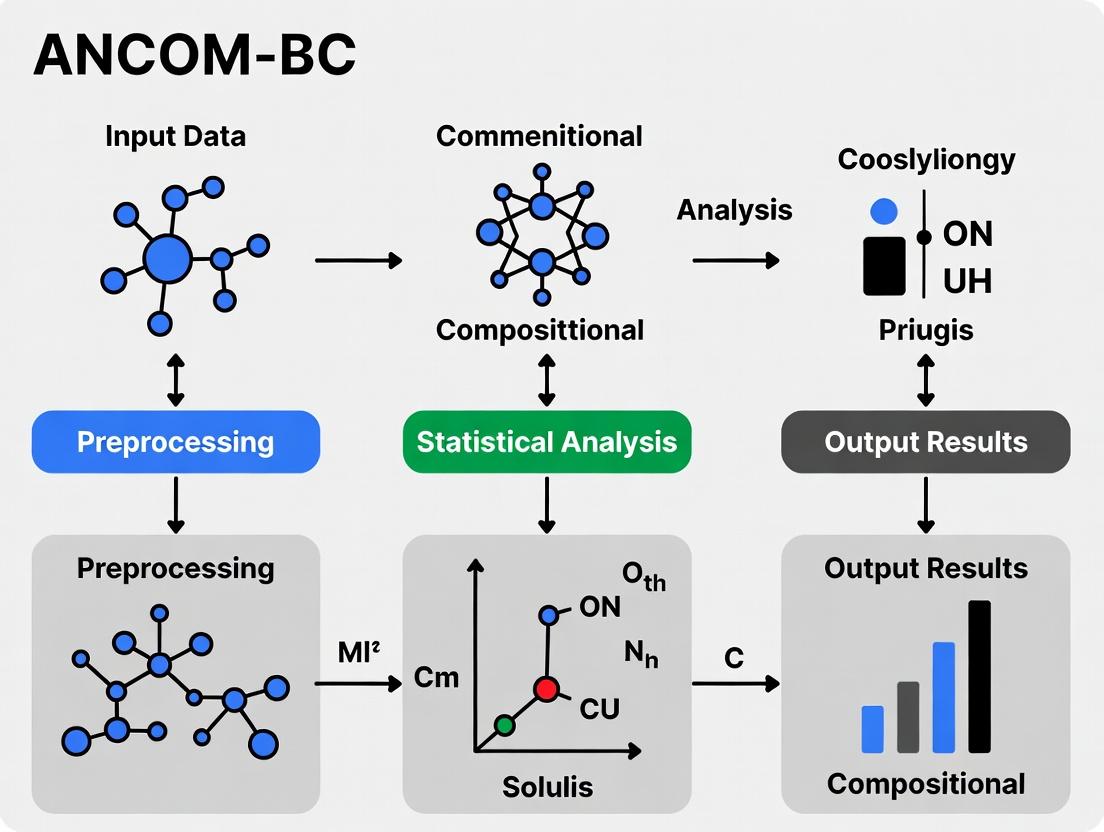
This article provides a complete guide to ANCOM-BC, a robust statistical framework for differential abundance analysis in compositional data, such as microbiome and metabolomics datasets.
ANCOM-BC: A Comprehensive Guide to Differential Abundance Analysis for Microbiome and Metabolomics Data
Abstract
This article provides a complete guide to ANCOM-BC, a robust statistical framework for differential abundance analysis in compositional data, such as microbiome and metabolomics datasets. We first explore the core principles of compositional data analysis (CoDA) and the limitations of traditional methods. We then detail the methodological steps of ANCOM-BC, from data preparation and log-ratio transformation to significance testing and bias correction. Practical guidance is offered for troubleshooting common issues and optimizing performance. Finally, we validate ANCOM-BC by comparing its performance and results against other leading tools like DESeq2, edgeR, and MaAsLin 2. Aimed at biomedical researchers and bioinformaticians, this guide empowers accurate and confident discovery of biologically relevant features in high-throughput sequencing studies.
Why ANCOM-BC? Understanding Compositional Data and the Need for Robust Differential Abundance Testing
Microbiome (16S rRNA gene amplicon or shotgun metagenomic) and metabolomics (e.g., from mass spectrometry) data are intrinsically compositional. This means the data we obtain do not represent absolute abundances but rather relative proportions that sum to a constant (e.g., 1, 100%, or a library size). This property arises because the measurement process involves a finite total count or total signal intensity.
Core Characteristics of Compositional Data:
- Relative Nature: Each value is meaningful only relative to other values in the same sample.
- Constant Sum Constraint: The total reads (in microbiome data) or total peak intensities (in metabolomics) per sample is an artifact of the measurement technique, not a biological truth.
- Spurious Correlations: Changes in the relative abundance of one component can create the illusion of opposing changes in others, even if their absolute abundances are stable.
- Subcompositional Incoherence: Results from a subset of features (e.g., a specific bacterial phylum) can differ from results of the full dataset, violating principles of logical consistency.
This compositional nature is the fundamental challenge that mandates the use of specialized statistical tools like ANCOM-BC (Analysis of Compositions of Microbiomes with Bias Correction) for differential abundance analysis.
Table 1: Key Properties and Artifacts of Compositional Microbiome/Metabolomics Data
| Property | Description | Consequence for Standard Statistical Methods |
|---|---|---|
| Closure | Data are constrained to a constant sum (e.g., 1 million reads/sample). | Violates the assumption of independence in tests like t-test or linear regression. |
| Spurious Correlation | Correlation between ratios of components can appear even when absolute abundances are uncorrelated. | Leads to false positive/negative associations in correlation networks. |
| Subcompositional Incoherence | Analysis of a subset of taxa can yield different results from the full composition. | Results are not reliable or generalizable; findings depend on arbitrary filtering. |
| Zero Inflation | Many features (ASVs, metabolites) have counts/intensities of zero. | Zeros can be structural (true absence) or sampling (below detection), complicating analysis. |
| Overdispersion | Variance exceeds the mean in count-based microbiome data. | Violates assumptions of Poisson-based models, leading to poor fit. |
| Scale Dependency | All measurements are expressed relative to an arbitrary sample total. | Relative abundances mask true changes in absolute abundance. |
Table 2: Comparison of Data Analysis Approaches
| Method | Handles Compositionality? | Key Assumption/Limitation | Typical Use Case |
|---|---|---|---|
| ANCOM-BC | Yes (Explicitly models it) | Log-linear model with sample-specific bias terms. Requires a reference taxon. | Differential abundance testing with bias correction. |
| CLR Transformation | Yes (Ad hoc) | Assumes all features are observed. Fails with true zeros. | Dimensionality reduction, some forms of correlation. |
| DESeq2/edgeR | Partially (Models count data) | Models sequencing depth as an offset. Not fully coherent for compositions. | RNA-seq differential expression; sometimes adapted for metagenomics. |
| Standard t-test/Wilcoxon | No | Assumes independent features. Highly prone to false conclusions. | Not recommended for untransformed relative abundance data. |
| ALDEx2 | Yes (Via CLR on Monte Carlo Dirichlet instances) | Assumes data are Dirichlet distributed. Computationally intensive. | Differential abundance for proportional data. |
Protocol: Implementing ANCOM-BC for Differential Abundance Analysis
This protocol details the steps for performing differential abundance analysis on compositional microbiome data using the ANCOM-BC R package.
Experimental & Computational Workflow
Title: ANCOM-BC Analysis Workflow
Detailed Stepwise Protocol
A. Prerequisite Data Preparation
- Feature Table: A matrix of counts (ASVs, OTUs, KEGG orthologs, metabolite intensities) with features as rows and samples as columns.
- Metadata: A data frame with sample IDs as rows and covariates (e.g., Disease_State, Age, Batch) as columns.
- Software: Install R and the
ANCOMBCpackage from Bioconductor.
B. Step 1: Data Preprocessing (in R)
- Goal: Remove uninformative features to reduce noise and computational load.
- Procedure:
- Prevalence Filtering: Remove features present in fewer than a threshold (e.g., 10%) of samples.
- Prevalence Filtering: Remove features present in fewer than a threshold (e.g., 10%) of samples.
C. Step 2: ANCOM-BC Model Fitting
- Goal: Fit the log-linear model to identify differentially abundant features between groups, correcting for compositionality and sampling fraction bias.
- Procedure:
D. Step 3: Interpretation of Results
- Goal: Extract and visualize differentially abundant features.
- Procedure:
The Scientist's Toolkit: Essential Reagents & Materials
Table 3: Research Reagent Solutions for Compositional Data Generation & Analysis


Item
Function/Description
Key Consideration for Compositionality


DNA Extraction Kit (e.g., DNeasy PowerSoil)
Isolates total genomic DNA from complex samples (stool, soil).
Critical: Efficiency varies per taxa, introducing compositional bias at the first step. Use consistent kits and bead-beating protocols.


16S rRNA Gene PCR Primers (e.g., 515F/806R)
Amplifies hypervariable regions for bacterial/archaeal profiling.
Primer bias alters the apparent relative abundance of taxa. Choice of region (V4 vs V3-V4) affects composition.


High-Throughput Sequencer (Illumina MiSeq)
Generates millions of paired-end reads per sample.
Source of Closure: The total reads per sample (library size) is fixed, creating the compositional constraint. Depth must be sufficient.


Internal Spike-Ins (e.g., Known qPCR Standards)
Exogenous DNA/RNA added at known concentrations before extraction.
Enables estimation of absolute microbial loads, moving beyond pure relative data. Essential for validating compositional findings.


LC-MS/MS System
Separates and detects metabolites based on mass/charge ratio.
Total ion current (TIC) normalization creates compositional data. Use internal standards (SIL IS) for absolute quantitation where possible.


ANCOM-BC R/Bioconductor Package
Statistical software for differential abundance testing.
Explicitly models and corrects for the sampling fraction (bias) inherent in compositional data, addressing the fundamental challenge.


Phyloseq R Package
Data structure and tools for microbiome analysis.
Facilitates organization of OTU table, taxonomy, and metadata into a single object compatible with ANCOM-BC.


QIIME 2 / DADA2 Pipeline
Processes raw sequences into amplicon sequence variants (ASVs).
Denoising and chimera removal affect low-abundance taxa, influencing the final compositional profile.
Application Notes on ANCOM-BC for Compositional Data Analysis
The Core Problem: Spurious Correlation in Relative Data
Analysis of relative abundance data (e.g., microbiome sequencing, metabolomics) without acknowledging compositionality leads to erroneous conclusions. Changes in the abundance of one component can create illusory, inverse changes in others, even when their absolute abundances are stable.
Table 1: Illustrative Example of Compositional Illusion
| Taxon | True Absolute Abundance (Sample A) | True Absolute Abundance (Sample B) | Relative Abundance (Sample A) | Relative Abundance (Sample B) | False Inference from Rel. Data |
|---|---|---|---|---|---|
| Taxon_1 | 1000 | 1000 | 50.0% | 33.3% | Appears to decrease |
| Taxon_2 | 500 | 500 | 25.0% | 16.7% | Appears to decrease |
| Taxon_3 | 500 | 2000 | 25.0% | 50.0% | Appears to increase |
| Total | 2000 | 3500 | 100% | 100% | Bias Induced |
Note: The massive increase in Taxon_3’s absolute abundance causes the relative proportions of Taxa 1 & 2 to decrease, even though their absolute counts are unchanged.
Analysis of Compositions of Microbiomes with Bias Correction (ANCOM-BC) is a statistical methodology that models observed abundances using a linear regression framework with a bias correction term for the sampling fraction. It tests for differential abundance across groups while addressing the compositional nature of the data.
Core Equation: log(observed_abundance) = β0 + β1*(Group) + θ + ε
Where θ is the sample-specific bias correction term (log sampling fraction).
Experimental Protocols
Protocol 1: Preparing Data for ANCOM-BC Analysis
Objective: To transform raw sequence count data into a properly formatted object for ANCOM-BC.
- Input: Amplicon Sequence Variant (ASV) or Operational Taxonomic Unit (OTU) table (samples x features), metadata table.
- Filtering: Remove features with zero counts in >75% of samples (adjustable threshold).
- Pseudo-count Addition: Add a uniform pseudo-count of 1 to all counts to handle zeros for log-transformation.
- Object Creation: In R, use
phyloseqto create aphyloseqobject from count table and metadata. - Verification: Ensure no sample has a total library size of zero.
Protocol 2: Executing ANCOM-BC Differential Abundance Testing
Objective: To identify features differentially abundant between two experimental conditions.
- Software: R environment (version 4.3+).
- Installation:
install.packages("ANCOMBC") - Code Execution:
- Output Extraction: The
out$resobject contains:beta_estimates: Log-fold change coefficients.p_val,q_val: Raw and adjusted p-values.diff_abn: Logical vector indicating differentially abundant features.
Protocol 3: Validating Results and Avoiding False Discoveries
Objective: To confirm ANCOM-BC findings and rule out technical artifacts.
- Positive Control: Spike-in microbes (if used) should be correctly identified as differentially abundant or not.
- Consistency Check: Compare results with a non-compositional method on absolute data (e.g., qPCR) for a subset of key taxa.
- Sensitivity Analysis: Re-run ANCOM-BC with different filtering thresholds (
zero_cutfrom 0.7 to 0.9). Core findings should be robust. - Effect Size Scrutiny: Prioritize features with significant
q_valAND large magnitudebeta_estimatesfor biological interpretation.
Mandatory Visualizations
Title: ANCOM-BC Analysis Workflow
Title: Path from Raw Data to Correct vs. Incorrect Inference
The Scientist's Toolkit: Research Reagent Solutions
Table 2: Essential Tools for Robust Compositional Data Analysis
| Item | Function in Research | Application Notes |
|---|---|---|
| ANCOM-BC R Package | Primary tool for differential abundance testing on relative data. Corrects for compositionality and sampling fraction bias. | Always use the latest version from CRAN/Bioconductor. Enable struc_zero=TRUE to handle structural zeros. |
| Phyloseq R Package | Data organization and preprocessing. Creates the essential object class that integrates counts, taxonomy, and metadata. | The standard entry point for most microbiome analysis pipelines in R. |
| Mock Community (e.g., ZymoBIOMICS) | Positive control containing known, absolute abundances of microbial cells. Validates pipeline and calibrates bias correction. | Spike into samples pre-DNA extraction to assess technical variability and recovery. |
| Internal Spike-Ins (e.g., Synthetic DNA Spikes) | Known quantities of non-biological DNA sequences added post-extraction. Used to estimate sample-specific sampling fractions (θ). | Critical for precise bias correction in ANCOM-BC when absolute quantification is needed. |
| qPCR Assay Kits (16S rRNA gene) | Independent, absolute quantification of total bacterial load or specific taxa. Validates trends identified by ANCOM-BC. | Use to confirm that a relative change corresponds to a true absolute change. |
FDR Control Software (e.g., R p.adjust) |
Corrects for multiple hypothesis testing across thousands of microbial features to minimize false discoveries. | ANCOM-BC integrates this (p_adj_method), but understanding the method (Benjamini-Hochberg) is crucial. |
| Graphical Tools (ggplot2, Graphviz) | Visualizes results (e.g., boxplots of log-ratios) and clarifies analytical workflows for publication and reproducibility. | Clear diagrams prevent misunderstanding of the compositional data analysis process. |
This primer establishes the foundational principles of Compositional Data Analysis (CoDA) essential for understanding and contextualizing the implementation of ANCOM-BC (Analysis of Composition of Microbiomes with Bias Correction) within microbiome and high-throughput sequencing research. ANCOM-BC represents a modern evolution of CoDA principles, directly addressing challenges of differential abundance testing in compositional datasets.
Core CoDA Principles: The Aitchison Foundation
Compositional data are vectors of positive components representing parts of a whole, constrained by a unit sum (e.g., 100%, 1). John Aitchison's seminal work established that such data reside in a constrained sample space (the simplex), invalidating standard Euclidean statistical methods.
Key Aitchison Principles:
- Scale Invariance: Conclusions should not depend on the total sum of the measurements (e.g., sequencing depth).
- Subcompositional Coherence: Insights from a subset of components should be consistent with insights from the full composition.
- Log-ratio Approach: The fundamental operation is the log-transformed ratio between components, moving data to unconstrained real space.
Table 1: Aitchison's Log-Ratio Transformations
| Transformation | Formula | Purpose | Property |
|---|---|---|---|
| Additive Log-Ratio (alr) | ( alr(xi) = \ln(xi / x_D) ) | Uses a reference denominator component (D). | Simple, but not isometric; choice of denominator affects results. |
| Centered Log-Ratio (clr) | ( clr(xi) = \ln(xi / g(x)) ) | Uses geometric mean (g(x)) of all components as divisor. | Symmetric, isometric, but leads to singular covariance matrix. |
| Isometric Log-Ratio (ilr) | ( ilr(x) = \Psi^T \ln(x) ) | Uses orthonormal basis (\Psi) in the simplex. | Isometric, coordinates are orthogonal; complex interpretation. |
Evolution to Modern Tools: ALDEx2
ALDEx2 (ANOVA-Like Differential Expression 2) operationalizes CoDA principles for high-throughput sequencing data. It uses a Bayesian multinomial model to account for sampling variation and converts counts to relative abundances via Monte Carlo sampling from a Dirichlet distribution, followed by clr transformation.
Protocol 1: Standard ALDEx2 Workflow for Differential Abundance Objective: Identify features differentially abundant between two or more groups.
Materials & Reagents:
- Input Data: A counts-per-feature matrix (e.g., OTU, ASV, gene table).
- R Environment: (v4.0+).
- ALDEx2 R Package: (v1.30.0+).
Procedure:
- Installation & Loading:
BiocManager::install("ALDEx2"); library(ALDEx2) - Data Preparation: Ensure the data matrix (
reads) contains only numeric counts. Prepare a condition vector (conds) describing the group for each sample column. - Generate Monte Carlo Instances:
x <- aldex.clr(reads=reads, conds=conds, mc.samples=128, denom="all")- mc.samples: Number of Dirichlet Monte Carlo instances (typically 128-1024).
- denom: Denominator for clr. "all" uses the geometric mean (recommended).
- Perform Statistical Testing:
x_tt <- aldex.ttest(x, paired.test=FALSE)- Calculates expected p-values and Benjamini-Hochberg corrected q-values.
- Calculate Effect Size:
x_effect <- aldex.effect(x, include.sample.summary=FALSE)- Provides the expected Cohen's d and the difference between groups.
- Result Integration: Combine test and effect results:
res <- data.frame(x_tt, x_effect). - Interpretation: Identify features with both a low expected q-value (e.g., < 0.1) and a meaningful effect size magnitude (e.g., |effect| > 1).
Comparative Framework for ANCOM-BC Implementation
ANCOM-BC builds upon the CoDA framework by introducing a linear regression model with bias correction for log-transformed abundances, addressing sample-specific sampling fractions.
Table 2: CoDA Method Comparison: Aitchison, ALDEx2, and ANCOM-BC
| Aspect | Aitchison's Log-Ratios | ALDEx2 | ANCOM-BC |
|---|---|---|---|
| Core Principle | Log-ratio transformations. | Monte Carlo Dirichlet-to-clr, followed by statistical tests. | Linear model on log-counts with bias correction for sampling fraction. |
| Handles Zeros | Requires imputation (e.g., pseudo-count). | Integrated via Dirichlet prior. | Handled through the log-linear model framework. |
| Differential Test | Not directly provided; basis for models. | Wilcoxon rank-sum / t-test on clr values. | Wald test on bias-corrected coefficients. |
| Key Output | Transformed coordinates. | p-values, q-values, effect sizes. | Log-fold changes, standard errors, p-values. |
| Strengths | Foundational, mathematically coherent. | Robust to sampling variability, provides effect size. | Directly estimates log-fold changes, controls FDR. |
| Weaknesses | Interpretational complexity (esp. ilr). | Computationally intensive; effect size can be conservative. | Assumes most features are not differentially abundant. |
Protocol 2: ANCOM-BC Implementation Protocol Objective: Apply ANCOM-BC for differential abundance analysis with bias correction.
Materials & Reagents:
- Input Data: A counts-per-feature matrix and sample metadata.
- R Environment: (v4.0+).
- ANCOMBC R Package: (v2.0.0+).
Procedure:
- Installation:
BiocManager::install("ANCOMBC") - Load Library & Data:
library(ANCOMBC); data(species_counts); data(sample_metadata) - Run Primary Analysis:
- Extract Results:
res <- out$res- Key columns:
lfc_*(log-fold change),se_*(standard error),p_*,q_*.
- Key columns:
- Identify Structural Zeros: Check
out$zero_indfor features deemed absent in a group. - Visualization: Plot log-fold changes with confidence intervals for significant features.
The Scientist's Toolkit: Research Reagent Solutions
Table 3: Essential Reagents & Materials for CoDA-Based Microbiome Analysis
| Item | Function / Relevance |
|---|---|
| High-Fidelity Polymerase (e.g., Q5, KAPA HiFi) | For accurate amplification of target genes (16S rRNA, ITS) prior to sequencing, minimizing compositional bias from PCR. |
| Standardized Mock Microbial Community (e.g., ZymoBIOMICS) | Positive control for evaluating technical variability, batch effects, and validating the accuracy of CoDA pipelines like ALDEx2/ANCOM-BC. |
| DNA Extraction Kit with Bead Beating (e.g., DNeasy PowerSoil) | Ensures standardized and efficient lysis across diverse cell wall types, crucial for obtaining a representative initial composition. |
| Unique Molecular Identifiers (UMIs) | Attached during library prep to correct for PCR amplification bias, improving the quantitative fidelity of initial count data. |
| Spike-in Synthetic Genes (e.g., External RNA Controls Consortium - ERCC) | Added at known concentrations pre-extraction to estimate and correct for technical variation and sampling fractions, relevant for ANCOM-BC's bias correction. |
| Phusion or Platinum Taq Polymerase | Standard polymerases used in library amplification steps. Variability here can introduce compositional noise. |
| Quant-iT PicoGreen dsDNA Assay | For accurate quantification of DNA libraries before sequencing, ensuring balanced loading and reducing lane-to-lane compositional variation. |
Visualization of Methodological Relationships and Workflows
Evolution of CoDA Methods from Principles to Tools
ALDEx2 Core Analytical Workflow
ANCOM-BC Analytical Procedure
Thesis Context: This document forms part of a comprehensive thesis exploring the implementation of Analysis of Compositions of Microbiomes with Bias Correction (ANCOM-BC) for robust differential abundance testing in compositional data, a prevalent challenge in microbiome, metabolomics, and related life sciences research.
Core Philosophy and Key Innovations
ANCOM (Analysis of Compositions of Microbiomes) addressed the compositional nature of relative abundance data by testing for differential abundance based on pairwise log-ratios, controlling the False Discovery Rate (FDR). However, it had limitations: it provided only qualitative results (relative change), could be conservative, and did not directly estimate fold changes.
ANCOM-BC was developed to overcome these limitations. Its core philosophy is to explicitly model and correct for the sample-specific sampling fraction bias while testing for differential abundance. It treats the observed data as a compositionally transformed version of the true, unobserved absolute abundances and uses a linear regression framework to correct the bias introduced during sampling.
Key Innovations of ANCOM-BC over ANCOM:
- Bias Correction: ANCOM-BC directly estimates and corrects for the bias term (log of sampling fraction) in its linear model.
- Quantitative Results: It provides estimated fold changes (on the log-scale) for each feature, along with standard errors and p-values, allowing for quantitative interpretation of differential abundance.
- Structured Hypothesis Testing: It offers a principled statistical framework for testing differential abundance (β=0) while accounting for compositionality.
- Improved FDR Control: While both control FDR, ANCOM-BC's model-based approach can offer more power (sensitivity) to detect true differences compared to ANCOM's conservative log-ratio procedure.
Quantitative Comparison of ANCOM and ANCOM-BC:
Table 1: Core Methodological and Output Comparison
| Aspect | ANCOM | ANCOM-BC |
|---|---|---|
| Core Approach | Non-parametric, uses pairwise log-ratios. | Parametric, linear regression with bias correction. |
| Output | Qualitative (Reject/Not reject differential abundance). | Quantitative (Estimated log-fold change, SE, p-value). |
| Bias Handling | Implicitly through log-ratios. | Explicit estimation and correction of sample-specific bias. |
| Statistical Test | FDR control on proportion of significant log-ratios. | Wald-type test on the bias-corrected coefficient. |
| Interpretation | "Feature X is differentially abundant." | "Feature X has an estimated [fold change] with a p-value of [p]." |
| Sensitivity | Can be conservative, lower power. | Generally higher statistical power. |
Application Notes and Protocols
Protocol 1: Standard Differential Abundance Analysis with ANCOM-BC
Objective: To identify microbial taxa (or other features) that are differentially abundant between two or more study groups from 16S rRNA gene sequencing (or similar) data.
Research Reagent Solutions Toolkit: Table 2: Essential Computational Toolkit
| Item | Function |
|---|---|
| R Statistical Software (v4.0+) | Environment for statistical computing and graphics. |
| ANCOMBC R Package | Implements the core ANCOM-BC algorithm. |
| phyloseq or SummarizedExperiment Object | Data structure containing OTU/ASV table, sample metadata, and taxonomy. |
| ggplot2 R Package | For generating publication-quality visualizations of results. |
| High-Performance Computing (HPC) Cluster | Recommended for large datasets (>1000 features, >100 samples). |
Methodology:
- Data Preprocessing: Load your OTU/ASV table (features × samples), taxonomy table, and sample metadata into a
phyloseqobject. Filter out low-abundance features (e.g., those with less than 10 total reads or present in <10% of samples). - ANCOM-BC Execution: Run the
ancombc2function, specifying the formula (e.g.,~ group), thephyloseqobject, and necessary parameters (p_adj_method = "fdr"). - Results Extraction: Extract the results data frame containing log-fold changes (
lfc), standard errors (se), p-values (p), and adjusted p-values (q). - Interpretation & Visualization: Identify significant features (e.g.,
q < 0.05). Create volcano plots (log-fold change vs. -log10(p-value)) and generate bar plots of effect sizes for top significant taxa.
Experimental Workflow Diagram:
ANCOM-BC Differential Abundance Workflow
Protocol 2: Longitudinal Analysis with ANCOM-BC
Objective: To model time-dependent changes in microbial abundance within subjects, accounting for repeated measures.
Methodology:
- Model Specification: Use the
ancombc2function with a formula that includes the time variable and a subject identifier as a random effect (if supported in the specific implementation), or use a fixed-effects model with subject ID as a covariate for a simpler approach. For example:formula = "~ time + subject_id". - Bias Consideration: Ensure the bias correction term accounts for within-subject correlation structure if possible. The bias is still estimated per sample.
- Trend Analysis: The primary coefficient of interest is for the
timevariable. Extract log-fold changes per unit time. - Visualization: Plot the fitted regression lines for significant features over time for individual subjects or groups.
Longitudinal Model Diagram:
ANCOM-BC Model for Repeated Measures
Key Statistical Model and Signaling Pathway
The ANCOM-BC Linear Model:
The fundamental equation is: E[log(o_ij)] = β_j + θ_i + log(T_i), where the observed log relative abundance is modeled as the sum of the true feature-specific log absolute abundance (βj), a sample-specific bias term (θi), and the log total count. In the regression framework, the bias θ_i is estimated as a fixed effect per sample.
Logical Relationship: From Data to Discovery
Logical Flow of ANCOM-BC's Bias Correction
Within the broader thesis on the implementation of ANCOM-BC for compositional data analysis (CoDA) in microbiome and multi-omics research, a precise understanding of core terminology is foundational. This document serves as an application note, detailing key concepts, protocols, and practical considerations essential for researchers, scientists, and drug development professionals applying these methods to high-throughput sequencing data.
Core Terminology & Quantitative Framework
Differential Abundance (DA) Analysis refers to the statistical process of identifying features (e.g., microbial taxa, genes) whose relative abundances change significantly between experimental conditions, accounting for the compositional nature of the data.
Log-Ratios are the fundamental transformation for CoDA. They convert relative abundances (constrained to a sum) into unconstrained, scale-invariant values suitable for standard statistical tests. The log-ratio between two features is invariant to the sampling depth (library size).
Bias Correction is a critical step, particularly in methods like ANCOM-BC. It addresses the systematic bias introduced by differences in sample sampling fractions (the proportion of the microbial community actually sequenced) that confound true differential abundance estimates.
False Discovery Rate (FDR) is the expected proportion of false positives among all features declared as differentially abundant. Controlling the FDR (e.g., via the Benjamini-Hochberg procedure) is standard in high-dimensional DA testing to manage multiple comparisons.
| Metric/Concept | Formula/Definition | Typical Range/Value | Interpretation in Context |
|---|---|---|---|
| Log-Ratio (LR) | LR(A,B) = log(A / B) |
(-∞, +∞) | A measure of relative abundance. LR > 0 indicates A > B. |
| Fold Change (FC) | FC = 2^(LR) |
(0, +∞) | FC=2 means the feature is twice as abundant. |
| Sampling Fraction | Unobserved; proportion of community sequenced. | Varies per sample | The source of bias requiring correction. |
| Bias Estimate (β) | Estimated by ANCOM-BC algorithm. | ~0 if no bias | Correction term added to log-abundances. |
| W-statistic | Test statistic in ANCOM-BC. | Higher values indicate stronger DA signal. | Used to rank features for significance. |
| q-value (FDR) | Adjusted p-value controlling FDR. | 0 to 1 | q < 0.05: feature is significant at 5% FDR. |
| Effect Size | Bias-corrected log-fold change. | (-∞, +∞) | Magnitude and direction of abundance change. |
Experimental Protocols for DA Analysis Using ANCOM-BC
Protocol 3.1: Pre-processing of 16S rRNA Gene Sequencing Data for ANCOM-BC
Objective: To generate a high-quality count table from raw sequencing reads suitable for ANCOM-BC analysis.
- Demultiplexing & Quality Control: Use
demux(QIIME 2) orcutadaptto separate samples. Assess read quality withFastQC. - Denoising & ASV/OTU Picking: Use DADA2 (
qiime dada2 denoise-paired) for Amplicon Sequence Variant (ASV) generation orqiime vsearch cluster-features-de-novofor Operational Taxonomic Unit (OTU) clustering. - Taxonomic Assignment: Classify sequences using a pre-trained classifier (e.g., Silva, Greengenes) via
qiime feature-classifier classify-sklearn. - Generate Count Table: Export the resulting feature table (BIOM format or TSV) containing sample IDs, feature IDs (ASV/OTU), and raw read counts.
- Filtering: Apply a prevalence filter (e.g., retain features present in >10% of samples) to remove rare noise. Do not normalize the data; ANCOM-BC uses raw counts.
Protocol 3.2: Executing ANCOM-BC in R
Objective: To perform bias-corrected differential abundance testing between two or more groups.
- Installation & Data Load:
Run ANCOM-BC Model:
zero_cut: Prevalence cutoff for zero counts (0.90 = keep features with zeros in <90% of samples).struc_zero: Identifies structural zeros (true absences in a group).neg_lb: Checks for log ratios below detection limit.global: Performs global test for multi-group comparisons.
Interpret Results:
Visualization: Generate volcano plots or boxplots of log-fold changes for significant features.
Visualizations
Diagram 1: ANCOM-BC Analytical Workflow
Diagram 2: Bias Correction Conceptual Framework
The Scientist's Toolkit: Research Reagent Solutions
Table 2: Essential Materials & Software for DA Analysis
| Item | Category | Function/Explanation |
|---|---|---|
| QIIME 2 (2024.5) | Software Pipeline | End-to-end platform for microbiome analysis from raw reads to count tables. |
| R (≥4.3.0) / RStudio | Software Environment | Statistical computing and graphics; primary platform for running ANCOMBC. |
| ANCOMBC R package (≥2.2.0) | R Library | Implements the bias-corrected differential abundance algorithm. |
| phyloseq R package (≥1.46.0) | R Library | Data structure and tools for handling microbiome count data and metadata. |
| Silva 138 or GTDB r214 | Reference Database | Provides taxonomic classification for 16S rRNA sequences. |
| DADA2 R package | R Library | Alternative denoising algorithm for high-resolution ASV inference. |
| Benjamini-Hochberg Procedure | Statistical Method | Standard method for FDR control, integrated into ANCOM-BC output. |
| High-Performance Computing (HPC) Cluster | Infrastructure | Recommended for large dataset pre-processing (denoising, alignment). |
| BIOM Format File | Data Format | Standardized JSON-based format for representing biological sample by observation matrices. |
Step-by-Step Implementation: How to Run ANCOM-BC in R for Your Own Datasets
Application Notes
This protocol is a foundational component of a thesis investigating differential abundance analysis in microbiome and other compositional datasets using ANCOM-BC (Analysis of Composition of Microbiomes with Bias Correction). Proper installation and data preparation are critical for valid, reproducible results. ANCOM-BC addresses the compositional nature of sequencing data and corrects for sample- and taxon-specific biases.
Key Considerations:
- Compositionality: Feature table data (e.g., OTU/ASV, gene counts) are relative, not absolute. ANCOM-BC explicitly models this constraint.
- Bias Correction: The method estimates and corrects for biases introduced by differences in sampling fractions across samples.
- Prerequisites: A correctly formatted feature table and sample metadata are non-negotiable inputs. Errors here propagate through the entire analysis.
Experimental Protocols
Protocol 2.1: Installing the ANCOM-BC R Package
Objective: To install the ANCOM-BC package and its dependencies in the R environment.
Methodology:
- Ensure a current version of R (≥ 4.0.0) is installed.
- Launch R or RStudio.
- Install the package from Bioconductor using the following commands in the R console:
Load the package into your session to verify installation:
Additionally, install and load suggested packages for data manipulation and visualization:
Protocol 2.2: Preparing the Feature Table
Objective: To create a clean, numeric feature-by-sample matrix suitable for ANCOM-BC input.
Methodology:
- Source Data: Begin with output from bioinformatics pipelines (e.g., QIIME2, DADA2, MOTHUR). The table should contain counts (e.g., sequence reads, OTU abundances).
- Formatting: The table must be a
data.frameormatrixwhere:- Rows: Correspond to features (e.g., bacterial taxa, genes).
- Columns: Correspond to individual samples.
- Row Names: Must be set to unique feature identifiers (e.g.,
"OTU_1","Genus_Species").
- Filtering: Apply a prevalence filter to remove spurious features. A common standard is to retain features present in at least 10% of samples.
- Verification: Confirm the object contains only numeric values and sample IDs match the metadata.
Protocol 2.3: Preparing the Sample Metadata
Objective: To create a sample-by-covariate data frame linking samples to experimental groups and variables of interest.
Methodology:
- Structure: The metadata must be a
data.framewhere:- Rows: Correspond to samples.
- Row Names: Must be set to sample IDs that exactly match the column names of the feature table.
- Columns: Correspond to covariates (e.g.,
Treatment,TimePoint,PatientID,Batch).
- Variable Type: Categorical variables (factors) and continuous variables (numeric) must be correctly specified.
- Alignment: Critically ensure the order of samples in the metadata matches the order of columns in the feature table.
Data Presentation
Table 1: Minimum Recommended Data Specifications for ANCOM-BC Input
| Component | Format | Required Characteristics | Example |
|---|---|---|---|
| Feature Table | matrix or data.frame |
Numeric values only; Row names = Feature IDs; Column names = Sample IDs. | otu_table[1:3, 1:3] → S1 S2 S3OTU1 125 0 67OTU2 0 340 89 |
| Sample Metadata | data.frame |
Row names = Sample IDs; Columns contain factors/numeric covariates. | meta[1:3, ] → Treatment BatchS1 Control AS2 Drug B |
| Sample IDs | Character | Must be identical and in the same order in both feature table columns and metadata row names. | all(colnames(otu_table) == rownames(metadata)) returns TRUE |
Visualizations
Workflow for ANCOM-BC Data Preparation
ANCOM-BC Input-Output Relationship
The Scientist's Toolkit
Table 2: Essential Research Reagent Solutions for ANCOM-BC Analysis
| Item | Function/Description | Example/Note |
|---|---|---|
| R Statistical Environment | Open-source platform for statistical computing and graphics. Foundational software. | Version ≥ 4.0.0. Available from CRAN. |
| Bioconductor Project | Repository for bioinformatics R packages, providing rigorous quality control. | Required for installing the ANCOMBC package. |
| ANCOMBC R Package | Implements the core algorithm for differential abundance analysis with bias correction. | Primary tool under investigation in this thesis. |
| Feature Count Matrix | The primary numerical data representing the abundance of each feature in each sample. | Must be free of non-numeric characters and sample IDs as column names. |
| Structured Metadata File | Tabular data describing the experimental design and sample characteristics. | Critical for defining the formula (formula argument) in ancombc2(). |
| Data Wrangling Packages | Packages like tidyverse/dplyr for cleaning, filtering, and transforming input tables. |
Essential for executing Protocol 2.2 and 2.3. |
| Phyloseq Object (Optional) | A powerful container for integrating features, metadata, taxonomy, and phylogeny. | Can be used as direct input to the ancombc2() function. |
This application note details critical preprocessing steps for high-dimensional compositional data (e.g., microbiome 16S rRNA gene sequencing, metabolomics) prior to applying differential abundance analysis methods like ANCOM-BC (Analysis of Compositions of Microbiomes with Bias Correction). ANCOM-BC explicitly accounts for the compositional nature of the data and corrects for bias due to sampling fraction differences. However, its performance and validity are contingent upon appropriate preprocessing to handle zeros and filter low-abundance features. The choice of normalization is distinct; ANCOM-BC internally models sampling fractions and does not require prior normalization like Total Sum Scaling (TSS), making its preprocessing protocol unique.
Table 1: Comparative Overview of Preprocessing Steps for Compositional Data Analysis
| Preprocessing Step | Common Methods | Typical Parameters/Thresholds | Primary Rationale | Consideration for ANCOM-BC |
|---|---|---|---|---|
| Zero Handling | Pseudo-count addition | 0.5, 1, or minimal detectable value | Enable log-transformations, avoid undefined math. | Can bias results; ANCOM-BC has its own zero-handling in log-ratio transforms. Often avoided prior to input. |
| Bayesian Multiplicative Replacement (e.g., cmultRepl) | z.warning parameter (default 0.1) | Model-based imputation preserving compositionality. | More principled than pseudo-counts. Can be applied before ANCOM-BC if zeros are excessive. | |
| Simple removal | N/A | Simplifies analysis. | Leads to loss of data and potential information. Not generally recommended. | |
| Low-Abundance Filtering | Prevalence filtering | Retain features present in >X% of samples (e.g., 10-25%). | Remove spurious OTUs/features from sequencing errors. | Crucial to reduce false discovery rate and computational load. Recommended. |
| Abundance-based filtering | Retain features with mean/median abundance >Y (e.g., 0.001%). | Remove non-informative low-count features. | Often used in conjunction with prevalence filtering. Recommended. | |
| Normalization | Total Sum Scaling (TSS) | Divide counts by total count per sample. | Account for varying sequencing depth. | NOT required or recommended for ANCOM-BC. The method models sampling fractions internally. |
| Cumulative Sum Scaling (CSS) | Scale using cumulative sum up to a data-driven percentile. | More robust to outliers than TSS. | Not needed for ANCOM-BC. | |
| Rarefaction | Random subsampling to even depth. | Statistical comparability. | Controversial; discards data. ANCOM-BC's bias correction is a superior alternative. |
Experimental Protocols
Protocol 3.1: Recommended Preprocessing Workflow for ANCOM-BC Input
Objective: To generate a filtered, zero-aware feature table suitable for differential abundance analysis with ANCOM-BC.
Materials:
- Raw count table (OTU/ASV/Feature table) from bioinformatic pipeline (e.g., QIIME2, mothur).
- Associated sample metadata.
- R statistical environment (v4.0+) with packages:
ANCOMBC,tidyverse,phyloseq.
Procedure:
- Data Import: Load the raw count table and metadata into a
phyloseqobject or equivalent data structure. - Low-Abundance Filtering:
a. Prevalence Filter: Remove features with non-zero counts in less than 10% of total samples (or a condition-specific group if sample size is small).
- Zero Handling: Do not add a pseudo-count. ANCOM-BC will handle zeros during its internal log-ratio calculation using a careful methodology. For excessive zero abundance, consider Bayesian replacement prior to this step using the
zCompositions::cmultReplfunction. - Input to ANCOM-BC: Use the filtered count table directly. Do not normalize.
Protocol 3.2: Benchmarking the Impact of Filtering Stringency
Objective: To empirically determine the effect of prevalence threshold on result stability.
Procedure:
- Define a set of prevalence thresholds (e.g., 5%, 10%, 20%, 30%).
- For each threshold
t: a. Filter the raw dataset, retaining features present in >t% of samples. b. Run ANCOM-BC with identical model parameters (formula,p_adj_method). c. Record the number of significant differentially abundant (DA) features (W-statistic > 0.7, p-adjusted < 0.05). - Plot the number of DA features against the prevalence threshold. The optimal threshold is often at the "elbow" of the curve, balancing feature retention and false discovery control.
- Compare the overlap of DA feature lists across thresholds using Jaccard indices or Venn diagrams to assess stability.
Visualizations
Diagram 1: ANCOM-BC Preprocessing Decision Workflow
Diagram 2: Compositional Data Analysis Pathway Contrast
The Scientist's Toolkit
Table 2: Essential Research Reagent Solutions & Tools
| Item / Software | Function / Purpose | Application in Preprocessing |
|---|---|---|
| QIIME 2 (v2024.5) | End-to-end microbiome analysis platform from raw sequences. | Generates the initial feature count table and phylogenetic tree. DADA2 plugin for denoising is standard. |
R package phyloseq |
R class and tools for handling phylogenetic sequencing data. | Primary container for OTU table, taxonomy, metadata. Enables streamlined filtering and subsetting. |
R package ANCOMBC |
Official implementation of the ANCOM-BC method. | Performs the core differential abundance analysis on the preprocessed count table. |
R package zCompositions |
Methods for imputing zeros in compositional data sets. | Provides cmultRepl() for Bayesian multiplicative replacement of zeros when essential. |
R package tidyverse |
Collection of R packages for data science. | Used for all data manipulation, cleaning, and visualization steps in the preprocessing workflow. |
| FastQC & MultiQC | Quality control tools for high-throughput sequencing data. | Assesses sequence quality prior to feature table generation; informs need for pipeline parameter adjustment. |
| Benchmarking Scripts (Custom) | R/Python scripts to test filtering thresholds. | Empirically determines the impact of preprocessing parameters on final DA results for a given dataset. |
Introduction In the implementation of ANCOM-BC for differential abundance analysis in compositional microbiome data, the precise mathematical specification of the model is critical. The ANCOM-BC procedure corrects bias and estimates unknown sampling fractions by formulating a linear model that can accommodate both fixed and random effects. This document provides detailed protocols for specifying these model components and establishing appropriate reference groups, which is foundational to the broader thesis on robust ANCOM-BC application in pharmaceutical development research.
1. Core Model Specification in ANCOM-BC
The fundamental ANCOM-BC model for the observed abundance O_{ij} of taxon i in sample j is:
E[ln(O_{ij})] = β_i + Σ_{k=1}^{p} θ_{ik} x_{jk} + Σ_{l=1}^{q} γ_{il} z_{jl} + ln(η_{j})
- Fixed Effects (θ{ik}): The primary coefficients of interest, representing the log-fold change in the absolute abundance of taxon *i* per unit change in the covariate *xk* (e.g., treatment group, dose). These are estimated and tested for differential abundance.
- Random Effects (γ{il}): Coefficients for covariates *zl* (e.g., subject ID, batch) that are modeled as coming from a random distribution. This accounts for repeated measures or hierarchical sampling structure.
- Reference Group: Implicitly defined by the parameterization of categorical fixed effects (e.g., treatment group). The intercept β_i represents the baseline log-abundance for the reference group.
- Bias Term (ln(η_{j})): The estimated sample-specific bias correction for the sampling fraction.
2. Protocol for Defining Fixed Effects & Reference Groups
Objective: To correctly parameterize categorical and continuous predictor variables to test specific biological hypotheses.
Materials & Workflow:
Diagram Title: Workflow for Specifying Fixed Effects
Procedure:
- Hypothesis Formulation: State the comparison of interest (e.g., "Drug A alters abundance relative to Placebo").
- Categorical Variable Coding:
- Convert the factor variable (e.g.,
Groupwith levels: Placebo, DrugA, DrugB). - Designate Reference: Set the control group (
Placebo) as the first factor level (factor(Group, levels=c("Placebo","Drug_A","Drug_B"))). - Default Coding: Use treatment contrasts (default in R). The model intercept will represent the
Placebogroup mean.Drug_AandDrug_Bcoefficients will be contrasts vs.Placebo.
- Convert the factor variable (e.g.,
- Continuous Variable Inclusion: Add the variable directly to the formula. Its coefficient represents the change per unit increment.
- Formula Construction in R:
formula <- feature_table ~ Group + Age + (1 | SubjectID)- Here,
GroupandAgeare fixed effects.
3. Protocol for Incorporating Random Effects
Objective: To model cluster-specific or repeated-measures effects, controlling for non-independence.
Materials & Workflow:
Diagram Title: Random Effects Model Specification Flow
Procedure:
- Identify Clustering Factor: Determine the variable defining clusters (e.g.,
SubjectIDfor longitudinal sampling,Batchfor technical replication). - Choose Random Structure:
- Random Intercept: Allows baseline abundance to vary by cluster. Syntax:
(1 | SubjectID). - Random Slope: Allows the effect of a fixed covariate (e.g.,
Time) to vary by cluster. Syntax:(1 + Time | SubjectID).
- Random Intercept: Allows baseline abundance to vary by cluster. Syntax:
- Formula Integration: Incorporate the random effect structure into the ANCOM-BC model call.
- Implementation Example in R:
4. Quantitative Data Summary: Model Formulations & Interpretation
Table 1: Common ANCOM-BC Model Specifications and Output Interpretation
| Research Scenario | Fixed Effect Formula | Random Effect Formula | Key Coefficient to Test | Interpretation | |
|---|---|---|---|---|---|
| Case-Control | ~ Disease_Status |
None |
Disease_StatusCase |
Log-fold change in taxon abundance in Cases vs. Controls (Reference). | |
| Multi-group Treatment | ~ 0 + Treatment_Group |
`(1 | Batch)` | Treatment_GroupDrug_A, Treatment_GroupDrug_B |
Log-fold change relative to the implied baseline (if intercept omitted). Batch variation is modeled. |
| Longitudinal Study | ~ Timepoint + Treatment |
(1 + Timepoint | SubjectID) |
TreatmentActive |
Treatment effect, adjusting for time and accounting for subject-specific temporal trajectories. | |
| Covariate Adjustment | ~ Group + BMI + Antibiotic_Use |
`(1 | Site)` | GroupIntervention |
Group effect, adjusted for continuous BMI and a binary covariate, with site-specific random intercept. |
The Scientist's Toolkit: ANCOM-BC Model Specification Essentials
Table 2: Essential Reagents & Computational Tools for Model Crafting
| Item / Resource | Function / Purpose |
|---|---|
| R Statistical Software | Primary platform for implementing ANCOM-BC and related statistical models. |
ANCOMBC R Package |
Implements the ANCOM-BC2 methodology, supporting both fixed and mixed-effects models. |
phyloseq R Package |
Standard object for organizing microbiome data (OTU table, sample data, taxonomy) for input to ANCOM-BC. |
lme4 R Package |
Underlies the syntax and estimation of linear mixed-effects models within the ANCOM-BC framework. |
| Contrast Coding Guide | Documentation (e.g., ?contr.treatment) to understand and customize the parameterization of factor variables. |
| Sample Metadata Table | Clean, curated spreadsheet linking sample IDs to all relevant fixed and random effect covariates. |
| High-Performance Computing (HPC) Cluster | Resource for computationally intensive runs with large feature counts and complex random effect structures. |
Application Notes
Within the framework of a thesis investigating ANCOM-BC (Analysis of Composition of Microbiomes with Bias Correction) for compositional data, interpreting its core statistical output is paramount. The model corrects for bias from sample dilution and sampling fraction differences, yielding results that require careful biological and statistical contextualization. The following notes detail the interpretation of each output component.
- Log-Fold Change (logFC): The primary measure of differential abundance. A positive logFC indicates the taxon is more abundant in the experimental group relative to the reference group. Due to the compositional nature of the data, these values represent relative changes. A logFC of 1.5 means the taxon's relative abundance is approximately 2.8 times (2^1.5) higher in the experimental group.
- Standard Error (SE): Measures the precision of the logFC estimate. A smaller SE suggests a more reliable estimate. It is used to calculate confidence intervals (e.g., logFC ± 1.96*SE).
- W-statistic: The test statistic for the null hypothesis that the logFC is zero. It is calculated as
W = logFC / SE. Larger absolute values of W provide stronger evidence against the null hypothesis. - p-value: The probability of observing a W-statistic as extreme as, or more extreme than, the one calculated, assuming the null hypothesis is true. A small p-value (< 0.05) suggests the observed differential abundance is unlikely due to chance alone.
- q-value: The false discovery rate (FDR)-adjusted p-value. Corrects for multiple hypothesis testing across all taxa examined. A q-value < 0.05 indicates that an estimated 5% of the taxa called significant will be false positives. This is the primary metric for declaring statistically significant differentially abundant taxa.
Table 1: Summary and Interpretation of ANCOM-BC Core Output Metrics
| Metric | Description | Interpretation in Compositional Context | Key Threshold |
|---|---|---|---|
| logFC | Estimated log2-fold change in abundance. | Direction and magnitude of relative change. Biological significance depends on effect size. | Varies by study (e.g., |logFC| > 1). |
| SE | Standard error of the logFC estimate. | Precision of the estimate. Used for confidence intervals. | Smaller is better. |
| W-statistic | Test statistic (logFC / SE). | Signal-to-noise ratio for the differential abundance test. | |W| > 2 suggests evidence against null. |
| p-value | Unadjusted probability value. | Initial evidence of statistical significance. Unreliable for multiple tests. | Typically < 0.05. |
| q-value | FDR-adjusted p-value. | Primary metric for significance accounting for multiple testing. | < 0.05 (commonly). |
Experimental Protocols
Protocol 1: Standard ANCOM-BC Execution and Output Generation
Objective: To perform differential abundance analysis on microbiome count data using ANCOM-BC and generate the core statistical output table.
Materials: See "The Scientist's Toolkit" below.
Methodology:
- Data Preprocessing: Load the OTU/ASV count table and metadata into R. Filter out low-prevalence taxa (e.g., retain taxa present in at least 10% of samples).
- Model Specification: Execute the
ancombc2()function. Key arguments include:data: The preprocessed phyloseq object or count table.tax_tab: The taxonomy table.sample_data: The metadata/data.frame containing group variables.formula: The linear model formula (e.g.,~ treatment_group).p_adj_method: Method for p-value adjustment (e.g., "BH" for Benjamini-Hochberg FDR).prv_cut,lib_cut: Prevalence and library size cutoffs for filtering.group: The name of the group variable insample_data.struc_zero: Logical, whether to detect structural zeros per group.neg_lb: Logical, whether to classify taxa as outliers using a lower bound.
- Output Extraction: The
ancombc2()function returns a complex list. Extract thereselement, which is a data frame containing columns fortaxon,logFC,SE,W,p_val, andq_valfor each covariate in the model. - Results Compilation: Create a results table sorted by ascending q-value (or descending \|W-statistic\|). Apply a significance filter (e.g., q-value < 0.05) and an effect size filter (e.g., \|logFC\| > 0.5) for downstream interpretation.
Protocol 2: Validation and Sensitivity Analysis for Output Stability
Objective: To assess the robustness of identified differentially abundant taxa to model parameters and data perturbation.
Methodology:
- Parameter Sensitivity: Re-run ANCOM-BC while varying key parameters:
prv_cut: Test values (e.g., 0.05, 0.10, 0.15).p_adj_method: Compare "BH" with "holm".neg_lb: Run withneg_lb = TRUEandFALSE.
- Data Subsampling (Bootstrap): Perform bootstrap resampling (e.g., 100 iterations) of the original data at 90% depth. Run ANCOM-BC on each resampled dataset.
- Stability Metric Calculation: For each taxon, calculate the proportion of bootstrap iterations where it remains significant (q < 0.05). Record the mean and variance of its logFC across iterations.
- Concordance Evaluation: Generate a consensus list of high-confidence differentially abundant taxa defined as those significant in the primary analysis and in >70% of bootstrap iterations with a consistent logFC direction.
Visualizations
ANCOM-BC Analysis Workflow from Data to Interpretation
Logic Flow for Interpreting ANCOM-BC Results
The Scientist's Toolkit
Table 2: Essential Research Reagents & Solutions for ANCOM-BC Implementation
| Item | Function/Description |
|---|---|
| R Statistical Software | Open-source environment for statistical computing. The primary platform for running ANCOM-BC. |
| ANCOMBC R Package | The specific library (ancombc package) that implements the bias-corrected model for differential abundance testing. |
| Phyloseq R Package | A standard package for handling and organizing microbiome data (OTU table, taxonomy, metadata). Often used as input for ANCOM-BC. |
| High-Quality 16S rRNA Gene Amplicon or Shotgun Metagenomic Data | The foundational raw data. Requires processing (DADA2, QIIME2, MOTHUR) into an OTU/ASV count table. |
| Detailed Sample Metadata | Crucial covariates (e.g., treatment group, patient ID, batch, age) that must be included in the model formula to correct for confounding. |
| High-Performance Computing (HPC) Resources | For large datasets or many bootstrap iterations, computational clusters may be necessary to reduce analysis time. |
| FDR Correction Method (e.g., BH) | A statistical method (built into ANCOM-BC) to adjust p-values for multiple comparisons, controlling the false discovery rate. |
This Application Note details the critical visualization step following statistical analysis using ANCOM-BC in compositional data research. The ANCOM-BC (Analysis of Compositions of Microbiomes with Bias Correction) methodology corrects for bias from sampling fractions and provides p-values and confidence intervals for differential abundance testing. Interpreting these statistical results requires effective visual translation into biological insight, primarily achieved through Volcano Plots and Bar Charts.
Key Data Tables from ANCOM-BC Output
Table 1: Exemplar ANCOM-BC Output for Differential Abundance (Top 10 Features)
| Feature ID (e.g., ASV/OTU) | log2 Fold Change (W) | Standard Error | Test Statistic | p-value | q-value (FDR) | Reject Null Hypothesis (TRUE/FALSE) |
|---|---|---|---|---|---|---|
| Bacteroides ASV_12 | 3.45 | 0.67 | 5.15 | 1.2e-06 | 0.0004 | TRUE |
| Prevotella ASV_8 | -2.89 | 0.71 | -4.07 | 4.8e-05 | 0.0072 | TRUE |
| Ruminococcus ASV_3 | 1.23 | 0.89 | 1.38 | 0.167 | 0.342 | FALSE |
| Faecalibacterium ASV_1 | 2.15 | 0.54 | 3.98 | 6.9e-05 | 0.0081 | TRUE |
| Akkermansia ASV_5 | 4.12 | 0.92 | 4.48 | 7.5e-06 | 0.0015 | TRUE |
| Clostridium ASV_20 | -1.05 | 0.62 | -1.69 | 0.091 | 0.215 | FALSE |
| Bifidobacterium ASV_9 | 0.87 | 0.48 | 1.81 | 0.070 | 0.185 | FALSE |
| Roseburia ASV_14 | -3.56 | 0.75 | -4.75 | 2.0e-06 | 0.0005 | TRUE |
| Escherichia ASV_7 | -0.45 | 0.51 | -0.88 | 0.379 | 0.532 | FALSE |
| Lachnospira ASV_18 | 2.87 | 0.69 | 4.16 | 3.2e-05 | 0.0058 | TRUE |
Table 2: Threshold Definitions for Visualization
| Parameter | Typical Value | Purpose in Visualization |
|---|---|---|
| log2 FC Threshold | |1.5| | Minimum absolute fold change for biological significance in Volcano Plot. |
| p-value Threshold | 0.05 | Threshold for statistical significance (unadjusted). |
| q-value (FDR) Threshold | 0.1 | Threshold for significance after False Discovery Rate correction. More common for ANCOM-BC. |
| Top N Features | 20 | Number of most significant features to display in a Bar Chart. |
Experimental Protocols
Protocol 3.1: Generating an ANCOM-BC Volcano Plot in R
Purpose: To visually identify features that are both statistically significant and biologically relevant in their differential abundance.
Materials: R environment (v4.0+), ANCOMBC R package, ggplot2, dplyr, readr.
Procedure:
- Load Data and Libraries:
Extract and Prepare Results:
Create Volcano Plot:
Protocol 3.2: Creating a Top-N Differential Abundance Bar Chart
Purpose: To clearly display the magnitude and direction of change for the most significant features.
Procedure:
- Prepare Sorted Data:
- Create Horizontal Bar Chart:
Visual Diagrams
Diagram 1: From Raw Data to Biological Insight Workflow
Diagram 2: Volcano Plot Quadrant Interpretation
The Scientist's Toolkit: Research Reagent Solutions
Table 3: Essential Materials for Differential Abundance Visualization Workflow
| Item | Vendor Examples | Function in Workflow |
|---|---|---|
| R Statistical Environment | R Project (CRAN) | Primary platform for running ANCOM-BC and generating plots. |
| ANCOMBC R Package | Bioconductor | Implements the bias-corrected differential abundance testing algorithm. |
| ggplot2 R Package | CRAN | Provides a flexible, layered grammar of graphics for creating publication-quality plots. |
| Integrated Development Environment (IDE) | RStudio, Posit | Provides a user-friendly interface for writing, debugging, and executing R code. |
| High-Resolution Display | Standard hardware | Essential for clearly visualizing complex plots with many data points. |
| Color Palette Accessibility Checker | Color Oracle, WebAIM | Tool to simulate color vision deficiencies, ensuring plots are interpretable by all audiences. |
| Vector Graphics Export Software | Inkscape, Adobe Illustrator | Used for final polishing and formatting of plots for publication (e.g., adjusting labels, combining figures). |
Solving Common ANCOM-BC Problems: From Convergence Warnings to Result Interpretation
Application Notes and Protocols
Within a thesis investigating the implementation of ANCOM-BC (Analysis of Composition of Microbiomes with Bias Correction) for robust differential abundance testing in compositional data, a critical practical hurdle is the management of convergence issues and model fit warnings. These problems are prevalent in complex designs involving repeated measures, longitudinal sampling, multi-factorial treatments, or highly sparse data—common in microbiome, metabolomics, and proteomics research. This document provides protocols for diagnosing and resolving these computational challenges to ensure reliable statistical inference.
Table 1: Common Warnings, Diagnostics, and Initial Actions in ANCOM-BC
| Warning / Issue | Likely Cause | Diagnostic Check | Immediate Remedial Action |
|---|---|---|---|
| Iteration limit maxit reached | Slow convergence due to high dimensionality, zero inflation, or complex random effects. | Check res$df_adj for NA values; Examine res$res_adj for unstable estimates. |
Increase max_iter (e.g., from 100 to 200); Apply more aggressive neg_lb setting. |
| Model fit warning (NA p-values) | Singularity or perfect separation, often from sparse taxa or over-specified model. | Inspect taxa-wise log-fold changes for extreme values (±Inf). | Increase lib_cut to filter low-count samples; Group rare taxa into an "Other" category. |
| 'glm.fit: algorithm did not converge' | Quasi-complete separation in fixed effects or ill-conditioned covariance matrix. | Review design matrix for collinearity (e.g., time*group interaction). | Simplify the model formula; Apply pseudo_priors or add a minimal pseudo-count. |
| Large bias estimates | Severe sample- or group-specific sampling fractions. | Plot res$samp_frac against covariates. |
Verify struc_zero identification; Consider group-wise bias correction. |
Protocol 1: Diagnosing and Resolving Convergence Failures
1. Pre-processing Stabilization
- Input: Raw feature table (OTU/ASV, metabolite counts), metadata.
- Procedure:
- Aggregation: Sum features present in < 10% of samples at a low relative abundance (e.g., < 0.01%) into a composite "Other" feature.
- Prevalence Filtering: Apply a
lib_cutof 1000 (for read counts) andprev_cutof 0.1 to retain features with non-zero values in at least 10% of samples. - Pseudo-count: If warnings persist, add a uniform pseudo-count of 1 min (where min is the smallest non-zero count in the dataset) to all features.
- ANCOM-BC Call:
2. Iterative Control Optimization
- Procedure:
- Run an initial model with
verbose = TRUE. - If "maxit" warning occurs, extract the current parameter estimates from the
resobject. - Incrementally increase
max_iterby 50 until convergence is achieved, monitoring the log-likelihood trace. - If estimates oscillate, increase the tolerance
tolto 1e-4.
- Run an initial model with
- Code for Extended Iteration:
Protocol 2: Addressing Model Fit Warnings and Singularities
1. Structural Zero Diagnostics
- Rationale: True absence taxa can cause separation. Misidentification inflates warnings.
- Procedure:
- Run
ancombc2withstruc_zero = TRUE. - Export the structural zero matrix (
res_zero$zero_ind). - Cross-tabulate zero patterns against experimental groups. If a taxon is absent in an entire group, it is a valid structural zero. If zeros are scattered, consider it a data sparsity issue and apply Protocol 1.
- Run
2. Model Simplification Workflow
- Procedure:
- Start with a maximal model including all covariates and interactions of interest.
- Upon warning, remove the highest-order interaction term.
- Re-run and check for warnings. Proceed sequentially to simpler models if necessary.
- For longitudinal designs, compare random intercept vs. random slope models. The simpler model often resolves singularity.
- Simplified Model Example:
Diagrams
Title: ANCOM-BC Warning Diagnosis & Resolution Workflow
Title: ANCOM-BC Algorithm Stages & Failure Points
The Scientist's Toolkit: Key Research Reagent Solutions
| Item / Solution | Function in Mitigating Convergence Issues |
|---|---|
| High-Performance Computing (HPC) Cluster | Enables running multiple model iterations with high max_iter and complex rand_formula without hardware limits. |
R/Bioconductor (ANCOMBC v2.4+) |
Provides the core software with essential iter_control, pseudo_priors, and struc_zero parameters for troubleshooting. |
phyloseq Object (R) |
Standardized container for feature table, taxonomy, and sample data, ensuring correct alignment during pre-processing steps. |
| Aggregated "Other" Feature | A synthetic taxon created by summing very low-prevalence features, reduces sparsity and computational instability. |
| Structured Zero Matrix | Output from struc_zero=TRUE; critical diagnostic to distinguish true biological zeros from sampling artifacts. |
| Pseudo-count Algorithm | A minimal, uniform value added to all counts to stabilize log-ratios and avoid undefined operations on zeros. |
Iteration Control Parameters (max_iter, tol) |
Directly adjustable settings in ancombc2 to allow the Newton-Raphson/IRLS algorithm more time to find a solution. |
| Model Simplification Scripts | Pre-written R code to systematically test reduced model formulas (e.g., dropping interactions) to eliminate singularities. |
In the broader thesis implementing ANCOM-BC (Analysis of Compositions of Microbiomes with Bias Correction) for compositional data analysis, robust preprocessing is critical. The prv_cut (prevalence cutoff) and lib_cut (library size cutoff) parameters are essential for filtering the feature table before differential abundance testing. Their optimal adjustment directly influences the statistical power, false discovery rate, and biological validity of the results, forming a foundational step in the analytical workflow.
Table 1: Core Parameter Definitions and Defaults in ANCOM-BC
| Parameter | Definition | Typical Default | Impact on Data |
|---|---|---|---|
lib_cut |
Minimum library size (read count) for a sample to be retained. | 0 | Removes low-sequencing-depth samples. |
prv_cut |
Minimum prevalence (proportion of samples) for a feature to be retained. | 0.10 (10%) | Removes rare, sparsely observed features. |
Table 2: Effect of Parameter Adjustment on Output (Simulated Data Example)
| Parameter Setting | Initial Features | Retained Features | Samples Removed | Key Consequence |
|---|---|---|---|---|
Defaults (lib_cut=0, prv_cut=0.1) |
10,000 | ~6,500 | 0 | Moderate noise reduction. |
Stringent (lib_cut=1000, prv_cut=0.25) |
10,000 | ~3,200 | 12 (of 100) | High confidence features, potential loss of signal. |
Lenient (lib_cut=0, prv_cut=0.05) |
10,000 | ~8,100 | 0 | Increased sensitivity, higher multiple-testing burden. |
Experimental Protocols for Parameter Optimization
Protocol 3.1: Systematic Grid Search for Parameter Determination
Objective: To empirically determine optimal prv_cut and lib_cut values for a specific dataset.
Materials: Feature table (OTU/ASV table), sample metadata, R environment with ANCOMBC package installed.
Procedure:
- Load Data: Import the feature table into R. Ensure samples are rows and features are columns.
- Define Grid: Create vectors of candidate values (e.g.,
lib_cut = c(0, 500, 1000, 5000);prv_cut = c(0.05, 0.1, 0.2, 0.3)). - Iterate and Apply: Write a loop to apply
ancombc2(data, lib_cut = i, prv_cut = j, ...)for each parameter combination. - Record Metrics: For each run, record:
- Number of retained features and samples.
- Number of differentially abundant (DA) features identified from a positive control group (if available).
- Mean/median variance of the bias correction terms estimated by ANCOM-BC.
- Analyze Trade-offs: Plot retained features vs. DA features. Select parameters that balance data rigor with biological plausibility.
Protocol 3.2: Prevalence-Abundance Curve Analysis
Objective: To visually inform the setting of prv_cut based on feature distribution.
Procedure:
- Calculate the prevalence (percentage of samples present) and mean non-zero abundance for each feature.
- Generate a scatter plot: Mean Abundance (log10) on the y-axis vs. Prevalence on the x-axis.
- Visually identify the "elbow" or inflection point where many features show very low prevalence and low abundance. This region typically represents technical noise.
- Set
prv_cutjust above this inflection point to filter mass noise while retaining potentially important low-abundance signals.
Visualization of the Parameter Optimization Workflow
Title: Parameter Tuning Workflow for ANCOM-BC Preprocessing
The Scientist's Toolkit: Research Reagent Solutions
Table 3: Essential Materials for ANCOM-BC Parameter Optimization Studies
| Item | Function in Protocol | Example/Specification |
|---|---|---|
| High-Quality 16S rRNA or Shotgun Metagenomic Dataset | The foundational input data for testing parameter effects. | Illumina MiSeq paired-end reads, >50k reads/sample recommended. |
| R Statistical Software | Platform for running ANCOM-BC and associated analysis. | Version 4.2.0 or higher. |
| ANCOMBC R Package | Implements the core differential abundance and bias correction algorithm. | Version 2.0.0 or higher from Bioconductor. |
| Tidyverse R Packages (dplyr, ggplot2) | For efficient data manipulation and visualization of results. | CRAN versions. |
| Positive Control Sample Spike-Ins (e.g., ZymoBIOMICS) | Validates sensitivity; known abundance microbes help gauge signal loss from filtering. | ZymoBIOMICS Microbial Community Standard. |
| High-Performance Computing (HPC) Cluster or Cloud Instance | Facilitates rapid iteration over parameter grids for large datasets. | AWS EC2 instance, Google Cloud, or local SLURM cluster. |
The implementation of Analysis of Compositions of Microbiomes with Bias Correction (ANCOM-BC) for differential abundance testing in compositional data (e.g., microbiome 16S rRNA sequencing, metabolomics) is critically challenged by sparse data matrices containing excessive zeros. These zeros, which may be biological absences or technical artifacts (below detection limit), violate key assumptions of many statistical models. This application note details protocols and strategies to diagnose, handle, and complement the analysis of sparse compositional data within a robust ANCOM-BC research workflow.
Table 1: Prevalence and Impact of Zero-Inflation in Common Compositional Datasets
| Data Type | Typical % Zeros (Range) | Primary Source of Zeros | Impact on ANCOM-BC Assumptions |
|---|---|---|---|
| 16S rRNA Amplicon (Gut) | 70-85% | Low abundance, sequencing depth | Bias in log-ratio variance, false positive/negatives |
| Metagenomic Shotgun (Soil) | 60-80% | High diversity, extraction bias | Over-dispersion, sample size inflation |
| Host Metabolomics (Plasma) | 40-60% | Detection limit, biological absence | Skewed reference selection, convergence failure |
| Single-Cell RNA-seq | 80-95% | Dropout, low mRNA capture | Severe compositionality distortion |
Diagnostic and Preprocessing Protocol
Protocol 3.1: Diagnosing Zero Structure and Sparsity Objective: Distinguish between technical (false) and biological (true) zeros to inform handling strategy.
- Data Input: Load your count or relative abundance table (samples x features).
- Zero Proportion Calculation: Compute per-feature and per-sample zero prevalence.
- Zero Pattern Visualization: Use heatmaps ordinated by sample metadata to identify batch or group-specific missingness.
- Correlation with Depth: For sequencing data, regress feature zero frequency against library size. A significant negative correlation suggests technical zeros.
- Output Decision: If zeros correlate with low sequencing depth/concentration, treat as technical. If zeros are abundant across all depths and associated with specific biological conditions, treat as potentially biological.
Table 2: Key Research Reagent Solutions for Sparse Data Analysis
| Item | Function/Description | Example/Note |
|---|---|---|
| ANCOM-BC R Package | Primary tool for differential abundance testing with bias correction for compositional data. | Handles zeros via pseudo-count addition or pre-imputation. |
| zCompositions R Package | Specialized tools for imputing zeros in compositional data (e.g., count-zero multiplicative, Bayesian-multiplicative). | Essential for technical zero replacement prior to ANCOM-BC. |
| ggplot2 & ComplexHeatmap | Visualization of sparsity patterns and post-analysis results. | Critical for diagnostic steps and presenting findings. |
| phyloseq / microbiome R Packages | Data object containers and standard preprocessing pipelines for microbiome data. | Streamlines import, filtering, and merging with metadata. |
| MBImpute | Model-based imputation method designed specifically for microbiome sparse data. | Alternative to simple multiplicative replacement. |
Strategic Handling Workflow and Complementary Tools
Title: Strategic Workflow for Handling Zeros Prior to ANCOM-BC Analysis
Detailed Experimental Protocols
Protocol 5.1: Count Zero Multiplicative (CZM) Implementation for ANCOM-BC Prep Purpose: Replace technical zeros with sensible non-zero probabilities to enable logarithmic transformations.
- Install and Load Package:
install.packages("zCompositions"); library(zCompositions). - Subset Data: Remove any features present in less than 5% of samples (adjustable threshold) to reduce noise.
- Define Detection Limit: For sequencing data, use 1/(minimum library size) or a known technical threshold from qPCR/spike-ins.
- Execute CZM Imputation:
imputed_table <- cmultRepl(otu_table, method="CZM", label=0, dl=detection_limit). - Output Check: Confirm no zeros remain. The output is a closed composition (sums to 1). Re-normalize if needed for downstream use.
- Proceed to ANCOM-BC: Use
ancombc(phyloseq_obj, formula = "~ group", p_adj_method = "fdr", zero_cut = 0.90)settingzero_cuthigh as zeros are already handled.
Protocol 5.2: Complementary Zero-Inflated Gaussian (ZIG) Model Validation Purpose: Use a complementary, distribution-specific model to validate ANCOM-BC findings on sparse features.
- Data Formatting: Use the unimputed, raw count data normalized to proportions (or CSS normalized).
- MetaPhlAn2/Mixture Model Alternative: If using shotgun data, consider the
fitFeatureModelin themetagenomeSeqpackage which employs a ZIG model. - Feature-wise Fitting: For a target feature identified by ANCOM-BC, fit a separate ZIG model using
glmmTMBR package:glmmTMB(count ~ group + (1\|batch), ziformula=~group, family=nbinom2, data=feature_df). - Compare Significance: Compare the p-value for the group coefficient in the conditional (count) model against the ANCOM-BC W-statistic/FDR. Concordance increases confidence.
- Interpret Divergence: If results diverge, investigate feature's zero distribution across groups; ANCOM-BC may be more robust to specific zero structures.
Pathway of Methodological Decision Logic
Title: Decision Logic for Handling a Single Sparse Feature
Integrated Analysis Workflow Combining ANCOM-BC and Complementary Tools
Table 3: Protocol for Integrated Sparse Data Analysis
| Step | Primary Tool/Action | Purpose | Key Parameters & Considerations |
|---|---|---|---|
| 1. Pre-filtering | phyloseq::filter_taxa |
Remove ultra-sparse features to stabilize variance. | prune_taxa(function(x) sum(x > 0) > (0.05 * length(x)), phyobj) keeps features in >5% samples. |
| 2. Imputation | zCompositions::cmultRepl |
Replace technical zeros. | Method="CZM", output="p-counts". Use dl from external calibration if available. |
| 3. Core Analysis | ANCOMBC::ancombc |
Primary differential abundance testing. | Set zero_cut=0.90, lib_cut=1000, group variable. Store W-statistics and FDR. |
| 4. Complementary Validation | glmmTMB or metagenomeSeq |
Validate key sparse hits with zero-inflated models. | Fit ZINB or ZIG model on raw counts for top 10 significant sparse features. |
| 5. Sensitivity Analysis | Re-run ANCOM-BC with varying zero_cut & imputation methods. |
Assess robustness of results to handling choices. | Document changes in significance of key findings. |
| 6. Visualization | ggplot2, pheatmap |
Present final robust differentials and sparsity context. | Plot log-fold changes from ANCOM-BC, annotate with zero prevalence per group. |
Choosing the Right Reference Taxa and the Impact on Log-Fold Change Estimates
Within the implementation of ANCOM-BC for compositional data analysis, the selection of a reference taxon (or a set of taxa) is a critical step. Compositional data, such as microbiome sequencing counts, carry only relative information. ANCOM-BC (Analysis of Compositions of Microbiomes with Bias Correction) addresses this by estimating and correcting for unknown sampling fractions, but its estimates of absolute log-fold changes (logFC) are still relative to a chosen reference. This application note details the impact of this choice and provides protocols for systematic evaluation.
Core Concepts and Data Presentation
The Impact of Reference Selection
The estimated logFC for a taxon in a differential abundance analysis is defined as the change relative to the reference. Choosing a taxon with genuine large shifts in absolute abundance can distort the estimated effects for all other taxa.
Table 1: Simulated Impact of Reference Taxon Choice on Log-Fold Change Estimates
| True Absolute Abundance Change | Reference Taxon A (Stable) | Reference Taxon B (True +2.0 logFC) |
|---|---|---|
| Taxon X (True +1.0 logFC) | Estimated: +1.0 (Accurate) | Estimated: -1.0 (Bias: -2.0) |
| Taxon Y (True -0.5 logFC) | Estimated: -0.5 (Accurate) | Estimated: -2.5 (Bias: -2.0) |
| Taxon Z (True 0.0 logFC) | Estimated: 0.0 (Accurate) | Estimated: -2.0 (Bias: -2.0) |
Note: All estimates are relative to the chosen reference. Bias is introduced when the reference itself changes.
ANCOM-BC Reference Options
ANCOM-BC offers flexibility in reference specification, each with distinct outputs.
Table 2: ANCOM-BC Reference Specification Methods and Outcomes
| Method | reference Argument |
Description | Impact on logFC Output |
|---|---|---|---|
| Default | Not specified | Uses an internally estimated "virtual" reference based on all taxa. | logFC represents change relative to this stable geometric mean. |
| Single Taxon | Taxon name (e.g., "g__Bacteroides") | All comparisons are made relative to this specific taxon. | logFC is the difference between the taxon's change and the reference's change. |
| Expert Set | Vector of taxon names | Uses the geometric mean of the specified set as the reference. | logFC is relative to the aggregate behavior of the expert set. |
Experimental Protocols
Protocol: Evaluating Reference Taxon Stability
Objective: To identify taxa most suitable for use as a stable reference in ANCOM-BC analysis.
Materials: Normalized microbiome abundance table (e.g., from 16S rRNA gene sequencing), associated sample metadata.
Software: R with ANCOMBC, tidyverse, phyloseq packages.
Procedure:
- Data Preparation: Load abundance data into a
phyloseqobject or a matrix. Ensure data are rarefied or transformed (e.g., centered log-ratio) appropriately for preliminary analysis. - Preliminary ANCOM-BC Run: Execute ANCOM-BC using the default virtual reference (
reference = NULL). Retain the estimated sample-specific bias terms (samp_frac) and the bias-corrected abundances. - Calculate Taxon-wise Variation: On the bias-corrected abundances (log-scale), calculate the variance or coefficient of variation for each taxon across all samples within the control group.
- Identify Low-Variance Taxa: Rank taxa by their within-group variability. Select candidate reference taxa that demonstrate the lowest variation, suggesting stable absolute abundance.
- Validate with Precedent: Cross-reference low-variance taxa with literature to confirm they are typically stable in the studied biological context (e.g., Faecalibacterium prausnitzii in gut homeostasis).
- Iterative Analysis: Re-run ANCOM-BC specifying the top candidate taxon as the reference (
reference = "candidate_taxon"). Compare the resulting differential abundance list and effect sizes to the default run to assess robustness.
Protocol: Sensitivity Analysis for Reference Choice
Objective: To quantify the impact of different reference selections on study conclusions. Procedure:
- From the stability analysis (Protocol 3.1), define three reference scenarios: a) Default virtual reference, b) Most stable single taxon, c) A taxon suspected of being differentially abundant.
- Run ANCOM-BC three times, altering only the
referenceparameter for scenarios b and c. - Create Impact Table: For a subset of key taxa, compile a table of the
logFC, standard error, and p-value from each of the three model outputs. - Define a Concordance Metric: Calculate the correlation coefficient (e.g., Pearson's r) between the
logFCvectors from model (a) and model (b). A high correlation (>0.95) indicates robustness to the choice of a biologically stable reference. - Report Inferences: Note how many taxa cross the significance threshold (e.g., p < 0.05) in all three scenarios versus only in scenario (c). This highlights findings sensitive to reference misspecification.
Visualization of Workflows and Relationships
Diagram 1: Reference Choice Impact on LogFC
Diagram 2: ANCOM-BC Reference Evaluation Protocol
The Scientist's Toolkit
Table 3: Essential Research Reagent Solutions for Reference Evaluation Studies
| Item | Function in Protocol |
|---|---|
R Package ANCOMBC |
Core software for performing bias-corrected differential abundance analysis and specifying reference taxa. |
R Package phyloseq / MicrobiomeStat |
Standardized data structures and tools for handling, subsetting, and pre-processing microbiome abundance data. |
| Stable Control Samples | Biological or synthetic microbiome samples (e.g., mock communities) used to empirically assess taxon variance and technical noise. |
| Literature-Derived Taxon List | A pre-compiled list of taxa known to be ecologically stable in the studied habitat (e.g., gut, soil), used for cross-validation. |
| High-Performance Computing (HPC) Access | Computational resource for running multiple iterative ANCOM-BC models as part of sensitivity analyses on large datasets. |
Best Practices for Large Datasets and High-Dimensional Meta-Analyses
This document provides application notes and protocols for the robust analysis of large, high-dimensional datasets, particularly within meta-analyses of microbiome and other compositional data. The guidance is framed within a broader thesis on implementing ANCOM-BC (Analysis of Composition of Microbiomes with Bias Correction), a state-of-the-art method for differential abundance testing that addresses compositional bias and false discovery rates in high-throughput sequencing data.
Foundational Best Practices: Data Handling and Pre-Processing
Data Curation and Quality Control
Effective meta-analysis begins with rigorous data curation. For compositional data (e.g., 16S rRNA gene sequencing, shotgun metagenomics), this involves:
- Uniform Processing: Re-processing raw sequence reads (if available) through a standardized pipeline (e.g., DADA2, QIIME 2, MOTHUR) to minimize batch effects from bioinformatic choices.
- Contaminant Removal: Application of tools like
decontam(R package) to identify and remove contaminant sequences based on prevalence in negative controls. - Metadata Harmonization: Standardizing clinical and experimental metadata using ontologies (e.g., NCBI BioSample attributes) to ensure comparability across studies.
Table 1: Key Quality Control Metrics and Thresholds for Amplicon Data
| Metric | Target/Threshold | Tool/Implementation |
|---|---|---|
| Read Depth | > 10,000 reads/sample after QC; evaluate rarefaction curves. | phyloseq::rarefy_even_depth() (use cautiously), ggplot2 |
| Chimeric Sequence % | < 5% | DADA2, VSEARCH within QIIME 2 |
| Negative Control Prevalence | Identify & remove ASVs/OTUs with higher abundance in controls. | decontam::isContaminant() (prevalence method) |
| Sample-wise PCR Amplification Efficiency | Check within-sample correlation of technical replicates. | vegan::mantel() |
Addressing Compositionality and Sparsity
Microbiome data is inherently compositional (relative abundance sums to a constant), violating assumptions of standard statistical tests.
- Normalization: Avoid total-sum scaling. Use alternatives:
- ANCOM-BC Internal Normalization: Uses a log-linear model to estimate sample-specific sampling fractions (bias) and corrects for them.
- CSS (Cumulative Sum Scaling): Implemented in
metagenomeSeq. - TMM (Trimmed Mean of M-values): Borrowed from RNA-seq, usable in some contexts.
- Sparsity Handling: Many taxa have zero counts (structural or sampling zeros).
- Zero Inflation Models: Methods like ANCOM-BC account for this in its log-linear model.
- Pre-Filtering: Remove taxa with near-zero variance (e.g., prevalence < 10% across samples) to reduce multiple testing burden.
Diagram 1: Core Workflow for Compositional Meta-Analysis
Experimental Protocol: Implementing an ANCOM-BC Meta-Analysis
Protocol Title:Cross-Study Differential Abundance Analysis Using ANCOM-BC
Objective: To identify taxa consistently differentially abundant across multiple independent microbiome datasets, while correcting for compositionality bias and study-specific confounding.
Materials & Software:
- Computing Environment: R (≥ v4.0.0).
- Primary R Packages:
ANCOMBC,phyloseq,tidyverse,ggplot2. - Input Data: Multiple
phyloseqobjects or individual feature count tables and metadata files from each study, all taxonomically aligned to the same database (e.g., SILVA, GTDB).
Procedure:
Data Aggregation & Harmonization:
- Load count tables and metadata from each study.
- Merge taxonomy tables, resolving nomenclature discrepancies.
- Create a
MultiAssayExperimentobject or a combinedphyloseqobject with astudy_idvariable in the sample metadata. Do not blindly merge count data before assessing batch effects.
Exploratory Data Analysis (EDA):
- Perform Principal Coordinates Analysis (PCoA) on Bray-Curtis distances, colored by
study_idand primary condition of interest. - Goal: Visualize the magnitude of study-specific batch effects versus biological signal.
- Perform Principal Coordinates Analysis (PCoA) on Bray-Curtis distances, colored by
ANCOM-BC Analysis with Random Effects:
Use the
ancombc2()function, which supports random effects to model within-study correlation.Extract results:
res <- out$res
Result Synthesis & Visualization:
- Create a forest plot of log-fold changes for top significant taxa across studies.
- Generate a heatmap of normalized relative abundances (bias-corrected) for the significant taxa, annotated by study and condition.
Troubleshooting: If the model fails to converge, increase iterations or simplify the random effects structure (e.g., (1 | study/patient) if nested).
The Scientist's Toolkit: Research Reagent Solutions
Table 2: Essential Tools for High-Dimensional Compositional Meta-Analysis
| Item/Category | Function & Rationale |
|---|---|
| ANCOM-BC R Package | Primary tool for differential abundance testing. Corrects for sample-specific bias (sampling fraction) and controls FDR, addressing core limitations of compositional data. |
| QIIME 2 or DADA2 Pipelines | Standardized, reproducible processing of raw amplicon sequences into Amplicon Sequence Variant (ASV) tables, minimizing bioinformatic batch effects. |
| SILVA / GTDB Reference Database | Curated, high-quality taxonomic databases for consistent classification of 16S rRNA sequences across studies. |
phyloseq (R/Bioconductor) |
Data structure and toolbox for handling, subsetting, and visualizing phylogenetic sequencing data. Essential for organizing multi-study data. |
MetaPhlAn / HUMAnN |
For shotgun metagenomic meta-analyses, provides standardized profiling of taxonomic and functional pathway abundances. |
mixOmics (R/Bioconductor) |
Provides sparse multiblock methods (e.g., DIABLO) for integrative analysis of multiple omics datasets from the same study cohort. |
Diagram 2: Core Problems and Analytical Solutions
Advanced Considerations: Multi-Omics and Longitudinal Data
For integrative meta-analyses:
- Multi-Block Analysis: Use methods like Projection to Latent Structures (PLS) or its discriminant analysis variant to find correlated signals between, for example, microbiome and metabolome datasets across studies.
- Longitudinal Meta-Analysis: When combining time-series data, employ ANCOM-BC with mixed-effects models where
(time | study/subject)is specified as a random effect to account for repeated measures.
Table 3: Summary of Key Statistical Adjustments
| Challenge | Consequence if Ignored | Recommended ANCOM-BC Parameter / Approach | |
|---|---|---|---|
| Variable Sequencing Depth | Bias in differential abundance detection. | Internally corrected via sample_est (sampling fraction). |
|
| Cross-Study Batch Effects | False positives due to technical variation. | Include `rand_formula = "(1 | study)"`. |
| Multiple Hypothesis Testing | Inflated Type I error rate. | Built-in FDR control (p_adj_method = "fdr"). |
|
| Structural Zeros | Taxa truly absent in a group. | Identify with struc_zero = TRUE. |
|
| Confounding Covariates | Spurious associations. | Include in fix_formula (e.g., age + BMI). |
Implementing best practices for large-scale, high-dimensional meta-analyses of compositional data requires a deliberate, methodical approach centered on methods like ANCOM-BC that are specifically designed for the task. By rigorously harmonizing data, accounting for study effects as random variables, and correctly interpreting bias-corrected outputs, researchers can derive robust, biologically meaningful conclusions that transcend individual study limitations. This protocol provides a reproducible framework for such analyses within the broader context of advancing compositional data science.
ANCOM-BC vs. The Field: Benchmarking Performance Against DESeq2, edgeR, and MaAsLin 2
This document provides detailed application notes and protocols for contrasting compositional and count-based model assumptions, framed within a broader thesis investigating the implementation of ANCOM-BC (Analysis of Compositions of Microbiomes with Bias Correction) for compositional data analysis. ANCOM-BC addresses the challenge of differential abundance analysis in high-throughput sequencing data, which inherently generates compositional data due to constraints like library size. A core theoretical distinction lies in whether data should be treated as relative (compositional) or absolute (count-based), which fundamentally influences experimental design, statistical modeling, and interpretation.
Core Theoretical Assumptions: Comparative Analysis
Table 1: Foundational Assumptions of Compositional vs. Count-Based Models
| Assumption Category | Compositional Data Models (e.g., ANCOM, ANCOM-BC, ALDEx2) | Count-Based Models (e.g., DESeq2, edgeR, MAST) |
|---|---|---|
| Data Nature | Data are relative. Only the proportions/ratios between components carry information. | Data are absolute counts. The magnitude of each count is meaningful. |
| Scale Invariance | Core Principle: Analysis is invariant to scaling (e.g., multiplying all components by a constant). The total sum (library size) is an arbitrary constraint. | Not Assumed: Scale matters. A count of 1000 is interpreted as twice as abundant as a count of 500, all else equal. |
| Underlying Geometry | Aitchison geometry on the simplex sample space. Uses log-ratios (e.g., clr, ilr) as valid coordinates. | Euclidean geometry on real space. Operates on (transformed) raw or normalized counts. |
| Dependency Structure | Components are intrinsically dependent; an increase in one proportion necessitates a decrease in others. | Components are assumed to be independent prior to normalization, or dependencies are modeled separately. |
| Handling of Zeros | A significant challenge. Zeros can be essential (structural) or non-essential (sampling). Requires careful treatment (e.g., pseudo-counts, Bayesian-multiplicative replacement). | Often handled with pseudo-counts or modeled as part of a discrete distribution (e.g., Negative Binomial, Zero-Inflated models). |
| Variance Structure | Variance is focused on relative variances (log-ratio variances). | Variance is modeled per feature (e.g., mean-variance trend in DESeq2/edgeR). |
| Primary Goal in DA | Identify differentially abundant features in terms of relative change, independent of the arbitrary sequencing depth. | Identify differentially abundant features in terms of absolute change in expected counts. |
Experimental Protocols for Methodological Comparison
Protocol 1: Benchmarking Differential Abundance (DA) Performance
Objective: To empirically evaluate the false discovery rate (FDR) control and power of compositional (ANCOM-BC) versus count-based (DESeq2) methods under different data-generating models.
Materials: High-performance computing cluster, R statistical software (v4.3+), ANCOMBC R package, DESeq2 R package, phyloseq R package, simulated or spiked-in microbiome datasets (e.g., from SPsimSeq or microbiomeDASim packages).
Procedure:
- Data Simulation: a. Generate two distinct synthetic datasets using a controlled simulation framework: i. Compositional Truth: Simulate data where the total count per sample is a random variable (library size effect), and the biological signal is purely in the log-ratios of taxa abundances. Use a Dirichlet-multinomial or logistic-normal model. ii. Count-Based Truth: Simulate data from a Negative Binomial model where the mean counts for differentially abundant features change absolutely, and library size is a technical factor to be corrected. b. For each dataset, designate 10% of features as truly differentially abundant with a known log-fold change. c. Generate 100 replicate datasets for each model.
Differential Abundance Analysis: a. ANCOM-BC Workflow: i. Load data into a
phyloseqobject. ii. Executeancombc2()function, specifying the experimental group as the formula. iii. Extract results, including log-fold changes, p-values, and adjusted q-values. b. DESeq2 Workflow: i. Create aDESeqDataSetfrom the count matrix and metadata. ii. RunDESeq()using the standard median-of-ratios normalization and Negative Binomial Wald test. iii. Extract results usingresults()function.Performance Assessment: a. For each method and simulation scenario, calculate: i. False Discovery Rate (FDR): Proportion of identified DA features that are false positives. ii. True Positive Rate (Power): Proportion of truly DA features correctly identified. iii. Precision-Recall AUC. b. Summarize metrics across all 100 replicates in a comparative table.
Table 2: Example Benchmark Results (Hypothetical Data)
| Simulation Truth | Method | Average FDR | Average Power | Precision-Recall AUC |
|---|---|---|---|---|
| Compositional | ANCOM-BC | 0.048 | 0.89 | 0.91 |
| Compositional | DESeq2 | 0.112 | 0.85 | 0.79 |
| Count-Based | ANCOM-BC | 0.065 | 0.92 | 0.88 |
| Count-Based | DESeq2 | 0.051 | 0.94 | 0.93 |
Protocol 2: Assessing Sensitivity to Library Size Variation
Objective: To determine how robust ANCOM-BC and DESeq2 inferences are to extreme variation in sequencing depth.
Procedure:
- Start with a real or simulated baseline dataset (e.g., from a 16S rRNA study).
- Artificially subsample the count data for one experimental group to 10% of its original library size, mimicking a technical batch effect.
- Apply both ANCOM-BC and DESeq2 to the perturbed dataset.
- Compare the list of significant DA features and their estimated effect sizes to those obtained from the unperturbed (balanced) baseline.
- Quantify the correlation of log-fold changes and the Jaccard similarity index of significant feature lists between the perturbed and baseline analyses.
Visualizing Logical Relationships and Workflows
Title: Decision Workflow for Choosing a Data Analysis Paradigm
Title: Core Algorithmic Workflows: ANCOM-BC vs DESeq2
The Scientist's Toolkit: Research Reagent Solutions
Table 3: Essential Materials for Comparative Differential Abundance Studies
| Item / Solution | Function / Purpose | Example / Specification |
|---|---|---|
| Benchmarked R Packages | Provides the statistical algorithms for DA testing under different assumptions. | ANCOMBC (v2.2+), DESeq2 (v1.42+), edgeR (v4.0+), ALDEx2 (v1.38+). |
| Data Simulation Package | Generates synthetic datasets with ground truth for method validation and power analysis. | SPsimSeq (v1.14+), microbiomeDASim (v1.8+), HMP (v1.9+). |
| Data Object Manager | Standardized R object for handling phylogenetic sequencing data and metadata. | phyloseq R package (v1.46+). |
| Synthetic Mock Communities | Physical controls with known, absolute abundances of strains to validate methods against empirical truth. | ZymoBIOMICS Microbial Community Standards (D6300-D6306). |
| High-Performance Compute (HPC) Access | Enables large-scale simulation studies and analysis of large datasets (e.g., meta-analyses). | Linux cluster with SLURM scheduler, ≥ 32GB RAM/core. |
| Interactive Analysis Environment | Facilitates exploratory data analysis, visualization, and reproducible reporting. | RStudio Server Pro or JupyterLab with R kernel. |
| Version Control System | Tracks all changes to analysis code, ensuring reproducibility and collaboration. | Git, with remote repository (GitHub, GitLab, Bitbucket). |
Within the broader thesis investigating the implementation and validation of ANCOM-BC for compositional data analysis in microbiome research, rigorous benchmarking is paramount. This document provides detailed application notes and protocols for evaluating differential abundance (DA) methods, including ANCOM-BC, using controlled mock and simulated microbial community data. The focus is on assessing critical performance metrics: Sensitivity (True Positive Rate), Specificity (True Negative Rate), and False Discovery Rate (FDR) control.
Key Performance Metrics & Quantitative Benchmarks
Table 1: Core Performance Metrics for DA Method Evaluation
| Metric | Formula | Interpretation | Target Value |
|---|---|---|---|
| Sensitivity/Recall/TPR | TP / (TP + FN) | Proportion of true differentially abundant (DA) features correctly identified. | High (Close to 1) |
| Specificity/TNR | TN / (TN + FP) | Proportion of true non-DA features correctly identified as null. | High (Close to 1) |
| False Discovery Rate (FDR) | FP / (FP + TP) or E[FP/(FP+TP)] | Expected proportion of false positives among all features called DA. | ≤ Nominal level (e.g., 0.05) |
| Precision | TP / (TP + FP) | Proportion of identified DA features that are truly DA. | High (Close to 1) |
| F1-Score | 2 * (Precision * Recall) / (Precision + Recall) | Harmonic mean of precision and recall. | High (Close to 1) |
Table 2: Example Benchmark Results from Recent Studies (Synthetic Data)
| DA Tool | Average Sensitivity | Average Specificity | FDR Control (at α=0.05) | Notes (Simulation Setting) |
|---|---|---|---|---|
| ANCOM-BC | 0.72 | 0.95 | Adequate (~0.06) | High sparsity, large effect sizes |
| DESeq2 | 0.85 | 0.88 | Inflated (~0.15) | Low library size, compositional effect present |
| edgeR | 0.83 | 0.90 | Inflated (~0.12) | Low library size, compositional effect present |
| ALDEx2 | 0.65 | 0.98 | Conservative (<0.05) | Moderate sample size, log-ratio based |
| LinDA | 0.78 | 0.93 | Good (~0.05) | Designed for compositional data |
Note: Example values are illustrative composites from recent literature. Actual performance is highly dependent on simulation parameters (e.g., effect size, sample size, community sparsity, baseline dispersion).
Experimental Protocols
Protocol: Benchmarking withIn SilicoSimulated Communities
This protocol outlines steps to generate and analyze synthetic microbiome count data for benchmarking.
A. Simulation of Ground Truth Data
- Choose a Simulation Framework: Select a robust tool such as
SPsimSeq(R package),SparseDOSSA2, ormicrobiomeDASim. - Parameterize Baseline Community:
- Define the number of taxa (e.g., 200).
- Set the total sequencing depth per sample (e.g., median 50,000 reads, with possible variation).
- Define the prevalence and mean abundance parameters for each taxon, often fit from a real dataset (e.g., from the Global Patterns dataset).
- Set overdispersion parameters for biological variability.
- Introduce Differential Abundance:
- Randomly select a specified percentage of taxa as truly DA (e.g., 10%).
- For each DA taxon, assign a log-fold change (LFC) (e.g., drawn from a uniform distribution between 1.5 and 3 for positive DA).
- Apply the LFC to the abundance parameters in the designated "case" group.
- Generate Count Matrices: Use the simulation tool to produce a count matrix (
features x samples) for both control and case groups (e.g., n=10 per group). - Replicate: Repeat the simulation process 50-100 times to obtain robust performance estimates across different random seeds.
B. Analysis and Metric Calculation
- Apply DA Methods: Run ANCOM-BC and comparator methods (DESeq2, edgeR, etc.) on each simulated dataset using a common significance threshold (e.g., adjusted p-value < 0.05, W-statistic cutoff for ANCOM-BC).
- Map Results to Ground Truth: For each method and simulation, classify outcomes:
- True Positive (TP): DA taxon correctly identified.
- False Positive (FP): Non-DA taxon incorrectly called DA.
- True Negative (TN): Non-DA taxon correctly rejected.
- False Negative (FN): DA taxon missed.
- Aggregate Metrics: Calculate Sensitivity, Specificity, FDR, and Precision for each method across all simulation replicates. Report means and confidence intervals.
Protocol: Benchmarking with Physical Mock Community Experiments
This protocol uses commercially available, defined genomic mixtures.
A. Experimental Design
- Acquire Mock Communities: Obtain standards such as the ZymoBIOMICS Microbial Community Standards (e.g., D6300 for even, D6305 for log-abundance distributions). These provide a known, stable composition of bacterial and fungal strains.
- Create Differential Conditions:
- Dilution Series: Create mixtures where specific member(s) are serially diluted (2-fold, 5-fold, 10-fold) relative to the background community. This provides known true positives.
- Spike-in Controls: Spike a known quantity of an exogenous organism (e.g., Salmonella bongori) into a subset of replicates to simulate a rare DA event.
- Sample Processing: Extract genomic DNA, perform 16S rRNA gene (or shotgun) sequencing across multiple lanes/runs to assess technical variability.
B. Bioinformatic & Statistical Analysis
- Processing: Process raw sequences through a standardized pipeline (e.g., DADA2 for 16S, Kraken2/Bracken for shotgun) to generate a count table.
- Define Ground Truth: The expected composition (from manufacturer's data) and the designed dilution/spike-in factors constitute the ground truth for DA.
- Apply DA Methods: Test for differential abundance between the altered (diluted/spiked) samples and the baseline mock samples.
- Evaluate Performance: Assess the method's ability to:
- Detect Diluted Taxa (Sensitivity): Identify the known diluted taxa as DA.
- Maintain Specificity: Correctly not call non-diluted taxa as DA.
- Estimate Effect Size Accuracy: Compare the estimated LFC from ANCOM-BC to the known log dilution factor.
Visualizations
Title: Benchmarking Workflow for DA Methods
Title: FDR Control Logic & Error Types
The Scientist's Toolkit
Table 3: Essential Research Reagent Solutions & Materials for Benchmarking
| Item | Function in Benchmarking | Example/Supplier |
|---|---|---|
| Defined Microbial Community Standards | Provides physical ground truth with known, stable composition for wet-lab validation. | ZymoBIOMICS D6300 (Even), D6305 (Log); ATCC MSA-1003 |
| Synthetic Sequence Data Generator | Software to create in silico count data with user-defined DA for large-scale statistical benchmarking. | SPsimSeq (R), SparseDOSSA2 (R/Python), microbiomeDASim (R) |
| High-Fidelity Polymerase & Master Mix | Ensures accurate and unbiased amplification during library prep for mock community sequencing. | KAPA HiFi HotStart ReadyMix, Q5 High-Fidelity DNA Polymerase |
| Standardized DNA Extraction Kit | Provides consistent and efficient lysis of diverse cell types in mock communities, minimizing bias. | DNeasy PowerSoil Pro Kit (Qiagen), ZymoBIOMICS DNA Miniprep Kit |
| Bioinformatic Standard Reference Databases | Essential for accurate taxonomic profiling of mock and simulated data. | SILVA, Greengenes (16S); GTDB, RefSeq (Shotgun) |
| Statistical Computing Environment | Platform for implementing DA methods, running simulations, and calculating performance metrics. | R (v4.3+), Python (v3.10+) with relevant packages (ANCOMBC, DESeq2, scikit-bio) |
| High-Performance Computing (HPC) Cluster Access | Enables the large number of simulation replicates and analyses required for robust benchmarking. | Local institutional cluster or cloud computing services (AWS, GCP) |
Application Notes
This analysis applies a multi-tool bioinformatics workflow to a public 16S rRNA gene sequencing dataset from Inflammatory Bowel Disease (IBD) studies, framed within research on implementing ANCOM-BC for compositional data. The primary dataset used is the "IBD Multi'omics Database" (IBDMDB) from the Human Microbiome Project, specifically the PRJNA400072 (16S data from the iHMP-IBD study).
Key Quantitative Findings from Multi-Tool Analysis
Table 1: Differential Abundance Results for IBD vs. Healthy Controls (Subset of Genera)
| Genus | ANCOM-BC W-statistic | ANCOM-BC adj. p-value | DESeq2 log2FoldChange | LEfSe LDA Score (log10) | Meta-Analysis Agreement |
|---|---|---|---|---|---|
| Faecalibacterium | -8.21 | 1.2e-08 | -3.45 | 4.8 | 3/3 tools |
| Escherichia/Shigella | 7.85 | 3.5e-08 | 2.98 | 4.5 | 3/3 tools |
| Bacteroides | 1.32 | 0.18 | 0.87 | 3.2 | 0/3 tools |
| Roseburia | -5.44 | 1.1e-04 | -2.12 | 4.1 | 3/3 tools |
| Fusobacterium | 6.92 | 2.3e-07 | 2.67 | 4.3 | 3/3 tools |
Table 2: Alpha Diversity Metrics (Shannon Index) by Disease Phenotype
| Cohort Group | Sample Size (n) | Mean Shannon Index (±SD) | Kruskal-Wallis p-value |
|---|---|---|---|
| Healthy Control | 58 | 5.12 (±0.45) | Ref. |
| Crohn's Disease (CD) | 92 | 4.21 (±0.78) | 2.4e-09 |
| Ulcerative Colitis (UC) | 74 | 4.55 (±0.62) | 1.8e-05 |
| IBD-Unclassified | 21 | 4.33 (±0.71) | 6.7e-06 |
Table 3: Core Protocol Parameters for 16S rRNA Analysis Pipeline
| Step | Tool / Package | Version | Critical Parameter | Setting in This Study |
|---|---|---|---|---|
| Sequence Processing | DADA2 | 1.26.0 | trimLeft (forward/reverse) |
17/21 |
truncLen (forward/reverse) |
240/160 | |||
| Taxonomy Assignment | SILVA | 138.1 | minBoot confidence |
80 |
| Phylogenetic Tree | phangorn | 2.11.1 | Model for pml |
GTR+G+I |
| Compositional Correction | ANCOM-BC | 2.1.2 | neg_lb (zero handling) |
TRUE |
lib_cut (library size cutoff) |
1000 | |||
| Differential Abundance | DESeq2 | 1.40.2 | fitType |
Local |
| LEfSe | 1.1.2 | LDA threshold | 3.5 | |
| Visualization | ggplot2 | 3.4.4 | NA | NA |
Experimental Protocols
Protocol 1: End-to-End 16S rRNA Amplicon Analysis with ANCOM-BC Integration
Objective: To process raw 16S rRNA sequences, generate an Amplicon Sequence Variant (ASV) table, perform taxonomic assignment, conduct compositional differential abundance analysis with ANCOM-BC, and compare results against standard tools.
Materials:
- Raw paired-end FASTQ files (e.g., from iHMP-IBD).
- High-performance computing cluster or workstation (≥16 GB RAM, multi-core CPU).
- R (version ≥4.2) with necessary packages.
- SILVA 138.1 reference database.
Procedure:
- Quality Control & ASV Inference (DADA2):
- Load FASTQ files into R using
readFastq(). - Plot quality profiles with
plotQualityProfile()to determine trim parameters. - Filter and trim:
filterAndTrim(truncLen=c(240,160), trimLeft=c(17,21), maxN=0, maxEE=c(2,5), truncQ=2). - Learn error rates:
learnErrors(..., nbases=1e8, multithread=TRUE). - Dereplicate:
derepFastq(). - Infer ASVs:
dada(..., pool="pseudo"). - Merge paired reads:
mergePairs(minOverlap=12). - Construct sequence table:
makeSequenceTable(). - Remove chimeras:
removeBimeraDenovo(method="consensus").
- Load FASTQ files into R using
Taxonomy Assignment & Phylogeny:
- Assign taxonomy:
assignTaxonomy(seqtab, refFasta="silva_nr99_v138.1_train_set.fa.gz"). - Add species:
addSpecies(..., refFasta="silva_species_assignment_v138.1.fa.gz"). - Align sequences with
DECIPHER::AlignSeqs(). - Build phylogenetic tree with
phangorn::pml()andoptim.pml().
- Assign taxonomy:
Phyloseq Object Creation & Pre-processing:
- Create
phyloseqobject:phyloseq(otu_table(), tax_table(), sample_data(), phy_tree()). - Filter low-abundance features:
prune_taxa(taxa_sums(physeq) > 5, physeq). - Rarefy (for non-compositional metrics only):
rarefy_even_depth(..., rngseed=123). - Aggregate at genus level:
tax_glom(..., NArm=FALSE).
- Create
Compositional Differential Abundance with ANCOM-BC:
- Install/load ANCOMBC:
library(ANCOMBC). - Run primary analysis:
ancombc2(data=physeq, tax_level="Genus", fix_formula="diagnosis + age", rand_formula=NULL, p_adj_method="fdr", lib_cut=1000, neg_lb=TRUE). - Extract results:
res <- out$res. - Interpret: Significant taxa have
diff_abn = TRUEand lowqvalues.
- Install/load ANCOMBC:
Comparative Analysis with Other Tools:
- DESeq2: Convert to
DESeqDataSetwithphyloseq_to_deseq2(). RunDESeq(test="Wald", fitType="local"). Extract results withresults(..., contrast=c("diagnosis", "CD", "healthy")). - LEfSe: Export genus-level table and metadata in appropriate format. Run on Galaxy server or command line with
format_input.pyandrun_lefse.py. LDA threshold set to 3.5.
- DESeq2: Convert to
Integration & Visualization:
- Create consensus list of differentially abundant taxa.
- Generate heatmaps using
pheatmap(). - Plot effect sizes (W-statistics from ANCOM-BC) vs. log2FoldChange (DESeq2) in a scatter plot.
Protocol 2: Validation of Compositional Effects via a Spike-in Simulation
Objective: To empirically demonstrate the necessity of compositionally aware methods like ANCOM-BC using a defined spike-in experiment on a subset of samples.
Materials:
- DNA extracts from 10 selected IBD samples.
- Genomic DNA from Pseudomonas aeruginosa (ATCC 10145) as a non-native spike-in.
- Qubit Fluorometer, KAPA Library Quantification Kit.
Procedure:
- Spike-in Addition:
- Quantify DNA from each sample extract.
- Add a known, varying mass (0.1%, 1%, 5%) of P. aeruginosa DNA to different aliquots of each sample.
- Re-quantify pooled DNA.
Re-sequencing & Analysis:
- Re-amplify the 16S V4 region for all spiked samples and controls.
- Sequence on a MiSeq (2x250 bp).
- Process through the DADA2 pipeline (Protocol 1, Steps 1-3).
Data Analysis for Compositionality Assessment:
- Apply ANCOM-BC, DESeq2, and simple Wilcoxon test to detect the spiked-in Pseudomonas.
- Compare the observed log-fold change of the spike-in to its known added proportion.
- ANCOM-BC should correctly estimate the absolute change, while other methods will show relative changes confounded by compositionality.
Diagrams
Title: Multi-Tool 16S Analysis Workflow for IBD
Title: The Compositional Data Problem in Microbiome Analysis
The Scientist's Toolkit: Research Reagent Solutions
Table 4: Essential Reagents and Materials for 16S rRNA Microbiome Study
| Item / Reagent | Function / Purpose in Protocol |
|---|---|
| QIAamp PowerFecal Pro DNA Kit (QIAGEN 51804) | Robust microbial cell lysis and inhibitor removal for optimal DNA extraction from stool samples, critical for IBD samples with high inflammatory content. |
| KAPA HiFi HotStart ReadyMix (Roche KK2602) | High-fidelity PCR amplification of the 16S V4 region with low error rates, essential for accurate ASV inference in DADA2. |
| MiSeq Reagent Kit v3 (600-cycle) (Illumina MS-102-3003) | Standardized reagent cartridges for 2x300 bp paired-end sequencing, providing the read length and quality required for the V4 region. |
| SILVA SSU Ref NR 138.1 Database (https://www.arb-silva.de/) | Curated reference database for precise taxonomic assignment of 16S rRNA sequences. |
| ZymoBIOMICS Microbial Community Standard (Zymo D6300) | Defined mock community with known composition, used to validate the entire wet-lab and bioinformatics pipeline for accuracy and bias detection. |
| PhiX Control v3 (Illumina FC-110-3001) | Internal sequencing control for run quality monitoring, base calling calibration, and error rate estimation. |
| Mag-Bind TotalPure NGS Beads (Omega M1378-01) | Magnetic beads for post-PCR clean-up and library normalization, ensuring even representation and removal of primer dimers. |
| Qubit dsDNA HS Assay Kit (Thermo Fisher Q32851) | Fluorometric quantification of DNA libraries with high specificity for double-stranded DNA, crucial for accurate pooling and loading on the sequencer. |
| RStudio with Conda Environment (yml configuration file) | Reproducible computational environment specifying exact versions of R, Bioconductor, and CRAN packages (DADA2, phyloseq, ANCOMBC, DESeq2) for seamless analysis replication. |
Application Notes and Protocols
1. Introduction: Divergence in Compositional Data Analysis Within the framework of a thesis on ANCOM-BC (Analysis of Composition of Microbiomes with Bias Correction) implementation, a common challenge is reconciling its results with those from other differential abundance (DA) testing tools (e.g., DESeq2, edgeR, ALDEx2, LEfSe). Divergent results arise from differing underlying statistical assumptions about microbial count data. These notes provide protocols to systematically investigate and interpret such discrepancies.
2. Core Quantitative Comparison Framework When DA tools disagree, a structured comparison of outputs is essential. The following metrics should be tabulated.
Table 1: Summary of Divergent Results from Two Hypothetical DA Tools
| Feature (ASV/OTU) | ANCOM-BC Log2FC | ANCOM-BC W-statistic (Adj. p-value) | Tool B (e.g., DESeq2) Log2FoldChange | Tool B Adj. p-value | Concordance Status |
|---|---|---|---|---|---|
| Bacteroides A | 3.2 | 12.5 (0.001) | 2.9 | 0.003 | Concordant |
| Prevotella B | -1.8 | 8.1 (0.02) | -0.9 | 0.15 | Discordant |
| Firmicutes C | 0.5 | 2.3 (0.45) | 2.1 | 0.01 | Discordant |
| Proteobacteria D | 4.5 | 15.2 (<0.001) | 4.6 | <0.001 | Concordant |
Table 2: Tool Assumptions & Data Properties Impacting Results
| Tool | Assumes Compositionality? | Handles Zeros Via | Normalization Method | Key Assumption Violation Leading to Divergence |
|---|---|---|---|---|
| ANCOM-BC | Yes (Core Focus) | Additive Log-Ratio (ALR) | Bias Correction term | Low sample size, extreme dispersion. |
| DESeq2 | No (Model Raw Counts) | Geometric Mean (Implicit) | Median of Ratios | Compositional bias in high-depth samples. |
| ALDEx2 | Yes (Uses CLR) | Prior: Monte Carlo Dirichlet | Centered Log-Ratio (CLR) | Small effect sizes with high within-group variance. |
3. Experimental Protocol: Reconciliation Workflow Follow this step-by-step protocol to diagnose and reconcile divergent DA findings.
Protocol 1: Diagnostic Assessment of Data and Parameters
- Data Preparation: Ensure identical input data (count matrix, metadata) is used for all tools. Use a standardized pre-processing pipeline (minimum read count, prevalence filtering).
- Parameter Synchronization: Document all non-default parameters. Key parameters to check:
- ANCOM-BC:
p_adj_method,zero_cut(zero handling),lib_cut(library size cutoff). - DESeq2:
fitType,betaPrior,independentFiltering. - ALDEx2:
denom(choice of denominator for CLR),mc.samples.
- ANCOM-BC:
- Run All Tools: Execute ANCOM-BC and comparator tool(s) on the identical filtered dataset. Record full outputs.
Protocol 2: Investigative Analysis for Discordant Features
- Identify Discordance: Generate a Venn diagram or list of significant features (adj. p < 0.05) from each tool. Isolate features called significant by only one tool (discordant hits).
- Visualize Feature Properties: For each discordant feature, plot:
- Abundance Distribution: Boxplots of CLR-transformed abundances per group.
- Prevalence: Calculate % of samples where the feature is non-zero in each group.
- Mean-Abundance-Dispersion Relationship: Plot feature-wise dispersion vs. mean abundance; note location of discordant features.
- Check for Confounders: Correlate the abundance of discordant features with potential technical confounders (batch, sequencing depth) or clinical covariates not in the model.
Protocol 3: Validation via Complementary Techniques
- Sensitivity Analysis: Re-run analyses with slightly altered parameters (e.g., stricter prevalence filter) to assess robustness of discordant signals.
- Alternative Compositional Method: Apply a third, methodologically distinct compositional tool (e.g., a Bayesian multinomial model like
boral) as an arbitrator. - Correlation Network Analysis: Examine whether discordant features are central nodes in a microbial co-occurrence network, suggesting ecological importance not captured by univariate DA.
4. Visualizing the Reconciliation Workflow
Title: Workflow for Reconciling Divergent DA Results
5. The Scientist's Toolkit: Research Reagent Solutions
Table 3: Essential Toolkit for Compositional DA Reconciliation Studies
| Item / Solution | Function / Purpose | Example / Note |
|---|---|---|
| ANCOM-BC R Package | Primary DA tool implementing bias-corrected log-ratio models for compositional data. | ancombc() function; critical for handling sample-wise variability and bias. |
| DESeq2 / edgeR | Non-compositional, count-based DA tools for comparison. Highlight differences in assumption. | Use DESeqDataSetFromMatrix(); provides variance-stabilized counts for visualization. |
| ALDEx2 R Package | Compositional tool using Monte-Carlo Dirichlet instance-based CLR. Serves as a compositional arbitrator. | aldex() with denom="all" or denom="iqlr". |
| CLR Transformation | Transforms counts to a Euclidean space for visualization and correlation analysis. | microbiome::transform(x, "clr") or compositions::clr(). |
| Robust Aitchison Distance (DEICODE) | A beta-diversity metric robust to compositionality and sparsity. Checks if discordant features drive overall differences. | Used via qiime2 plugin or skbio.stats.distance.distance. |
R/Bioconductor (phyloseq) |
Data object for unified storage and manipulation of OTU tables, taxonomy, and sample metadata. | Essential for ensuring data parity across all tool runs. |
| ggplot2 & pheatmap | Creation of diagnostic plots (boxplots, mean-dispersion, heatmaps of discordant features). | Standard visualization suite. |
| Benchmarking Dataset (e.g., HMP, mock community) | Validated dataset with known differential abundance signals to ground-truth tool performance. | Used during method development phase, not primary research data. |
1. Introduction and Context
Within the broader thesis on implementing ANCOM-BC for compositional data analysis (CoDA) in microbiome and multi-omics research, selecting an appropriate differential abundance (DA) tool is a critical first step. This protocol provides a structured decision matrix and application notes to guide researchers, scientists, and drug development professionals through the evaluation and selection process, ensuring methodological rigor aligned with the principles of CoDA.
2. The Decision Matrix: Quantitative Comparison of Leading DA Tools
The following table synthesizes current data on the strengths, limitations, and optimal use cases for prominent DA tools, with a specific focus on their relationship to compositional data principles.
Table 1: Decision Matrix for Differential Abundance Tool Selection
| Tool | Core Algorithm | Handles Compositionality? | Key Strength | Primary Limitation | Best For |
|---|---|---|---|---|---|
| ANCOM-BC | Linear model with bias correction | Yes (Explicitly) | Controls FDR, provides effect sizes & SE, less sensitive to dispersion. | Assumes log-normal distribution; slower on very large datasets. | Most general applications requiring rigorous effect estimates. |
| ALDEx2 | Monte Carlo Dirichlet sampling, CLR transformation | Yes (Via CLR) | Robust to sampling fraction variation; good for small sample sizes. | Computationally intensive; output is relative, not absolute. | Small sample sizes, RNA-seq, meta-genomic count data. |
| DESeq2/ edgeR | Negative binomial model | No (Requires careful interpretation) | High sensitivity, excellent for RNA-seq, vast ecosystem. | Prone to false positives with compositional data if ignored. | Controlled RNA-seq experiments where total count is meaningful. |
| MaAsLin2 | Generalized linear models | Optional (Via TSS) | Flexible covariate adjustment, comprehensive model checking. | Default total sum scaling (TSS) is a simple compositionality approach. | Complex study designs with multiple, correlated metadata variables. |
| LEfSe | K-W test, LDA | Indirectly (Uses relative abundance) | Identifies biomarkers across multiple classes, graphical output. | No formal FDR control; prone to overfitting with many classes. | Exploratory biomarker discovery for class comparisons. |
3. Experimental Protocol: Benchmarking DA Tools for a CoDA Study
This protocol outlines a standard benchmarking workflow to evaluate tool performance prior to full study implementation.
A. Materials and Reagent Solutions
Table 2: Research Reagent Solutions & Computational Toolkit
| Item | Function |
|---|---|
| R (v4.3+) / Python (v3.9+) | Core programming environments for statistical computing. |
| phyloseq (R) | Data object for organizing and analyzing microbiome data. |
| ANCOM-BC R package | Implementation of the ANCOM-BC algorithm. |
| ALDEx2 R package | Implementation of the ALDEx2 algorithm. |
| DESeq2 R package | Implementation of the DESeq2 algorithm. |
| Mock community data (e.g., from GMBC) | Ground-truth datasets with known differential features for validation. |
| High-performance computing (HPC) cluster or equivalent | For computationally intensive simulations and analyses. |
B. Procedure: Simulated Data Benchmarking
- Data Simulation: Using the
SPsimSeqR package or similar, generate synthetic 16S rRNA gene sequencing count data for two experimental groups (e.g., Control vs. Treated). Introduce a known set of differentially abundant taxa with defined effect sizes. Vary parameters: sample size (n=10-50/group), sequencing depth (1k-100k reads/sample), and effect magnitude. - Data Preprocessing: For all tools, filter taxa with a prevalence < 10% across all samples. Do not normalize data; apply each tool's built-in normalization or transformation procedure.
- Tool Execution:
- ANCOM-BC: Run
ancombc()function withgroupas the primary covariate. Setzero_cut = 0.90,lib_cut = 0. Extract log-fold changes, p-values, and adjusted p-values. - ALDEx2: Run
aldex()withmc.samples=128. Calculate effect sizes usingaldex.effect(). Use theglmmethod for testing. - DESeq2: Use the
DESeq()standard workflow. Note: Do not apply variance stabilizing transformation prior to differential testing. - MaAsLin2: Run with TSS normalization and a negative binomial or zero-inflated Gaussian model.
- ANCOM-BC: Run
- Performance Metrics Calculation: For each tool and simulation iteration, calculate:
- False Discovery Rate (FDR): Proportion of identified DA taxa that are false positives.
- Sensitivity/Power: Proportion of true DA taxa correctly identified.
- Precision: Proportion of identified DA taxa that are truly differential.
- Analysis: Plot FDR vs. Sensitivity (ROC curves) and Precision vs. Recall for each tool under different simulation conditions. The tool that maintains high sensitivity with controlled FDR (<0.05) across conditions is most robust.
4. Visualizing the Decision and Analytical Workflow
Diagram 1: DA Tool Selection Decision Workflow (100 chars)
Diagram 2: ANCOM-BC Analytical Steps (82 chars)
Conclusion
ANCOM-BC represents a significant advancement in differential abundance analysis by rigorously accounting for the compositional nature of microbiome and metabolomics data. This guide has walked through its foundational logic, practical application, common pitfalls, and validation against peers. The key takeaway is that no tool is universally best; ANCOM-BC excels in controlling false discovery rates in complex, high-throughput compositional datasets, particularly when the assumption of a stable reference feature is reasonable. Researchers must select tools aligned with their data's nature and biological questions. Future developments in the field will likely focus on integrating ANCOM-BC's robust framework with longitudinal modeling, multi-omics fusion, and automated diagnostic pipelines, further strengthening its role in discovering reliable biomarkers and mechanistic insights for drug development and clinical diagnostics.