Navigating Microbiome Compositional Data Analysis: Overcoming CoDA Challenges for Robust Biomedical Insights
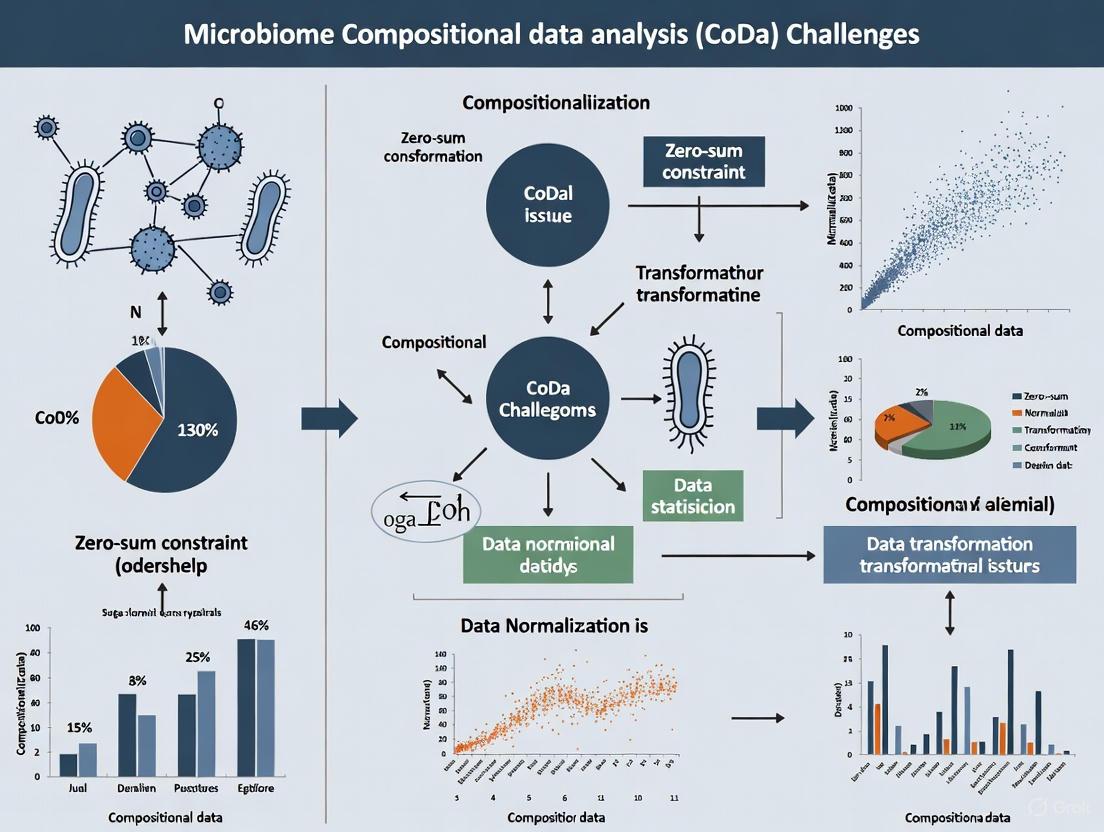
Microbiome sequence data are inherently compositional, with relative abundances constrained by a constant sum, leading to spurious correlations and analytical challenges if ignored.
Navigating Microbiome Compositional Data Analysis: Overcoming CoDA Challenges for Robust Biomedical Insights
Abstract
Microbiome sequence data are inherently compositional, with relative abundances constrained by a constant sum, leading to spurious correlations and analytical challenges if ignored. This comprehensive review explores Compositional Data Analysis (CoDA) fundamentals, tools, and challenges for researchers and drug development professionals. We cover foundational principles of compositional data, methodological approaches including log-ratio transformations and Bayesian models, troubleshooting strategies for zero-rich high-dimensional data, and validation frameworks for clinical translation. The article addresses critical gaps in handling microbiome data's unique properties while highlighting emerging applications in immunotherapy response prediction, disease diagnostics, and therapeutic development.
The Compositional Nature of Microbiome Data: Why Traditional Statistics Fail
In microbiome research, data derived from next-generation sequencing are inherently compositional. This means the data are vectors of non-negative elements (e.g., counts of microbial taxa) that are constrained to sum to a constant, such as 100% or one million reads for a sample normalized by total sequence count [1]. This "constant-sum constraint" is not a property of the microbial community itself but is an artifact of the measurement process. Since sequencing depth varies between samples, we must normalize the data, converting absolute counts into relative abundances to make samples comparable. Consequently, the absolute abundances of bacteria in the original sample cannot be recovered from sequence counts alone; we can only access the proportions of different taxa [1] [2].
This simple feature has profound implications. The components of the composition (the different microbial taxa) are not independent—they necessarily compete to make up the constant total. This leads to the "closure problem," where an increase in the measured proportion of one taxon forces an apparent decrease in the proportions of all others, even if their absolute abundances have not changed [1] [3]. This property violates the assumption of sample independence in many traditional statistical methods and can create spurious correlations, leading to biased and flawed biological inference [1] [4] [2].
Core Concepts: The FAQ
What is the "closure problem" in compositional data? The closure problem arises because all components in a composition are linked by the constant-sum constraint. When the absolute abundance of one microbe increases, its proportion of the total increases. To maintain the fixed total, the proportions of other microbes must decrease, even if their absolute abundances remain unchanged. This creates a negative bias in the covariance structure and makes the data appear to compete, which can be a mere artifact of the measurement scale rather than a true biological relationship [1] [3].
What are spurious correlations, and how does compositionality cause them? Spurious correlations are apparent statistical associations between variables that are not causally related but appear related due to the structure of the data or the analysis method [4]. In compositional data, spurious correlations inevitably arise from the shared denominator (the total sequence count). As noted by Karl Pearson over a century ago, comparing proportions haphazardly will produce such spurious correlations [1] [4].
Illustration: If you take three independent random variables, x, y, and z, they will be uncorrelated. However, if you form the ratios x/z and y/z, these two new ratios will exhibit a correlation, purely as an artifact of sharing the same divisor, z [4]. In a microbiome context, if two rare taxa (x and y) are independent, but a third, highly variable taxon (z) changes in abundance, the proportions of x and y will appear to correlate negatively with each other simply because they are both being "diluted" or "concentrated" by changes in z.
Why are traditional statistical methods problematic for compositional data? Standard statistical methods and correlation measures (e.g., Pearson correlation) assume data can vary independently in Euclidean space. Compositional data, however, reside in a constrained space known as the simplex, which has a different geometry (Aitchison geometry) [1]. Applying traditional methods to raw proportions or other normalized counts violates this fundamental assumption. It leads to inevitable errors in covariance estimates, making results unreliable and often uninterpretable [1] [2] [3]. This problem is particularly acute in high-dimensional, sparse microbiome datasets where the number of taxa far exceeds the number of samples [2].
Is this problem restricted to communities with only a few dominant taxa? No. While it has been suggested that compositional effects might be most severe in low-diversity communities (e.g., the vaginal microbiome), they pose a fundamental challenge to the analysis of any microbial community surveyed by relative abundance data, including the highly diverse gut microbiome [1].
A Troubleshooting Guide for Researchers
Problem: My analysis is revealing microbial correlations that may be spurious.
Diagnosis: You have applied correlation analysis (e.g., co-occurrence network analysis) directly to relative abundance data (proportions, percentages, or rarefied counts) without accounting for compositionality.
Solution: Adopt a Compositional Data Analysis (CoDa) framework centered on log-ratio transformations.
Detailed Methodology:
Replace Absolute Abundance Thinking with Relative Thinking: Shift your focus from "How much of microbe A is there?" to "How does the amount of microbe A compare to microbe B?" or "How does the amount of microbe A compare to a typical microbial community?" [1].
Apply a Log-Ratio Transformation: Transform your data to move from the constrained simplex space to the real Euclidean space, where standard statistical tools are valid. The three primary transformations are detailed in the table below [1] [5] [3].
Conduct Downstream Analysis: Use the transformed data for all subsequent statistical analyses, including ordination, clustering, correlation, and differential abundance testing.
Table 1: Core Log-Ratio Transformations for Microbiome Data
| Transformation | Acronym | Formula (for D parts) | Key Properties | Ideal Use Case |
|---|---|---|---|---|
| Additive Log-Ratio [1] [3] | ALR | ( alr(x) = \left[ \ln\frac{x1}{xD}, \ln\frac{x2}{xD}, ..., \ln\frac{x{D-1}}{xD} \right] ) | Simple; creates a real-valued vector. Asymmetric (depends on choice of denominator (x_D)). | Preliminary analysis; when a natural reference taxon exists. |
| Centered Log-Ratio [1] [5] | CLR | ( clr(x) = \left[ \ln\frac{x1}{g(x)}, \ln\frac{x2}{g(x)}, ..., \ln\frac{x_D}{g(x)} \right] ) where (g(x)) is the geometric mean of all parts. | Symmetric; preserves all parts. Results in a singular covariance matrix (parts sum to zero). | PCA; covariance-based analyses; computing Aitchison distance. |
| Isometric Log-Ratio [1] [5] | ILR | ( ilr(x) = [y1, y2, ..., y{D-1}] ) where (yi) are coordinates in an orthonormal basis built from balances. | Complex to define. Preserves isometric properties (distances and angles). | Most robust statistical analyses; when an orthonormal coordinate system is needed. |
The following workflow diagram illustrates the decision path for diagnosing and correcting compositional data problems.
Problem: My dataset contains many zeros, preventing log-ratio transformations.
Diagnosis: The logarithm of zero is undefined, and many microbial datasets are sparse (most taxa are absent in most samples).
Solution: Use robust methods for handling zeros.
Detailed Methodology:
- Identify the Nature of Zeros: Determine if zeros are "count zeros" (the taxon is truly absent) or "essential zeros" (the taxon is present but undetected due to low sequencing depth) [1].
- Apply a Replacement Strategy: Use specialized methods to impute zeros with small positive values. The zCompositions R package provides multivariate imputation methods for left-censored data (e.g., Bayesian-multiplicative replacement or other model-based approaches) under a compositional approach [1].
- Proceed with Transformation: After careful imputation, apply your chosen log-ratio transformation.
Problem: My experimental design may introduce confounding factors.
Diagnosis: The microbiome is highly sensitive to environmental and host factors, which can confound results and be misinterpreted as a compositional effect or vice versa.
Solution: Implement rigorous experimental controls.
Detailed Methodology:
- Document Extensive Metadata: Record all possible confounding factors such as age, diet, antibiotic use, geography, pet ownership, and host genetics [6] [7]. Treat these as independent variables in statistical models.
- Control for Batch Effects: For longitudinal studies, use the same batch of DNA extraction kits for all samples or extract DNA in a single batch to minimize technical variation [7].
- Account for Cage Effects in Animal Studies: House experimental and control groups in multiple, separate cages. In statistical analysis, treat "cage" as a random effect or blocking factor, as co-housing leads to microbial sharing [7].
- Include Proper Controls: Always run positive and negative controls (e.g., mock communities with known composition and blank extraction kits) to identify contamination, especially in low-biomass samples [7].
The Scientist's Toolkit: Essential Research Reagents & Materials
Table 2: Key Reagents and Computational Tools for CoDa Research
| Item / Resource | Function / Description | Relevance to CoDA |
|---|---|---|
| CoDaPack Software [5] | A user-friendly, standalone software for compositional data analysis. | Performs ALR, CLR, and ILR transformations; includes PCA and other CoDa-specific analyses. Ideal for non-programmers. |
| R Statistical Software [3] | An open-source environment for statistical computing and graphics. | The primary platform for CoDa, with packages like zCompositions (zero imputation) and compositions or robCompositions for transformations and analysis [1]. |
| OMNIgene Gut Kit [7] | A non-invasive collection kit for stool samples that stabilizes microbial DNA at room temperature. | Ensures sample integrity during storage/transport, crucial for generating reliable data for downstream CoDa. |
| Mock Community [7] | A defined mix of microbial cells or DNA with known abundances. | Serves as a positive control to test the entire workflow, from DNA extraction to sequencing and bioinformatics, including the performance of CoDa transformations. |
| Standardized DNA Extraction Kit [7] | A consistent kit lot used for all extractions in a study. | Reduces batch-effect technical variation, which can interact with and exacerbate compositional effects. |
The compositional nature of microbiome sequencing data is an inescapable mathematical property, not a mere technical nuisance. Ignoring it guarantees that some findings will be spurious artifacts of the data structure rather than reflections of true biology. The path to robust inference requires a paradigm shift from an absolute to a relative perspective, implemented through the consistent use of log-ratio transformations and compositionally aware statistical methods. While challenges remain—particularly with data sparsity and the fundamental inability to recover absolute abundance from sequencing data alone—the tools and frameworks of Compositional Data Analysis provide the necessary foundation for valid and reliable conclusions in microbiome research.
Troubleshooting Guides and FAQs
Frequently Asked Questions (FAQs)
Q1: Why does my beta-diversity analysis show different patterns when I use different distance metrics?
The choice of distance metric fundamentally changes how your data is compared because microbiome data is compositional. Bray-Curtis dissimilarity, a non-compositional metric, tends to emphasize differences driven primarily by the most abundant taxa. In contrast, Aitchison distance, a compositional metric, compares taxa through their abundance ratios and preserves the underlying overall compositional structure, providing a more balanced view that incorporates variation from both dominant and less abundant taxa [8]. For example, in human gut microbiome data, Bray-Curtis emphasized differences driven by dominant genera like Bacteroides and Prevotella, while Aitchison distance revealed a structure more strongly associated with individual subjects [8].
Q2: I keep getting errors when running CoDA-based analyses on my microbiome data. What could be causing this?
A common source of error is the presence of zeros in your dataset, as log-ratio transformations cannot be applied to zero values [9]. Furthermore, formatting issues in your input data, such as unexpected spaces or special characters in taxonomy labels, or blank cells in your taxonomy table, can cause failures in processing pipelines [10]. Always check your input tables for formatting consistency and implement an appropriate zero-handling strategy, such as Bayesian-multiplicative replacement [8] or using a pseudocount [9].
Q3: When should I use Aitchison distance over Bray-Curtis dissimilarity in my analysis?
Your choice should be guided by your biological question. Use Bray-Curtis if your research question is focused on changes in the most dominant taxa, as this metric is highly sensitive to abundant species [8]. Choose Aitchison distance if you are interested in the overall community structure and the coordinated changes among all taxa (both dominant and rare), as it is grounded in compositional theory and analyzes log-ratios [8]. For studies where the library sizes between groups vary dramatically (e.g., ~10x difference), Aitchison distance and other compositional methods are strongly recommended to avoid artifacts [9].
Troubleshooting Common Experimental Issues
Problem: High False Discovery Rate (FDR) in Differential Abundance Testing
- Symptoms: Statistical tests identify a large number of taxa as significantly different between groups, but many are likely false positives, especially when groups have very different average library sizes.
- Investigation Checklist:
- Solutions:
- For large sample sizes (>20 per group): Use ANCOM, which controls the FDR well for drawing inferences regarding taxon abundance in the ecosystem [9].
- For smaller datasets (<20 per group): Methods like DESeq2 can be more sensitive, but monitor the FDR as it can increase with more samples or uneven library sizes [9].
- Consider rarefying: While it results in a loss of sensitivity, rarefying can lower the FDR when library sizes are very uneven [9]. Always use a rarefaction depth informed by a rarefaction curve [9].
Problem: Poor Clustering in Ordination Plots (PCoA)
- Symptoms: Samples do not cluster meaningfully according to expected biological groups in a PCoA plot.
- Investigation Checklist:
- Verify the distance metric: Using a Euclidean distance metric on raw or relative abundance data is inappropriate for compositional data and will produce misleading results [8].
- Check for normalization: If not using a compositionally-aware method, ensure proper normalization has been applied to account for varying library sizes [9].
- Solutions:
Table 1: Comparison of Distance Metrics in Microbiome Analysis (G-HMP2 Dataset Example)
| Distance Metric | Mathematical Foundation | Key Feature | Variance Explained by Subject (R²) | Variance Explained by Dominant Taxa (R²) |
|---|---|---|---|---|
| Bray-Curtis | Non-compositional (Ecological) | Emphasizes abundant taxa | 0.15 [8] | 0.24 [8] |
| Aitchison | Compositional (Log-ratios) | Balances all taxa | 0.36 [8] | 0.02 [8] |
Table 2: Performance of Differential Abundance Testing Methods Under Different Conditions
| Method | Recommended Sample Size | Handles Uneven Library Size (~10x) | Key Strength / Weakness |
|---|---|---|---|
| ANCOM | >20 per group [9] | Good control [9] | Best control of False Discovery Rate [9] |
| DESeq2 | <20 per group [9] | Higher FDR [9] | High sensitivity in small datasets; FDR can increase with more samples [9] |
| Rarefying + Nonparametric Test | Varies | Lowers FDR [9] | Controls FDR with uneven sampling; reduces sensitivity/power [9] |
Experimental Protocols
Protocol 1: Conducting a Compositionally-Aware Beta-Diversity Analysis Using Aitchison Distance
This protocol details how to perform a Principal Coordinates Analysis (PCoA) using Aitchison distance, a method grounded in compositional data theory [8].
- Data Preprocessing: Start with a raw OTU or ASV count table. Remove any samples with an extremely low number of reads.
- Zero Imputation: Aitchison distance relies on log-ratios and cannot handle zeros. Replace zeros using a Bayesian-multiplicative method (e.g.,
cmultReplfunction from thezCompositionspackage in R) [8]. - Center Log-Ratio (CLR) Transformation: Calculate the CLR for each sample. For a sample vector
xwithDtaxa, the CLR is calculated asclr(x) = [ln(x1/g(x)), ln(x2/g(x)), ..., ln(xD/g(x))], whereg(x)is the geometric mean of all taxa inx[11]. - Calculate Aitchison Distance: The Aitchison distance between two samples
xandyis the Euclidean distance of their CLR-transformed vectors:dist_A(x, y) = sqrt( sum( (clr(x) - clr(y))^2 ) )[8]. - Ordination and Visualization: Perform PCoA on the resulting Aitchison distance matrix. Visualize the PCoA results to inspect for sample clustering.
Protocol 2: Evaluating Differential Abundance with ANCOM
ANCOM (Analysis of Composition of Microbiomes) is a robust method for identifying differentially abundant taxa while controlling for false discovery [9].
- Input Data: Use the raw count data. ANCOM is designed to work with the original counts, avoiding the need for rarefaction or other normalizations that discard data [9].
- Log-Ratio Formation: For each taxon, ANCOM performs a series of statistical tests on all pairwise log-ratios between that taxon and all other taxa. This tests the null hypothesis that the log-ratio of the abundances of two taxa is not different between groups.
- Test Statistic (W): For a given taxon, the number of times it is detected as significantly different from other taxa in the pairwise log-ratio tests is counted. This count is the test statistic
W. A highWstatistic suggests the taxon is differentially abundant relative to many other taxa in the community. - Significance Determination: The empirical distribution of
Wacross all taxa is examined. A threshold (e.g., the 70th percentile of the W distribution) is often used to declare which taxa are differentially abundant, as this method provides good control of the FDR [9].
The Scientist's Toolkit: Essential Research Reagent Solutions
Table 3: Key Computational Tools and Methods for Microbiome CoDA
| Item / Reagent Solution | Function / Explanation |
|---|---|
| Log-Ratio Transformations (CLR, ALR, ILR) | "Opens" the simplex, transforming compositional data into real-valued vectors for use with standard statistical and machine learning models [11]. |
| Aitchison Distance | A compositionally valid distance metric for comparing microbial communities, based on the Euclidean distance of CLR-transformed data [8]. |
| Bayesian-Multiplicative Zero Replacement | A strategy for handling zeros in compositional data (e.g., cmultRepl in R) that is more robust than simple pseudocounts for preparing data for log-ratio analysis [8]. |
| ANCOM Software | A statistical method and corresponding software implementation for differential abundance testing that provides good control of the false discovery rate [9]. |
| Simplex Visualization Tools | Software and scripts for creating ternary (3D) and higher-order simplex (4D) plots to visualize compositional data without information loss [12]. |
Workflow and Relationship Visualizations
Microbiome CoDA Analysis Workflow
Why Do We Need Special Methods for Microbiome Data?
Microbiome data, derived from high-throughput sequencing, is inherently compositional. This means the data consists of vectors of non-negative values that carry only relative information, as the total number of sequences per sample is arbitrary and uninformative [1] [13]. Analyzing this data with standard statistical methods, which assume data can vary independently, leads to spurious correlations and flawed inferences [1] [13] [2]. Compositional Data Analysis (CoDA) provides a robust framework to overcome these pitfalls, built upon three key properties: scale invariance, subcompositional coherence, and permutation invariance [1] [14] [15]. The table below summarizes these foundational properties.
Table 1: Key Properties of Compositional Data Analysis (CoDA)
| Property | Definition | Practical Implication for Microbiome Analysis |
|---|---|---|
| Scale Invariance | The analysis is unaffected by multiplying all components by a constant factor [1] [15]. | Normalizing data (e.g., converting to proportions) or having different library sizes does not change the relative information in the ratios between taxa [13]. |
| Subcompositional Coherence | Results remain consistent when the analysis is performed on a subset (subcomposition) of the original components [1] [14]. | Insights gained from analyzing a select group of taxa are reliable and not an artifact of having ignored other members of the community [1] [13]. |
| Permutation Invariance | The analysis is unaffected by the order of the components in the data vector. | Standard property in multivariate analysis; the ordering of taxa in your OTU table does not influence the outcome of CoDA methods. |
The core transformation in CoDA is the log-ratio, which converts the constrained compositional data into a real-space where standard statistical methods can be safely applied [14] [13]. The following diagram illustrates the logical workflow for addressing compositional data challenges, from problem identification to solution.
Troubleshooting Common CoDA Challenges
The Spurious Correlation Problem
- Observed Issue: I have found a strong negative correlation between two dominant taxa in my dataset. Is this a real biological relationship?
- Underlying Cause: This is a classic symptom of ignoring compositionality. In a composition, all parts are linked because they sum to a constant (e.g., 1 or 100%). If one taxon's proportion increases, it forces the proportions of others to decrease, creating a spurious negative correlation that may not reflect the true biological state [1] [13]. This effect is exacerbated when working with subcompositions [13].
- Solution: Analyze data using log-ratios. The correlation between two log-ratios, or between a log-ratio and an external variable, is a valid measure of association free from the spurious correlation introduced by the constant sum constraint [13] [15].
The Subcomposition Incoherence Problem
- Observed Issue: When I filter out rare taxa from my dataset, the statistical relationships between the remaining abundant taxa completely change. My results are not stable.
- Underlying Cause: Standard statistical analyses applied to raw abundances or proportions are not subcompositionally coherent. The relationship between two taxa can appear to change dramatically simply because a third, unrelated taxon was removed from the analysis [1] [13].
- Solution: Use CoDA methods based on log-ratios. A log-ratio between two taxa is immune to changes in other parts of the composition. Therefore, the relationship you measure for those two taxa remains valid regardless of which other taxa are included in or excluded from the analysis, ensuring stability and coherence [14].
The Differential Abundance Fallacy
- Observed Issue: My differential abundance test shows that 10 taxa are significantly increased in the disease group. However, I am unsure if this represents a true increase or just a relative change.
- Underlying Cause: With relative data (proportions), an increase in one taxon's proportion can cause others to appear to decrease. You cannot distinguish between an absolute increase in Taxon A versus an absolute decrease in all other taxa from compositional data alone [13]. This is a fundamental limitation.
- Solution: Frame your hypotheses and conclusions in terms of ratios. Instead of stating "Taxon A is more abundant in disease," state "The ratio of Taxon A to Taxon B (or to a reference) is higher in disease" [14] [16] [17]. Methods like
ALDEx2andcoda4microbiomeare designed for this and test for differences in log-ratios, not raw abundances [16] [17].
Experimental Protocols for Robust CoDA
Protocol 1: Additive Logratio (ALR) Transformation for Dimensionality Reduction
The ALR transformation is a simple and interpretable method to convert compositional data into a set of real-valued log-ratios.
- Preprocessing: Start with a count or proportion matrix where rows are samples and columns are taxa.
- Handle Zeros: Address zero counts using a method like Bayesian-multiplicative replacement (e.g., as implemented in the
zCompositionsR package) [17]. - Reference Selection: Choose a reference taxon (
X_ref). For high-dimensional data, select a taxon that is prevalent and has low variance in its log-transformed relative abundance to maximize isometry and ease interpretation [14]. - Transformation: For each sample and for every other taxon
j, compute:ALR(j | ref) = log(X_j / X_ref)[14]. - Downstream Analysis: The resulting
(J-1)ALR values can be used in standard statistical models like linear regression, PERMANOVA, or machine learning algorithms.
Protocol 2: Identifying Microbial Signatures with coda4microbiome
The coda4microbiome R package identifies predictive microbial signatures in the form of log-ratio balances for both cross-sectional and longitudinal studies [16].
- Data Preparation: Load your OTU table and phenotype data into R.
- Model Fitting: For a cross-sectional study, the algorithm fits a penalized regression model (e.g., elastic net) on the "all-pairs log-ratio model":
g(E(Y)) = β₀ + Σ β_jk * log(X_j / X_k)[16]. - Variable Selection: The penalization drives the selection of the most informative pairwise log-ratios for predicting the outcome
Y. - Signature Interpretation: The final model is reparameterized as a log-contrast model, which can be interpreted as a balance between two groups of taxa: those with positive coefficients and those with negative coefficients [16].
- Visualization: Use the package's plotting functions to visualize the selected taxa, their coefficients, and the model's prediction accuracy.
Table 2: Essential Research Reagent Solutions for CoDA
| Tool / Reagent | Function / Purpose | Implementation Example |
|---|---|---|
| Log-ratio Transformation | Converts relative abundances into real-valued, analyzable data while respecting compositionality. | ALR: log(X_j / X_ref) [14]. CLR: log(X_j / g(X)) where g(X) is the geometric mean [13]. |
R Package coda4microbiome |
Identifies microbial signatures via penalized regression on all pairwise log-ratios for cross-sectional and longitudinal data [16]. | coda4microbiome::coda_glmnet() |
R Package ALDEx2 |
Uses a Bayesian framework to model compositional data and perform differential abundance analysis between groups [17] [15]. | ALDEx2::aldex() |
| Zero Handling Methods | Addresses the challenge of sparse data with many zero counts, a common issue in microbiome datasets [17]. | Bayesian-multiplicative replacement (e.g., zCompositions package). |
The relationship between the core CoDA principles and the analytical solutions that uphold them is summarized in the following diagram.
Frequently Asked Questions (FAQs)
Q: My data is raw count data from my sequencer, not proportions. Is it still compositional?
A: Yes. Read counts are constrained by the sequencing depth (the total number of reads per sample), which is an arbitrary constant. This induces the same dependencies and spurious correlations as working with proportions. The raw counts still only provide relative information about the taxa within each sample [13] [15].
Q: Which log-ratio transformation should I use: ALR, CLR, or ILR?
A: The choice depends on your goal and the software.
- ALR (Additive Logratio): Simple to compute and interpret, as each variable is a simple log-ratio against a reference. It is excellent for high-dimensional data and prediction tasks, though it is not isometric [14].
- CLR (Centered Logratio): Symmetrical and preserves all taxa. It is useful for computing Aitchison distances and PCA. However, the resulting variables are correlated, which can complicate some regression models [13] [15].
- ILR (Isometric Logratio): Provides an orthonormal basis, which is ideal for many multivariate statistics. However, the balances can be complex and difficult to interpret [14] [15].
Q: How do I handle zeros in my data before doing a log-ratio transformation?
A: Zeros are a major challenge because the logarithm of zero is undefined. Simple replacements (like adding a pseudo-count) can introduce biases. It is recommended to use more sophisticated methods like Bayesian-multiplicative replacement (e.g., the zCompositions R package), which are designed specifically for compositional data [17].
Q: I've heard that CoDA makes it hard to recover absolute abundances. Is that true?
A: Yes, this is a fundamental limitation. The process of sequencing and creating relative abundances or counts loses all information about the absolute number of microbes in the original sample. CoDA provides powerful tools for analyzing the relative structure of the community, but it cannot recover the absolute abundances without additional experimental data (e.g., from flow cytometry or qPCR) [1] [2].
Frequently Asked Questions (FAQs)
1. What makes microbiome data "compositional," and why is this a problem? Microbiome sequencing data are compositional because the data you get are relative abundances (proportions) rather than absolute counts. This happens because the sequencing process forces each sample to sum to a constant total number of reads (a process called "closure") [18]. This simple feature has a major adverse effect: the abundance of one taxon appears to depend on the abundances of all others. This can lead to spurious correlations, where a change in one taxon creates illusory changes in others, violating the assumption of sample independence and biasing covariance estimates [18]. Traditional statistical methods applied to raw relative abundances can therefore produce flawed and misleading inferences.
2. My data has many zeros. What causes this sparsity, and how does it affect my analysis? Sparsity (an excess of zero values) in microbiome data arises from several factors:
- Biological Reality: The microbe might be genuinely absent from the sample [19].
- Technical Limitations: The microbe may be present but at an abundance too low for the sequencing depth to detect, a victim of undersampling [19]. This high sparsity is a significant challenge for statistical analysis. If not handled appropriately, these excessive zeros can introduce substantial bias, reducing the sensitivity, specificity, and accuracy of your analyses, including differential abundance testing [19].
3. How should I normalize my microbiome data to account for different sequencing depths? Proper normalization is critical to correct for varying sequencing depths (library sizes) across samples. The table below summarizes common methods, though note that "rarefying" is considered statistically inadmissible by some experts [18].
| Method | Brief Description | Key Consideration |
|---|---|---|
| Total Sum Scaling | Converts counts to relative abundances (proportions). | Does not correct for compositionality; susceptible to spurious results [18]. |
| Rarefying | Randomly subsamples reads to a common depth. | Discards data; considered "inadmissible" for some statistical tests [18]. |
| CSS (Cumulative Sum Scaling) | Normalizes using a percentile of the cumulative distribution of counts. | More robust to outliers than total sum scaling [19]. |
| GMPR | Geometric mean of pairwise ratios. | Designed specifically for zero-inflated microbiome data [19]. |
| Log-Ratio Transformation | Uses ratios of abundances within a sample (e.g., Aitchison geometry). | Directly addresses the compositional nature of the data [18]. |
4. Which statistical methods are best for identifying differentially abundant taxa? Because microbiome data are compositional and sparse, standard tests like t-tests or simple linear models are often inappropriate. Methods that explicitly account for these properties are recommended. The following table compares several approaches.
| Method | Framework | Key Feature for Microbiome Data |
|---|---|---|
| ALDEx2 | Bayesian Model / Log-Ratio | Models the compositional data within a Dirichlet distribution and uses a log-ratio approach [18]. |
| DESeq2 / edgeR | Negative Binomial Model | Designed for count-based RNA-Seq data; can be applied to microbiome data but may be sensitive to the high sparsity [19]. |
| ANCOM-BC | Linear Model / Log-Ratio | Accounts for compositionality by correcting the bias in log abundances using a linear regression framework [19]. |
| Zero-Inflated Models (e.g., ZINB) | Mixed Distribution | Explicitly models the data as coming from two processes: one generating zeros and one generating counts [19]. |
5. Can I use Machine Learning with my microbiome data, and what are the pitfalls? Yes, machine learning (ML) can be applied to microbiome data for tasks like classification or prediction. However, the compositional and sparse nature of these datasets poses a significant challenge [20]. If these properties are not considered, they can severely impact the predictive accuracy and generalizability of your ML model. Noise from low sample sizes and technical heterogeneity can further degrade performance. It is essential to use ML methods and pre-processing steps designed for or robust to these data characteristics [20].
Troubleshooting Guides
Issue 1: High False Discovery Rate in Differential Abundance Analysis
Problem: Your analysis identifies many differentially abundant taxa, but you suspect many are false positives due to compositional effects and sparsity.
Solution:
- Shift to a Compositional Framework: Abandon analyses based on raw relative abundances. Instead, use methods built on log-ratio transformations (e.g., centered log-ratio, alr, or ilr) [18]. These transformations map the data from the simplex to real Euclidean space, allowing for the use of standard statistical tools.
- Apply Robust Normalization: Use a normalization method like GMPR or CSS that is more robust to the high sparsity and compositionality of the data [19].
- Choose a Suitable Model: Employ a differential abundance tool designed for these challenges, such as ALDEx2 or ANCOM-BC, which incorporate principles of compositional data analysis [18] [19].
- Validate with Care: Be cautious when interpreting p-values from models that do not account for compositionality. Consider using a tool that provides effect sizes and confidence intervals on log-ratios.
Issue 2: Managing Technical Bias and Contamination
Problem: Your data is confounded by biases from DNA extraction, PCR amplification, and contamination, making results unreliable and irreproducible.
Solution:
- Incorporate Mock Communities: Include standardized mock communities (with known compositions) in your sequencing runs. These serve as positive controls to quantify protocol-dependent biases [21].
- Use Negative Controls: Process blank (no-template) controls through your entire workflow to identify contaminants originating from reagents or the lab environment [21].
- Computational Correction: Leverage data from your mock communities to correct for observed biases. Pioneering approaches like metacal can assess and transfer bias, and newer research suggests bias can be linked to bacterial cell morphology for more general correction [21].
- Standardize Protocols: Within a study, use a single, consistent DNA extraction and library preparation protocol to minimize batch effects. The DNA extraction protocol is a major source of bias, with significant differences observed between kits and lysis conditions [21].
Diagram: Workflow for Identifying and Correcting Technical Bias.
Issue 3: Low Statistical Power Due to Data Sparsity
Problem: The high number of zeros in your dataset is reducing the power of your statistical tests, making it difficult to detect true biological signals.
Solution:
- Aggregate Data: Before analysis, consider aggregating counts at a higher taxonomic level (e.g., genus instead of species). This reduces the number of features and consequently the sparsity.
- Use Zero-Inflated Models: Implement statistical models that are specifically designed for zero-inflated data, such as zero-inflated negative binomial (ZINB) models. These models treat the zeros as coming from two sources: "true" absences and "false" absences due to undersampling [19].
- Apply Bayesian or Regularization Methods: Use methods that incorporate shrinkage or regularization (e.g., via Bayesian priors or penalized models). These techniques borrow information across features to produce more stable estimates, which is particularly helpful when data is sparse [19].
- Prune Low-Abundance Features: As a preprocessing step, filter out taxa that are present in only a very small percentage of your samples (e.g., less than 5-10%). This removes features that carry little reliable information.
Diagram: Strategies to Overcome Data Sparsity.
The Scientist's Toolkit: Research Reagent Solutions
| Reagent / Material | Function in Microbiome Research |
|---|---|
| Mock Community Standards (e.g., ZymoBIOMICS) | Defined mixtures of microbial cells or DNA with known composition. Served as positive controls to quantify and correct for technical biases across the entire workflow, from DNA extraction to sequencing [21]. |
| DNA Extraction Kits (e.g., QIAamp UCP, ZymoBIOMICS Microprep) | Kits for isolating bacterial genomic DNA from samples. Different kits, lysis conditions, and buffers have taxon-specific lysis efficiencies, making them a major source of extraction bias that must be controlled [21]. |
| Negative Control Buffers (e.g., Buffer AVE) | Sterile buffers processed alongside samples. Serves as a negative control to identify background contamination originating from reagents or the laboratory environment [21]. |
| Standardized Swabs | For consistent sample collection, particularly from surfaces like skin. Used with mock communities to test feasibility and taxon recovery of extraction protocols in specific sample contexts [21]. |
Troubleshooting Guides
Problem: Spurious Correlation in Microbiome Data
- Question: Why do my microbiome datasets show unexpected or uninterpretable correlation structures between microbial features?
- Answer: High-Throughput Sequencing (HTS) data, including 16S rRNA gene amplicon and metagenomic data, are compositional [22]. This means the data convey relative abundance information, not absolute counts, because the total number of sequences obtained per sample is arbitrary and constrained by the sequencing instrument's capacity [22]. Analyzing compositional data with standard correlation methods induces a negative bias and can produce spurious correlations, a problem identified by Pearson in 1897 [22]. This is because an increase in the relative abundance of one feature necessitates an apparent decrease in others.
- Solution: Apply Compositional Data Analysis (CoDa) methods that use log-ratio transformations. These transformations account for the constant-sum constraint. Avoid using raw relative abundances or normalized counts for correlation analysis.
Problem: Low Library Yield in Sequencing Preparation
- Question: My final NGS library concentration is unexpectedly low. What are the common causes and how can I fix them?
- Answer: Low library yield can stem from issues at multiple preparation stages [23]. The root cause must be systematically diagnosed.
- Solution: Follow this diagnostic table to identify and correct the issue.
| Category of Issue | Common Root Causes | Corrective Actions |
|---|---|---|
| Sample Input / Quality | Degraded DNA/RNA; sample contaminants (phenol, salts); inaccurate quantification [23]. | Re-purify input sample; use fluorometric quantification (e.g., Qubit) instead of only absorbance; check purity ratios (260/280 ~1.8) [23]. |
| Fragmentation & Ligation | Over- or under-shearing; inefficient ligation; suboptimal adapter-to-insert ratio [23]. | Optimize fragmentation parameters; titrate adapter:insert molar ratios; ensure fresh ligase and optimal reaction conditions [23]. |
| Amplification (PCR) | Too many PCR cycles; enzyme inhibitors; primer exhaustion [23]. | Reduce the number of PCR cycles; use master mixes to reduce pipetting errors; ensure clean input sample free of inhibitors [23]. |
| Purification & Cleanup | Incorrect bead-to-sample ratio; over-drying beads; inefficient washing [23]. | Precisely follow cleanup protocol instructions for bead ratios and washing; avoid over-drying magnetic beads during cleanup steps [23]. |
Problem: Inaccurate Differential Abundance Identification
- Question: My differential abundance analysis yields a high number of false positives, especially with sparse data (many zeros). What went wrong?
- Answer: Many standard statistical tools for differential abundance assume data are absolute counts and do not account for compositionality [22]. This makes them sensitive to data sparsity and leads to unacceptably high false positive rates [22]. The relative nature of the data means a change in one feature's abundance can falsely appear to change others.
- Solution: Employ differential abundance tools specifically designed for compositional data. These methods are based on log-ratio analysis of the component structure, which provides a valid basis for inference [22].
Frequently Asked Questions (FAQs)
Question: What does it mean that microbiome data are compositional?
- Answer: It means that the data from a sequencing instrument represent relative proportions, not absolute counts [22]. The total number of sequences per sample is fixed by the instrument's capacity, so the data for each sample sum to a constant (or an arbitrary total). The information is contained in the ratios between the different microbial features, not in their individual counts [22].
Question: Can't I just normalize my count data to fix compositionality?
- Answer: Common count normalization methods (e.g., TMM, Median) from RNA-seq are less suitable for highly sparse and asymmetrical microbiome datasets [22]. More critically, these methods do not fully address the fundamental issue that the data are relative, and investigators may misinterpret the normalized outputs as absolute abundances [22]. True compositional data analysis requires a paradigm shift to log-ratios.
Question: Are common distance metrics like Bray-Curtis and UniFrac invalid for compositional data?
- Answer: While useful, these distances do not fully account for compositionality. They can be strongly confounded by total read depth and primarily discriminate samples based on the most abundant features, potentially missing important variation in low-abundance taxa [22]. It is recommended to use them with caution and to explore compositional alternatives when possible, such as distances derived from log-ratio transformations [22].
Question: What deliverables should I expect from a robust CoDA-based microbiome analysis?
- Answer: A comprehensive analysis should include data processing, CoDA-specific transformations, and rigorous interpretation [24]. Key deliverables are:
- Raw data processing (quality control, denoising, taxonomic profiling).
- Alpha and beta diversity analysis using appropriate metrics.
- Exploratory data analysis with ordination plots (e.g., based on log-ratio components).
- Omnibus and per-feature statistics (e.g., using tools like
MaAsLin 2or other CoDA-aware methods) [24]. - Results interpretation and discussion within the compositional framework [24].
- Answer: A comprehensive analysis should include data processing, CoDA-specific transformations, and rigorous interpretation [24]. Key deliverables are:
Experimental Workflow & Signaling Pathways
Microbiome Data Analysis: Problematic vs. CoDA Workflow
Troubleshooting NGS Library Preparation
The Scientist's Toolkit: Key Research Reagent Solutions
| Item / Reagent | Function / Application | Considerations for CoDA |
|---|---|---|
| Log-Ratio Transformations | Mathematical foundation for CoDA. Transforms relative abundances from a simplex to real space for valid statistical analysis [22]. | Includes Centerd Log-Ratio (CLR) and Isometric Log-Ratio (ILR). Choice depends on the specific hypothesis and data structure. |
| Robust DNA Extraction Kit | Isolates microbial DNA from complex samples. The first step in generating HTS data. | Protocol must be consistent across samples. Does not recover absolute abundances, reinforcing the need for CoDA. |
| Fluorometric Quantification Assay | Accurately measures concentration of nucleic acids (e.g., dsDNA) using fluorescence. | Essential for verifying input material before library prep. Prevents quantification errors that lead to low yield [23]. More accurate than UV absorbance for library prep. |
| High-Fidelity Polymerase | Amplifies DNA fragments during library PCR with minimal bias and errors. | Reduces amplification artifacts and bias, which can distort the underlying composition [23]. |
| Size Selection Beads | Magnetic beads used to purify and select for DNA fragments of a desired size range. | Critical for removing adapter dimers and other artifacts. Incorrect bead ratios are a major source of library prep failure [23]. |
| CoDA-Capable Software/Packages | Statistical software (e.g., R, Python) with packages designed for compositional data analysis. | Necessary to implement log-ratio transforms and CoDA-aware differential abundance and ordination methods [22]. |
CoDA Methodologies in Practice: From Log-Ratios to Bayesian Models
Microbiome data, derived from high-throughput sequencing technologies, is inherently compositional. This means that the data represents parts of a whole, where each sample is constrained to a constant sum (e.g., the total sequencing depth) [16] [14]. Analyzing such data with standard statistical methods, which assume independence between features, can lead to spurious correlations and misleading results [25] [11]. Compositional Data Analysis (CoDA) provides a robust framework to address these challenges, with log-ratio transformations at its core [16].
This guide addresses common experimental challenges and provides troubleshooting support for implementing key log-ratio transformations—Additive (ALR), Centered (CLR), and Isometric (ILR)—in your microbiome research pipeline.
Core Concepts FAQ
What is the fundamental principle behind log-ratio transformations? Log-ratio transformations "open" the simplex, the constrained space where compositional data resides, and map the data to real Euclidean space. This allows for the valid application of standard statistical and machine learning techniques by focusing on relative information (ratios between components) rather than absolute abundances [11] [14].
Why can't I use raw relative abundances or count data directly? Using raw relative abundances or counts ignores the constant-sum constraint. This means that an observed increase in one taxon will artificially appear to cause a decrease in others, creating illusory correlations [25] [16] [11]. Furthermore, sequencing depth variation between samples is a technical artifact that does not reflect biological truth and must be accounted for [25].
How do I choose between ALR, CLR, and ILR? The choice depends on your research goal, the nature of your dataset, and the importance of interpretability versus mathematical completeness. See the section "Choosing the Appropriate Transformation: A Decision Guide" below.
Transformation Methodologies & Performance
Technical Specifications of Core Transformations
Table 1: Technical Specifications of ALR, CLR, and ILR Transformations
| Transformation | Formula | Dimensionality Output | Key Property | Primary Use Case |
|---|---|---|---|---|
| Additive Log Ratio (ALR) | ALR(j) = log(X_j / X_ref) |
J-1 features (J is original number of features) [14] | Non-isometric; simple interpretation [14] | When a natural reference taxon is available and interpretability is key [25] [14] |
| Centered Log Ratio (CLR) | CLR(j) = log(X_j / g(X)) where g(X) is the geometric mean of all components [26] |
J features (same as input) [26] | Isometric; symmetric treatment of all parts [26] | Standard PCA; generating symmetric, whole-community profiles [26] [27] |
| Isometric Log Ratio (ILR) | Complex, based on sequential binary partitions of a phylogenetic tree or other hierarchy [27] | J-1 features [27] | Isometric; orthonormal coordinates [27] | Statistical methods requiring orthogonal, non-collinear predictors (e.g., linear regression) [27] |
Figure 1: A simplified workflow showing the three primary log-ratio transformation paths from raw compositional data to data ready for downstream statistical analysis.
Empirical Performance in Machine Learning Tasks
Recent large-scale benchmarking studies have yielded critical insights into the performance of these transformations in predictive modeling.
Table 2: Transformation Performance in Machine Learning Classification Tasks (e.g., Healthy vs. Diseased)
| Transformation | Reported Classification Performance (AUROC) | Key Findings and Considerations |
|---|---|---|
| ALR & CLR | Effective when zero values are less prevalent [25] | Performance can be mixed; sometimes outperformed by simpler methods in cross-study prediction [28]. |
| Presence-Absence (PA) | Comparable to, and sometimes better than, abundance-based transformations [26] | Robust performance; suggests simple microbial presence can be highly predictive. |
| Proportions (TSS) | Often outperforms ALR, CLR, and ILR by a small but statistically significant margin [27] | Read depth correction without complex transformation can be a preferable strategy for ML. |
| ILR (e.g., PhILR) | Generally performs slightly worse or only as well as compositionally naïve transformations [27] | Complex transformation may not provide a predictive advantage in ML contexts. |
| Batch Correction Methods (e.g., BMC, Limma) | Consistently outperform other normalization approaches in cross-study prediction [28] | Highly effective when dealing with data from different populations or studies (heterogeneity). |
Troubleshooting Common Experimental Challenges
FAQ: Handling Zeros in Compositional Data
What is the problem with zeros? Logarithms of zero are undefined, making zeros a direct technical obstacle for any log-ratio transformation [25].
What are the common types of zeros in microbiome data?
- Biological Zero: The taxon is truly absent in the sample [25].
- Sampling Zero: The taxon is present but undetected due to limited sequencing depth [25].
- Technical Zero: Absence due to errors in sample preparation or sequencing [25].
What are the standard strategies for handling zeros?
- Pre-processing: Use a pseudo-count (a small positive value, e.g., 1) added to all counts before transformation [27]. This is simple but can bias results.
- Advanced Imputation: Replace zeros with estimated values using methods designed for compositional data, which can provide more statistically sound results [29]. The choice of method depends on the nature and abundance of zeros in your dataset.
FAQ: Dealing with High-Dimensional Data
The Pairwise-Log Ratio (PLR) approach creates too many features. How can I manage this?
A full PLR model creates K(K-1)/2 features, which for high-dimensional microbiome data leads to a combinatorial explosion [11]. Solutions include:
- Sparse Regularization: Use penalized regression (e.g., LASSO, Elastic Net) on the "all-pairs log-ratio model" to automatically select the most informative log-ratios for prediction [16].
- Targeted Log-ratios: Use phylogeny to guide the creation of log-ratios. Tools like the coda4microbiome R package or PhILR construct ILR balances based on phylogenetic trees, which reduces dimensionality and incorporates biological structure [16] [27].
Experimental Protocols
Protocol 1: Basic Workflow for Log-Ratio Transformation with Microbiome Data
- Data Preprocessing: Filter out low-prevalence taxa (e.g., those present in less than 10% of samples) to reduce noise [27].
- Handle Zeros: Apply a pseudo-count or a more sophisticated imputation method to replace zero values [29].
- Normalize to Proportions: Convert raw counts to relative abundances using Total Sum Scaling (TSS) unless using a method that incorporates scale directly [25] [26].
- Apply Log-Ratio Transformation: Choose and compute ALR, CLR, or ILR on the proportional data.
- Proceed with Downstream Analysis: Use the transformed data in your chosen statistical or machine learning model.
Figure 2: A standard experimental workflow for applying log-ratio transformations to microbiome data, from raw counts to analysis.
Protocol 2: Identifying a Microbial Signature using Penalized Regression
This protocol uses the coda4microbiome R package to identify a minimal set of taxa with maximum predictive power [16] [30].
- Construct the All-Pairs Log-Ratio Model: From your proportional data
X, create a design matrixMthat contains all possible pairwise log-ratios,log(X_j / X_k)[16]. - Perform Penalized Regression: Fit a generalized linear model (e.g., logistic regression for a binary outcome) to the model
g(E(Y)) = Mβusing an elastic net penalty. This minimizes a loss functionL(β)subject toλ₁||β||₂² + λ₂||β||₁[16]. - Cross-Validation: Use cross-validation (e.g.,
cv.glmnet) to determine the optimal penalization parameterλthat minimizes prediction error [16]. - Interpret the Signature: The model selects pairs of taxa with non-zero coefficients. The final microbial signature can be expressed as a balance—a weighted log-contrast between the group of taxa that positively influence the outcome and the group that negatively influence it [16] [30].
The Scientist's Toolkit: Essential Research Reagents & Software
Table 3: Key Software Tools for Compositional Microbiome Analysis
| Tool / Resource | Type | Primary Function | Access |
|---|---|---|---|
| coda4microbiome | R Package | Identifies microbial signatures via penalized regression on pairwise log-ratios for cross-sectional, longitudinal, and survival studies [16] [31] [30]. | CRAN |
| ALDEx2 | R Package | Differential abundance analysis using a CLR-based Bayesian framework [16]. | Bioconductor |
| PhILR | R Package | Implements Isometric Log-Ratio (ILR) transformations using phylogenetic trees to create "balance trees" [27]. | Bioconductor |
| glmnet | R Package | Performs penalized regression (Lasso, Elastic Net) essential for variable selection in high-dimensional models [16]. | CRAN |
| curatedMetagenomicData | R Package / Data Resource | Provides curated, standardized human microbiome datasets for benchmarking and method validation [26]. | Bioconductor |
Choosing the Appropriate Transformation: A Decision Guide
Figure 3: A practical decision guide to help researchers select an appropriate transformation or normalization strategy based on their specific analytical context and goals.
FAQs: Understanding and Addressing Zeros in Microbiome Data
FAQ 1: Why are zeros a particularly challenging problem in microbiome sequencing data? Zeros in microbiome data are challenging because they are pervasive and can arise from two fundamentally different reasons: genuine biological absence of a taxon or technical absence due to insufficient sampling depth (a missing value). This ambiguity, combined with the compositional nature of the data (where abundances are relative and sum to one), makes standard statistical approaches prone to bias. Excessive zeros are especially problematic for downstream analyses that require log-transformation, as they necessitate a value to be inserted in place of zero [32] [33].
FAQ 2: What is the simplest method to handle zeros, and what are its drawbacks? The simplest method is the pseudocount approach, where a small value (like 0.5 or 1) is added to all counts before normalization and log-transformation. The primary drawback is that this method is naive and does not exploit the underlying correlation structure or distributional characteristics of the data. It has been shown to have "detrimental consequences" in certain contexts and is far from optimal for recovering true abundances [32] [33].
FAQ 3: How do advanced imputation methods improve upon simple pseudocounts? Advanced imputation methods use sophisticated models to make an educated guess about the true abundance. For example:
- Model-Based Methods: Assume an underlying true abundance matrix and use Bayesian or variational inference to estimate it (e.g.,
mbDenoise,SAVER) [32] [33]. - Correlation-Based Methods: Use information from similar samples or similar taxa to impute missing values (e.g.,
mbImpute,scImpute) [32] [33]. - Low-Rank Approximation: Methods like
ALRAuse singular value decomposition to approximate the true, underlying abundance matrix [32] [33]. These approaches aim to be more principled by accounting for data structure, leading to more accurate recovery of true microbial profiles.
FAQ 4: What is a key limitation of many existing imputation methods that newer approaches are trying to solve? Many existing methods implicitly or explicitly assume that the abundance of each taxon follows a unimodal distribution. In reality, the abundance distribution of some taxa is bimodal, for instance, in case-control studies where a microbe's abundance is different in healthy versus diseased groups. Newer methods like BMDD (BiModal Dirichlet Distribution) explicitly model this bimodality, leading to a more flexible and realistic fit for the data and superior imputation performance [32] [33].
FAQ 5: Should I impute zeros before a meta-analysis of multiple microbiome studies? There is no consensus, and imputation may introduce additional bias in a meta-analysis context. An alternative framework like Melody is designed for meta-analysis without requiring prior imputation, rarefaction, or batch effect correction. It uses study-specific summary statistics to identify generalizable microbial signatures directly, thereby avoiding potential biases introduced by imputing data from different studies separately [34].
Troubleshooting Guides
Issue 1: Choosing an Appropriate Method for Zero Handling
| Symptom | Potential Cause | Recommended Solution |
|---|---|---|
| Downstream log-scale analysis (e.g., PCA, log-fold-change) fails or produces errors. | Presence of zeros makes log-transformation impossible. | Apply a method to handle zeros. Start with a diagnostic of your data's distribution. |
| Differential abundance analysis results are biased or unreliable. | Compositional bias introduced by improper zero handling inflates false discovery rates. | Use a method that accounts for compositionality. Consider group-wise normalization (e.g., FTSS, G-RLE) before analysis [35]. |
| Analysis results are unstable, especially with rare taxa. | Simple pseudocounts are overly influential on low-abundance, zero-inflated taxa. | Use a model-based imputation method like BMDD or mbImpute that leverages the data's correlation structure [32] [33]. |
| Need to perform a meta-analysis across heterogeneous studies. | Study-specific biases and differing zero patterns make harmonization difficult. | Avoid imputing individual studies. Use a framework like Melody that performs meta-analysis on summary statistics without imputation [34]. |
Issue 2: Diagnosing the Nature of Zeros in Your Dataset
Objective: To assess whether zeros in your dataset are likely biological or technical, informing your choice of handling method.
Protocol Steps:
- Calculate Prevalence: For each taxon, compute the proportion of samples in which it is non-zero. Taxa with very low prevalence (e.g., present in <5% of samples) are more likely to be genuine biological absences in most samples.
- Examine Abundance Distribution: Plot the distribution of non-zero abundances for taxa of interest. If a taxon shows a bimodal distribution with one mode near zero, this is evidence that
BMDD-style bimodal modeling could be appropriate [32] [33]. - Correlate with Sequencing Depth: For a given taxon, check if the presence/absence is correlated with the sample's library size. A strong correlation suggests zeros in that taxon are likely technical (due to undersampling) [36].
- Inspect in PCA/MDS Plots: Visualize your data using principal components. If samples cluster strongly by experimental group and this separation is driven by many zero values, it suggests the zeros may contain meaningful biological signal that should be preserved.
Diagram: A workflow to diagnose the nature of zeros in a microbiome dataset.
Comparative Analysis of Zero-Handling Methods
| Method Category | Examples | Key Principle | Best Used For |
|---|---|---|---|
| Pseudocount | Add 0.5, 1 | Add a small constant to all counts to allow log-transformation. | Quick, preliminary analyses where advanced computation is not feasible. Not recommended for final, rigorous analysis [32] [33]. |
| Model-Based Imputation | BMDD [32] [33], mbDenoise [32] [33] |
Use a probabilistic model (e.g., Gamma mixture, ZINB) to estimate true underlying abundances. | Studies aiming for accurate true abundance reconstruction, especially when taxa show bimodal distributions [32] [33]. |
| Correlation-Based Imputation | mbImpute [32] [33], scImpute |
Impute zeros using information from similar samples and similar taxa via linear models. | Datasets with a clear structure where samples/taxa are expected to be correlated. |
| Low-Rank Approximation | ALRA [32] [33] |
Use singular value decomposition to obtain a low-rank approximation of the count matrix, denoising and imputing simultaneously. | Large, high-dimensional datasets where a low-rank structure is a reasonable assumption. |
| Compositional-Aware DA | Melody [34], LinDA [34], ANCOM-BC2 [34] |
Perform differential abundance analysis by directly modeling compositionality, often avoiding the need for explicit imputation. | Differential abundance analysis, particularly in meta-analyses or when wanting to avoid potential biases from imputation. |
| Method | Key Performance Finding | Context / Note |
|---|---|---|
| BMDD | "Outperforms competing methods in reconstructing true abundances" and "improves the performance of differential abundance analysis" [32] [33]. | Demonstrated via simulations and real datasets; robust even under model misspecification. |
| Melody | "Substantially outperforms existing approaches in prioritizing true signatures" in meta-analysis [34]. | Provides superior stability, reliability, and predictive performance for identifying generalizable microbial signatures. |
| Group-Wise Normalization (FTSS, G-RLE) | "Achieve higher statistical power for identifying differentially abundant taxa" and "maintain the false discovery rate in challenging scenarios" where other methods fail [35]. | Used as a normalization step before differential abundance testing, interacting with how zeros are effectively handled. |
Experimental Protocols
Protocol 1: Imputing Zeros using the BMDD Framework
Objective: To accurately impute zero-inflated microbiome sequencing data using the BiModal Dirichlet Distribution model.
Background: BMDD captures the bimodal abundance distribution of taxa via a mixture of Dirichlet priors, providing a more flexible fit than unimodal assumptions [32] [33].
Materials/Reagents:
- Software: R programming environment.
- R Package:
BMDDpackage, available from GitHub (https://github.com/zhouhj1994/BMDD) and CRAN (https://CRAN.R-project.org/package=MicrobiomeStat) [32]. - Input Data: A microbiome count table (samples x taxa).
Method Steps:
- Data Preparation: Load your count data into R. Ensure data is in a matrix or data frame format with taxa as columns and samples as rows.
- Package Installation and Loading: Install and load the
BMDDpackage. - Model Fitting: Run the BMDD model on your count data. The core function uses variational inference and an EM algorithm for efficient parameter estimation.
- Output Extraction: The result object contains the posterior means of the true compositions, which are the imputed values.
- Downstream Analysis: Use the
imputed_datamatrix for your subsequent analyses, such as differential abundance testing or clustering.
Troubleshooting:
- Computational Time: For very large datasets, the algorithm may take considerable time. Ensure you have adequate computational resources.
- Convergence Warnings: Check model convergence. The variational EM algorithm in
BMDDis designed to be scalable, but parameters can be adjusted if needed [32] [33].
Protocol 2: Conducting Meta-Analysis without Imputation using Melody
Objective: To identify generalizable microbial signatures across multiple studies without performing zero imputation.
Background: Melody harmonizes and combines study-specific summary association statistics generated from raw (un-imputed) relative abundance data, effectively handling compositionality [34].
Materials/Reagents:
- Software: R programming environment.
- R Package/Pipeline:
Melodyframework. - Input Data: A list of individual microbiome count tables and corresponding covariate data from each study for the meta-analysis.
Method Steps:
- Study-Specific Summary Statistics: For each study individually, Melody fits a quasi-multinomial regression model linking the microbiome count data to the covariate of interest. This generates summary statistics (estimates of RA association coefficients and their variances) without needing imputation or rarefaction [34].
- Summary Statistics Combination: Melody combines the RA summary statistics across all studies. It frames the meta-analysis as a best subset selection problem to estimate sparse meta absolute abundance (AA) association coefficients [34].
- Hyperparameter Tuning: The framework jointly tunes hyperparameters (a sparsity parameter
sand study-specific shift parametersδ_ℓ) using the Bayesian Information Criterion (BIC) to find the most sparse and consistent set of AA associations across studies [34]. - Signature Identification: The final output is a set of driver microbial signatures—taxa with non-zero estimates of the meta AA association coefficients. These are the features whose consistent change in absolute abundance is believed to drive the observed association pattern [34].
Troubleshooting:
- Reference Feature Sensitivity: The signature selection in Melody is not sensitive to the choice of reference feature used in the initial quasi-multinomial regression, as reference effects are offset during the meta-analysis step [34].
The Scientist's Toolkit: Key Research Reagents & Software
Table 3: Essential Computational Tools for Handling Zeros
| Item Name | Function / Purpose | Relevant Context / Note |
|---|---|---|
| BMDD R Package | Probabilistic imputation of zeros using a BiModal Dirichlet Distribution model. | Available on GitHub and CRAN. Ideal when bimodal abundance distributions are suspected [32]. |
| Melody Framework | Meta-analysis of microbiome association studies without requiring zero imputation. | Discovers generalizable microbial signatures by combining RA summary statistics [34]. |
| MetagenomeSeq | Differential abundance analysis tool that can be paired with novel normalization methods. | Using it with FTSS normalization is recommended for improved power and FDR control [35]. |
| Kaiju | Taxonomic classifier for metagenomic reads. | Useful for the initial data generation step; was identified as the most accurate classifier in a benchmark, reducing misclassification noise that could interact with zero patterns [37]. |
coda4microbiome for Cross-Sectional and Longitudinal Studies
Frequently Asked Questions (FAQs)
Q1: What is the primary purpose of the coda4microbiome package? A1: The
coda4microbiomeR package is designed for identifying microbial signatures—a minimal set of microbial taxa with maximum predictive power—in cross-sectional, longitudinal, and survival studies, while rigorously accounting for the compositional nature of microbiome data [16] [31] [30]. Its aim is prediction, not just differential abundance testing.Q2: Why is a compositional data analysis (CoDA) approach necessary for microbiome data? A2: Microbiome data, whether as raw counts or relative abundances, are compositional. This means they carry only relative information, and ignoring this property can lead to spurious results and false conclusions. The CoDA framework, using log-ratios, is the statistically valid approach for such data [16] [31] [30].
Q3: What types of study designs and outcomes does coda4microbiome support? A3: The package supports three main study designs:
Q4: How is the final microbial signature interpreted? A4: The signature is expressed as a balance—a weighted log-contrast function between two groups of taxa [16] [39]. The risk or outcome is associated with the relative abundance between the group of taxa with positive coefficients and the group with negative coefficients.
Q5: Where can I find tutorials and detailed documentation? A5: The project's website (https://malucalle.github.io/coda4microbiome/) hosts several tutorials. The package vignette, available through CRAN (https://cran.r-project.org/package=coda4microbiome), provides a detailed description of all functions [16] [30].
Troubleshooting Guides
Problem: Package Installation and Dependency Issues
- Symptoms: Errors during installation like
package not found, or failures loading required packages (e.g.,glmnet,pROC). - Solutions:
Problem: Function Execution Errors with Input Data
- Symptoms: Errors such as
'x' must be a numeric matrix, or'y' should be a factor or numeric vector. - Solutions:
- Format
xas a Matrix: The abundance table (x) must be a numeric matrix or data frame where rows are samples and columns are taxa. Pre-process your data (rarefaction, filtering) before using it with coda4microbiome. - Format
yCorrectly: Forcoda_glmnet, the outcomeymust be a vector (factor for binary, numeric for continuous). Forcoda_coxnet, ensuretimeandstatusare numeric vectors [38]. - Handle Zeros: The package uses log-ratios, so ensure your data handling (e.g., pseudocount addition) is applied prior to analysis.
- Format
Problem: Model Interpretation Challenges
- Symptoms: Difficulty understanding the selected taxa and their coefficients in the microbial signature.
- Solutions:
- Use Built-in Plots: The functions (
coda_glmnet,coda_coxnet) have ashowPlots=TRUEargument by default, which generates a signature plot showing the selected taxa and their coefficients [38]. - Understand the Balance: Interpret the results as the log-ratio between the geometric means of the two groups of taxa defined by the positive and negative coefficients [16] [39].
- Use Built-in Plots: The functions (
Problem: Poor Model Performance or Long Computation Time
- Symptoms: Low cross-validated AUC (for classification) or C-index (for survival), or the model takes too long to run.
- Solutions:
- Tune Hyperparameters: The default
alphais 0.9, but you can adjust it. Uselambda = "lambda.min"instead of the default"lambda.1se"for a less complex model [38]. - Pre-filter Taxa: For datasets with a very large number of taxa, consider a pre-filtering step (e.g., prevalence or variance) to reduce the number of taxa before running the core algorithm, as the number of all pairwise log-ratios grows quadratically.
- Check Data Quality: Ensure the outcome is not perfectly balanced and that there is a true biological signal to be captured.
- Tune Hyperparameters: The default
Essential Research Reagent Solutions
Table 1: Key R Packages and Their Roles in the coda4microbiome Workflow
| Package Name | Category | Primary Function in Analysis |
|---|---|---|
| glmnet | Core Algorithm | Performs the elastic-net penalized regression for variable selection and model fitting [16] [38]. |
| pROC | Model Validation | Calculates the Area Under the ROC Curve (AUC) to assess prediction accuracy for binary outcomes [38]. |
| ggplot2 | Visualization | Generates the publication-quality plots for results, including signature and prediction plots [40] [38]. |
| survival | Survival Analysis | Provides the underlying routines for fitting the Cox proportional hazards model in coda_coxnet [38] [39]. |
| corrplot | Data Exploration | Useful for visualizing correlations, which can complement the coda4microbiome analysis [40]. |
Experimental Protocol: Cross-Sectional Analysis with coda_glmnet
This protocol outlines the steps to identify a microbial signature from a cross-sectional case-control study.
1. Data Preparation:
- Abundance Table (
x): Format your data as a matrix or data frame. Rows are individual samples, and columns are microbial taxa (e.g., genera). Apply any necessary pre-processing (e.g., adding a small pseudocount to handle zeros). - Outcome Vector (
y): For a binary outcome (e.g., Case vs Control), formatyas a factor.
2. Model Fitting:
- Run the
coda_glmnetfunction with your data. It's good practice to set a random seed for reproducibility. - Example Code:
3. Interpretation of Results:
- The function output is a list. Use
results$taxa.nameto see the selected taxa andresults$log-contrast coefficients` to see their weights. - The model will automatically generate two plots:
- Signature Plot: Visualizes the selected taxa and their coefficients.
- Prediction Plot: Shows the model's predicted values, grouped by the outcome.
4. Validation:
- The output provides apparent AUC and cross-validated AUC (mean and standard deviation) to help assess the model's predictive performance [38].
Troubleshooting Workflow Diagram
Microbiome data are inherently compositional. This means that the data represent relative abundances, where each taxon's abundance is a part of a whole (the total sample), and all parts sum to a constant [41] [36]. This fixed-sum constraint means that the abundances are not independent; an increase in one taxon must be accompanied by a decrease in one or more others [41]. Analyzing such data with standard statistical methods, which assume data can exist in unconstrained Euclidean space, is problematic and can lead to spurious correlations and misleading results [42] [43]. Compositional Data Analysis (CoDA) provides a robust statistical framework specifically designed for such data, using log-ratio transformations to properly handle the relative nature of the information [42] [44].
The analysis of microbiome data presents several unique challenges. Beyond compositionality, the data are often high-dimensional (with far more taxa than samples), sparse (containing many zero counts), and overdispersed [36]. These characteristics complicate the identification of taxa that are genuinely associated with health outcomes or disease states. The Bayesian Compositional Generalized Linear Mixed Model (BCGLMM) is a recently developed advanced method that addresses these challenges directly, offering a powerful approach for predictive modeling using microbiome data [41] [45] [46].
Understanding the BCGLMM Framework
Core Model Specification
The BCGLMM is built upon a standard generalized linear mixed model but is specifically adapted for compositional covariates [41] [46]. The model consists of three key components: a linear predictor, a link function, and a data distribution.
The linear predictor ((\eta)) incorporates the compositional covariates and a random effect term [41]: [\etai = \beta0 + \mathbf{xi \beta} + ui] where (\mathbf{u} \sim MVN_n(\mathbf{0}, \mathbf{K}\nu))
To handle the compositional nature of the microbiome data, a log-transformation is applied to the relative abundances, and a soft sum-to-zero constraint is imposed on the coefficients to satisfy the constant-sum constraint [41] [46]: [\boldsymbol{\eta} = \beta0 + \mathbf{Z \beta^*} + \mathbf{u}, \quad \sum{j=1}^{m} \betaj^* = 0] Here, (\mathbf{Z} = { \log(x{ij}) }) is the (n \times m) matrix of log-transformed relative abundances. The sum-to-zero constraint is realized through "soft-centers" by assuming (\sum{j=1}^{m} \betaj^* \sim N(0, 0.001 \times m)) [41].
The Innovation: Capturing Major and Minor Effects
A key innovation of the BCGLMM is its ability to simultaneously capture both moderate effects from specific taxa and the cumulative impact of numerous minor taxa [41] [45]. Traditional models often operate under a high-dimensional sparse assumption, where only a small subset of features is considered relevant to the outcome. However, in real-world microbiome data, both large and small effects frequently coexist, and acknowledging the contribution of smaller effects can significantly enhance predictive performance [41].
- For Moderate Effects: The model uses a structured regularized horseshoe prior on the compositional coefficients. This sparsity-inducing prior effectively identifies phylogenetically related moderate effects while shrinking irrelevant coefficients toward zero [41] [46].
- For Minor Effects: The random effect term ((\mathbf{u})) efficiently captures sample-related minor effects by incorporating sample similarities within its variance-covariance matrix ((\mathbf{K}\nu)), thus accumulating the combined effects of numerous small contributors for each sample [41].
Figure 1: BCGLMM Analysis Workflow. This diagram illustrates the key steps in implementing the Bayesian Compositional Generalized Linear Mixed Model, from data preprocessing to final output.
Key Methodologies and Experimental Protocols
Prior Distributions in BCGLMM
The BCGLMM uses a Bayesian approach with carefully chosen prior distributions to handle the high-dimensionality of microbiome data, where the number of taxa often exceeds the sample size [41] [46].
Table 1: Prior Distributions in the BCGLMM Framework
| Parameter | Prior Distribution | Purpose and Rationale |
|---|---|---|
| Intercept ((\beta_0)) | t(3, 0, 10) |
Relatively flat, weakly informative prior [41]. |
| Compositional Coefficients ((\beta_j^*)) | Regularized Horseshoe Prior | Sparsity-inducing prior; identifies significant taxa while shrinking others [41] [46]. |
| Global Shrinkage ((\tau)) | half-Cauchy(0, 1) |
Shrinks all coefficients toward zero [41]. |
| Local Shrinkage ((\lambda_j)) | half-Cauchy(0, 1) |
Allows some coefficients to escape shrinkage [41]. |
| Slab Scale ((c)) | Inv-Gamma(4, 8) |
Regularizes large coefficients; ensures model identifiability [41]. |
| Random Effects ((\mathbf{u})) | MVN(0, Kν) |
Captures cumulative impact of minor taxa and sample-specific effects [41]. |
The regularized horseshoe prior for the compositional coefficients can be specified as [41]: [ \betaj^* | \lambdaj, \tau, c \sim N(0, \tau^2 \tilde{\lambda}j^2), \quad \tilde{\lambda}j^2 = \frac{c^2\lambdaj^2}{c^2 + \tau^2\lambdaj^2} ] [ \lambda_j \sim \text{half-Cauchy}(0,1), \quad \tau \sim \text{half-Cauchy}(0,1), \quad c^2 \sim \text{Inv-Gamma}(\nu/2, \nu s^2/2) ]
Model Fitting and Implementation
The BCGLMM is implemented using Markov Chain Monte Carlo (MCMC) algorithms with the rstan package in R [41] [45]. The model performance has been validated through extensive simulation studies, demonstrating superior prediction accuracy compared to existing methods [41]. Researchers can access the code and data for implementation from the GitHub repository: https://github.com/Li-Zhang28/BCGLMM [41].
Table 2: Essential Research Reagent Solutions for BCGLMM Implementation
| Tool/Resource | Type | Function in Analysis |
|---|---|---|
| R Statistical Software | Software Environment | Primary platform for statistical computing and analysis [41]. |
| rstan Package | R Package | Fits the BCGLMM using MCMC sampling [41] [46]. |
| BCGLMM Code (GitHub) | Code Repository | Provides the specific implementation code for the model [41] [45]. |
| American Gut Data | Data Source | Example dataset used to demonstrate the method's application [41]. |
| Zero-handling Procedures | Data Processing | Methods for replacing zero counts with small pseudo-counts (e.g., 0.5) before log-transformation [41]. |
Troubleshooting Common Challenges in BCGLMM Analysis
Frequently Asked Questions
Q1: My model has convergence issues or is running very slowly. What could be the problem? A: High-dimensional microbiome data can challenge MCMC sampling.
- Check prior specifications: Ensure the hyperparameters for the regularized horseshoe prior are set appropriately (e.g.,
ν=4, s²=2for the slab) [41]. - Examine diagnostics: Use stan's built-in diagnostics to check for divergent transitions and monitor R-hat statistics.
- Consider data preprocessing: Verify that zero counts have been properly handled with a pseudo-count and that the log-transformation is applied correctly [41].
Q2: How do I interpret the coefficients from the BCGLMM, given the compositional constraint? A: The coefficients ((\beta^*)) are interpreted relative to the compositional whole.
- The soft sum-to-zero constraint means that a positive coefficient indicates a taxon that is more abundant than the average compositional effect, while a negative coefficient indicates a taxon that is less abundant than the average [41] [46].
- The effects represent log-ratio relationships rather than absolute abundances, consistent with the principles of CoDA [41] [43].
Q3: Why include both fixed effects with a horseshoe prior and random effects in the same model? A: This hybrid approach is the core innovation of BCGLMM.
- The horseshoe prior on fixed effects identifies specific taxa with moderate to large effects on the outcome [41].
- The random effects capture the collective, cumulative impact of the many taxa that individually have very small effects but together can influence the outcome [41] [45]. This structure more realistically reflects the biology of microbiome communities.
Q4: My dataset has a very high proportion of zeros. Is BCGLMM still appropriate? A: Microbiome data are often characterized by zero inflation [36].
- BCGLMM handles this by replacing zeros with a small pseudo-count (e.g., 0.5 or 0.5 times the minimum abundance) before log-transformation and normalization [41].
- This standard approach allows the log-ratio methodology to be applied. The model's Bayesian framework, with its regularizing priors, also helps provide stability in the presence of sparse data.
Comparative Analysis with Other CoDA Approaches
The BCGLMM sits within a broader ecosystem of methods for analyzing compositional data. Understanding its position relative to other approaches helps in selecting the right tool.
Table 3: Comparison of Compositional Data Analysis Methods
| Method | Key Principle | Advantages | Limitations |
|---|---|---|---|
| BCGLMM | Bayesian GLMM with sparsity-inducing priors and random effects. | Captures both major and minor taxon effects; handles phylogenetic structure; high predictive accuracy [41] [45]. | Computationally intensive; requires MCMC expertise. |
| Linear Log-Contrast Models | Applies linear models to log-ratio transformed data with a zero-sum constraint on coefficients [41]. | Statistically sound for CoDA; various regularization options (e.g., l₁) [41]. | Typically assumes a sparse setting; may miss cumulative minor effects. |
| Isometric Log-Ratio (ILR) Models | Uses orthogonal log-ratio transformations before standard modeling [42] [44]. | Respects compositional geometry; allows application of standard multivariate methods [42]. | Interpretation of coordinates can be challenging. |
| Isotemporal/Isocaloric Models | A "leave-one-out" approach where one component is omitted as a reference [44]. | Intuitive interpretation of substitution effects (e.g., replacing one activity with another) [44]. | Results depend on choice of reference component; not all methods handle variable totals well [44]. |
| Ratio-Based Models | Uses proportions or ratios of components as predictors [44]. | Simple to implement and understand. | High risk of spurious correlations if the total is variable and not properly accounted for [44]. |
Figure 2: Selection Guide for Compositional Data Methods. This flowchart aids in selecting an appropriate CoDA method based on the primary research question, highlighting the niche for BCGLMM.
Application in Disease Prediction: The Inflammatory Bowel Disease (IBD) Case Study
The BCGLMM method was applied to predict Inflammatory Bowel Disease (IBD) using data from the American Gut Project [41] [45]. This real-world application demonstrated the model's practical utility in a high-dimensional, compositional setting.
In this study, the BCGLMM was able to:
- Identify specific bacterial genera (moderate effects) associated with IBD status, leveraging the structured horseshoe prior to select relevant taxa while accounting for phylogenetic relationships.
- Capture the cumulative effect of the many other microbial taxa in the gut that individually have minor contributions to disease prediction but collectively improve the model's accuracy through the random effects component.
- Achieve higher prediction accuracy compared to existing methods, as validated through prior simulation studies [41].
This case study underscores BCGLMM's value in translational research, where accurately predicting disease susceptibility from complex microbiome data is a key goal.
Troubleshooting Guides
FAQ 1: Why does my zero-rich microbiome data fail with traditional CoDa transformations, and how can L∞-normalization help?
Problem: Standard compositional data analysis (CoDa) methods, like Aitchison's logistic transformations, require data with no zeros. However, most high-throughput microbiome datasets are rich in structural zeros, meaning they exist entirely on the boundary of the compositional space. Using traditional methods necessitates removing these zeros or using imputation, which can alter the data's inherent structure and lead to biased results [47].
Solution: L∞-normalization is designed specifically for this challenge. It identifies the compositional space with the L∞-simplex, which is naturally represented as a union of top-dimensional faces called L∞-cells. Each cell contains samples where one component's absolute abundance is the largest. This approach aligns with the true nature of your data, which resides on the boundary of the compositional space, and allows for analysis without removing or imputing zeros [47].
Application Protocol:
- Data Input: Start with your raw, zero-rich count data (e.g., an ASV/OTU table).
L∞-Decomposition: ApplyL∞-normalization to decompose your dataset intoL∞-cells. Each cell will group samples dominated by the same component (e.g., a specific bacterial taxon).- Coordinate Mapping: Within each populated
L∞-cell, the data is identified with a d-dimensional unit cube[0,1]^d, providing a homogeneous coordinate system for downstream analysis [47].
Diagram 1: L∞-normalization workflow for zero-rich data.
FAQ 2: How do I define stable biological groups (like CSTs) using L∞-decomposition compared to cluster-based methods?
Problem: Cluster-based approaches for defining community state types (CSTs) or enterotypes can be unstable. Their results may change with the addition or removal of samples, and the biological meaning of the clusters is not always clear [47].
Solution: The L∞-decomposition method provides a stable, absolute-abundance-based framework for defining groups, termed L∞-CSTs. The membership of a sample in an L∞-CST is determined solely by its own abundance profile, not by its relationship to other samples. This makes the grouping stable and directly interpretable [47].
Application Protocol:
- Apply
L∞-Decomposition: Process your microbiome data (e.g., vaginal microbiome samples) through theL∞-decomposition. - Identify Dominant Taxa: Name each resulting
L∞-CST after the microbial taxon that dominates the absolute abundance in that group of samples (e.g., Lactobacillus-CST). - Truncated Decomposition (Optional): For practical analysis, you can perform a "truncated" decomposition by reassigning samples from sparsely populated
L∞-cells to adjacent, well-populated cells with similar dominance patterns [47].
The table below compares the two approaches:
| Feature | Traditional Cluster-Based CSTs | L∞-CSTs |
|---|---|---|
| Definition Basis | Relative similarity between samples | Absolute abundance dominance of a single taxon |
| Stability | Changes with sample addition/removal | Stable; sample membership is independent |
| Biological Meaning | Can be ambiguous | Directly named after the dominating component |
| Output | Clusters | L∞-Cells with internal coordinate systems |
FAQ 3: What are the practical steps for creating a unified analysis from multiple L∞-cell perspectives?
Problem: After L∞-decomposition, your data is split across multiple L∞-cells, each with its own coordinate system. This can make it difficult to form a unified view of the entire dataset [47].
Solution: Use a cube embedding technique to integrate the perspectives from all L∞-cells. This method maps the entire compositional dataset into a d-dimensional unit cube, [0,1]^d. Multiple such embeddings can be combined via their Cartesian product to create a single, unified representation of your data from multiple viewpoints [47].
Application Protocol:
- Individual Cube Embedding: For each
L∞-cell of interest, extend the homogeneous coordinates to map all samples into a d-dimensional cube. - Data Integration: Combine these various cube embeddings by taking their Cartesian product. This creates a multi-faceted representation of your compositional data.
- Unified Analysis: Use this integrated representation for downstream statistical analyses or visualization, similar to how different maps or tomographic angles are used to reconstruct a complete structure [47].
Diagram 2: Integrating multiple L∞-cell perspectives.
The Scientist's Toolkit: Key Research Reagent Solutions
The following table lists essential methodological "reagents" for implementing the L∞-normalization approach.
| Research Reagent | Function & Explanation |
|---|---|
L∞-Simplex |
The underlying geometric structure that identifies the compositional space. It is a union of its top-dimensional faces (L∞-cells), making it suitable for data on the boundary [47]. |
L∞-Cells |
The fundamental grouping unit. Each cell consists of samples where one component's absolute abundance is maximal, providing a biologically meaningful grouping (e.g., an L∞-CST) [47]. |
| Homogeneous Coordinate System | A projective geometry coordinate system (from Möbius) assigned to each L∞-cell. It identifies the cell with a d-dimensional unit cube, enabling further analysis of internal structure. Its log-transform is Aitchison's additive log-ratio [47]. |
| Cube Embedding | A parametrization technique that maps the entire compositional dataset into a d-dimensional unit cube [0,1]^d, allowing for a unified analysis of data from multiple L∞-cells [47]. |
Truncated L∞-Decomposition |
A practical variant that reassigns samples from sparsely populated L∞-cells to nearby, well-populated cells to ensure robust analysis of dominant community patterns [47]. |
Frequently Asked Questions (FAQs) and Troubleshooting Guides
Study Design and Data Collection
Q1: What are the most critical factors to consider in microbiome study design to ensure clinically meaningful results?
A robust study design is the foundation for successful clinical translation. Inconsistent designs are a major source of irreproducibility in microbiome research [48].
Key Considerations:
- Define Clear Hypotheses: Clearly state if the study is exploratory or hypothesis-driven in the introduction [48].
- Select Appropriate Controls: Always include appropriate negative (e.g., reagent blanks) and positive controls to detect contamination and batch effects [49].
- Detailed Participant Characterization: Report comprehensive metadata, as participant characteristics (diet, geography, medications, demographics) significantly influence the microbiome and are potential confounders [49] [48]. Crucially, document any antibiotic use or other treatments that could affect the microbiome [48].
- Standardize Sample Collection: Specify the methods for collection, handling, and preservation of biological specimens, as these can introduce significant variation [48].
Troubleshooting Guide:
- Problem: Inability to distinguish true microbial signals from background noise or confounding effects.
- Solution: Adhere to the STORMS (Strengthening The Organization and Reporting of Microbiome Studies) checklist, which provides a comprehensive framework for reporting microbiome studies to enhance reproducibility and clarity [48]. Increase sample size to improve power for detecting associations, and always pre-plan statistical models to adjust for key confounders.
Q2: How do I choose between 16S rRNA gene sequencing and shotgun metagenomics for my study?
The choice depends on your research question, budget, and the required resolution.
16S rRNA Gene Sequencing:
- Best for: Taxonomic profiling (identifying which microbes are present) at the genus level, typically at a lower cost. It targets a specific, conserved gene [49].
- Limitations: Limited resolution at the species or strain level. Cannot directly reveal the functional potential of the microbial community.
Shotgun Metagenomics:
- Best for: Unbiased profiling of all genetic material in a sample, allowing for species- and strain-level identification and inference of microbial functions (metabolic pathways, antibiotic resistance genes) [49].
- Limitations: Higher cost and more complex bioinformatics analysis.
Troubleshooting Guide:
- Problem: Lack of taxonomic resolution to identify clinically relevant strains.
- Solution: If your initial 16S rRNA data suggests a relevant genus, consider follow-up studies using shotgun metagenomics for higher resolution. Recent studies show that different branches of the same bacterial subspecies can have distinct roles in tumorigenesis and therapy response [50].
Data Analysis and Statistics
Q3: What are the core concepts for describing microbiome diversity, and why are they important?
Microbiome diversity is often categorized into alpha and beta diversity, which serve as key metrics in clinical studies.
Alpha Diversity: Measures the diversity within a single sample. Common indices include:
- Chao1: Estimates species richness (the total number of species) [49].
- Shannon-Wiener Index: Combines richness and evenness (how evenly individuals are distributed among species), giving more weight to rare species [49].
- Simpson Index: Also combines richness and evenness but emphasizes common species [49].
- Clinical Relevance: Higher gut microbial diversity is consistently associated with improved responses to immune checkpoint inhibitors (ICIs) in cancer immunotherapy [50] [51].
Beta Diversity: Measures the differences in microbial composition between samples or groups.
- Bray-Curtis Dissimilarity: Quantifies compositional dissimilarity, weighted by species abundance [49].
- UniFrac Distance: Incorporates phylogenetic information to measure the degree of shared evolutionary history between samples. The unweighted version is sensitive to rare taxa, while the weighted version accounts for taxon abundance [49].
- Clinical Relevance: Beta diversity analysis (e.g., via PCoA plots) can visually show and statistically test if the microbiome of responders to a therapy clusters separately from non-responders [50] [49].
Troubleshooting Guide:
- Problem: Conflicting or insignificant diversity results.
- Solution: Ensure you are using the appropriate metric for your biological question. For instance, use weighted UniFrac if you believe abundant taxa are more important. Always visualize beta diversity using ordination plots like PCoA and test for significance with methods like PERMANOVA [49].
Q4: My microbiome data is compositional. What does this mean, and what are the best practices for analysis?
Microbiome data derived from sequencing is compositional, meaning the data represents relative proportions that sum to a constant (e.g., 100%) rather than absolute abundances. This property violates the assumptions of many standard statistical tests and can create spurious correlations [18].
- Fundamental Challenge: An increase in the relative abundance of one taxon will inevitably cause an apparent decrease in others, even if its absolute abundance remains unchanged (the "closure problem") [18].
Best Practices:
- Use Compositional Data Analysis (CoDA) Methods: Apply log-ratio transformations, such as the centered log-ratio (CLR) transformation, before performing downstream statistical analyses like correlation or differential abundance testing [18]. The Aitchison distance is a metric designed for compositional data [18].
- Avoid Inadmissible Methods: Traditional normalization like rarefying and the use of Pearson correlation on proportional data are not recommended for compositional data, as they can lead to flawed inference [18].
Troubleshooting Guide:
- Problem: Potential false positive associations between microbial taxa.
- Solution: Instead of standard methods, use tools designed for compositional data. For differential abundance testing, consider methods like
ANCOM-BCorAldex2that incorporate log-ratio transformations. For correlation networks, useSparCCorSPIEC-EASIwhich are robust to compositionality [18].
Clinical Interpretation and Translation
Q5: Which specific microbial signatures are associated with response to cancer immunotherapy?
Clinical and preclinical studies have identified several microbial taxa associated with improved efficacy of Immune Checkpoint Inhibitors (ICIs). The table below summarizes key findings.
Table 1: Microbial Signatures Associated with Response to Immune Checkpoint Inhibitors
| Cancer Type | Therapy | Associated Taxa (Responders) | Clinical Effect | Citation |
|---|---|---|---|---|
| Melanoma | Anti-PD-1/PD-L1 | Bifidobacterium longum, Enterococcus faecium, Collinsella aerofaciens | Improved response | [50] |
| Melanoma, NSCLC | Anti-PD-1/PD-L1 | Bifidobacterium, Ruminococcaceae, Lachnospiraceae | Improved response | [50] |
| NSCLC, RCC, HCC | Anti-PD-1 | Akkermansia muciniphila | Improved efficacy | [50] |
| Various Cancers | ICIs (Meta-analysis) | Higher Microbial Diversity | Improved PFS (HR=0.64) | [51] |
| Hepatobiliary Cancer | ICIs (Meta-analysis) | Bacterial Enrichment | Improved OS (HR=4.33) | [51] |
HR: Hazard Ratio; PFS: Progression-Free Survival; OS: Overall Survival.
- Troubleshooting Guide:
- Problem: Inconsistent microbial biomarkers across studies.
- Solution: Microbial signatures can vary by ICI type (anti-CTLA-4 vs. anti-PD-1), cancer type, and patient geography [50]. Future development of diagnostics should be tailored to the specific treatment regimen. Focus on functional potential (e.g., via metagenomics) and strain-level analysis, which may provide more consistent biomarkers than genus-level taxonomy [50].
Q6: What are the primary mechanisms by which the gut microbiome influences immunotherapy response?
The gut microbiome modulates host immunity through several key mechanisms, shaping the tumor microenvironment and systemic immune responses.
Diagram Title: Microbiome Mechanisms in Immunotherapy Response
Key Mechanisms:
- Immune Cell Priming: Specific gut bacteria (e.g., Bacteroides fragilis) promote the maturation of dendritic cells and the activation of tumor-specific CD8+ T cells, which are crucial for attacking cancer cells [50].
- Metabolite Production: Microbial metabolites like short-chain fatty acids (SCFAs) and bile acids play crucial roles in shaping both innate and adaptive immune responses, enhancing the efficacy of ICIs [50] [52].
- Barrier Function and Systemic Immunity: Microbe-associated molecular patterns (MAMPs) such as bacterial lipopolysaccharide (LPS) can activate immune pathways (e.g., Toll-like receptor-4), which are necessary for the effectiveness of some adoptive cell therapies [50]. The gut is the largest peripheral immune organ, and microbial signals help maintain systemic immune tone [50].
Troubleshooting Guide:
- Problem: Difficulty moving from correlation to mechanism.
- Solution: Complement taxonomic profiling with multi-omics approaches. Metatranscriptomics can reveal active microbial functions, metabolomics can identify immune-modulatory metabolites, and gnotobiotic mouse models (where mice are colonized with specific microbes) can formally test causal relationships [50].
Experimental Protocols and Reagents
Table 2: Essential Research Reagent Solutions for Microbiome-Immunotherapy Studies
| Reagent / Material | Function / Application | Key Considerations |
|---|---|---|
| Fecal Microbiota Transplantation (FMT) | Transfer of entire microbial community from a donor (e.g., a therapy responder) to a recipient (e.g., a germ-free mouse or patient) to test causality and overcome resistance [50]. | Requires stringent donor screening. Used in phase I clinical trials to re-sensitize refractory melanoma to anti-PD-1 therapy [50]. |
| Probiotics (e.g., Bifidobacterium) | Defined live microbial supplements. Oral administration of Bifidobacterium was shown to enhance anti-PD-L1 efficacy in melanoma models [50]. | Effects can be strain-specific. May not colonize a pre-existing microbiome as effectively as FMT. |
| Prebiotics | Dietary substrates (e.g., specific fibers) that selectively promote the growth of beneficial microorganisms. | Can be used to shape the endogenous microbiome in a non-invasive manner. |
| Gnotobiotic Mice | Germ-free animals that can be colonized with defined microbial communities. | The gold-standard tool for establishing causal links between specific microbes and host phenotypes, including therapy response [50]. |
| Antibiotics (Broad-spectrum) | Used in preclinical models to deplete the microbiome and study its functional role. | Timing and regimen are critical. Antibiotic use in cancer patients is linked to reduced ICI efficacy [50]. |
Detailed Methodology: Fecal Microbiota Transplantation (FMT) in Preclinical Models
This protocol is used to test the causal effect of a donor's microbiome on immunotherapy response in vivo [50].
- Donor Material Preparation: Collect fresh fecal pellets from donor mice (e.g., responders vs. non-responders to ICIs). Homogenize the pellets in sterile, anaerobic PBS. Centrifuge briefly to remove large particulate matter. The supernatant is used as the FMT inoculum.
- Recipient Mouse Preparation: Use germ-free or antibiotic-treated (microbiota-depleted) mice as recipients. Antibiotic treatment typically involves a cocktail of broad-spectrum drugs (e.g., ampicillin, vancomycin, neomycin, metronidazole) administered in drinking water for 2-3 weeks.
- Transplantation: By oral gavage, administer the prepared fecal inoculum (e.g., 200 µL) to recipient mice. This is typically performed for several consecutive days to ensure stable engraftment.
- Engraftment Period: Allow 1-2 weeks for the new microbial community to stabilize within the recipient's gut.
- Therapy and Analysis: Initiate immunotherapy (e.g., anti-PD-1 treatment). Monitor tumor growth and, at endpoint, analyze immune cell infiltration in tumors (e.g., via flow cytometry for CD8+ T cells) and confirm microbial engraftment via 16S rRNA sequencing of fecal samples.
Workflow Diagram: From Sample to Insight in Microbiome-Immunotherapy Studies
Diagram Title: Microbiome-Immunotherapy Research Workflow
Solving Real-World CoDA Challenges: Zeros, Dimensionality, and Temporal Dynamics
Frequently Asked Questions (FAQs)
FAQ 1: What are the main causes of zero values in microbiome data? Zero values in microbiome data arise from two primary sources: true zeros (also called structural zeros), which represent the genuine biological absence of a taxon in a sample, and pseudo-zeros (or sampling zeros), which occur when a taxon is present but undetected due to technical limitations like insufficient sequencing depth [53] [54]. Distinguishing between these types is critical for choosing an appropriate analytical method.
FAQ 2: Why is simply adding a pseudocount (e.g., 0.5 or 1) not recommended? While simple, the pseudocount approach is statistically suboptimal. It can:
- Introduce bias in the estimation of covariance structures and distances between samples [55] [56].
- Produce distorted results after log-ratio transformation, as the Euclidean distance between samples with different zero patterns can artificially diverge to infinity as the pseudocount value approaches zero [55].
- Lead to overly conservative results in downstream analyses, such as differential abundance testing [56].
FAQ 3: My dataset has over 70% zeros. Which approach should I prioritize? For datasets with extreme zero-inflation, model-based approaches are generally recommended. Methods like the multivariate Hurdle model (used in COZINE) or zero-inflated probabilistic models (like ZIPFA) are specifically designed to model the joint distribution of both the binary (presence/absence) and continuous (abundance) aspects of the data, thereby leveraging more information from your dataset compared to simple replacement strategies [57] [53] [58].
FAQ 4: How do I choose between an imputation method and a model-based method? The choice depends on your analytical goal:
- Use imputation methods (e.g., BMDD) when you need a complete, imputed abundance matrix for downstream analyses that cannot handle zeros, such as certain forms of principal component analysis (PCA) or clustering. These methods estimate the missing abundances by leveraging the correlation structure of the data [32].
- Use model-based methods (e.g., COZINE, ZIPFA) when your goal is direct inference, such as estimating microbial interaction networks or performing differential abundance analysis. These methods incorporate the zero-inflation mechanism directly into the statistical model for hypothesis testing [57] [53] [54].
FAQ 5: Does accounting for compositionality change how I handle zeros? Yes, the two challenges are deeply intertwined. Many standard imputation methods do not account for the compositional nature of microbiome data. It is crucial to select methods that address both properties simultaneously. For instance, the COZINE method applies a centered log-ratio transformation only to non-zero values while jointly modeling the zero presence, and the BMDD framework uses a Dirichlet prior that is inherently compositional [57] [32]. Using methods that ignore compositionality can lead to spurious results.
Troubleshooting Guides
Issue 1: Choosing the Right Zero-Handling Strategy
Problem: A researcher is unsure whether to use pseudocounts, imputation, or a model-based method for their differential abundance analysis.
Solution: Follow this decision workflow to identify the most suitable approach.
Issue 2: Implementing a Model-Based Approach for Network Inference
Problem: A scientist wants to infer a microbial interaction network from compositional, zero-inflated data without using pseudocounts.
Recommended Solution: Use the COZINE (Compositional Zero-Inflated Network Estimation) method [57].
Experimental Protocol:
- Input Data Preparation: Start with an
n x pOTU abundance matrix, wherenis the number of samples andpis the number of taxa. - Data Separation: Create two representations of the data from the same input matrix:
- A binary matrix indicating presence (1) or absence (0) of each taxon.
- A continuous abundance matrix. For this, apply a centered log-ratio (CLR) transformation only to the non-zero values. Do not add a pseudocount to zeros.
- Model Fitting: Fit a multivariate Hurdle model to the combined data. This model consists of a mixture of singular Gaussian distributions, which simultaneously describes:
- The relationships among the binary presence/absence indicators.
- The relationships among the continuous CLR-transformed abundances.
- The relationships between the binary and continuous parts.
- Network Estimation: Perform neighborhood selection with a group-lasso penalty to estimate a sparse set of conditional dependencies (edges) between taxa. This penalty helps select edges that are jointly supported by both the binary and continuous data representations.
- Output Interpretation: The final output is an undirected network graph where edges represent significant conditional dependencies (e.g., co-occurrence or mutual exclusion) after accounting for compositionality and zero inflation.
Issue 3: Applying a Probabilistic Imputation Method
Problem: A large number of zeros is preventing the use of log-ratio based PCA, and pseudo-counts are causing visible distortion in the results.
Recommended Solution: Use the BMDD (BiModal Dirichlet Distribution) framework for imputation [32].
Experimental Protocol:
- Model Assumption: Assume that the underlying true composition of a sample follows a BiModal Dirichlet Distribution. This is more flexible than a standard Dirichlet as it can capture taxa whose abundance distributions are bimodal, often arising from case-control designs or from a mode close to zero.
- Parameter Estimation: Use a variational Expectation-Maximization (EM) algorithm to estimate the hyperparameters of the BMDD model. This approach is computationally efficient for high-dimensional data.
- Imputation: Draw multiple posterior samples of the underlying true composition for each sample. The posterior mean of these samples is used as the best estimate for the true abundance, effectively imputing zeros in a probabilistic manner.
- Downstream Analysis: Use the imputed composition matrix for your intended analysis (e.g., PCA, differential abundance with log-linear models). The multiple imputations allow for robust inference by accounting for the uncertainty introduced by the zero values.
Method Comparison Tables
Table 1: Comparison of General Approaches for Handling Zero-Inflated Microbiome Data
| Approach | Key Principle | Advantages | Limitations | Typical Use Cases |
|---|---|---|---|---|
| Pseudocount | Add a small value (e.g., 0.5) to all counts before transformation. | - Simple and fast to implement- Widely used and understood | - Can bias covariance & distances [55]- Results can be sensitive to value choice [58]- Often overly conservative [56] | Initial data exploration; prerequisite for some legacy tools |
| Imputation | Replace zeros with estimated non-zero values based on data structure. | - Produces a complete matrix for analysis- More principled than pseudocounts- Methods like BMDD account for compositionality [32] | - Risk of imputing biologically absent taxa- Can be computationally intensive- Results may depend on model assumptions | Preprocessing for methods requiring non-zero data (e.g., some PCA, clustering) |
| Model-Based | Incorporate a probabilistic model for zero generation directly into the analysis. | - Most statistically rigorous- Jointly models presence/absence and abundance [57]- Often superior for inference (e.g., DAA, networks) | - Computationally complex- Can be difficult to implement- Potential for model misspecification | Differential abundance analysis [54], network inference [57], hypothesis testing |
Table 2: Summary of Specific Tools and Methods
| Method Name | Approach Category | Key Feature | Reference |
|---|---|---|---|
| COZINE | Model-Based | Uses a multivariate Hurdle model for compositional zero-inflated network estimation. | [57] |
| BMDD | Imputation | Uses a BiModal Dirichlet prior and variational inference for probabilistic imputation. | [32] |
| ZIPFA | Model-Based | A zero-inflated Poisson factor analysis model that links zero probability to Poisson rate. | [53] |
| GZIGPFA | Model-Based | A GLM-based zero-inflated Generalized Poisson factor model that handles over-dispersion. | [58] |
| Square-Root Transform | Transformation | Maps compositional data to a hypersphere, allowing zeros to be handled without replacement. | [59] [60] |
| ANCOM-BC | Model-Based | Handles compositionality and zeros for differential abundance analysis using a bias-correction framework. | [54] |
The Scientist's Toolkit: Research Reagent Solutions
Table 3: Essential Computational Tools for Analyzing Zero-Inflated Microbiome Data
| Tool / Resource | Function | Implementation / Availability |
|---|---|---|
| COZINE R Package | Infers microbial ecological networks from zero-inflated compositional data. | Available on GitHub: https://github.com/MinJinHa/COZINE [57] |
| BMDD R Package | Accurately imputes zeros in microbiome sequencing data using a probabilistic framework. | Available on GitHub and CRAN (via MicrobiomeStat) [32] |
| Zcompositions R Package | Implements multiple zero-replacement methods for compositional data (e.g., Bayesian-multiplicative). | Available on CRAN [59] [60] |
| ANCOM-BC | Performs differential abundance analysis while adjusting for compositionality and zeros. | Available as an R package [54] |
| Corncob R Package | Uses a beta-binomial model to model the abundance and prevalence of taxa in differential abundance analysis. | Available on CRAN [54] |
| DeepInsight | A general framework that converts non-image data (e.g., high-dimensional microbiome data) into images for analysis with CNNs. | Available as a MATLAB implementation; can be adapted for zero-inflated data [59] [60] |
Troubleshooting Guides
Guide 1: Addressing Compositionality and Temporal Correlation in Longitudinal Designs
Problem: My longitudinal microbiome study shows spurious correlations between taxa, and I suspect compositionality is confounding my results over time.
Explanation: Microbiome data are compositional, meaning they sum to a constant (e.g., 1 or 100%), creating negative bias and false correlations where none exist biologically [9] [61]. In longitudinal designs, this problem is compounded because changes in one taxon's absolute abundance can create illusory changes in others across time points, making it difficult to distinguish true temporal dynamics from artifacts [62].
Solution: Apply compositionally aware transformations before analysis:
- Centered Log-Ratio (CLR) Transformation: Effectively handles compositionality by transforming data from simplex to Euclidean space [63] [62]. Calculated as CLR(x) = [log(x₁/G(x)), ..., log(xₙ/G(x))], where G(x) is the geometric mean of all taxa [63].
- Critical Consideration: CLR cannot handle zeros directly. Use a pseudocount or model-based zero replacement strategy before transformation [9] [61].
Best Practice Workflow:
- Filter out extremely rare taxa (present in <10% of samples) to reduce zero-inflation [64]
- Apply Bayesian zero replacement (e.g., via the zCompositions R package) to handle remaining zeros [61]
- Perform CLR transformation on zero-corrected data
- Use Generalized Estimating Equations (GEE) with exchangeable correlation structure to model the transformed longitudinal data [63]
Guide 2: Handling Uneven Sampling Depth and Library Size Variations Across Time Points
Problem: My samples have dramatically different sequencing depths (library sizes) across time points, and I'm concerned this technical variation is masking true biological signals.
Explanation: Variable library sizes between samples, particularly pronounced in longitudinal studies with repeated measurements, can severely bias diversity measures and differential abundance results [9] [61]. Traditional scaling methods like Total Sum Scaling (TSS) are particularly vulnerable to this when library sizes vary greatly (~10× difference) [9].
Solution: Implement specialized normalization accounting for both library size and temporal structure:
For cross-sectional comparison at baseline:
- Use Counts Adjusted with Trimmed Mean of M-values (CTF) normalization, which assumes most taxa are not differentially abundant at study initiation [63]
- CTF involves double-trimming (30% of M-values, 5% of A-values) to calculate a robust normalization factor [63]
For longitudinal analysis across time points:
- Apply TimeNorm, specifically designed for time-course data [64]
- TimeNorm performs: (1) Intra-time normalization within each time point using common dominant features; (2) Bridge normalization between adjacent time points using stable features [64]
Decision Framework:
Guide 3: Managing Zero-Inflation and Sparsity in Time-Series Data
Problem: Over 70% of my data entries are zeros, making it difficult to model temporal trajectories of low-abundance taxa.
Explanation: Zero-inflation in microbiome data ranges between 70-90% and arises from multiple sources: true biological absence (structural zeros), undetected taxa due to low sequencing depth (sampling zeros), or technical artifacts [61] [62]. In longitudinal designs, distinguishing these zero types is crucial as each requires different handling.
Solution: Implement a tiered zero-handling strategy:
Step 1: Zero Classification
- Structural zeros: Taxa absent from certain environments biologically (e.g., obligate aerobes in gut)
- Sampling zeros: Taxa present but undetected due to limited sequencing depth
- Outlier zeros: Caused by technical artifacts or data entry errors [61]
Step 2: Method Selection Based on Zero Type
- For sampling zeros: Use model-based imputation (e.g., zCompositions R package)
- For structural zeros: Preserve zeros as meaningful biological information
- For unknown zero types: Apply zero-inflated models that can handle mixtures of zero types
Recommended Models for Longitudinal Zero-Inflated Data:
- ZIBR: Zero-Inflated Beta Random-effects model for longitudinal proportions [62]
- NBZIMM: Negative Binomial and Zero-Inflated Mixed Models for count data [62]
- FZINBMM: Fast Zero-Inflated Negative Binomial Mixed Model for large datasets [62]
Frequently Asked Questions (FAQs)
Q1: Why can't I use the same normalization methods for longitudinal data that work for cross-sectional studies?
Standard normalization methods designed for cross-sectional data (e.g., TSS, TMM, DESeq2) fail to account for temporal dependencies present in longitudinal designs [64]. These methods treat each sample as independent, violating the fundamental structure of repeated measures data. Specialized longitudinal methods like TimeNorm explicitly model these temporal dependencies through bridge normalization between adjacent time points, preserving the time-informed structure of your data [64].
Q2: How do I choose between rarefying and other normalization methods for my longitudinal study?
Rarefying (subsampling to even depth) remains controversial but can be appropriate in specific scenarios [9] [61]:
Table 1: Rarefying Decision Framework
| Scenario | Recommendation | Rationale |
|---|---|---|
| Groups with large (~10×) library size differences | Use rarefying | Lowers false discovery rate in DA analysis [9] |
| Beta diversity analysis using presence/absence metrics | Use rarefying | More clearly clusters samples by biological origin [9] |
| Analysis focusing on rare taxa | Avoid rarefying | Excessive data loss reduces power for low-abundance taxa [61] |
| Large-scale longitudinal modeling | Use CTF or TimeNorm | Preserves statistical power and accounts for temporal dependencies [64] [63] |
Q3: What statistical models are most appropriate for normalized longitudinal microbiome data?
After proper normalization, several modeling frameworks effectively handle longitudinal microbiome data:
Table 2: Longitudinal Modeling Approaches
| Method | Best For | Key Features | Considerations |
|---|---|---|---|
| GEE-CLR-CTF | Population-average inferences | Accounts for within-subject correlation; robust to correlation structure misspecification [63] | Preferred for balanced designs with moderate sample sizes |
| Linear Mixed Effects Models (LMM) | Subject-specific trajectories | Models individual variability through random effects [65] [66] | Computationally intensive with many random effects |
| ZIBR | Zero-inflated proportional data | Specifically handles excess zeros in longitudinal proportions [62] | Assumes beta distribution for non-zero values |
| NBZIMM | Zero-inflated count data | Handles over-dispersion and zero-inflation simultaneously [62] | Complex model specification required |
Q4: How does normalization impact my downstream differential abundance analysis?
Normalization directly controls the trade-off between sensitivity (power to detect true differences) and false discovery rate (FDR) in differential abundance analysis [63] [9]. Methods like DESeq2 and edgeR can achieve high sensitivity but often fail to control FDR, especially with uneven library sizes [63] [9]. Methods integrating robust normalization like CTF with CLR transformation followed by GEE modeling have demonstrated better FDR control while maintaining good sensitivity in both cross-sectional and longitudinal settings [63].
Experimental Protocols
Protocol 1: Implementing TimeNorm Normalization for Time-Course Data
Purpose: To normalize microbiome time-series data while accounting for both compositionality and temporal dependencies.
Materials:
- Raw count table (features × samples × time points)
- Sample metadata with time point and condition information
- R statistical environment with TimeNorm package
Procedure:
- Data Preprocessing:
- Filter features present in <10% of samples at each time point
- Split data by condition and time point
Intra-time Normalization (within each time point):
- For each time point and condition, identify "common dominant features" (present in all samples)
- Calculate normalization factors based on these stable features [64]
Bridge Normalization (across time points):
Application:
- Apply composite normalization factors to entire dataset
- Proceed with downstream longitudinal analysis (e.g., GEE, mixed models)
Validation: Check that technical variation has been reduced while preserving biological signal by visualizing PCA plots colored by time point and batch.
Protocol 2: GEE-CLR-CTF Framework for Differential Abundance Analysis
Purpose: To identify differentially abundant taxa in longitudinal microbiome data while controlling false discovery rates.
Materials:
- Normalized count data (preferably via CTF or TimeNorm)
- R environment with gee, compositions, and metagenomeSeq packages
Procedure:
- Normalization:
Transformation:
- Replace zeros using Bayesian multiplicative replacement
- Apply CLR transformation: CLR(x) = [log(x₁/G(x)), ..., log(xₙ/G(x))] [63]
Modeling:
- Specify GEE model with exchangeable correlation structure
- Include time, group, and time×group interaction terms
- Use robust variance estimators for hypothesis testing [63]
Interpretation:
- Examine time×group interaction terms for longitudinal differential abundance
- Apply FDR correction (Benjamini-Hochberg) to p-values
- Report population-average effects with confidence intervals
Method Comparison and Selection Framework
Table 3: Comprehensive Normalization Method Comparison
| Method | Data Type | Handles Zeros | Longitudinal Support | Compositionality Aware | Implementation |
|---|---|---|---|---|---|
| TimeNorm | 16S rRNA, WGS | Via preprocessing | Excellent (explicitly designed for time series) | Yes | R package [64] |
| CTF + CLR | 16S rRNA, WGS | Via pseudocount | Good (with GEE extension) | Yes (via CLR) | Custom R code [63] |
| Rarefying | 16S rRNA | No (may increase zeros) | Poor (ignores temporal dependencies) | No | Various packages [9] [61] |
| CSS | 16S rRNA | Moderate | Poor | Partial | metagenomeSeq package [67] |
| TMM | RNA-seq, WGS | Moderate | Poor | No | edgeR package [67] |
| GMPR | 16S rRNA | Good (designed for zeros) | Poor | No | Standalone R code [64] |
The Scientist's Toolkit: Research Reagent Solutions
Table 4: Essential Computational Tools for Longitudinal Microbiome Analysis
| Tool/Resource | Function | Application Context | Key Features |
|---|---|---|---|
| TimeNorm R Package | Time-course normalization | Longitudinal 16S or metagenomic data | Intra-time and bridge normalization; Manages temporal dependencies [64] |
| metaGEENOME R Package | Differential abundance analysis | Cross-sectional and longitudinal designs | Implements GEE-CLR-CTF pipeline; Good FDR control [63] |
| zCompositions R Package | Zero imputation | Preprocessing for compositional methods | Bayesian multiplicative replacement for zeros; Essential before CLR transformation [61] |
| NBZIMM R Package | Zero-inflated modeling | Longitudinal count data with excess zeros | Negative binomial and zero-inflated mixed models; Handles over-dispersion [62] |
| GEE Software (multiple implementations) | Longitudinal modeling | Correlated microbiome data | Population-average estimates; Robust to correlation misspecification [63] [65] |
Workflow Visualization
Microbiome data, generated by high-throughput sequencing technologies, are inherently compositional. This means the data convey relative information, where the total number of counts per sample is arbitrary and irrelevant, and only the ratios between components contain meaningful information [14] [13]. Treating such data with standard statistical methods, which assume unconstrained data, can lead to spurious correlations and misleading inferences [13]. A fundamental task in microbiome analysis is variable selection—identifying which microbial taxa are associated with a specific outcome, such as a disease state or drug response. When performing variable selection on compositional data, the log-ratio approach, which analyzes the logarithms of ratios between components, is the statistically coherent foundation [14]. However, in high-dimensional settings typical of microbiome studies, where the number of taxa (p) can far exceed the number of samples (n), applying penalized regression (e.g., Lasso) directly to all possible pairwise log-ratios is computationally intensive and presents unique challenges. This guide addresses these challenges through troubleshooting and methodological insights.
Core Concepts & FAQs
FAQ 1: Why can't I use standard penalized regression (e.g., Lasso) directly on raw microbiome abundances?
Microbiome data reside in a constrained sample space called the simplex, where the sum of all abundances per sample is a constant (e.g., 1 for proportions or 100 for percentages) [68]. Standard statistical methods operate in real Euclidean space and are not designed for this constraint. Analyzing raw abundances or relative abundances with these methods introduces several issues:
- Spurious Correlation: Due to the constant sum, an increase in one component's proportion forces a decrease in others, creating artificial negative correlations that do not reflect biological reality [13].
- Subcompositional Incoherence: Results can change arbitrarily if you add or remove a taxon from your analysis, making your findings non-robust [14].
- Identifiability: In regression, the design matrix is not full rank because of the sum constraint, making model parameters unidentifiable without special handling [69].
FAQ 2: What are the primary strategies for applying penalized regression to compositional data?
The two dominant strategies involve transforming the compositional data into log-ratios, which map the data from the simplex to unconstrained real space, making them suitable for standard penalized regression techniques.
Strategy 1: CLR Transformation followed by Lasso (CLR-Lasso) The Centered Log-Ratio (CLR) transformation is defined for a composition ( x = (x1, x2, ..., xD) ) as: [ clr(x) = \left( \ln\frac{x1}{g(x)}, \ln\frac{x2}{g(x)}, ..., \ln\frac{xD}{g(x)} \right) ] where ( g(x) ) is the geometric mean of all components [13]. This creates a set of features symmetric for all components. Penalized regression (e.g., using the
glmnetpackage in R) is then applied to the CLR-transformed data [70]. A key consideration is that the CLR-transformed variables are collinear (they sum to zero), but Lasso can still be applied for variable selection.Strategy 2: Log-Contrast Models with Penalty This approach embudes the compositional constraint directly into the regression model. A linear log-contrast model is formulated as: [ yi = \sum{j=1}^p \log(x{ij}) \betaj + \varepsiloni \quad \text{subject to} \quad \sum{j=1}^p \betaj = 0 ] where the sum-to-zero constraint on the coefficients ( \betaj ) ensures scale invariance and coherence [69]. Modern implementations use penalized regression to enforce both this constraint and sparsity on the coefficients.
FAQ 3: Why is penalized regression on all-pairs log-ratios particularly challenging, and what are the alternatives?
Using all possible pairwise log-ratios, ( \log(xi/xj) ), as features in a regression model is computationally prohibitive in high dimensions. For ( p ) taxa, the number of all possible pairs is ( p(p-1)/2 ). For a typical microbiome dataset with hundreds of taxa, this results in tens of thousands of features, many of which are redundant.
- Challenge 1: Computational Burden: Fitting a penalized regression model with a massive number of highly correlated features is computationally intensive and can become unstable.
- Challenge 2: Interpretation Overload: Selecting hundreds of log-ratio features makes biological interpretation extremely difficult.
Proposed Alternatives:
- Additive Log-Ratio (ALR) Transformation: Instead of all pairs, use one taxon as a reference. This creates ( p-1 ) features of the form ( \log(xj / x{ref}) ). For high-dimensional data, a reference can be chosen to make this transformation nearly isometric (geometry-preserving), offering a simple and interpretable set of features [14].
- Penalized Log-Contrast Models: These methods, such as the
FLORALpackage, perform variable selection directly within the log-contrast framework, avoiding the explicit creation of a quadratic number of features [71]. - Stepwise Log-Ratio Selection: Methods like those in the
easyCODApackage can be used to select a small, optimal set of pairwise log-ratios before applying regression [71].
Troubleshooting Guides
Issue 1: Handling Zeros in Compositional Data
Problem: Log-ratios cannot be computed when a taxon has a zero count. This is a common issue in sparse microbiome data.
Solutions:
- Use a Pseudocount: Add a small positive value (e.g., 1 or 0.5) to all counts before transformation. This is a simple but commonly used approach [70].
- Imputation: Use specialized compositional imputation methods designed for zeros, such as those implemented in the
zCompositionsR package. These methods replace zeros with sensible estimates based on the multivariate compositionality of the data [71]. - Model-Based Approaches: Consider methods that model the count nature of the data directly, such as a logistic normal-multinomial model, which can handle zeros [71].
Issue 2: Controlling False Discoveries in High Dimensions
Problem: Standard penalized regression does not provide control over the False Discovery Rate (FDR), leading to potentially non-reproducible findings.
Solution: Implement the Compositional Knockoff Filter (CKF) [69]. This is a two-step procedure designed specifically for high-dimensional compositional data.
- Compositional Screening: First, reduce the number of taxa using a screening procedure that respects the compositional constraint.
- Knockoff Filter: Apply the fixed-X knockoff filter to the screened set of log-transformed taxa to select variables with a guaranteed finite-sample FDR control.
Table 1: Comparison of Variable Selection Methods for Compositional Data
| Method | Core Principle | Handles High Dimensions? | Controls FDR? | Key R Package(s) |
|---|---|---|---|---|
| CLR-Lasso | Applies Lasso to CLR-transformed data. | Yes | No | glmnet [70] |
| Penalized Log-Contrast | Embeds sum-to-zero constraint in Lasso/Penalty. | Yes | No | FLORAL, coda4microbiome [71] |
| Compositional Knockoff Filter | Uses knockoffs on log-abundances for FDR control. | Yes | Yes | Custom implementation [69] |
| ALR-Based Selection | Uses a single reference taxon for all log-ratios. | Yes | No | compositions [14] [71] |
Issue 3: Managing Computational Complexity
Problem: The model fitting process is too slow or runs out of memory, especially when considering many taxa or log-ratios.
Solutions:
- Initial Screening: Perform an initial variable screening to reduce the dimensionality before applying a more complex penalized regression. The CKF's first step is an example [69].
- Use ALR over All-Pairs: The ALR transformation provides a linear rather than quadratic number of features, drastically reducing computational load. Research shows that for high-dimensional data, a well-chosen ALR can approximate the full log-ratio geometry very closely (Procrustes correlation >0.99) [14].
- Optimized Software: Utilize optimized R packages from the CRAN Task View on Compositional Data Analysis, such as
robCompositionsandeasyCODA, which are designed for efficient computation [71].
Experimental Protocols & Workflows
Protocol 1: Standard CLR-Lasso Pipeline for Case-Control Studies
This protocol is adapted from an analysis of a Crohn's disease microbiome dataset [70].
Data Preprocessing:
- Input: Raw count matrix (taxa as columns, samples as rows).
- Zero Handling: Add a pseudocount of 1 to all counts.
x_processed <- x_raw + 1 - CLR Transformation:
- Log-transform the processed data:
z <- log(x_processed) - Center the log-transformed values by row (sample):
clr_x <- z - rowMeans(z) - The resulting
clr_xis the design matrix for regression.
- Log-transform the processed data:
Penalized Regression with
glmnet:- Specify the outcome
y(e.g., 1 for disease, 0 for control) and family'binomial'. - Fit the model:
model <- glmnet(x = clr_x, y = y, family = 'binomial') - The function
glmnetfits a regularization path for a range of lambda (( \lambda )) values.
- Specify the outcome
Model Tuning and Variable Selection:
- Examine the model output to find the lambda value that selects a pre-determined number of variables (e.g., 12 taxa) [70].
- Alternatively, use cross-validation with
cv.glmnet()to find the optimal lambda that minimizes prediction error. - Extract the non-zero coefficients at the chosen lambda to identify the selected taxa.
The following workflow diagram illustrates the key steps and decision points in this protocol:
Protocol 2: FDR-Controlled Selection via Compositional Knockoff Filter
This protocol is based on the methodology developed by [69].
Compositional Screening:
- Apply a screening method (e.g., based on marginal correlations) to the log-transformed abundance data, ( Z = \log(X) ), to reduce the number of taxa from ( p ) to a smaller number ( d ), where ( d < n ). This step must be performed while respecting the compositional nature to avoid introducing bias.
Knockoff Filter on Screened Set:
- On the screened set of ( d ) taxa, construct the ( n \times d ) matrix of log-abundances.
- Generate the knockoff matrix ( \tilde{Z} ), which mimics the correlation structure of ( Z ) but is conditionally independent of the response ( Y ).
- Compute a statistic ( Wj ) for each taxon ( j ) that measures the evidence against the null hypothesis (e.g., by comparing the coefficient of ( Zj ) to the coefficient of ( \tilde{Z}_j ) in a Lasso regression).
- Apply the knockoff filter to the statistics ( Wj ): select the taxon ( j ) if ( Wj \ge \tau ), where the threshold ( \tau ) is chosen to control the FDR at a predefined level (e.g., 20%).
Table 2: Key Software Packages for Compositional Variable Selection in R
| Package Name | Primary Function | Relevance to Penalized Log-Ratio Regression |
|---|---|---|
compositions |
General CoDA operations | Provides functions for ALR, CLR, and ILR transformations; core data handling [71]. |
robCompositions |
Robust CoDA methods | Offers robust versions of PCA, regression, and methods for handling compositional tables [71]. |
easyCODA |
Pairwise log-ratio analysis | Useful for stepwise selection of a parsimonious set of pairwise log-ratios for regression [71]. |
glmnet |
Penalized regression | The standard engine for fitting Lasso, Ridge, and Elastic Net models on transformed data [70]. |
zCompositions |
Handling zeros | Implements multiple methods for imputing zeros in compositional data sets [71]. |
coda4microbiome |
Microbiome-specific selection | Implements penalized log-contrast models for cross-sectional and longitudinal microbiome data [71]. |
Addressing Batch Effects and Sampling Depth Variation in Study Design
Frequently Asked Questions
Q1: What are the primary experimental sources of batch effects in microbiome studies? Several steps in the microbiome sequencing workflow introduce technical variations that can obscure biological signals. Major sources include sample storage conditions (temperature, duration, freeze-thaw cycles), DNA extraction methods, choice of library preparation kits, and sequencing platforms [72]. These factors can create strong technical clustering in data that is unrelated to the biological conditions of interest.
Q2: How does sampling depth variation affect compositional data analysis? Microbiome data are compositional, meaning they carry relative rather than absolute abundance information. Variations in sampling depth (total read count per sample) can:
- Introduce false positives in differential abundance testing
- Create spurious correlations between taxa
- Interfere with the detection of true biological signals [72] Proper normalization techniques are essential to address these issues before statistical analysis.
Q3: Which methods effectively remove batch effects while preserving biological signals? Multiple computational approaches exist for batch effect correction, with varying performance characteristics:
Table 1: Comparison of Batch Effect Correction Methods
| Method | Underlying Approach | Best For | Considerations |
|---|---|---|---|
| RUV-III-NB | Negative Binomial distribution, uses control features [72] | Studies with technical replicates | Robust performance across metrics |
| ComBat-Seq | Empirical Bayes framework [72] | Large sample sizes | Moderate performance |
| RUVs | Remove Unwanted Variation [72] | Designed for use with spike-in controls | Variable performance |
| CLR Transformation | Centered log-ratio transformation [16] | Initial normalization | Alone may be insufficient for strong batch effects [72] |
Q4: When should I use spike-in controls versus empirical negative controls? Spike-in controls (known quantities of exogenous microorganisms added to samples) are ideal when available, as they provide genuine negative controls with known behavior. When spike-ins are not available, empirical negative control taxa (taxa unaffected by biological variables of interest) can be identified from the data itself. Research shows that supplementing with empirical controls improves performance of RUV-based methods [72].
Troubleshooting Guides
Problem: Suspected Batch Effects in PCA Clustering
Symptoms: Principal Component Analysis shows strong clustering by processing batch, date, or other technical factors rather than biological groups.
Solution Protocol:
- Visual Diagnosis: Generate PCA plots colored by technical factors (extraction batch, sequencing run) and biological groups
- Statistical Confirmation: Calculate silhouette scores for technical factor clustering - scores >0.4 indicate strong batch effects [72]
- Apply Correction: Implement RUV-III-NB using the following workflow:
- Validation: Re-check silhouette scores post-correction (target: <0.2) and confirm biological signals are retained
Problem: Inconsistent Results Across Studies
Symptoms: Models trained on one dataset perform poorly when applied to new data from the same biome.
Solution Protocol:
- Normalization: Apply centered log-ratio (CLR) transformation to address compositionality [16] [73]
- Cross-Study Validation: Use tools like CODARFE specifically designed for cross-study prediction [74]
- Performance Metrics: Evaluate using Mean Absolute Percentage Error (MAPE) - well-performing methods can achieve ~11% MAPE in cross-study predictions [74]
Table 2: Normalization Methods for Compositional Data
| Method | Formula | Advantages | Limitations |
|---|---|---|---|
| Centered Log-Ratio (CLR) | $clr(x) = \log[\frac{x}{g(x)}]$ where $g(x)$ is geometric mean | Preserves Euclidean distances, works with standard ML algorithms [73] | May be insufficient for strong batch effects alone [72] |
| Hellinger Transformation | $\sqrt{\frac{x{ij}}{\sumj x_{ij}}}$ | Effective for preserving Euclidean structure [74] | May not fully address compositionality |
| Presence-Absence | $I(x > 0)$ | Reduces sparsity impact, achieves performance similar to abundance-based methods [73] | Loses abundance information |
Problem: Handling Excessive Zeros in Sparse Data
Symptoms: Many zero values in count data, potentially due to true absences or undersampling.
Solution Protocol:
- Filter Low-Variance Features: Remove taxa with variance <1/8 of mean dataset variance [74]
- Avoid Simple Pseudocounts: Standard log(x+1) transformation distracts ratio comparisons in sparse data [72]
- Use Appropriate Methods: Implement RUV-III-NB which uses Negative Binomial distribution without requiring pseudocounts [72]
- Consider Presence-Absence: For severe sparsity, presence-absence transformation can maintain performance while reducing noise [73]
Experimental Design Recommendations
Preventive Measures for Batch Effects
Sample Processing:
- Process cases and controls simultaneously in randomized order
- Use identical storage conditions for all samples (-80°C preferred)
- Minimize freeze-thaw cycles
- Employ the same DNA extraction kit across all samples
Sequencing Design:
- Balance biological groups across sequencing lanes and runs
- Include technical replicates (split samples) to assess technical variation
- Consider spike-in controls for absolute quantification
Quality Control:
- Calculate Relative Log Expression (RLE) metrics to assess unwanted variation
- Monitor ΩRLE scores - values >3.0 indicate substantial technical variation [72]
- Perform regular PCA monitoring colored by technical factors
Research Reagent Solutions
Table 3: Essential Materials for Batch Effect Management
| Reagent/Method | Function | Implementation Example |
|---|---|---|
| Spike-in Control Communities | Distinguish technical from biological variation | Add known quantities of exogenous microorganisms before DNA extraction [72] |
| RUV-III-NB Algorithm | Batch effect correction | Available as computational tool; uses Negative Binomial distribution for sparse data [72] |
| DNA Extraction Kit (Consistent) | Minimize technical variation | Use same manufacturer and lot across all samples [72] |
| coda4microbiome R Package | Compositional data analysis | Implements penalized regression on pairwise log-ratios for microbial signatures [16] |
| CODARFE Tool | Cross-study prediction | Predicts continuous environmental factors from microbiome data using compositional approach [74] |
| CLR Transformation | Basic normalization | Standard approach to address compositionality before downstream analysis [16] [73] |
Optimizing Computational Efficiency for Large-Scale Microbiome Datasets
Frequently Asked Questions (FAQs)
FAQ 1: What are the most computationally efficient data transformations for machine learning classification tasks with microbiome data?
For standard machine learning classification tasks (e.g., distinguishing healthy from diseased individuals), the choice of data transformation has a minimal impact on classification accuracy. However, simpler transformations often provide the best balance of performance and computational efficiency.
- Presence-Absence (PA) Transformation: This transformation, which converts abundance data to simple binary (0/1) values indicating whether a taxon is present, performs equivalently or even better than more complex abundance-based transformations in many classification scenarios [75]. Its simplicity makes it highly computationally efficient.
- Relative Abundance (Total Sum Scaling - TSS): Transforming raw counts to proportions by dividing by the total read depth per sample is a straightforward and effective normalization [27] [75].
- Log-TSS: Taking the logarithm of relative abundances (with an added pseudo-count) can help handle the skewness of microbiome data [75].
More complex, compositionally-aware transformations like Centered Log-Ratio (CLR) or Isometric Log-Ratio (ILR) do not consistently outperform these simpler methods in classification tasks and can be more computationally intensive [27] [75]. Notably, ILR and robust CLR (rCLR) have been shown to perform significantly worse in some analyses [75].
FAQ 2: How can I identify a robust microbial signature from my dataset without overfitting?
A powerful strategy is to use methods designed specifically for prediction that incorporate penalized regression within a compositional data framework.
- The coda4microbiome Approach: This algorithm is designed to identify a minimal model with maximum predictive power. It works by:
- Model Construction: Building an "all-pairs log-ratio model," which is a generalized linear model containing all possible pairwise log-ratios between taxa [16].
- Variable Selection: Applying elastic-net penalized regression (via
glmnet) to this model to select the most informative pairs of taxa while avoiding overfitting [16]. - Signature Interpretation: The final microbial signature is expressed as a balance—a weighted log-ratio between one group of taxa that contributes positively to the outcome and another group that contributes negatively [16]. This method is applicable to both cross-sectional and longitudinal studies.
FAQ 3: What strategies exist for integrating multiple large-scale microbiome cohorts to identify generalizable biomarkers?
Integrating data from different studies is crucial for robust biomarker discovery but is challenged by technical batch effects and biological heterogeneity.
- The NetMoss Algorithm: This network-based method is particularly effective for large-scale data integration. Instead of directly comparing abundances, it assesses the shift in microbial network modules between health and disease states across different cohorts [76].
- Key Integration Step: NetMoss uses a univariate weighting method during network integration, assigning greater weight to larger datasets. This approach has been demonstrated to better capture original biological features and reduce the bias introduced by batch effects compared to traditional methods like ComBat or limma, which show poor performance on sparse microbiome data [76].
FAQ 4: Which machine learning algorithms generalize best when applying models to new patient cohorts?
Model generalizability is critical for clinical application. Benchmarks using Leave-One-Dataset-Out (LODO) cross-validation, where a model trained on several studies is tested on a completely held-out study, provide insights.
- Non-linear Models: Machine learning models that can identify non-linear decision boundaries, such as Random Forest (RF) and Extreme Gradient Boosting (XGBoost), generally show better generalizability to new cohorts compared to linearly constrained models like Elastic Net [77].
- Recommended Pipeline: For optimal generalizability, a pipeline using taxonomic features processed with a compositional transformation (like CLR) and batch effect correction (like a naive zero-centering method) has been shown to achieve the best classification performance across unseen datasets [77].
Troubleshooting Guides
Problem 1: My machine learning model performs well during cross-validation but fails on a new dataset.
This is a classic sign of overfitting and poor generalizability, often due to batch effects or dataset-specific biases.
Solution Steps:
- Re-evaluate Data Pre-processing:
- Action: Apply a compositional data transformation (e.g., CLR) followed by a dedicated batch-effect correction method before model training [77].
- Rationale: This directly addresses technical variation between your training and new validation cohorts.
- Switch to a More Robust Model:
- Action: If using a linear model (e.g., logistic regression, Elastic Net), try a non-linear alternative like Random Forest or XGBoost [77].
- Rationale: These models can capture complex, non-linear relationships in the data that are more likely to be biologically generalizable than patterns overfitted to technical noise.
- Validate with the Correct Framework:
- Action: Use Leave-One-Dataset-Out (LODO) cross-validation instead of standard k-fold cross-validation to benchmark your pipeline during development [77].
- Rationale: LODO more accurately simulates the real-world scenario of applying your model to a new study population, giving a realistic estimate of generalizable performance.
Problem 2: My analysis of longitudinal microbiome data is computationally intensive and I struggle to interpret the results.
Longitudinal data analysis requires specialized methods to model trajectories over time.
Solution Steps:
- Use a Method Designed for Temporal Data:
- Action: Employ the longitudinal functionality of the
coda4microbiomeR package [16]. - Methodology: The algorithm performs penalized regression on a summary of the log-ratio trajectories (specifically, the area under the curve of these trajectories) for each sample. This condenses the time-series information into a feature that can be used to infer a dynamic microbial signature associated with the outcome [16].
- Action: Employ the longitudinal functionality of the
- Interpret the Dynamic Signature:
- Action: The package provides graphical representations of the results. The signature will define two groups of taxa with different log-ratio trajectories for cases and controls, which is more interpretable than analyzing each time point independently [16].
Problem 3: I am getting conflicting differential abundance results when using different tools or datasets.
This is a common issue arising from the compositional nature of the data and the sensitivity of statistical methods to data structure and sparsity.
Solution Steps:
- Shift from Abundance to Balance/Ratio Analysis:
- Action: Move away from methods that test individual taxa in isolation. Instead, use methods like
coda4microbiomeorNetMossthat identify biomarkers based on ratios between taxa or shifts in their co-occurrence networks [16] [76]. - Rationale: Since microbiome data is relative, the signal is often contained in the relationship between taxa, not in their individual abundances. This approach is more robust to compositionality and batch effects.
- Action: Move away from methods that test individual taxa in isolation. Instead, use methods like
- Focus on Multi-Study Consistency:
- Action: When integrating data from multiple cohorts, use network-based integration methods like NetMoss [76].
- Rationale: NetMoss identifies biomarkers based on conserved changes in microbial interaction networks across studies, which are more likely to be biologically relevant than abundance changes that are inconsistent across cohorts.
Experimental Protocols & Data Summaries
Protocol 1: Implementing the coda4microbiome Microbial Signature Workflow
Objective: To identify a robust, minimal microbial signature for phenotype prediction from cross-sectional microbiome data [16].
Methodology:
- Input Data Preparation: Start with a count or proportion table of microbial taxa (X) and a vector of patient outcomes (Y).
- All-Pairs Log-Ratio Model: Construct a design matrix (M) where each column is the log-ratio of a unique pair of taxa,
log(Xj / Xk)for all j < k. - Penalized Regression: Fit a generalized linear model with elastic-net penalization using the
cv.glmnetfunction from theglmnetR package. The optimization problem is:\(\hat{\beta} = \mathop {{\text{argmin}}}\limits_{\beta} \left\{ {L\left( \beta \right) + \lambda_{1} ||\beta||_{2}^{2} + \lambda_{2} ||\beta||_{1} } \right\}\)whereL(β)is the model's loss function, andλ1andλ2control the ridge and lasso penalization, respectively [16]. - Signature Extraction: The model selects pairs of taxa with non-null coefficients. The final signature is the linear predictor of the model, which can be re-expressed as a log-contrast model (a weighted sum of log-transformed abundances where the coefficients sum to zero).
Diagram 1: coda4microbiome analysis workflow.
Protocol 2: Benchmarking Machine Learning Pipelines for Generalizability
Objective: To evaluate and select a data processing and machine learning pipeline that maintains performance on unseen datasets [77].
Methodology:
- Data Collection & Curation: Gather multiple 16S rRNA or shotgun metagenomics datasets for the phenotype of interest (e.g., IBD, CRC). Ensure the training set is demographically balanced.
- Feature & Pre-processing Selection: Test different combinations of:
- Features: Taxonomic units vs. predicted functional profiles.
- Transformations: CLR, TSS, PA, etc.
- Batch Correction: Naive zero-centering, MMUPHin, ComBat-seq.
- Model Training: Train various machine learning models (e.g., Random Forest, XGBoost, Elastic Net) on the processed data.
- LODO Validation: For each pipeline, iteratively hold out all samples from one entire dataset for testing, training the model on the remaining datasets. Repeat for all datasets.
- Performance Analysis: Compute the average AUROC and other metrics across all LODO iterations to identify the most generalizable pipeline.
Diagram 2: LODO validation workflow for benchmarking.
Performance Data & Research Toolkit
Table 1: Comparison of Data Transformation Performance in Machine Learning Classification
This table summarizes findings from a large-scale benchmark study on the impact of data transformations on binary classification performance using shotgun metagenomic data [75].
| Data Transformation | Description | Classification Performance (Relative to Best) | Computational Efficiency | Key Consideration |
|---|---|---|---|---|
| Presence-Absence (PA) | Converts abundance to binary (0/1) indicators. | Equivalent or Superior | Very High | Simplicity leads to robust performance, especially with Random Forest. |
| Total Sum Scaling (TSS) | Normalizes counts to relative abundances (proportions). | High | Very High | A simple and effective baseline method. |
| Log-TSS | Logarithm of relative abundances. | High | High | Handles data skewness; performance similar to TSS. |
| Centered Log-Ratio (CLR) | Log-ratio using geometric mean of all features. | Moderate to High | Moderate | Compositionally aware, but does not consistently outperform simpler methods. |
| Isometric Log-Ratio (ILR) | Log-ratio using phylogenetically-guided balances. | Lower | Lower | Complex and computationally intensive; often underperforms in ML tasks. |
Table 2: Key Research Reagent Solutions for Computational Microbiome Analysis
| Tool / Resource | Function | Application Context |
|---|---|---|
| coda4microbiome R package [16] | Identifies microbial signatures via penalized regression on pairwise log-ratios. | Prediction model development for cross-sectional and longitudinal studies. |
| NetMoss algorithm [76] | Identifies robust biomarkers by assessing shifts in microbial network modules across studies. | Large-scale data integration and biomarker discovery from multiple cohorts. |
| glmnet R package [16] | Fits generalized linear models with elastic-net penalization. | Core engine for variable selection in high-dimensional data (e.g., within coda4microbiome). |
| curatedMetagenomicData R package [75] | Provides curated, standardized human microbiome datasets from multiple studies. | Benchmarking and training machine learning models on real-world data. |
| Random Forest / XGBoost [77] | Non-linear machine learning algorithms for classification and regression. | Building generalizable prediction models that perform well on new cohorts (LODO). |
| SILVA Living Tree Project (LTP) [27] | A curated reference database and tree for 16S rRNA sequences. | Used for phylogenetic placement and guiding transformations like PhILR (a type of ILR). |
Frequently Asked Questions (FAQs)
Q1: What is the primary statistical challenge when analyzing microbiome abundance data over time? The primary challenge is the compositional nature of the data. Microbiome data, obtained from sequencing, provides relative abundances (proportions), not absolute counts. This means that an increase in the relative abundance of one taxon necessitates an apparent decrease in others, which can lead to spurious correlations if not handled properly. This is particularly critical in longitudinal studies where samples taken at different times may represent different sub-compositions [16] [62].
Q2: How does the coda4microbiome package address this challenge for longitudinal studies?
The coda4microbiome R package uses compositional data analysis (CoDA) to infer dynamic microbial signatures. For longitudinal data, it:
- Calculates pairwise log-ratios between taxa for each sample at each time point, creating a trajectory for each log-ratio.
- Summarizes the shape of these individual trajectories by calculating their Area Under the Curve (AUC).
- Performs penalized regression (elastic-net) on these AUC values to select the most predictive log-ratios.
- The final signature is expressed as a balance between two groups of taxa: those with a positive association and those with a negative association with the outcome [16] [31].
Q3: What are common pitfalls in the design of a microbiome longitudinal study? Common pitfalls include:
- Insufficient Sample Size: Microbial load can vary significantly between biological replicates, making it hard to detect weak biological signals with small samples [6].
- Inadequate Controls: Failing to account for confounding factors like diet, age, genetics, and medication (especially antibiotics) can lead to spurious results. Documenting all such metadata is crucial [6] [48].
- Handling Zeros: A high proportion of zero values (zero-inflation) is inherent in microbiome data. It is critical to determine if a zero represents a true absence (structural zero) or merely a non-detection (sampling zero), as this influences the choice of statistical model [62].
Q4: My data has many zeros. Are standard statistical models still appropriate? No, standard parametric models are generally not trustworthy for zero-inflated data. Specialized models have been developed to handle this issue, such as:
- ZIBR: Zero-Inflated Beta Regression with random effects.
- NBZIMM: Negative Binomial and Zero-Inflated Mixed Models.
- FZINBMM: Fast Zero-Inflated Negative Binomial Mixed Model. These models can account for both the excess zeros and the over-dispersed count nature of the data [62].
Troubleshooting Guides
Issue 1: Poor Model Performance or Uninterpretable Signatures
Potential Causes and Solutions:
- Cause: Improper Normalization. Ignoring the compositional nature of the data.
- Solution: Apply a log-ratio transformation, such as the centered log-ratio (CLR) transformation, before conducting downstream analyses [62].
- Cause: Unaccounted Batch Effects.
- Cause: High-Dimensionality and Multicollinearity.
- Solution: Use regularized regression methods, like the elastic-net implemented in
coda4microbiome, which automatically perform variable selection to find a minimal, predictive signature [16].
- Solution: Use regularized regression methods, like the elastic-net implemented in
Issue 2: Inability to Detect Significant Longitudinal Trends
Potential Causes and Solutions:
- Cause: Irregular Time Intervals or Missing Data Points.
- Solution: Employ statistical methods designed for irregular longitudinal data or use deep-learning-based interpolation techniques to infer missing values [62].
- Cause: Ignoring Within-Subject Correlation.
- Solution: Use mixed-effects models (e.g., ZIBR, NBZIMM) that include a random subject effect to account for the correlation between repeated measurements from the same individual [62].
Key Methodologies and Experimental Protocols
Protocol: Identifying a Dynamic Microbial Signature with coda4microbiome
1. Input Data Preparation:
- Abundance Table: A table of taxonomic relative abundances or raw counts (e.g., from 16S rRNA or shotgun metagenomic sequencing) across multiple time points.
- Metadata: A table containing the outcome variable (e.g., disease status) and relevant covariates (e.g., age, diet) for each sample.
2. Pre-processing and Normalization:
- Filter out taxa with very low prevalence.
- The
coda4microbiomealgorithm inherently handles compositionality through its log-ratio approach, so transformations like CLR are not needed prior to using this specific tool [16].
3. Model Fitting and Signature Identification:
- Execute the
coda4microbiomelongitudinal analysis function. - The algorithm will: a. Compute all possible pairwise log-ratio trajectories. b. Summarize each trajectory by its AUC. c. Perform penalized logistic/linear regression on the AUCs to select the most predictive log-ratios. d. Output the final model as a balance of taxa [16].
4. Interpretation and Validation:
- Visualize the trajectory of the key log-ratios between case and control groups.
- Use cross-validation to assess the prediction accuracy of the identified signature.
- Report the signature according to STORMS guidelines, detailing the selected taxa and their coefficients in the balance [16] [48].
The following workflow diagram illustrates this analytical process:
Table 1: Common Statistical Models for Longitudinal Microbiome Data
| Model Name | Acronym Expansion | Primary Use Case | Key Features |
|---|---|---|---|
| ZIBR [62] | Zero-Inflated Beta Regression with Random Effects | Modeling relative abundances (proportions) over time | Handles zero-inflation; includes random effects for within-subject correlation. |
| NBZIMM [62] | Negative Binomial and Zero-Inflated Mixed Models | Analyzing over-dispersed raw count data over time | Combines negative binomial distribution for counts with zero-inflation and mixed effects. |
| FZINBMM [62] | Fast Zero-Inflated Negative Binomial Mixed Model | Analyzing over-dispersed raw count data (large datasets) | Efficient implementation for large data; handles zero-inflation and over-dispersion. |
| coda4microbiome [16] | Compositional Data Analysis for Microbiome | Prediction & signature identification in cross-sectional/longitudinal data | Uses log-ratios and penalized regression; outputs interpretable taxon balances. |
Table 2: Essential Reporting Items per STORMS Guidelines (Selection) [48]
| Section | Item to Report | Description / Example |
|---|---|---|
| Abstract | Study Design & Body Site | e.g., "Longitudinal cohort study of the gut microbiome..." |
| Methods | Eligibility Criteria | Detailed inclusion/exclusion criteria, especially antibiotic use. |
| Methods | Laboratory Procedures | DNA extraction method, sequenced region (e.g., 16S V4). |
| Methods | Bioinformatics & Stats | Software (e.g., R/coda4microbiome), normalization, model used. |
| Results | Participant Flow | Flowchart showing sample collection and exclusion at each time point. |
| Results | Microbiome Findings | Describe the microbial signature (taxa, direction of association). |
The Scientist's Toolkit: Research Reagent Solutions
Table 3: Essential Materials and Tools for Analysis
| Item / Resource | Function / Purpose |
|---|---|
| 16S rRNA Gene Sequencing [6] | Gold-standard amplicon sequencing for phylogenetic profiling and taxonomic identification of bacterial/archaeal communities. |
| Shotgun Metagenomic Sequencing [6] | Comprehensive, culture-independent genomic analysis for superior taxonomic resolution and functional profiling (e.g., gene content). |
R package coda4microbiome [16] |
Identifies predictive microbial signatures from compositional data for both cross-sectional and longitudinal study designs. |
| STORMS Checklist [48] | A reporting guideline to ensure completeness, reproducibility, and reader comprehension of human microbiome studies. |
| Zero-Inflated Mixed Models (e.g., ZIBR) [62] | Statistical models that correctly handle the excess zeros and within-subject correlations inherent in longitudinal microbiome data. |
Benchmarking CoDA Methods: Validation Frameworks and Clinical Applications
High-throughput sequencing data, common in microbiome studies, are inherently compositional. This means the data represent relative proportions of components (e.g., microbial taxa) that sum to a constant total (e.g., 100% or 1,000,000 reads) rather than absolute abundances [78] [18]. Analyzing such data with traditional statistical methods designed for unconstrained data can induce spurious correlations and misleading results because an increase in one taxon's relative abundance necessarily forces a decrease in others due to the fixed total [43] [78] [18].
Compositional Data Analysis (CoDA) provides a rigorous mathematical framework to address these challenges. Founded on the work of John Aitchison, CoDA uses log-ratio transformations to analyze the relative information between components properly [16] [39] [43]. This approach ensures scale invariance, sub-compositional coherence, and permutation invariance [79]. Ignoring compositional principles has been shown to lead to high false-positive rates in differential abundance testing, sometimes exceeding 30% [80] [43].
Key Concepts and Terminology
Q1: What makes microbiome data compositional? Microbiome data from sequencing technologies (e.g., 16S rRNA gene sequencing) are compositional because the total number of sequences obtained per sample (the sequencing depth) is arbitrary and constrained by the instrument's capacity. The data, therefore, only provide information on the relative proportions of each taxon within a sample, not its absolute abundance in the original environment [78] [18].
Q2: What is the "spurious correlation" problem? Spurious correlations are apparent associations between taxa that arise purely from the data's compositional nature, not from true biological relationships. For example, if one taxon genuinely increases in absolute abundance, its relative proportion increases, making it appear as if all other taxa have decreased, even if their absolute abundances remain unchanged [43] [78] [18].
Q3: What are common log-ratio transformations used in CoDA?
- Additive Log-Ratio (ALR): Components are transformed by taking the logarithm of their ratio to a chosen reference component (e.g.,
log(X_i / X_ref)). - Centered Log-Ratio (CLR): Components are transformed by taking the logarithm of their ratio to the geometric mean of all components in the sample (e.g.,
log(X_i / g(X)), whereg(X)is the geometric mean). This transformation is symmetric but results in a singular covariance matrix [79] [80] [43].
Performance Evaluation: CoDA vs. Traditional Methods
Table 1: Comparative Performance of Differential Abundance Methods Across 38 Microbiome Datasets [80]
| Method Category | Example Methods | Typical False Positive Rate (FPR) | Key Characteristics and Performance Notes |
|---|---|---|---|
| CoDA Methods | ALDEx2, ANCOM-II | Lower, more controlled FPR | Most consistent results across studies; best agreement with consensus of different methods. |
| Traditional Count-Based Models | DESeq2, edgeR | Can be unacceptably high | Assume data are counts from a negative binomial distribution; not designed for compositional data. |
| Other Conventional Methods | LEfSe, limma voom, Wilcoxon on CLR | Variable, often high | Performance highly variable; some methods (e.g., limma voom) can identify a very high proportion of significant taxa. |
Insights from a Simulation Study on Fixed and Variable Totals
A 2025 simulation study compared methods for analyzing compositional data with fixed (e.g., 24-hour time-use) and variable totals (e.g., dietary energy intake) [44]. The study simulated data with known parametric relationships (linear, log2, and isometric log-ratios) to evaluate how well different approaches estimated a known effect.
Key Findings:
- The performance of any method depends critically on how closely its parameterization matches the true, underlying data-generating process.
- The consequences of using an incorrect parameterization (e.g., using a CoDA model when the true relationship is linear) are more severe for larger reallocations (e.g., 10-min or 100-kcal) than for 1-unit reallocations.
- The implications of choosing an unsuitable approach may be starker in compositional data with variable totals.
- The study concluded that no single approach is universally superior. Investigators should explore the shape of the relationships between components and the outcome and choose an approach that matches it best [44].
Experimental Protocols for Benchmarking CoDA
Protocol: Benchmarking CoDA Methods Using Simulated Data
Objective: To evaluate the false positive rate (FPR) and sensitivity of CoDA methods against traditional methods under a known null hypothesis (no true differences).
Materials:
- A real microbiome dataset with multiple samples.
- Statistical software (e.g., R, Python).
Methodology:
- Dataset Preparation: Start with a real dataset and artificially subsample it to create two groups where no biological differences are expected (e.g., by randomly splitting the samples) [80].
- Method Application: Apply a suite of differential abundance methods to this "null" dataset. This should include:
- CoDA-based methods: ALDEx2, ANCOM-II.
- Traditional methods: DESeq2, edgeR, LEfSe, limma voom.
- FPR Calculation: For each method, calculate the proportion of taxa falsely identified as differentially abundant (i.e., the false discovery rate).
- Sensitivity Analysis (Optional): To test sensitivity (power), "spike" known amounts of difference into a subset of taxa in a dataset and measure the method's ability to detect these true positives [80].
Expected Outcome: CoDA methods like ALDEx2 and ANCOM-II are expected to demonstrate better control of the FPR compared to many traditional methods in this simulated null setting [80].
Protocol: Evaluating Performance with Variable vs. Fixed Totals
Objective: To compare the performance of CoDA, isocaloric/isotemporal, and ratio-based models when the compositional total is fixed versus variable.
Materials:
- Simulation code capable of generating compositional data with controlled relationships (e.g., linear, log-ratio) to the outcome.
Methodology:
- Data Simulation: Simulate 10,000 datasets with 1,000 observations each, using different parametric relationships (linear, log2, isometric log-ratios) between the compositional components and an outcome variable (e.g., fasting plasma glucose). Simulate scenarios for both fixed and variable totals [44].
- Model Fitting: Apply the following models to each simulated dataset:
- Isotemporal/Isocaloric ("leave-one-out") models
- Ratio-based models (e.g., nutrient density model)
- CoDA models using isometric log-ratio transformations
- Performance Evaluation: For each model, evaluate its accuracy in estimating a known, pre-specified unit reallocation effect (e.g., a 1-unit and a 10-unit reallocation of time or energy) under the different parametric scenarios.
Expected Outcome: The performance of each model will be strongest when its underlying assumptions match the true data-generating process, highlighting the importance of model selection based on exploratory data analysis [44].
Visual Guide: CoDA Analysis Workflow
The following diagram illustrates a generalized CoDA workflow for differential abundance analysis, integrating principles from the cited methodologies.
Table 2: Key Software Tools for CoDA and Comparative Analysis
| Tool / Resource | Primary Function | Application Note |
|---|---|---|
| coda4microbiome (R) [16] [39] | Identifies microbial signatures via penalized regression on pairwise log-ratios. | Suitable for cross-sectional, longitudinal, and survival studies. Outputs an interpretable balance between groups of taxa. |
| ALDEx2 (R) [80] | Differential abundance using CLR transformation and a scale uncertainty model. | Known for robust FPR control; recommended for a consensus approach. |
| ANCOM-II / ANCOM-BC (R) [16] [80] | Differential abundance using additive log-ratio transformations. | Designed to handle compositionality; often agrees with a consensus of methods. |
| CoDAhd (R) [79] | Applies CoDA transformations to high-dimensional data like single-cell RNA-seq. | Useful for exploring CoDA applications beyond microbiome, in very high-dimensional spaces. |
| glmnet (R) [16] [39] | Fits penalized generalized linear models (e.g., lasso, elastic net). | Core engine for variable selection in tools like coda4microbiome. |
| glycowork (Python) [43] | A CoDA-based framework for comparative glycomics data analysis. | Demonstrates the broad applicability of CoDA principles to other -omics fields. |
Frequently Asked Questions (FAQs) & Troubleshooting
Q1: My dataset has many zeros. Can I still use CoDA? A: Zero values are a common challenge as log-ratios are undefined when components are zero. Potential solutions include:
- Specific count addition schemes (e.g., the SGM method proposed for single-cell data) to enable CoDA application [79].
- Novel transformations like Centered Arcsine Contrast (CAC) and Additive Arcsine Contrast (AAC), which were developed for scenarios with high zero-inflation and may outperform ALR/CLR in these cases [81].
- Multivariate imputation methods designed for left-censored compositional data [18].
Q2: Should I use ALR or CLR transformation? A: The choice depends on your data and question.
- CLR is symmetric and does not require choosing a reference taxon, but it results in a singular covariance matrix, which can be problematic for some multivariate analyses.
- ALR requires a carefully chosen reference component that is present in all samples and has low variance. Some pipelines automatically infer the best transformation based on data properties [43].
Q3: The results from different DA methods conflict. What should I do? A: This is a common observation [80]. To ensure robust biological interpretations:
- Use a consensus approach. Relying on the intersect of results from multiple methods, particularly those that control FPR well (like ALDEx2 and ANCOM-II), is a recommended strategy.
- Do not rely on a single method. The choice of method can drastically change the list of significant taxa and subsequent conclusions.
Q4: How do I validate my CoDA-based microbial signature? A: Beyond standard statistical cross-validation:
- Use independent cohorts. Validate the predictive power of the signature in a separate, independent set of samples.
- Benchmark against simulated truths. If using simulated data, compare the identified signature against the known, spiked-in differences.
- Biological validation. Whenever possible, use non-sequencing based methods (e.g., qPCR, culture) to confirm key findings on a subset of taxa.
Troubleshooting Guides
1. Low Prediction Accuracy in Microbiome Models
- Problem: Your classification or regression model shows poor performance on validation data.
- Solution:
- Check Data Preprocessing: Ensure you are using the correct data transformation for compositional data, such as a Centered Log-Ratio (CLR) transformation, to account for the non-normal, sparse nature of microbiome datasets [82] [83].
- Review Feature Selection: High-dimensional microbiome data (more features than samples) can lead to overfitting [82]. Re-evaluate your feature selection method. Consider using a consensus across multiple stability metrics to select robust features.
- Validate Model Assumptions: Confirm that the machine learning algorithm you've chosen is appropriate for your data characteristics. For complex, non-linear relationships, tree-based models might outperform linear ones.
2. Unstable Feature Selection Results
- Problem: The list of selected microbial features (e.g., taxa, genes) changes drastically with small changes in the input data (e.g., different data splits).
- Solution:
- Quantify Stability: Systematically calculate feature selection stability using metrics like Jaccard index or Kuncheva's index across multiple iterations or subsamples of your data.
- Increase Subsampling Rounds: Use a larger number of bootstrap or subsampling iterations (e.g., >100) to get a more reliable estimate of stability.
- Apply Consensus Methods: Instead of relying on a single feature selection algorithm, use an ensemble or consensus approach to identify features that are consistently selected by multiple methods.
3. Experiments Taking Too Long to Complete
- Problem: Computational runtimes for analysis or model training are prohibitively long.
- Solution:
- Profile Your Code: Use profiling tools in R or Python to identify bottlenecks. The computational inefficiency often lies in a specific step, such as differential abundance testing or distance matrix calculation [83].
- Optimize Workflows: Leverage specialized, efficient R packages like
microecofor comprehensive analysis, which can handle various data types and complex pipelines [83]. - Use Worker Columns: For complex formulas and calculations, break them into smaller "worker columns." This can break up computational dependencies and improve efficiency by allowing more values to be cached [84].
4. Inconsistent Results When Reusing Public Data
- Problem: Findings from analyzing public microbiome data are inconsistent or difficult to reproduce.
- Solution:
- Verify Data Provenance: Check for a Data Reuse Information (DRI) tag associated with the dataset. This machine-readable tag provides the ORCID of data creators and indicates if they prefer to be contacted before reuse, which can provide crucial context [85].
- Adhere to FAIR Principles: Ensure the data you use and generate is Findable, Accessible, Interoperable, and Reusable. Utilize data portals like the National Microbiome Data Collective (NMDC) that provide standardized, FAIR-compliant data [86].
Frequently Asked Questions (FAQs)
Q1: What are the most appropriate metrics for measuring prediction accuracy in microbiome classification tasks? For balanced datasets, accuracy is a straightforward metric. However, for imbalanced datasets common in microbiome studies, Area Under the Receiver Operating Characteristic Curve (AUC-ROC) and Area Under the Precision-Recall Curve (AUC-PR) are more informative. F1-score is also valuable when you need a balance between precision and recall.
Q2: How can I improve the computational efficiency of my beta diversity analysis? Beta diversity analysis, which compares taxonomic diversity between samples, can be computationally intensive [82]. To improve efficiency:
- Use optimized functions in R packages (e.g.,
phyloseq,microeco) [83]. - When possible, perform calculations on a powerful computing cluster or in the cloud.
- For very large datasets, consider using a subset of data or a faster distance metric during the exploratory phase.
Q3: My model has high accuracy on training data but poor performance on test data. What should I do? This is a classic sign of overfitting. Solutions include:
- Increase Regularization: Apply stronger L1 (Lasso) or L2 (Ridge) regularization penalties to your model.
- Simplify the Model: Reduce model complexity or perform more aggressive feature selection to decrease the number of input features.
- Gather More Data: If possible, increase your sample size.
Q4: Why is feature selection stability important in microbiome research? Microbiome data is highly dimensional and sparse, meaning it has many more microbial features than samples and a high number of zeros [82]. This can make selected features highly variable. Stable feature selection ensures that the microbial biomarkers you identify are robust and reproducible, not just artifacts of a particular data sample, which is critical for developing reliable diagnostic tools or understanding biological mechanisms.
Q5: Where can I find standardized workflows for microbiome data analysis?
The R package microeco provides a comprehensive and step-by-step protocol for the statistical analysis and visualization of microbiome omics data, including amplicon and metagenomic sequencing data [83]. It covers everything from data preprocessing and normalization to differential abundance testing and machine learning.
Validation Metrics and Methodologies
Table 1: Metrics for Core Validation Areas
| Validation Area | Metric | Formula / Interpretation | Use Case in Microbiome CoDa | ||||
|---|---|---|---|---|---|---|---|
| Prediction Accuracy | Accuracy | ( \frac{TP+TN}{TP+TN+FP+FN} ) | Overall classification performance. | ||||
| Area Under the ROC Curve (AUC-ROC) | Area under the TP rate vs. FP rate curve | Model performance across all classification thresholds; good for imbalanced data. | |||||
| Mean Squared Error (MSE) | ( \frac{1}{n}\sum{i=1}^{n}(Yi-\hat{Y_i})^2 ) | Error in regression tasks (e.g., predicting a continuous outcome from microbial abundance). | |||||
| Feature Selection Stability | Jaccard Index | ( J(A,B) = \frac{ | A \cap B | }{ | A \cup B | } ) | Measures similarity between two feature sets (A and B); range [0,1]. |
| Kuncheva's Index | ( KI(A,B) = \frac{ | A \cap B | - \frac{k^2}{p}}{k - \frac{k^2}{p}} ) | Corrects for the chance of selecting overlapping features; range [-1,1]. | |||
| Average Overlap (AO) | ( AO = \frac{1}{m-1}\sum{t=1}^{m-1}J(St, S_{t+1}) ) | Average Jaccard index across multiple consecutive subsamples. | |||||
| Computational Efficiency | Wall-clock Time | Total time to complete a task. | Comparing total runtime of different analysis pipelines. | ||||
| Memory Usage | Peak RAM consumption during execution. | Critical for large datasets to avoid system crashes. | |||||
| Big O Notation | Theoretical upper bound on runtime growth (e.g., O(n²)). | Understanding algorithm scalability with data size. |
Experimental Protocol: Evaluating Feature Selection Stability
- Input: Normalized microbiome abundance table (e.g., after CLR transformation).
- Subsampling: Generate ( m ) (e.g., 100) random subsamples from the original dataset. Each subsample should contain a fixed proportion (e.g., 80%) of the total samples.
- Feature Selection: Apply your chosen feature selection algorithm (e.g., Lasso, Random Forest feature importance) to each of the ( m ) subsamples. This will produce ( m ) feature sets ( (S1, S2, ..., S_m) ), each containing ( k ) top-ranked features.
- Stability Calculation: Calculate the pairwise stability between all pairs of feature sets. For example, compute the Jaccard index ( J(Si, Sj) ) for every pair ( (i, j) ).
- Aggregation: The overall stability is the average of all these pairwise scores: ( \text{Stability} = \frac{2}{m(m-1)}\sum{i=1}^{m-1}\sum{j=i+1}^{m} J(Si, Sj) ).
Experimental Protocol: Benchmarking Computational Efficiency
- Define Tasks: Isolate the specific computational task to be benchmarked (e.g., running a differential abundance test on a dataset of size N, calculating a distance matrix).
- Set Environment: Perform all tests on identical hardware and software environments to ensure a fair comparison.
- Measure Baseline: Execute the task multiple times (e.g., 10), recording the wall-clock time and peak memory usage for each run.
- Scale Data: Repeat the measurement by systematically increasing the input data size (e.g., number of samples, number of features).
- Analyze Trends: Plot runtime/memory against data size to understand the scaling behavior of the algorithm or workflow.
Experimental Workflow Visualization
The Scientist's Toolkit
Table 2: Essential Research Reagents & Computational Tools
| Item | Function in Microbiome CoDa Research |
|---|---|
| R Programming Language | An open-source environment for powerful statistical computing, data analysis, and visualization; the primary platform for most microbiome data analysis [82] [83]. |
| microeco R Package | A comprehensive R package that provides a workflow for the statistical analysis and visualization of microbiome omics data, including amplicon and metagenomic sequencing data [83]. |
| Centered Log-Ratio (CLR) Transformation | A statistical method used to transform compositional data (like microbiome relative abundances) to make them more applicable for standard statistical and machine learning techniques. |
| QIIME 2 | A powerful, extensible, and decentralized microbiome analysis platform with a focus on data and analysis transparency [83]. |
| Data Reuse Information (DRI) Tag | A proposed machine-readable metadata tag for public sequence data that indicates the data creator's preference for contact before reuse, facilitating equitable collaboration [85]. |
| Jaccard & Kuncheva's Index | Statistical metrics used to quantify the similarity between different sets of selected features, providing a measure of feature selection stability. |
Troubleshooting Guides
Common Experimental Challenges & Solutions
Challenge 1: Handling Compositional Data in Microbial Analysis
- Problem: Spurious correlations and erroneous results from analyzing microbiome relative abundance data with standard statistical methods.
- Diagnosis: This occurs because microbiome data is constrained (all abundances sum to 100%), creating inherent dependencies between taxa. Ignoring this compositional nature violates the assumptions of many statistical tests [2] [16].
- Solution: Adopt Compositional Data Analysis (CoDA) principles. Use log-ratio transformations instead of raw abundances. Tools like
coda4microbiomeare specifically designed for this and can express microbial signatures as a balance between groups of taxa, ensuring analysis is based on relative information [16].
Challenge 2: High Dimensionality and Data Sparsity
- Problem: Machine learning models perform poorly due to the large number of microbial features (often >1,000 genera) and many zero counts (sparsity).
- Diagnosis: The "curse of dimensionality" leads to overfitting, where models memorize noise instead of learning generalizable patterns.
- Solution:
- Feature Aggregation: Aggregate data from the Operational Taxonomic Unit (OTU) level to a higher taxonomic rank (e.g., Genus) [87].
- Feature Selection: Implement robust feature selection to identify the most informative taxa. Effective methods include:
- Filter Methods: Kruskal-Wallis tests to rank features by significance [87].
- Multivariate Filters: Fast Correlation Based Filter (FCBF) to remove redundant features [87].
- Differential Abundance: Tools like
LEfSe(Linear Discriminant Analysis Effect Size) to find taxa with significantly different abundances between groups [88] [89].
- High-Variance OTUs: Select the top 500 high-variance OTUs for model training, which has been shown to improve performance [88] [89].
Challenge 3: Differentiating IBD Subtypes
- Problem: A model successfully distinguishes IBD from non-IBD but fails to accurately differentiate between Crohn's Disease (CD) and Ulcerative Colitis (UC).
- Diagnosis: The microbial signatures for CD and UC are more subtle and require a more specific set of features.
- Solution: Perform a separate, targeted feature selection using data from only CD and UC patients. Studies have identified over 100 differential bacterial taxa between CD and UC, which can be used to train specialized sub-models achieving high accuracy (AUC > 0.90) [88] [89].
Machine Learning Model Performance Issues
Problem: Low Model Accuracy or AUC on Test Data
- Potential Causes and Solutions:
- Data Leakage: Ensure that no information from the test set is used during feature selection or model training. The feature selection process must be performed only on the training set [87].
- Incorrect Data Splitting: Use a robust method for creating training and testing sets, such as a 70%/30% or 85%/15% split, and perform multiple iterations (e.g., 50) with data shuffling to ensure results are stable [87] [89].
- Hyperparameter Tuning: Do not use default hyperparameters. Employ a 10-fold cross-validation repeated multiple times (e.g., 10) on the training set to tune model parameters optimally [89].
- Class Imbalance: If control samples vastly outnumber IBD samples, the model may be biased. Balance the dataset by randomly sub-sampling the majority class to match the sample size of the case group [87] [89].
Frequently Asked Questions (FAQs)
FAQ 1: What is the expected performance for an IBD diagnostic model using gut microbiome data from the American Gut Project? Performance can vary based on the model and features used. The table below summarizes benchmark performance from published studies:
Table 1: Expected Machine Learning Performance for IBD Diagnosis
| Prediction Task | Best Model | Key Features Used | Expected AUC | Citation |
|---|---|---|---|---|
| IBD vs. Non-IBD | Random Forest | 50 Differential Taxa (from LEfSe) | ~0.80 | [88] [89] |
| IBD vs. Non-IBD | Random Forest | Top 500 High-Variance OTUs | ~0.82 | [88] [89] |
| CD vs. UC | Random Forest | 117 Differential Taxa or High-Variance OTUs | >0.90 | [88] [89] |
| IBD vs. Non-IBD | Multiple (RF, EN, NN) | Metagenomic Signature (External Validation) | 0.74 - 0.76 | [87] |
FAQ 2: Which machine learning algorithm is best for classifying IBD based on microbiome data? While the "best" algorithm can be data-dependent, Random Forest consistently demonstrates high performance in multiple studies for this task [88] [87] [89]. It is robust to noisy data and complex interactions. Other models like Elastic Net (EN), Neural Networks (NN), and Support Vector Machines (SVM) also achieve respectable results and should be considered during model benchmarking.
FAQ 3: How can I validate that my microbial signature is generalizable and not overfit? External validation is the gold standard. The most robust approach is to train your model on one dataset (e.g., a subset of the American Gut Project) and test its performance on a completely independent cohort from a different study or population [87]. This confirms the signature's real-world diagnostic potential.
FAQ 4: What are the most important bacterial taxa associated with IBD? Studies consistently find a reduction in Firmicutes and an enrichment of Proteobacteria in IBD patients. At the genus level, IBD groups often show increased levels of Akkermansia, Bifidobacterium, and Ruminococcus, and decreased levels of Alistipes and Phascolarctobacterium [88] [89]. It is critical to note that these are relative abundances, and their interpretation must consider the compositional nature of the data.
Experimental Protocols
Core Machine Learning Workflow for IBD Prediction
This workflow diagram outlines the key steps for building a predictive model, from raw data to a validated microbial signature.
Diagram 1: ML workflow for IBD prediction.
Detailed Protocol: Data Preprocessing and Feature Selection
Step 1: Data Acquisition and Initial Processing
- Data Source: Download 16S rRNA metagenomic data and metadata from the American Gut Project (AGP) using tools like Redbiom or from the Qiita database (Study ID: 10317) [89].
- Inclusion Criteria: Select fecal samples from subjects with a professional IBD diagnosis (Crohn's disease or ulcerative colitis). Exclude self-diagnosed cases.
- Quality Control (QC):
Step 2: Feature Selection for Model Training
- Goal: Reduce dimensionality from thousands of taxa to a manageable, informative subset.
- Option A: Differential Abundance Analysis
- Use the LEfSe (Linear Discriminant Analysis Effect Size) tool with an LDA score threshold > 3.0 to identify taxa that are statistically different in abundance between IBD and non-IBD groups [88] [89].
- Alternatively, use an LDM (Linear Decomposition Model) with FDR correction to detect taxa with significant differential abundance [87].
- Option B: High-Variance OTUs
- Option C: Multivariate Filtering
- Apply the Fast Correlation Based Filter (FCBF) to select features that are highly correlated with the class (IBD) but have low correlation with each other, reducing redundancy [87].
The Scientist's Toolkit
Table 2: Essential Research Reagents and Computational Tools
| Item Name | Type | Primary Function in IBD Prediction | Key Notes |
|---|---|---|---|
| American Gut Project (AGP) Data | Dataset | Provides large-scale, publicly available 16S rRNA sequencing data and metadata from IBD and healthy subjects. | Contains thousands of fecal samples; essential for training and initial validation [88] [87] [89]. |
| QIIME 2 | Software Pipeline | Performs core microbiome data analysis, including quality control, OTU picking, and taxonomic assignment. | Used for demultiplexing and sequence quality filtering; integrates with Greengenes database [89]. |
| LEfSe | Algorithm | Identifies statistically significant biomarkers (taxa) that explain differences between biological classes. | Outputs a list of differential taxa with LDA scores; used for feature selection [88] [89]. |
| coda4microbiome (R pkg) | Software Package | Performs Compositional Data Analysis (CoDA) for cross-sectional and longitudinal studies to find predictive microbial signatures. | Identifies microbial balances with maximum predictive power; addresses compositionality [16]. |
| glmnet / caret (R pkgs) | Software Library | Provides functions for implementing penalized regression models (Elastic Net) and a unified interface for training a wide variety of ML models. | Used for model training with built-in cross-validation and hyperparameter tuning [87] [89]. |
| Random Forest | Algorithm | A ensemble ML method that creates multiple decision trees for robust classification. | Often the best-performing model for IBD classification tasks [88] [87] [89]. |
Frequently Asked Questions (FAQs)
Data Generation & Experimental Design
Q1: What are the primary technological methods for studying the microbiome in clinical trials? Two fundamental methods are employed, each with specific applications and considerations:
- Marker Gene Analysis (e.g., 16S rRNA sequencing): This targeted approach sequences conserved microbial genes to identify and quantify taxa present in a sample. It is a cost-effective method for profiling microbial community composition [90].
- Shotgun Metagenomics: This untargeted method sequences all genetic material in a sample, enabling strain-level identification and functional profiling of the microbial community [90].
Q2: Why is the compositional nature of microbiome data a critical challenge for biomarker discovery? Microbiome data (e.g., relative abundances or raw counts) are compositional, meaning they carry only relative information and are constrained to a constant sum [36] [16]. Ignoring this property can lead to spurious correlations and false conclusions [16]. For instance, an observed increase in one taxon's abundance might be an artifact caused by a decrease in another. Analysis must therefore be based on log-ratios between components to extract valid relative information [16].
Data Analysis & Statistics
Q3: What are the best practices for handling zeros and high dimensionality in microbiome datasets? Microbiome data is characterized by high dimensionality (many taxa, few samples), zero-inflation (many missing observations), and overdispersion [36].
- For Zero-Inflation: Use statistical models specifically designed for zero-inflated count data, such as zero-inflated negative binomial or Poisson regression models [36].
- For High Dimensionality: Employ penalized regression techniques like LASSO or elastic net, which perform variable selection to identify the most predictive taxa or biomarkers while preventing model overfitting [16].
Q4: How can I identify a robust microbial signature for patient stratification in a clinical trial?
The coda4microbiome R package is designed for this purpose within the Compositional Data Analysis (CoDA) framework [16]. Its algorithm:
- Builds a model from all possible pairwise log-ratios between taxa [16].
- Uses penalized regression (elastic net) to select the most predictive log-ratios, resulting in a microbial signature [16].
- Expresses the final signature as a balance—a weighted log-ratio between two groups of taxa: those positively associated with the outcome and those negatively associated [16]. This signature can then be used to stratify patients.
Troubleshooting Common Technical Issues
Q5: My analysis pipeline fails during data upload or pre-processing. What are common causes? This is frequently related to incorrect data formatting, especially in taxonomy labels [10].
- Cause: Unexpected spaces or special characters in taxonomy strings. For example, a string formatted as
Bacteria ; Firmicutes ; Clostridia(with spaces) may cause an error, whereasBacteria;Firmicutes;Clostridiais often acceptable [10]. - Solution: Carefully inspect your taxonomy file. Ensure delimiters like semicolons are used consistently without leading or trailing spaces [10]. Also, check for and eliminate any completely blank cells in your data table [10].
Q6: What should I do if a specific experimental factor is not appearing in my statistical analysis? If a factor from your metadata is not available for analysis in a tool like MicrobiomeAnalyst, it is often because that factor contains only one sample in a given category [10]. Statistical comparisons require multiple samples per group, and factors that do not meet this criterion are automatically filtered out [10]. Ensure your metadata is correctly structured with sufficient biological replicates for each condition you wish to test.
Troubleshooting Guides
Issue 1: Resolving Microbiome Data Pre-processing and Upload Errors
Problem: An error occurs when uploading marker gene data (e.g., 16S rRNA) to an analysis platform. The error message is often generic and does not specify the exact cause [10].
Diagnosis and Solution: This guide will help you systematically identify and fix the problem.
Data Upload Troubleshooting Workflow
- Step 1: Validate Data Format. Confirm your files (feature table, taxonomy, metadata) match the platform's required format. Use a text editor to check for hidden characters or formatting errors [10].
- Step 2: Scrutinize Taxonomy Strings. This is the most common culprit. Ensure taxonomy labels use consistent delimiters (e.g., semicolons) and remove any unexpected spaces between them [10].
- Step 3: Inspect Metadata. Ensure there are no blank cells and that all experimental factors have at least two samples per group for valid statistical comparison [10].
- Step 4: Test with Example Data. Run one of the platform's provided example datasets. If it works, the issue is almost certainly with your data formatting [10].
Issue 2: Addressing the Compositional Nature of Data in Biomarker Validation
Problem: Analytical results are unstable or unreliable. Shifts in microbial abundance are difficult to interpret, and biomarker signatures fail to validate in independent cohorts due to data compositionality.
Diagnosis and Solution: Adopt a Compositional Data Analysis (CoDA) workflow to ensure robust and interpretable results.
CoDA-Based Biomarker Validation Workflow
- Step 1: Shift to Log-ratio Analysis. Replace analyses based on raw abundances with analyses based on log-ratios between taxa. This transformation extracts the valid relative information [16].
- Step 2: Implement CoDA-Capable Tools. Use software packages designed for compositional data.
- For Microbial Signature Identification: Use the
coda4microbiomepackage. It performs penalized regression on all pairwise log-ratios to find a predictive signature expressed as a balance [16]. - For Differential Abundance Testing: Consider tools like
ALDEx2orANCOM, which also use log-ratio methodologies to control for false positives [16].
- For Microbial Signature Identification: Use the
- Step 3: Validate Signature Interpretation. A valid microbial biomarker should not be a list of individual taxa but a balance between groups of taxa (e.g.,
Balance = log[(Taxa_A * Taxa_B) / (Taxa_C * Taxa_D)]) that is predictive of the clinical outcome [16].
Research Reagent Solutions and Essential Materials
The following table details key reagents, technologies, and tools essential for microbiome-based drug development.
| Item Name | Type/Category | Function in Microbiome Research |
|---|---|---|
| Illumina MiSeq [90] | Sequencing Platform | Performs high-throughput marker gene analysis (e.g., 16S rRNA gene sequencing) for microbial community profiling. |
| SILVA Database [90] | Reference Database | Provides a curated, high-quality reference for taxonomic classification of 16S rRNA gene sequences. |
| coda4microbiome [16] | R Software Package | Identifies microbial signatures for diagnosis/prognosis from cross-sectional and longitudinal data within the CoDA framework. |
| Glmnet [16] | R Software Package | Performs penalized regression (LASSO, elastic net) essential for variable selection in high-dimensional microbiome data. |
| Live Biotherapeutic Products (LBPs) [91] | Therapeutic Modality | Defined consortia of live microorganisms (bacteria) developed as prescription drugs for specific diseases. |
| Fecal Microbiota Transplantation (FMT) [91] | Therapeutic Protocol | Procedure to transfer processed stool material from a healthy donor to a patient to restore a healthy gut microbiota. |
| Zero-inflated Models [36] | Statistical Model | Class of models (e.g., zero-inflated negative binomial) that account for the excess zeros typical in microbiome count data. |
| Oxalobacter formigenes (Oxabact) [91] | Live Biotherapeutic Strain | Example of a specific bacterial strain in development (Phase III) to degrade intestinal oxalate for treating primary hyperoxaluria. |
Quantitative Data in Microbiome Drug Development
This table summarizes the projected growth and segmentation of the microbiome market, highlighting key areas of commercial and therapeutic potential [92] [91].
| Market Segment | Market Size (USD) in 2024 | Projected Market Size (USD) by 2030 | Compound Annual Growth Rate (CAGR) |
|---|---|---|---|
| Total Human Microbiome Market | 0.62 - 0.99 Billion [92] [91] | 1.52 - 5.1 Billion [92] [91] | 16.28% - 31% [92] [91] |
| Live Biotherapeutic Products (LBP) | 425 Million [91] | 2.39 Billion [91] | Not Specified |
| Microbiome Diagnostics | 140 Million [91] | 764 Million [91] | Not Specified |
| Nutrition-Based Interventions | 99 Million [91] | 510 Million [91] | Not Specified |
| Fecal Microbiota Transplantation (FMT) | 175 Million [91] | 815 Million [91] | Not Specified |
Table 2: Selected Microbiome Therapeutics in Clinical Development (as of 2025)
This table provides a snapshot of the diverse therapeutic modalities and disease targets in the current microbiome clinical pipeline [91].
| Company / Product | Indication(s) | Modality & Mechanism | Development Stage |
|---|---|---|---|
| Seres Therapeutics – Vowst (SER-109) [91] | rCDI | Oral live biotherapeutic; purified Firmicutes spores | Approved |
| Ferring Pharma/Rebiotix – Rebyota (RBX2660) [91] | rCDI | Rectally administered fecal microbiota transplant | Approved |
| Vedanta Biosciences – VE303 [91] | rCDI | Defined eight-strain bacterial consortium | Phase III |
| 4D Pharma – MRx0518 [91] | Oncology (solid tumors) | Single-strain Bifidobacterium longum engineered to activate immunity | Phase I/II |
| Synlogic – SYNB1934 [91] | Phenylketonuria (PKU) | Engineered E. coli Nissle expressing phenylalanine ammonia lyase | Phase II |
| Eligo Bioscience – Eligobiotics [91] | Carbapenem-resistant infections | CRISPR-guided bacteriophages to eliminate antibiotic-resistant bacteria | Phase I |
Integrating microbiome, metabolomics, and transcriptomics data is a powerful approach to gain a systems-level understanding of complex biological systems. However, this integration presents distinct computational and statistical challenges that researchers must navigate to generate robust, biologically meaningful results.
The primary hurdles include:
- Compositional Nature of Microbiome Data: Microbiome data, whether as count data from sequencing or relative abundances (proportions), is compositional. This means the data is constrained to a constant sum, creating inherent dependencies between the abundances of different taxa. Ignoring this property can lead to spurious correlations and false conclusions [16] [30].
- Data Heterogeneity and Scale: Each omics layer has different scales, measurement units, technical biases, and data dimensionality. Combining a stable genome, dynamic transcriptome, and highly variable metabolome requires careful normalization and harmonization [93] [94] [95].
- Temporal Misalignment: The different omics layers have distinct biological rhythms and half-lives. The transcriptome can shift rapidly, while the proteome and metabolome may change more slowly. Integrating data collected at different time points as if they are synchronous is a common pitfall [93] [95].
- Complex Data Interpretation: The high dimensionality and complexity of multi-omics datasets demand sophisticated computational tools and statistical models to accurately extract and interpret biological signals [93] [96].
Troubleshooting Guides & FAQs
Frequently Asked Questions (FAQs)
FAQ 1: Why is it crucial to account for the compositional nature of microbiome data in multi-omics integration?
Microbiome data, derived from sequencing, provides relative, not absolute, abundance information. This creates a "closed" system where an increase in one taxon's abundance necessitates an apparent decrease in others. If this compositionality is ignored, standard correlation analyses can identify spurious relationships that are mathematical artifacts rather than true biological associations. Using Compositional Data Analysis (CoDA) methods, which rely on log-ratios between components, is essential to avoid these false discoveries [16] [30].
FAQ 2: We see poor correlation between our transcriptomics data and metabolomics data. Is this normal?
Yes, this is a common and often biologically expected finding. Several factors contribute to this discordance:
- Post-Transcriptional Regulation: mRNA expression levels do not always directly translate to protein activity due to regulatory mechanisms like miRNA silencing.
- Protein and Metabolic Turnover: Proteins and metabolites have different half-lives; a transient mRNA spike may not lead to a sustained change in metabolite levels.
- External Sources: Many metabolites are not solely produced by the host or its microbiome but can be influenced by diet and environment. Instead of expecting a perfect correlation, the focus should be on identifying key driver relationships that are supported by prior biological knowledge and pathway context [95].
FAQ 3: What is the most common mistake in normalizing data from different omics modalities?
A frequent mistake is applying the same normalization method indiscriminately to all data types or failing to bring the different layers to a comparable scale. For instance, using raw counts for one modality (e.g., ATAC-seq) while another is Z-scaled (e.g., proteomics) will cause the non-normalized data to dominate any integrated analysis, such as a principal component analysis (PCA). Each data type should be appropriately transformed (e.g., log-transformation for counts, CLR for compositions) and then harmonized to ensure one modality does not skew the results [94] [95].
FAQ 4: How can we handle samples that are not matched across all omics layers?
Forcing integration with severely unmatched samples can produce misleading results. The best practice is to first create a "matching matrix" to visualize the sample overlap. If the overlap is low, consider:
- Stratified Analysis: Conduct analyses only on the subset of samples with complete data.
- Group-Level Summarization: Use with caution, as it masks individual-level variation.
- Meta-Analysis Models: Analyze each dataset separately and then integrate the results statistically. It is critical to avoid simply concatenating data from different sample sets based only on group labels (e.g., "disease" vs. "healthy") [95].
Troubleshooting Common Problems
Problem: Integrated clustering is dominated by technical batch effects, not biology.
- Why it happens: Batch effects from different sequencing runs, labs, or sample preparation dates can be stronger than the biological signal. When integrating multiple omics layers, these batch effects can compound.
- Solution:
- Apply batch-effect correction tools (e.g., ComBat, Harmony) to each omics layer individually.
- Perform a joint, cross-modal batch correction after data alignment.
- Always validate that known biological groups (e.g., disease status, cell type) drive the clustering in the integrated space, not technical covariates [95].
Problem: The multi-omics signature fails to validate in an independent dataset.
- Why it happens: This can be due to overfitting during feature selection, where the model learns noise specific to the initial dataset rather than general biological patterns. Using unsupervised feature selection (e.g., highest variance) without biological context can exacerbate this.
- Solution:
- Apply regularized regression methods (e.g., LASSO, elastic net) that perform feature selection while penalizing model complexity.
- Use biology-aware feature filters (e.g., remove mitochondrial genes, focus on annotated genomic regions).
- Always split data into training and testing sets, and use cross-validation to assess model generalizability [16] [95].
Problem: The integration tool finds a "shared space" but hides important modality-specific signals.
- Why it happens: Many integration algorithms, like canonical correlation analysis (CCA) or joint matrix factorization, are designed to find a consensus signal across data types. In doing so, they may discard unique, biologically important patterns present in only one omics layer.
- Solution:
- Choose tools that allow for the exploration of both shared and unique variation (e.g., MOFA+).
- Explicitly analyze and report discordances between layers (e.g., high chromatin accessibility but low gene expression), as these can reveal important regulatory mechanisms [95].
Experimental Protocols & Workflows
Protocol 1: A CoDA-Based Workflow for Cross-Sectional Microbiome-Transcriptomics Integration
This protocol uses the coda4microbiome R package to identify a microbial signature associated with a host transcriptomic profile.
- Step 1: Data Preprocessing and Normalization
- Microbiome Data: Convert raw counts to relative abundances. Apply a Centered Log-Ratio (CLR) transformation or use the package's built-in log-ratio methods.
- Transcriptomics Data: Normalize RNA-seq count data (e.g., using TPM or FPKM) and apply a log2 transformation.
- Step 2: Formulating the "All-Pairs Log-Ratio Model"
The core model regresses the outcome (e.g., a key host gene's expression level) against all possible pairwise log-ratios of microbial taxa:
Y = β₀ + Σ β_jk * log(X_j / X_k)for all j < k [16]. - Step 3: Microbial Signature Identification via Penalized Regression
Use elastic net penalized regression (via
glmnet) on the all-pairs log-ratio model. This selects the most predictive, non-redundant log-ratios while avoiding overfitting [16]. - Step 4: Interpretation of Results
The final signature is expressed as a balance:
Signature Score = Σ w_i * log(X_i). Thecoda4microbiomepackage provides visualization tools to plot the selected taxa and their coefficients, showing which groups of microbes are positively or negatively associated with the host transcriptomic signal [16] [30].
Protocol 2: Longitudinal Integration of Microbiome and Metabolomics Data
This protocol is designed for time-series data, where samples are collected from the same subjects over multiple time points.
- Step 1: Longitudinal Sampling and Data Collection
- Collect stool samples for 16S rRNA or shotgun metagenomic sequencing (microbiome).
- Collect plasma or urine for mass spectrometry (metabolomics).
- Critical Consideration: Align sampling times as closely as possible for both modalities to minimize temporal misalignment.
- Step 2: Dynamic Trajectory Summarization
- For each subject and each pairwise log-ratio of microbial taxa (or individual metabolite), calculate its trajectory over time.
- Summarize the shape of each trajectory using a summary statistic, such as the Area Under the Curve (AUC) of the log-ratio values over time [16].
- Step 3: Integrative Modeling with Summarized Data
- The AUC values for all log-ratios and metabolites become the features for a penalized regression model.
- This model identifies which specific log-ratio trajectories (microbial dynamics) are associated with which metabolite trajectories, generating a "dynamic microbial signature" [16].
Table 1: Key Experimental Considerations for Longitudinal Multi-Omics
| Factor | Microbiome Considerations | Metabolomics Considerations |
|---|---|---|
| Sampling Frequency | Can be frequent; community shifts can occur rapidly. | Can be frequent; metabolite levels are highly dynamic. |
| Sample Type | Stool (luminal), mucosal biopsies (adherent). | Plasma (systemic), urine (waste), stool (local). |
| Key Normalization | Compositional methods (CLR, ALDEx2). | Probabilistic Quotient Normalization, internal standards. |
| Data Summary for Integration | AUC of log-ratio trajectories. | AUC of metabolite concentration trajectories. |
The Scientist's Toolkit
Essential Computational Tools & Packages
Table 2: Key Software Tools for Multi-Omics Integration
| Tool Name | Language | Primary Function | Application in Microbiome Integration |
|---|---|---|---|
| coda4microbiome [16] [30] | R | Identification of microbial signatures using CoDA. | Core tool for cross-sectional and longitudinal analysis of microbiome data in relation to other omics. |
| mixOmics [94] | R | Multivariate data integration (CCA, DIABLO). | Useful for projecting microbiome and metabolomics data into a shared latent space. |
| MOFA+ [95] | R, Python | Factor analysis for multi-omics integration. | Identifies shared and unique sources of variation across microbiome, metabolome, and transcriptome. |
| MicrobiomeAnalyst 2.0 [96] | Web-based | Comprehensive statistical, functional, and integrative analysis. | User-friendly platform for integrating microbiome data with other omics, including pathway analysis. |
| gNOMO2 [96] | Pipeline | Modular pipeline for integrated multi-omics of microbiomes. | Handles the full workflow from raw data processing to integrated analysis of microbiome-metabolome data. |
Research Reagent Solutions
Table 3: Essential Materials and Reagents for Multi-Omics Studies
| Item | Function / Application | Notes |
|---|---|---|
| QIAamp PowerFecal Pro DNA Kit | DNA extraction from complex stool samples for microbiome sequencing. | Ensures high yield and quality DNA, critical for robust sequencing results. |
| NovaSeq 6000 Sequencing System | High-throughput sequencing for metagenomics and transcriptomics. | Provides the depth of sequencing required for profiling complex communities. |
| C18 Solid-Phase Extraction Columns | Purification and concentration of metabolites from biofluids prior to LC-MS. | Reduces matrix effects and improves sensitivity in metabolomics. |
| MTBE/Methanol Solvent System | Liquid-liquid extraction for comprehensive lipidomics from plasma or tissue. | Efficiently recovers a broad range of lipid classes. |
| RNeasy Kit | RNA isolation from host tissue or cells for transcriptomics. | Preserves RNA integrity, essential for accurate gene expression measurement. |
A growing body of clinical evidence demonstrates that the gut microbiome significantly influences patient responses to cancer immunotherapy, particularly immune checkpoint inhibitors (ICIs) [97] [98]. The microbiome's composition, diversity, and functional capabilities have emerged as crucial factors that can predict both treatment efficacy and the occurrence of immune-related adverse events (irAEs) [98]. Unlike other biomarkers, the gut microbiome offers a unique advantage: it can serve not only as a predictive biomarker but also as a modifiable therapeutic target to enhance treatment outcomes [98]. This technical guide addresses the key challenges, methodologies, and analytical considerations for researchers investigating microbiome-based predictors of therapy response.
Key Clinical Evidence Summarized
Table 1: Clinical Evidence Linking Gut Microbiome to Immunotherapy Response
| Cancer Type | Key Microbial Taxa in Responders | Key Microbial Taxa in Non-Responders | Reported Impact on Survival |
|---|---|---|---|
| Metastatic Melanoma | Faecalibacterium, Ruminococcaceae, Clostridiales [97] [98] | Bacteroidales [97] [98] | Improved PFS and OS [97] |
| Hepatocellular Carcinoma (HCC) | Lachnoclostridium (associated with UDCA/UCA) [98] | Not specified in results | Improved response to anti-PD-1/PD-L1 [97] [98] |
| Non-Small Cell Lung Cancer (NSCLC) | Eubacterium, Lactobacillus, Streptococcus [98] | Not specified in results | Improved response to anti-PD-1/PD-L1 [97] [98] |
| Renal Cell Carcinoma (RCC) | Enterococcus hirae (with specific prophage) [98] | Not specified in results | Enhanced immunotherapy efficacy [98] |
Table 2: Microbial Metabolites Influencing Immunotherapy Response
| Metabolite | Producing Bacteria | Effect on Immunotherapy | Proposed Mechanism |
|---|---|---|---|
| Short-Chain Fatty Acids (SCFAs) | Eubacterium, Lactobacillus, Streptococcus [98] | Varies (can be positive or negative) | Modulates DC and T-cell activity; can limit anti-CTLA-4 efficacy [98] |
| Inosine | Bifidobacterium pseudolongum [98] | Enhances response | Acts via adenosine A2A receptor on T cells [98] |
| Ursodeoxycholic Acid (UDCA) & Ursocholic Acid (UCA) | Lachnoclostridium [98] | Enriched in responders | Association noted, specific mechanism under investigation [98] |
| Anacardic Acid | Diet-derived (cashews) [98] | Enhances response | Stimulates neutrophils/macrophages and enhances T-cell recruitment [98] |
FAQs on Microbiome and Therapy Response
Q1: What specific characteristics of the gut microbiome are used to predict immunotherapy response? Three primary characteristics serve as predictive biomarkers:
- Community Structure & Diversity: Significant differences in the overall diversity and composition of the gut microbiome have been consistently identified between responders and non-responders to immune checkpoint inhibitors [97].
- Taxonomic Composition: The presence and abundance of specific bacterial taxa are crucial. For instance, enrichment of Faecalibacterium, Ruminococcaceae, and Clostridiales is associated with responders in melanoma studies, while Bacteroidales are often linked to non-response [97] [98].
- Molecular Functions & Metabolites: The functional potential of the microbial community, including the production of metabolites like inosine and short-chain fatty acids, plays a key immunomodulatory role and predicts efficacy [98].
Q2: How can the microbiome be modulated to improve cancer therapy outcomes? Several approaches are under clinical investigation:
- Fecal Microbiota Transplantation (FMT): Studies in refractory melanoma patients show that FMT from responders can improve response rates without added toxicity [97] [98].
- Probiotics/Prebiotics Supplementation: Specific bacterial strains, such as Bacteroides fragilis or Bacteroides thetaiotaomicron, can restore response to CTLA-4 blockade in mouse models. Lactobacillus acidophilus lysates also show synergistic effects [98].
- Dietary Interventions: Diet influences microbiome composition and can be harnessed to create a favorable environment for immunotherapy [98].
- Antibiotics: The use of antibiotics can have a complex, dual effect on immunotherapy outcomes and is a critical factor to consider in study design and patient management [98].
Q3: What are the major analytical challenges in microbiome data analysis for clinical studies?
- Compositional Nature: Microbiome data is compositional, meaning measurements are relative and not absolute. Ignoring this property can lead to spurious results [16] [80] [39].
- Methodological Inconsistency: Different differential abundance (DA) testing methods (e.g., ALDEx2, ANCOM, DESeq2) can produce vastly different results on the same dataset, leading to inconsistent biological interpretations [80].
- Data Sparsity and Filtering: Microbiome datasets are often sparse (many zero counts), and decisions on how to filter rare taxa can significantly impact the results [80].
Troubleshooting Guide for Microbiome Analysis
Problem 1: Inconsistent Differential Abundance Results
- Potential Cause: Using a single differential abundance method that may be biased or inappropriate for your data's characteristics [80].
- Solution: Employ a consensus approach. Run multiple DA methods (e.g., ALDEx2, ANCOM-II, and a count-based model) and focus on the intersecting results. ALDEx2 and ANCOM-II have been shown to be among the most consistent and to agree well with the consensus of multiple methods [80].
Problem 2: How to Account for the Compositional Nature of Data
- Potential Cause: Applying standard statistical tests designed for absolute abundances to relative abundance data [16] [39].
- Solution: Use Compositional Data Analysis (CoDA) methods. For cross-sectional and longitudinal studies, the
coda4microbiomeR package uses penalized regression on all pairwise log-ratios to identify microbial signatures [16]. For survival studies, the same package provides a CoDA-proper extension for Cox's proportional hazards model [39].
Problem 3: Low Predictive Power of Microbial Signature
- Potential Cause: The identified signature may be overfitted or may not capture the dynamic nature of the microbiome in a longitudinal context.
- Solution: For longitudinal data, use methods like
coda4microbiomethat infer dynamic signatures by summarizing the area under the log-ratio trajectories. This captures temporal changes more effectively [16]. Ensure robust variable selection with penalization (e.g., elastic-net) to avoid overfitting [16] [39].
Essential Experimental Protocols
Protocol 1: Building a Microbial Signature for a Cross-Sectional Study using CoDA
This protocol is based on the coda4microbiome R package [16].
- Input Data: Prepare a matrix (n samples x K taxa) of microbial relative abundances or raw counts.
- Model Construction: Fit a generalized linear model where the outcome (e.g., response vs. non-response) is regressed against all possible pairwise log-ratios of the K taxa. This is the "all-pairs log-ratio model."
- Variable Selection: Perform penalized regression (elastic-net) on this model to shrink the coefficients of non-informative log-ratios to zero. This selects the most relevant log-ratios for prediction.
- Reparameterization: Transform the model of selected log-ratios into a log-contrast model, expressed as a weighted sum of the log-transformed original taxa. The result is a microbial signature defined by a balance between two groups of taxa: those with positive coefficients (contributing to the outcome) and those with negative coefficients.
- Validation: Validate the predictive accuracy of the signature using cross-validation and plot the results.
Protocol 2: Integrating Microbiome Data into a Survival Analysis
This protocol uses the coda4microbiome extension for survival studies [39].
- Input Data: A matrix of microbial abundances and a survival object (time-to-event and event status).
- Model Fitting: Fit a Cox proportional hazards model with all pairwise log-ratios as covariates.
- Penalized Regression: Apply an elastic-net penalty to the Cox model log-likelihood to perform variable selection. The optimal penalization parameter (λ) is chosen via cross-validation to maximize Harrell's C-index.
- Signature Extraction: Reparameterize the model with selected log-ratios into a microbial risk score (M). This score is a log-contrast function of the original taxa.
- Interpretation: Patients are stratified based on their microbial risk score. The signature identifies taxa associated with a higher or lower risk of the event.
Visualizing Workflows and Pathways
Microbiome Analysis Workflow
Immunotherapy Modulation Pathway
The Scientist's Toolkit: Essential Research Reagents & Software
Table 3: Key Tools for Microbiome Compositional Data Analysis
| Tool / Reagent | Type | Primary Function | Key Consideration |
|---|---|---|---|
| coda4microbiome [16] [39] | R Package | Identifies microbial signatures for cross-sectional, longitudinal, and survival studies within the CoDA framework. | Uses penalized regression on pairwise log-ratios; results in an interpretable balance. |
| ALDEx2 [80] | R Package / Algorithm | Differential abundance analysis using a compositional paradigm (CLR transformation). | Known for low false positive rates and consistency, but may have lower power [80]. |
| ANCOM / ANCOM-II [80] | R Package / Algorithm | Differential abundance analysis using an additive log-ratio approach. | Considered robust and consistent across studies [80]. |
| MicrobiomeAnalyst [99] | Web-based Platform | User-friendly platform for comprehensive statistical, functional, and meta-analysis of microbiome data. | Good for exploratory analysis and visualization; includes marker gene and shotgun data profiling. |
| Fecal Microbiota Transplantation (FMT) | Biological Reagent | Modulates the recipient's gut microbiome using donor material. | Used in clinical trials to convert non-responders to responders in melanoma [97] [98]. |
| Specific Probiotic Strains (e.g., B. fragilis) | Biological Reagent | Used to test causal relationships between specific bacteria and therapy response in vivo. | B. fragilis polysaccharides can restore response to CTLA-4 blockade in mice [98]. |
Conclusion
Compositional Data Analysis provides an essential statistical foundation for robust microbiome research, addressing the inherent limitations of relative abundance data through log-ratio methodologies and specialized modeling approaches. The integration of CoDA principles—from basic transformations to advanced Bayesian frameworks—enables more accurate disease prediction, therapeutic response assessment, and biomarker discovery. Future directions must focus on developing standardized protocols for handling zeros and sparsity, creating unified frameworks for multi-omics integration, and establishing regulatory-grade analytical pipelines for clinical applications. As microbiome-based therapeutics advance through clinical trials, rigorous compositional data analysis will be crucial for validating efficacy, ensuring reproducibility, and ultimately translating microbial insights into personalized medical interventions. The field stands to benefit from increased collaboration between statisticians, bioinformaticians, and clinical researchers to overcome remaining challenges in dynamic modeling, causal inference, and clinical implementation.
References
- 1. Compositional data analysis of the microbiome [https://www.sciencedirect.com/science/article/pii/S1047279716300722]
- 2. Compositional data analysis of the microbiome [https://pubmed.ncbi.nlm.nih.gov/27255738/]
- 3. Spurious correlation and the closure property of ... [https://faculty.kashanu.ac.ir/ghorbani/en/articlesInPublications/16755/spurious-correlation-and-the-closure-property-of-compositional-data-in-earth-sciences]
- 4. Spurious correlation of ratios [https://en.wikipedia.org/wiki/Spurious_correlation_of_ratios]
- 5. Compositional Data Analysis - Valls Geoconsultant [https://vallsvg.wordpress.com/2024/08/08/compositional_data_analysis_copack/]
- 6. Current challenges and best-practice protocols for ... [https://pmc.ncbi.nlm.nih.gov/articles/PMC7820839/]
- 7. Optimizing methods and dodging pitfalls in microbiome research [https://microbiomejournal.biomedcentral.com/articles/10.1186/s40168-017-0267-5]
- 8. Microbiome data: tell me which metrics and I will tell you which ... [https://pmc.ncbi.nlm.nih.gov/articles/PMC12342790/]
- 9. Normalization and microbial differential abundance strategies ... [https://microbiomejournal.biomedcentral.com/articles/10.1186/s40168-017-0237-y]
- 10. Error in Marker Data Profiling - MicrobiomeAnalyst [https://omicsforum.ca/t/error-in-marker-data-profiling/583]
- 11. A Guide for Data Scientists: Log‐Ratio Transformations in ... [https://medium.com/@nextgendatascientist/a-guide-for-data-scientists-log-ratio-transformations-in-machine-learning-a2db44e2a455]
- 12. Lossless Visualization of 4D Compositional Data on a 2D ... [https://arxiv.org/html/2403.11141v1]
- 13. It's all relative: analyzing microbiome data as compositions [https://www.sciencedirect.com/science/article/abs/pii/S1047279716300734]
- 14. Compositional Data Analysis of Microbiome and Any ... [https://www.frontiersin.org/journals/microbiology/articles/10.3389/fmicb.2021.727398/full]
- 15. Variable selection in microbiome - PMC compositional data analysis [https://pmc.ncbi.nlm.nih.gov/articles/PMC7671404/]
- 16. coda4microbiome: compositional data analysis for ... [https://bmcbioinformatics.biomedcentral.com/articles/10.1186/s12859-023-05205-3]
- 17. Application of Compositional Data Analysis to Study the ... [https://pmc.ncbi.nlm.nih.gov/articles/PMC10452682/]
- 18. Compositional data analysis of the microbiome: fundamentals, tools, and challenges - ScienceDirect [https://www.sciencedirect.com/science/article/abs/pii/S1047279716300722]
- 19. Statistical analysis of microbiome data: The challenge of sparsity - ScienceDirect [https://www.sciencedirect.com/science/article/abs/pii/S2451965021000600]
- 20. Compositionality, sparsity, spurious heterogeneity, and other data-driven challenges for machine learning algorithms within plant microbiome studies - PubMed [https://pubmed.ncbi.nlm.nih.gov/36538837/]
- 21. De-biasing microbiome sequencing data - PubMed Central [https://pmc.ncbi.nlm.nih.gov/articles/PMC11792448/]
- 22. Microbiome Datasets Are Compositional: And This Is Not ... [https://pmc.ncbi.nlm.nih.gov/articles/PMC5695134/]
- 23. How to Troubleshoot Sequencing Preparation Errors (NGS ... [https://www.cd-genomics.com/resource-sequencing-preparation-troubleshooting.html]
- 24. FAQs | Harvard Chan Microbiome Analysis Core [https://hsph.harvard.edu/research/microbiome/hcmac/hcmac-faqs/]
- 25. Review and revamp of compositional data transformation [https://pmc.ncbi.nlm.nih.gov/articles/PMC11609487/]
- 26. Effects of data transformation and model selection on ... [https://pmc.ncbi.nlm.nih.gov/articles/PMC11699698/]
- 27. Proportion-based normalizations outperform compositional ... [https://microbiomejournal.biomedcentral.com/articles/10.1186/s40168-023-01747-z]
- 28. Comparison of the effectiveness of different normalization ... [https://www.nature.com/articles/s41598-024-57670-2]
- 29. Comparison of zero replacement strategies for ... [https://www.sciencedirect.com/science/article/pii/S0169743921000162]
- 30. coda4microbiome [https://malucalle.github.io/coda4microbiome/]
- 31. compositional data analysis for microbiome cross-sectional ... [https://pubmed.ncbi.nlm.nih.gov/36879227/]
- 32. BMDD: A probabilistic framework for accurate imputation of ... [https://journals.plos.org/ploscompbiol/article?id=10.1371/journal.pcbi.1013124]
- 33. BMDD: A probabilistic framework for accurate imputation of ... [https://pmc.ncbi.nlm.nih.gov/articles/PMC12582502/]
- 34. Melody: meta-analysis of microbiome association studies for ... [https://genomebiology.biomedcentral.com/articles/10.1186/s13059-025-03721-4]
- 35. Group-wise normalization in differential abundance analysis ... [https://pmc.ncbi.nlm.nih.gov/articles/PMC12308967/]
- 36. Methodology for microbiome data analysis: An overview [https://www.sciencedirect.com/science/article/abs/pii/S0010482525005086]
- 37. Testing the limits of short-reads metagenomic ... [https://www.nature.com/articles/s41598-025-07734-8]
- 38. Help for package coda4microbiome [https://cran.r-project.org/web/packages/coda4microbiome/refman/coda4microbiome.html]
- 39. Microbiome compositional data analysis for survival studies [https://pmc.ncbi.nlm.nih.gov/articles/PMC11044448/]
- 40. CRAN: Package coda4microbiome - R Project [https://cran.r-project.org/package=coda4microbiome]
- 41. Bayesian compositional generalized linear mixed models for ... [https://bmcbioinformatics.biomedcentral.com/articles/10.1186/s12859-025-06114-3]
- 42. Twenty-Four-Hour Compositional Data Analysis in Healthcare [https://pmc.ncbi.nlm.nih.gov/articles/PMC12295091/]
- 43. Compositional data analysis enables statistical rigor in ... [https://www.nature.com/articles/s41467-025-56249-3]
- 44. A comparison of methods for analysing compositional data ... [https://bmcmedresmethodol.biomedcentral.com/articles/10.1186/s12874-025-02509-1]
- 45. Bayesian compositional generalized linear mixed models ... [https://pubmed.ncbi.nlm.nih.gov/40188058/]
- 46. Bayesian compositional generalized linear mixed models ... [https://pmc.ncbi.nlm.nih.gov/articles/PMC11971746/]
- 47. A New Approach to Compositional Data Analysis using L ∞ [https://arxiv.org/html/2503.21543v1]
- 48. Reporting guidelines for human microbiome research [https://www.nature.com/articles/s41591-021-01552-x]
- 49. A guide to human microbiome research: study design ... [https://pmc.ncbi.nlm.nih.gov/articles/PMC7469990/]
- 50. Gut microbiota shapes cancer immunotherapy responses [https://www.nature.com/articles/s41522-025-00786-8]
- 51. Microbiome meets immunotherapy: unlocking the hidden ... [https://pmc.ncbi.nlm.nih.gov/articles/PMC12405452/]
- 52. Microbial signatures in metastatic cancer [https://www.frontiersin.org/journals/medicine/articles/10.3389/fmed.2025.1654792/full]
- 53. Zero-inflated Poisson factor model with application to ... [https://pmc.ncbi.nlm.nih.gov/articles/PMC7594114/]
- 54. A comprehensive evaluation of microbial differential ... [https://microbiomejournal.biomedcentral.com/articles/10.1186/s40168-022-01320-0]
- 55. Principal component analysis for zero-inflated ... [https://www.sciencedirect.com/science/article/abs/pii/S0167947324000732]
- 56. Analysis of Microbiome Data in the Presence of Excess Zeros [https://pmc.ncbi.nlm.nih.gov/articles/PMC5682008/]
- 57. Compositional zero-inflated network estimation for ... [https://bmcbioinformatics.biomedcentral.com/articles/10.1186/s12859-020-03911-w]
- 58. A GLM-based zero-inflated generalized Poisson factor ... [https://www.frontiersin.org/journals/microbiology/articles/10.3389/fmicb.2024.1394204/full]
- 59. Zero inflated high dimensional compositional data with ... [https://journals.plos.org/plosone/article?id=10.1371/journal.pone.0320832]
- 60. Zero inflated high dimensional compositional data with ... [https://pmc.ncbi.nlm.nih.gov/articles/PMC12002526/]
- 61. a review of normalization and differential abundance analysis [https://www.nature.com/articles/s41522-020-00160-w]
- 62. Methodological Considerations in Longitudinal Analyses of ... [https://www.mdpi.com/2073-4425/15/1/51]
- 63. an integrated framework for differential abundance analysis of ... [https://bmcbioinformatics.biomedcentral.com/articles/10.1186/s12859-025-06217-x]
- 64. TimeNorm: a novel normalization method for time course ... [https://www.frontiersin.org/journals/genetics/articles/10.3389/fgene.2024.1417533/full]
- 65. A Beginner's Guide to Longitudinal Data Analysis [https://statismed.com/en/a-beginners-guide-to-longitudinal-data-analysis/]
- 66. The Hitchhiker's guide to longitudinal models: A primer on ... [https://pmc.ncbi.nlm.nih.gov/articles/PMC10412784/]
- 67. Statistical normalization methods in microbiome data with ... [https://pmc.ncbi.nlm.nih.gov/articles/PMC10461514/]
- 68. Is Compositional Data Analysis (CoDA) a theory able to ... [https://www.sciencedirect.com/science/article/abs/pii/S037567421930545X]
- 69. Compositional knockoff filter for high-dimensional ... [https://pmc.ncbi.nlm.nih.gov/articles/PMC7831267/]
- 70. Chapter 3 clr-lasso | Variable selection in microbiome ... [https://malucalle.github.io/Microbiome-Variable-Selection/clr.html]
- 71. CRAN Task View: Compositional Data Analysis - R Project [https://cran.r-project.org/view=CompositionalData]
- 72. Assessing and removing the effect of unwanted technical ... [https://www.nature.com/articles/s41598-022-26141-x]
- 73. Exploring the role of normalization and feature selection in ... [https://pmc.ncbi.nlm.nih.gov/articles/PMC12402773/]
- 74. CODARFE: Unlocking the prediction of continuous ... [https://pmc.ncbi.nlm.nih.gov/articles/PMC12365963/]
- 75. Effects of data transformation and model selection on feature ... [https://microbiomejournal.biomedcentral.com/articles/10.1186/s40168-024-01996-6]
- 76. Large-scale microbiome data integration enables robust ... [https://www.nature.com/articles/s43588-022-00247-8]
- 77. Benchmark of Data Processing Methods and Machine ... [https://pmc.ncbi.nlm.nih.gov/articles/PMC8895431/]
- 78. Microbiome Datasets Are Compositional: And This Is Not ... [https://www.frontiersin.org/journals/microbiology/articles/10.3389/fmicb.2017.02224/full]
- 79. Compositional data modeling of high-dimensional single ... [https://pmc.ncbi.nlm.nih.gov/articles/PMC12539173/]
- 80. Microbiome differential abundance methods produce ... [https://www.nature.com/articles/s41467-022-28034-z]
- 81. Review and revamp of compositional data transformation [http://www.sciencedirect.com/science/article/pii/S200103702400374X]
- 82. Choosing the Perfect Way to Visualize Your Microbiome Data [https://bitesizebio.com/78637/visualize-microbiome-data/]
- 83. A workflow for statistical analysis and visualization of ... [https://pubmed.ncbi.nlm.nih.gov/40770112/]
- 84. Troubleshoot your formulas [https://help.coda.io/hc/en-us/articles/39555735651341-Troubleshoot-your-formulas]
- 85. A roadmap for equitable reuse of public microbiome data [https://www.nature.com/articles/s41564-025-02116-2]
- 86. From Data Chaos to Clarity: Best Practices for Managing ... [https://www.kitware.com/from-data-chaos-to-clarity-best-practices-for-managing-complex-datasets/]
- 87. Machine Learning Based Microbiome Signature to Predict ... [https://www.frontiersin.org/journals/microbiology/articles/10.3389/fmicb.2022.872671/full]
- 88. Gut microbiome-based supervised machine learning for ... [https://pubmed.ncbi.nlm.nih.gov/33439104/]
- 89. Gut microbiome-based supervised machine learning for ... [https://pmc.ncbi.nlm.nih.gov/articles/PMC8828266/]
- 90. Tools for Analysis of the Microbiome - PMC [https://pmc.ncbi.nlm.nih.gov/articles/PMC7598837/]
- 91. Human Microbiome Market & Therapeutic Pipeline 2025 [https://www.strategicmarketresearch.com/blogs/human-microbiome-market-clinical-trials-pipeline]
- 92. Human Microbiome Research Report 2025: Market ... [https://uk.finance.yahoo.com/news/human-microbiome-research-report-2025-093500551.html]
- 93. Navigating Challenges and Opportunities in Multi - Omics ... Integration [https://pmc.ncbi.nlm.nih.gov/articles/PMC11274472/]
- 94. Ten quick tips for avoiding pitfalls in multi-omics data ... [https://pmc.ncbi.nlm.nih.gov/articles/PMC10325053/]
- 95. Why Multi-Omics Data Integration Often Fails [https://www4.accurascience.com/blogs_44_0.html]
- 96. - Multi in the omics Era: One ‘Omic’ Just Isn’t Enough! Microbiome [https://www.linkedin.com/pulse/multi-omics-microbiome-era-one-omic-just-isnt-enough-niumhealth-zxwlf]
- 97. The Gut Microbiome and Cancer Immunotherapy : Can We Use the... [https://pubmed.ncbi.nlm.nih.gov/34638308/]
- 98. Role of gut microbiome in cancer immunotherapy : from predictive ... [https://ehoonline.biomedcentral.com/articles/10.1186/s40164-023-00442-x]
- 99. MicrobiomeAnalyst [https://www.microbiomeanalyst.ca/]